Have you ever opened a big nonfiction book and wondered, "Where do I find the part I need?" Good readers do not always read every page from beginning to end. They use special clues built into the book. These clues are called text features, and they help readers find facts, learn new words, and understand ideas more clearly.
Text features are especially important when you are trying to answer a question. If your class wants to learn, "How do baby birds get food?" you can use headings, bold words, pictures, and a table of contents to search for the answer. That means reading is not only about sounding out words. Reading is also about being a smart information finder.
When people do research, they gather information from different places such as books, magazines, classroom posters, and safe online articles selected with a teacher. Text features help readers move through those resources in an organized way. They save time because they point you toward the part you need.
Finding and understanding are different jobs
First, a reader locates information by finding where it is on the page or in the book. Then the reader interprets information by thinking about what it means. A good reader does both jobs.
For example, if you find a page with the heading How Bees Make Honey, you have located the right place. If you can explain that bees collect nectar from flowers and change it into honey, you have interpreted the information. Text features help with both steps.
A table of contents is a list near the front of a book that tells the names of sections or chapters and their page numbers. Headings are titles on pages or sections that tell the main idea of that part. Bold type means words are printed darker and thicker so they stand out. An illustration is a picture that helps the reader understand the text. A diagram is a drawing that often has labels to show parts or steps.
Each text feature has a job. Some help you find where to read. Others help you understand what you see. Strong readers notice these features right away and use them as tools.
Locate means to find where information is.
Interpret means to explain what information means.
When you read nonfiction, pay attention to the page design. The way information is arranged is not random. Authors and book designers choose text features carefully to help readers learn.
The table of contents is one of the fastest ways to find a topic, as [Figure 1] shows. If your question is about animal homes, you do not need to flip through every page. You can look for a chapter name like Habitats or Where Animals Live and then turn to that page number.
Suppose a book has these chapter names: Animals, Habitats, Food, and Life Cycles. If your class asks, "Where do frogs live?" the chapter called Habitats is probably the best place to start. The table of contents helps you make a smart guess about where the answer will be.
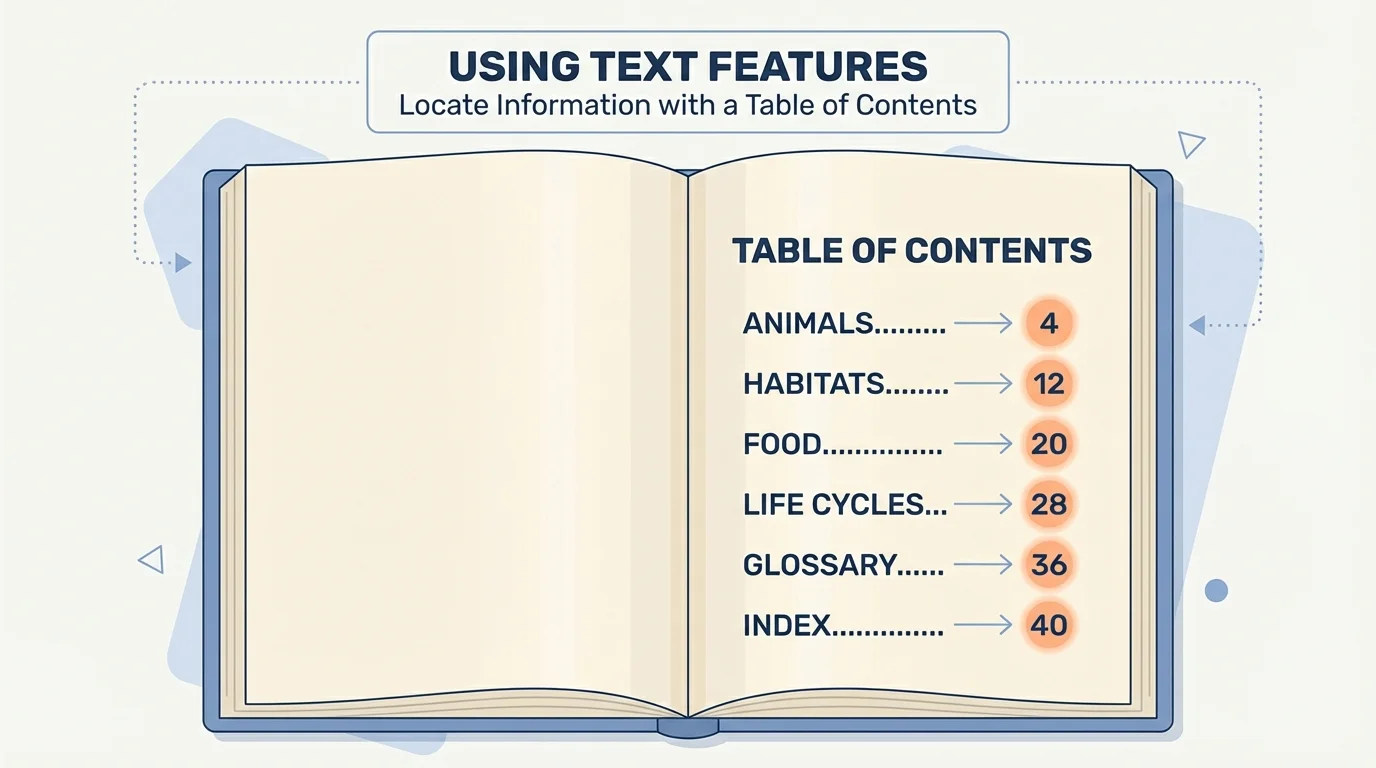
Sometimes more than one section may help. If your question is, "How does a frog change as it grows?" you may want Life Cycles. If your question is, "What does a frog need in its home?" you may want Habitats. Good readers think about the question and match it to the best section title.
The table of contents is also useful when working with classmates. During shared research, one student might use the table of contents to find a page about weather, while another classmate finds a page about seasons. Then both students can share what they learned. That is one way text features support teamwork during inquiry.
Headings help organize a big topic into smaller parts, and [Figure 2] illustrates how a page can be broken into clear sections. If a page is about birds, headings might say Beaks, Nests, and Feathers. This helps readers go straight to the part that answers their question.
Smaller headings can give even more help. A page might have the heading Beaks and a smaller heading How Beaks Help Birds Eat. Now the reader knows exactly what that section explains. Headings are like signs on a road. They point the way.
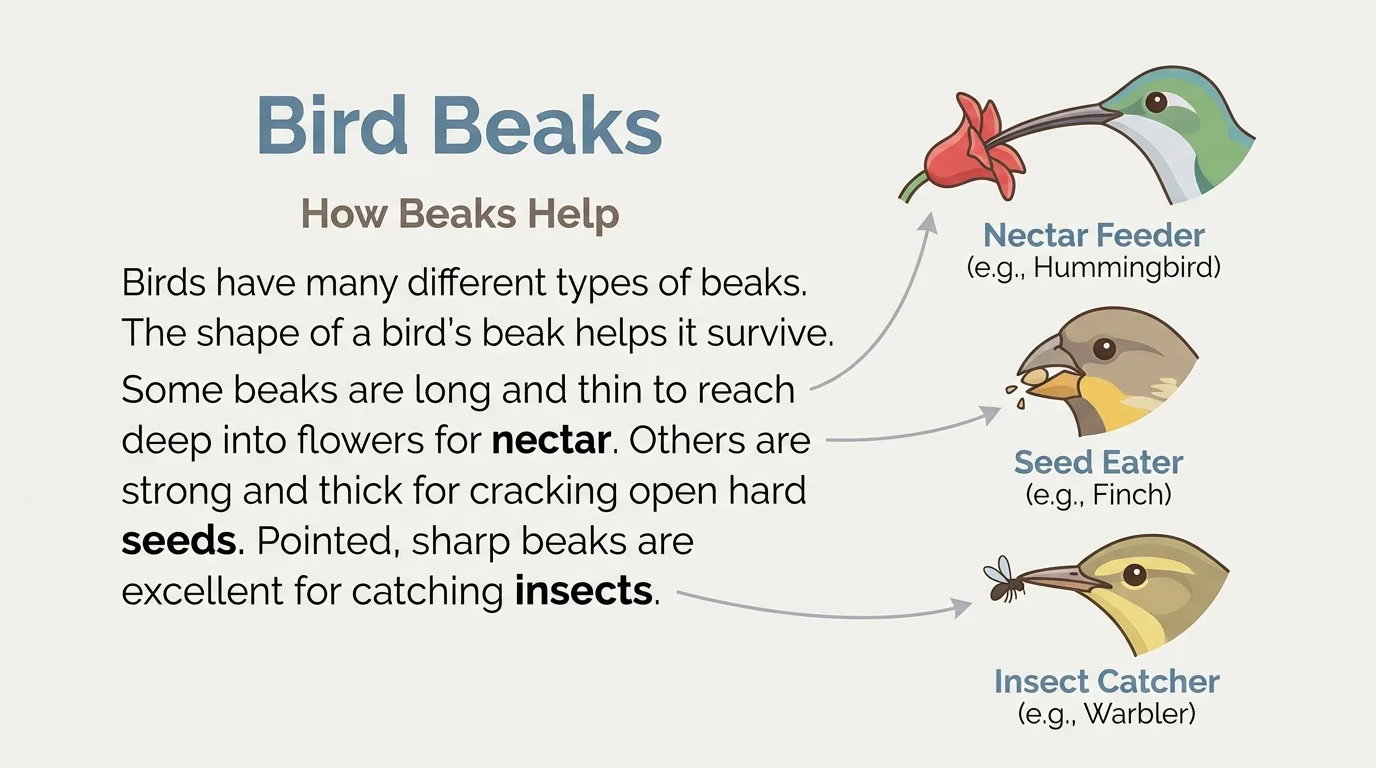
Bold type tells readers, "Pay close attention to this word." Often bold words are important vocabulary terms. For example, in a book about plants, the word stem may be in bold type because it is a key word the reader should learn. The bold word stands out from the rest of the sentence.
When you see a bold word, stop and think. Ask, "What does this word mean? Why is it important here?" Sometimes the meaning is explained right away. A sentence might say, "The stem holds the plant up." In that case, the bold word and the sentence work together to teach a new idea.
Later, when you return to your notes or talk with classmates, bold words help you remember important terms. Just as we saw with page titles in [Figure 1], the book gives clues about what matters most. Headings point to sections, and bold type points to special words inside those sections.
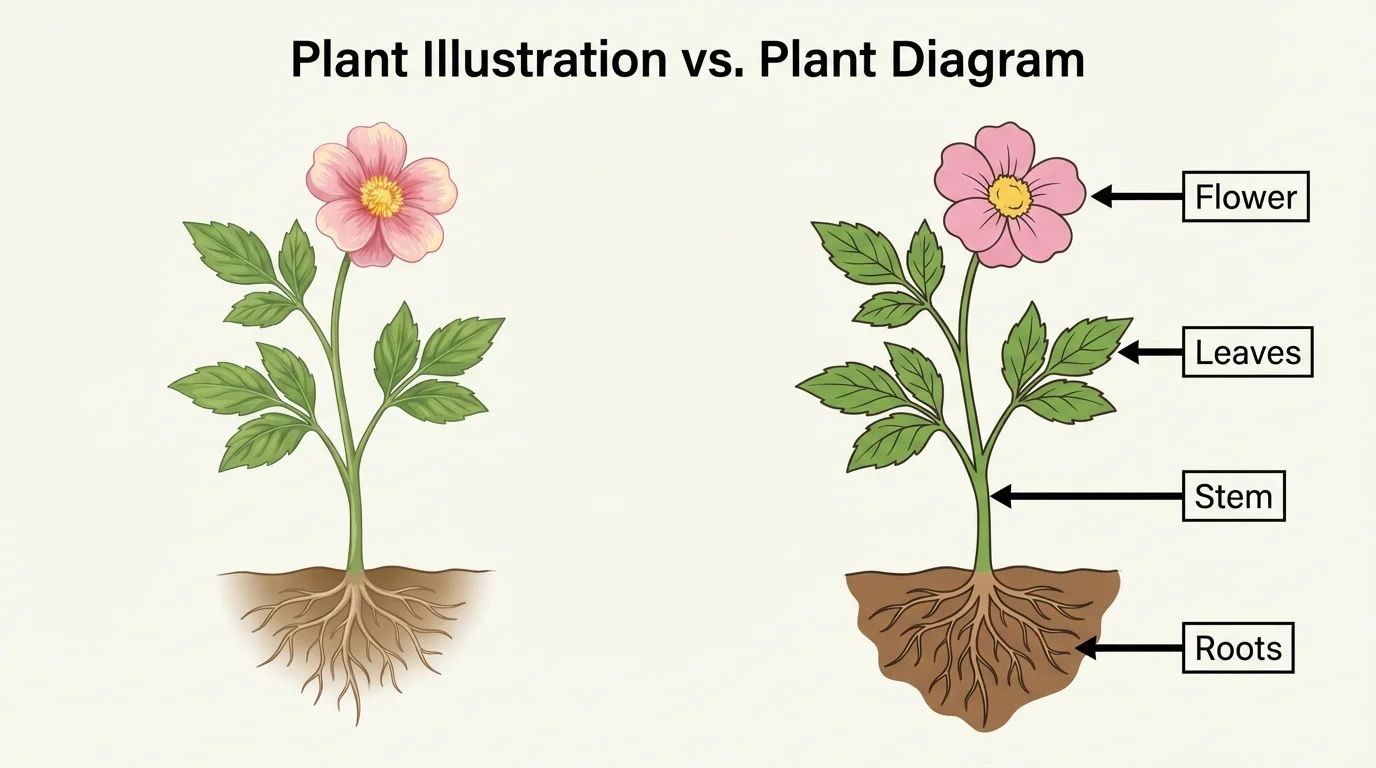
Pictures can teach, too. An illustration and a diagram are not exactly the same, and [Figure 3] shows the difference. An illustration may show what something looks like in real life, while a diagram often labels parts or shows how something works.
Think about a page on plants. An illustration might show a bright sunflower in a garden. That helps the reader picture the plant. A diagram of the same plant might label the roots, stem, leaves, and flower. That helps the reader learn the names of each part.
Diagrams are especially useful when the reader needs to understand parts, steps, or directions. A diagram of a butterfly life cycle may show egg, caterpillar, chrysalis, and butterfly in order. The labels and arrows help the reader see the pattern clearly.
Illustrations can also add details not stated in the words. A picture of penguins huddling together on ice may help you understand that they live in a very cold place. A reader should not just glance at the picture and move on. Careful readers study it.
Some readers learn new information faster when they use both words and pictures together. Looking at the text and the visual at the same time can help ideas make more sense.
Later in the lesson, the plant example in [Figure 3] still matters because it reminds us that one visual can show appearance while another visual explains structure. That is why good researchers look at all the features on a page, not just the sentences.
Research begins with a question. Maybe the class asks, "How do animals stay safe?" A student might first use the table of contents to find a chapter about protection or survival. Next, the student might scan headings to find a section about camouflage. Then the student might read bold words like predator or camouflage. Finally, the student might study an illustration or diagram to understand the idea better.
Notice how the reader uses more than one text feature. That is important. One feature may help find the right page, while another feature may help explain the meaning. Using several features together makes research stronger.
Example: answering a question with text features
Question: "What do turtles need to survive?"
Step 1: Use the table of contents.
Look for chapter titles such as Habitats, Animals, or Needs of Living Things.
Step 2: Use headings on the chosen page.
Find a section heading like What Turtles Eat or Where Turtles Live.
Step 3: Notice bold words.
Important words such as shelter or reptile may tell you what to learn.
Step 4: Study pictures and diagrams.
A diagram of a turtle habitat may help you understand what the turtle needs in its environment.
By using several text features, the reader can gather facts and explain them more clearly.
When students work together, they can compare what they found. One student may find that turtles need water and food. Another may notice from a diagram that turtles also need shelter and a safe place to lay eggs. Shared research helps everyone build a bigger answer.
Different questions call for different text features. If you need to know where to begin reading, the table of contents is best. If you need the part of one page that matches your question, headings help most. If you need to learn a special word, bold type is useful. If you need to understand what something looks like or how parts fit together, illustrations and diagrams are very helpful.
| Text feature | How it helps | Example question |
|---|---|---|
| Table of contents | Finds the right section or chapter | Where can I read about oceans? |
| Headings | Shows the main idea of a section | Which part explains animal teeth? |
| Bold type | Highlights important words | Which new word should I learn? |
| Illustrations | Shows what something looks like | What does this animal look like? |
| Diagrams | Shows parts, labels, or steps | How do the parts of a flower fit together? |
Table 1. A comparison of common text features and how each one helps a reader.
If a reader chooses the wrong feature, finding the answer may take longer. For instance, a picture alone may not tell the page number of the chapter you need. In the same way, the table of contents may lead you to a chapter, but it may not explain the labeled parts of a seed. Smart readers choose the right tool.
Finding information is only the first step. After you locate the answer, you must think about what it means. This is called interpreting information. Sometimes the words and the picture work together, and you need both.
For example, a diagram might show that a cactus has thick stems. The words may explain that thick stems store water. When you put those clues together, you can interpret the information: a cactus is able to live in dry places because it stores water. The diagram helps, but the thinking is done by the reader.
Remember that asking and answering questions is part of good reading. Text features help you answer questions more quickly, but you still need to read carefully, think, and talk about what you learn.
Sometimes readers make mistakes if they only look quickly. A heading might say Baby Animals, but your question may be about how adult animals protect themselves. An illustration may be beautiful, but it may not answer the exact question. Careful readers stay focused on the question they are trying to answer.
When you gather information from several resources, you become even more confident. A book heading, a labeled diagram, and a class chart may all teach the same big idea in slightly different ways. Looking across resources helps you check that your answer makes sense.
By using text features well, you become a stronger reader, a better researcher, and a more thoughtful learner. You learn how to search, notice, and explain. Those skills help in science, social studies, reading, and many other subjects.
