Have you ever wondered how a baby frog changes into an adult frog, or why some animals sleep during the day and come out at night? Big questions like these can be answered in more than one way. A book can tell you facts. A video can show movement. A picture can help you notice details. A recording can let you listen and learn. When we use many kinds of media to learn, we become careful, curious researchers.
A question of interest is something you truly want to know. It might be about animals, weather, plants, space, or how things work. Good research often begins with a question such as "What do bees do in a garden?" or "How do penguins stay warm?" A strong question is clear and helps you know what kind of information to look for.
Sometimes a question starts out very big. "Tell me everything about whales" is hard to answer all at once. A smaller question helps more. You might ask, "What do whales eat?" or "How do whales breathe?" Small, clear questions are easier to research and answer.
You already know how to ask questions when you read stories or look at pictures. Research uses that same skill, but now you ask questions to learn true information about the world.
Researchers listen, look, and read carefully. They do not grab the first fact they see and stop. They keep learning until they can answer the question with confidence.
Multimedia means using more than one kind of media, as [Figure 1] shows. Media are ways to share information. A printed book is one kind. A photograph is another. A video, a sound recording, a website, and a diagram are also types of media. When you use several of them together, you use multimedia sources.
A source is where information comes from. A book about insects is a source. A nature video is a source. A chart about the seasons is a source. Even a person speaking in an educational recording can be a source of information.
Different multimedia sources help us learn in different ways. A book gives words and sometimes labeled pictures. A photo freezes one moment so you can look closely. A video shows action over time. Audio lets you listen to spoken facts, sounds from nature, or directions. A website may combine words, pictures, and videos in one place.
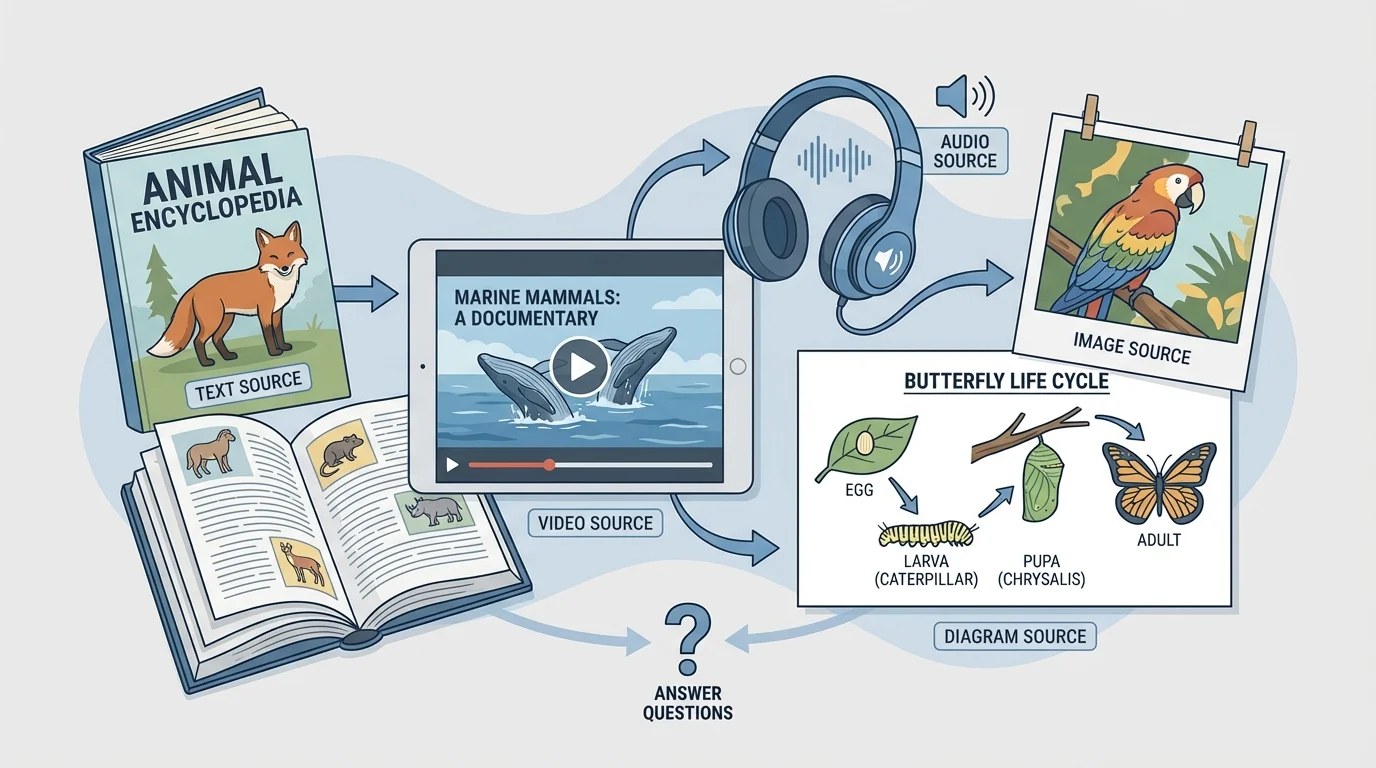
When you use only one source, you may miss something important. A picture of a bird can show its colors, but it cannot tell you much about its song. A recording of the bird can let you hear the song, but it may not show the bird's size or shape. Using more than one source gives you a fuller answer.
Multimedia sources are different kinds of materials used together to help answer a question. These can include books, photographs, videos, audio recordings, websites, and diagrams.
Some multimedia sources are read. Some are watched. Some are listened to. Good researchers know that all of these can teach something useful.
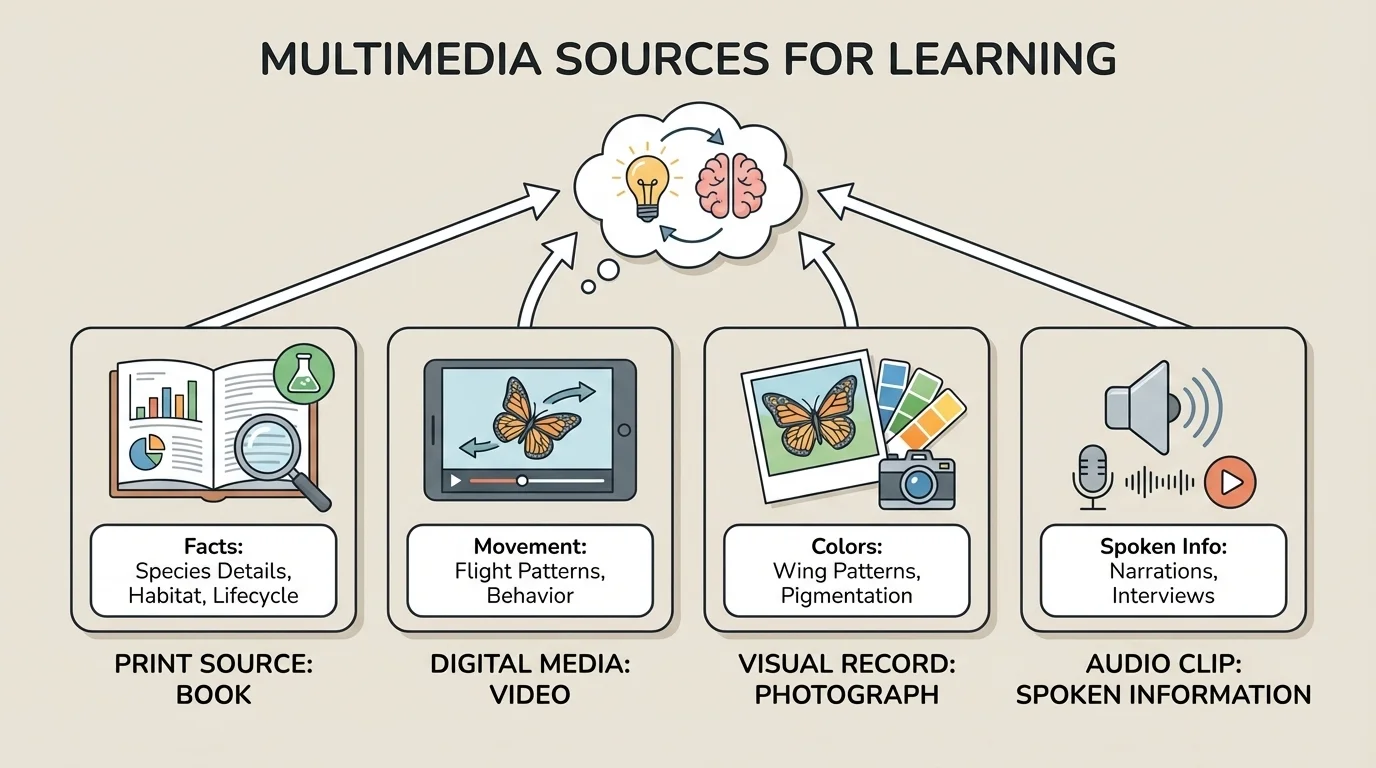
Different sources help us notice different things, and [Figure 2] makes this easy to see. If your question is about butterflies, a nonfiction book may tell you the names of butterfly body parts and what butterflies eat. A video may show how a butterfly flies or lands on a flower. A photograph may help you study wing colors and patterns. A spoken recording may explain the butterfly life cycle in simple steps.
Each source has a special strength. Books are strong for facts and details. Photos are strong for close looking. Videos are strong for movement and change. Audio is strong for listening and learning from speech or sounds. Diagrams are strong for showing parts or steps in order.
This is why researchers often combine sources. If one source answers part of the question and another source answers a different part, the two sources work together. Then your answer becomes stronger and clearer.
Think of multimedia sources as a team. One teammate may be best at showing. Another may be best at telling. Another may be best at helping you listen. Together, they help you understand more than one source alone.
| Source type | What it helps you learn | Example |
|---|---|---|
| Book | Facts, labels, explanations | A book about ocean animals |
| Photograph | Color, shape, details | A close-up photo of a shell |
| Video | Movement, action, change | A clip of a caterpillar moving |
| Audio | Speech, sound, listening | A recording of bird calls |
| Diagram | Parts, steps, order | A plant life cycle drawing |
| Website | A mix of text, pictures, and media | A children's science page |
Table 1. Different multimedia source types and the kinds of information they can provide.
Later, when you compare sources again, [Figure 2] still helps remind you that each kind of source gives a different piece of the puzzle.
When you research, you gather information step by step. A fact is something true that can help answer your question. As [Figure 3] illustrates, careful researchers collect facts in an orderly way instead of trying to remember everything at once.
You can begin by saying your question clearly. Then, as you read, watch, or listen, look for facts that match the question. If your question is "What do rabbits eat?" then facts about rabbit food matter most. A fact about where rabbits sleep may be interesting, but it does not answer that exact question.
It helps to organize your information. You might sort facts under small headings such as "What it looks like," "What it does," "Where it lives," or "What it eats." This makes your notes easier to understand later.
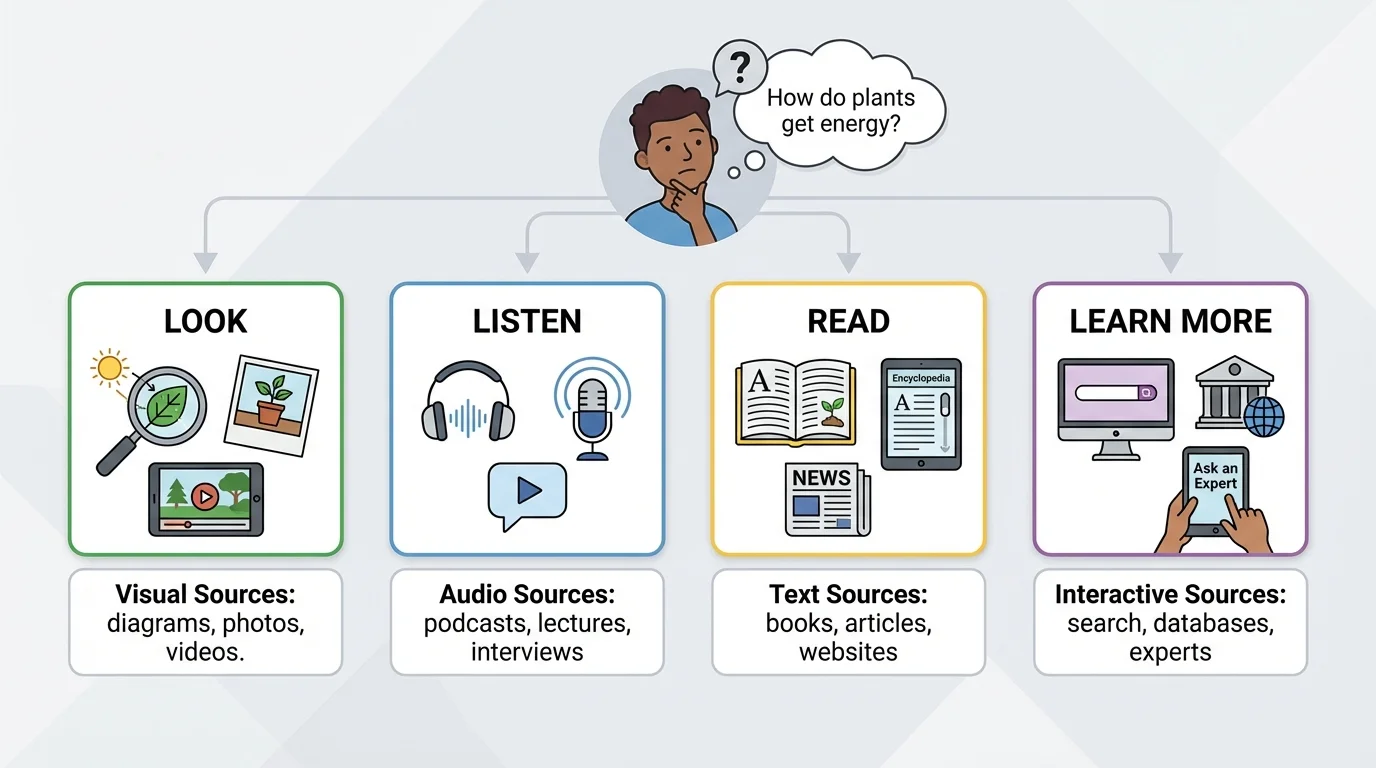
Good researchers also pay attention to details. If a video shows a frog jumping into water, that tells you frogs can move in a certain way. If a diagram labels the frog's life stages, that gives you a sequence. If a book says frogs begin life as eggs, that gives you an important fact. Careful looking and listening help you gather better information.
Gathering information from many sources means collecting useful facts from different kinds of media and putting them together to answer one question. The goal is not to collect the most facts. The goal is to collect the right facts.
You do not need to copy every word. Instead, think about the big idea in each source. Ask yourself, "What does this source teach me that helps answer my question?"
Sometimes two sources say almost the same thing. That is helpful because it means the information is supported by more than one place. For example, a book and a video may both explain that bees collect nectar from flowers. When two sources agree, your answer becomes stronger.
Sometimes one source gives extra details that another source does not. That can also be helpful. A photo may show a bee covered with pollen, while a book explains that pollen can move from flower to flower. The two sources fit together.
If something seems confusing, compare it with another source. You can ask: "Does this match what I read?" "Does this fit what I saw?" "Should I ask a teacher, librarian, or another trusted adult?" Good researchers know it is okay to pause and check.
Scientists, reporters, and authors often use many sources too. They compare information so they can be accurate and clear.
Not every website or video is the best choice. Young researchers often need help from adults to choose safe, trusted sources. A teacher or librarian can help find websites and books that are made for learning.
[Figure 4] Suppose your question is, "How does a frog grow?" One student uses a short video, a nonfiction book, and a diagram. Each source gives a different piece of the answer.
The video shows change over time. The student sees eggs in water, then tadpoles swimming, then young frogs growing legs. The book explains the names of each stage and says that frogs begin in water. The diagram puts the stages in order so the student can follow the life cycle clearly.
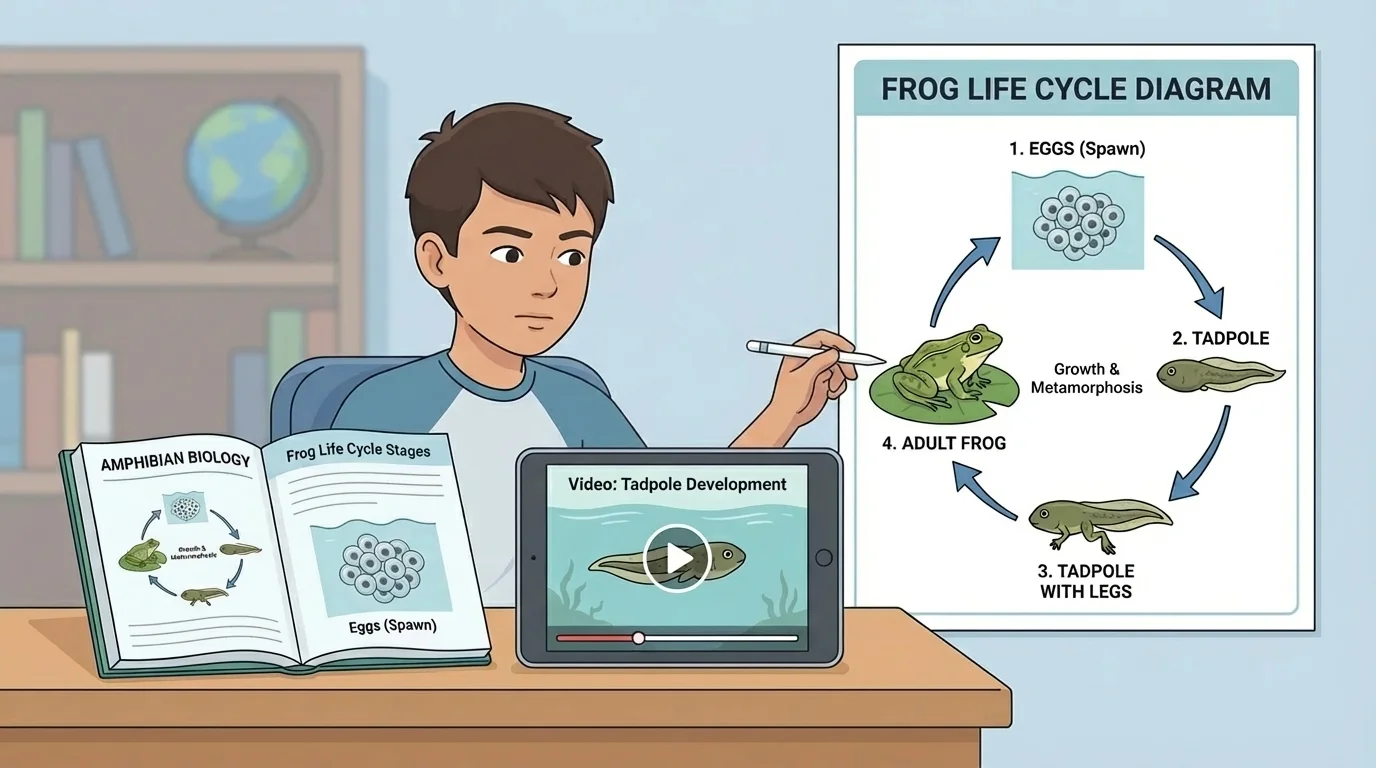
Now the student can answer the question with several facts: frogs begin as eggs, then become tadpoles, then grow legs, and later become adult frogs. This answer is stronger than an answer from only one source because it is built from reading, watching, and looking carefully.
Example: Answering one question with several sources
Question: "What do bees do in a garden?"
Step 1: Read a book.
The book explains that bees visit flowers to collect nectar and pollen.
Step 2: Look at photographs.
The photos show bees landing on flowers and carrying pollen on their bodies.
Step 3: Watch a short video.
The video shows bees moving from one flower to another.
Step 4: Put the facts together.
The student answers: bees visit flowers, collect nectar and pollen, and help move pollen between flowers.
This same idea works for many questions. If you wanted to learn about penguins, you might read a book for facts, watch a video for movement, and study a map or photo for where penguins live and what they look like. The picture becomes clearer each time you add a useful source.
When you think back to the frog example in [Figure 4], you can see how one question becomes easier to answer when the sources work together.
After gathering information, you can share your answer. You might speak to the class, write a few sentences, make a drawing with labels, or create a simple poster. The important part is that your answer matches the question and uses true information from your sources.
When sharing, it helps to choose the clearest facts. If your question was about how seeds grow, your answer should stay focused on seed growth. You can explain the stages in order and include details you learned from books, pictures, or videos.
Sometimes students share learning in more than one way too. They may speak while pointing to a picture, or write while adding labels to a drawing. That means the student is not only learning from multimedia sources but also communicating with more than one kind of media.
"Good researchers ask, look, listen, think, and check."
Research is really a way of answering wonder-filled questions with care. You begin with curiosity. Then you gather information from different sources. Then you compare what you learned and use it to explain an answer clearly.
