Good researchers are a little bit like detectives. They do not just look at something and say, "That is nice." They wonder, "What is happening here? Why does it happen? What else should I find out?" A strong question can open the door to learning. When you ask the right question, you can discover facts, ideas, and connections you did not know before.
When students do shared research, they often begin with a topic such as butterflies, weather, farms, oceans, or famous people. But a topic by itself is not enough. A topic tells what you are learning about. A question tells what you want to find out. Learning to ask strong questions helps you gather information from books, pictures, charts, videos, websites, and people.
Questions help our brains stay active. If a class is studying bees, one student might ask, "What do bees eat?" Another might ask, "Why are bees important to flowers?" A third might ask, "Are all bees the same?" Each question leads to new information. Without questions, research can feel like picking up random facts. With questions, research becomes a search for answers.
Strong questions also help students stay organized. Instead of trying to learn everything at once, you can focus on the most important ideas. A good question acts like a path. It helps you know what information to look for and what information does not fit your purpose.
Primary question is the main question a researcher wants to answer. It guides the whole research project.
Depth questions dig deeper into one part of a topic. They often ask how, why, or what causes something.
Breadth questions look across a topic. They help a researcher learn about different parts, groups, places, or times.
A class might start with the topic of trees. That topic is large. A primary question could be, "How do trees help living things?" Now the class has a clear direction. As [Figure 1] shows, students can search for answers about shade, homes for animals, oxygen, fruit, and wood. The main question keeps the research together.
A primary question is the big question at the center of your learning. It is not just any question. It is the question that guides what you read, watch, notice, and discuss. A main topic can lead to one strong primary question, and that question can lead to smaller questions that help you learn more.
For example, if the topic is frogs, a weak beginning might be just saying, "I want to learn about frogs." A stronger beginning is asking, "How do frogs grow and change?" That question gives your research a clear direction. You can then ask smaller questions such as, "What comes first in a frog's life cycle?" and "Why do tadpoles look different from adult frogs?"
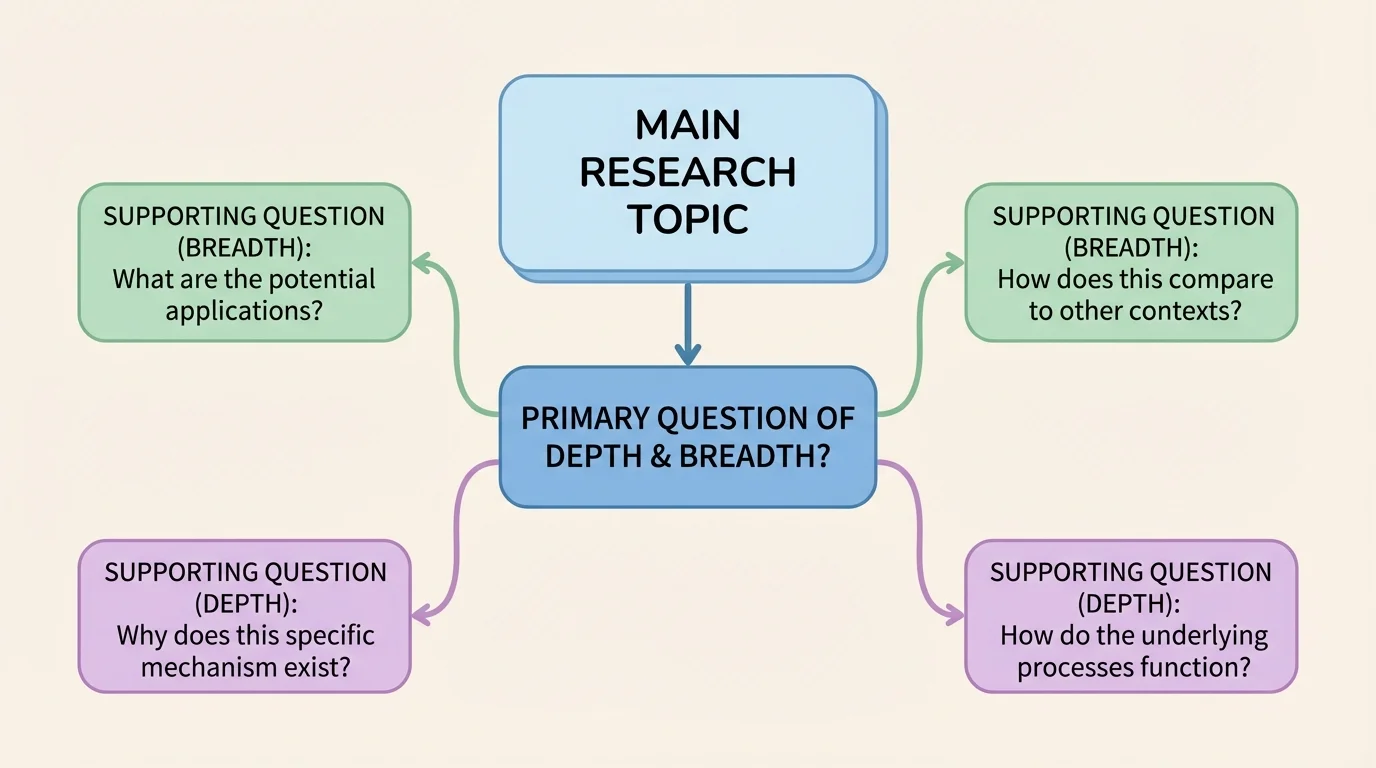
A good primary question is usually clear, focused, and important. It should not be so tiny that there is almost nothing to learn, and it should not be so huge that it is impossible to answer. "What is one thing about animals?" is too unclear. "Why do penguins huddle together in cold weather?" is clearer and easier to research.
Sometimes a primary question begins with words like how, why, what makes, or what happens when. These starters often lead to thoughtful answers instead of a simple yes or no.
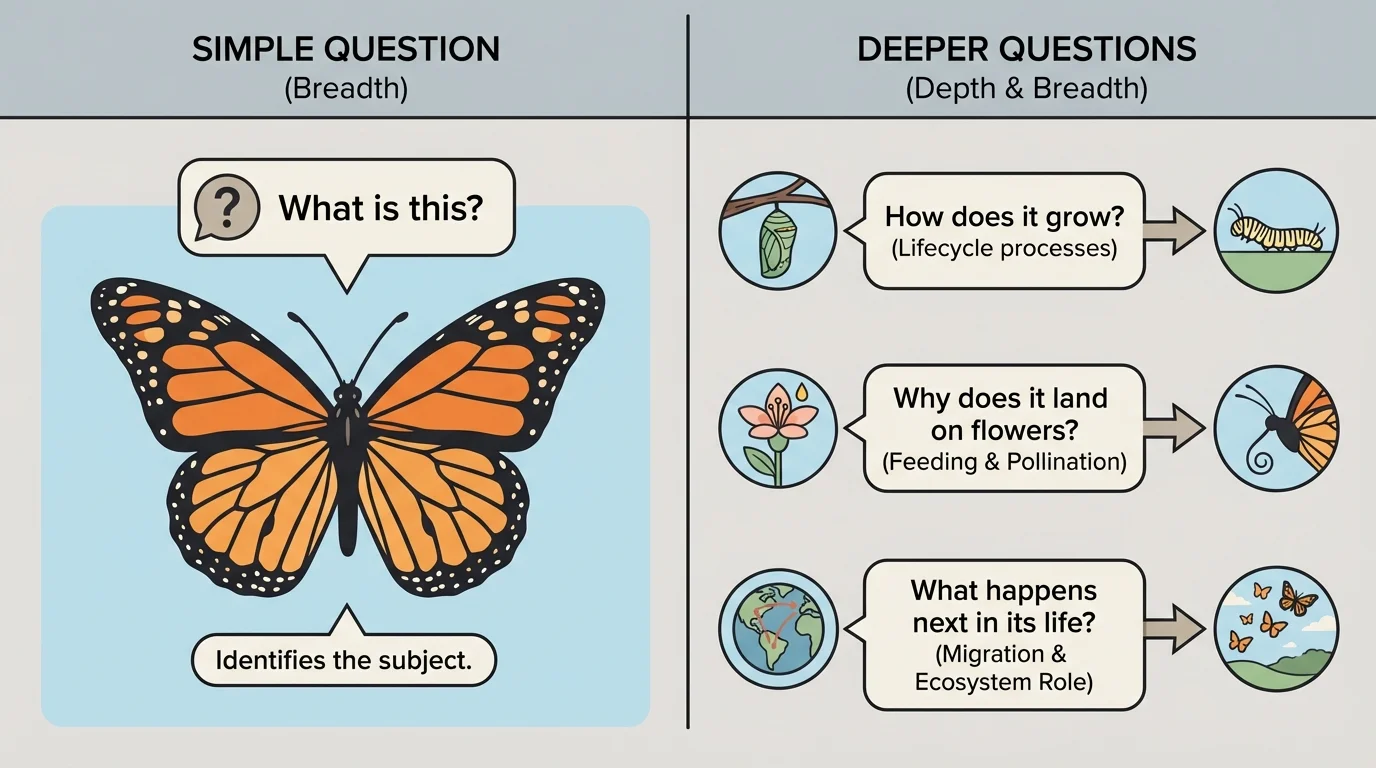
Depth questions help you go farther into one part of a topic. They are like digging into the soil instead of only looking at the surface. As [Figure 2] illustrates, in research, depth means learning details, causes, steps, and reasons. A simple question can become deeper when you ask how, why, or what changes over time.
Suppose the topic is butterflies. A simple question might be, "What colors are butterflies?" That can be useful, but it stays near the surface. A depth question might be, "Why do some butterflies have bright colors?" Another depth question could be, "How does a caterpillar change into a butterfly?" These questions ask for explanation, not just one fact.
Depth questions often use words such as how, why, what causes, what changes, or what happens next. They help students notice relationships. For example, if you are studying weather, "What is rain?" is a start, but "How do clouds make rain?" goes deeper.
Depth questions are helpful because they lead to richer answers. They often need more than one source. You may read a book, look at a labeled picture, and watch a short video to understand the answer. Later, when you explain what you learned, you will have more to say because you asked a question with depth.
Think about an ant hill. A broad fact is that ants live together. A depth question is, "How do ants work together to carry food?" That question helps you learn about jobs, teamwork, and movement. We can still remember the butterfly example in [Figure 2]: deeper questions ask for reasons and processes, not just quick facts.
From simple to deeper questions
Step 1: Start with a topic.
Topic: sharks
Step 2: Ask a surface question.
"What do sharks eat?"
Step 3: Ask a depth question.
"How do sharks find food in the ocean?"
Step 4: Ask another depth question.
"Why do different sharks eat different kinds of food?"
The later questions lead to bigger and more detailed answers.
Not every question has to be deep, but depth questions are powerful when you want real understanding.
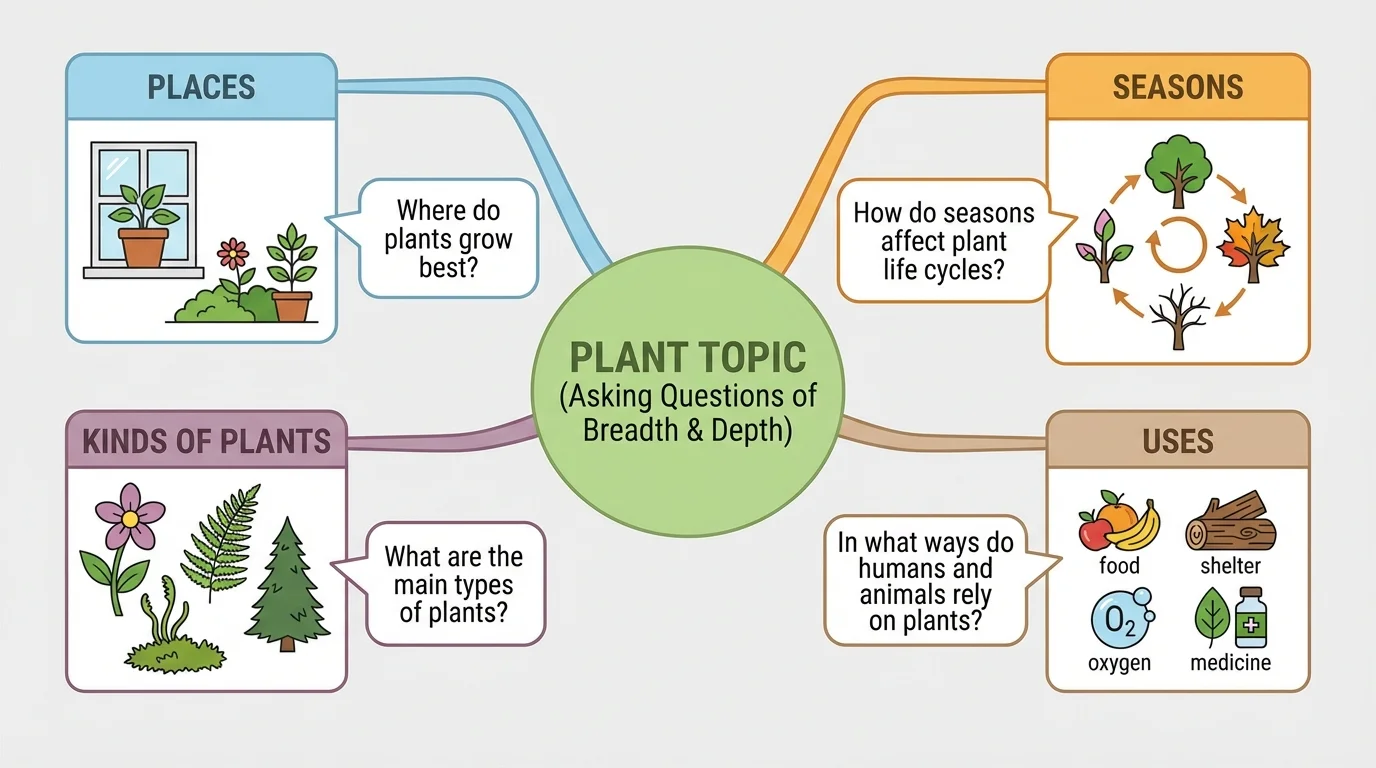
Breadth questions help you look across a topic instead of digging into just one small part. As [Figure 3] shows, breadth means looking at many sides of something. One topic can grow into questions about different places, times, kinds, and uses.
Imagine your class is studying plants. A depth question might be, "How does a seed sprout?" A breadth question might be, "What kinds of plants grow in different places?" Another breadth question could be, "How do people use different plants?" These questions widen the learning.
Breadth questions often use words such as what kinds, where, when, who, and how are these different. They help researchers compare and organize information. If your topic is homes, a breadth question could be, "What kinds of homes do people live in around the world?" That opens up many examples.
Breadth questions are useful when a topic is too narrow or when you want to understand the bigger picture. They can also help with a group project because different students can look at different parts of the same topic. One student might study desert plants, another forest plants, and another garden plants.
Looking back at the plant idea in [Figure 3], breadth lets you spread your thinking across a topic. You are still learning about plants, but you are noticing more categories and more connections.
Sometimes students ask questions that are too small, too large, or too simple. The good news is that questions can be improved. If a question is weak, you can change it into one that has more depth or more breadth.
Suppose the topic is the moon. A question like "Is the moon in the sky?" is too easy and has a yes-or-no answer. You can improve it by asking, "Why does the moon look different on different nights?" That adds depth. Or you can ask, "What are the different ways people have studied the moon?" That adds breadth.
How to strengthen a question
Start with the topic. Next, decide what kind of learning you want. If you want reasons, steps, or causes, make the question deeper. If you want categories, comparisons, or many examples, make the question wider. Strong researchers often revise a question more than once before they begin gathering information.
Here are some ways to improve questions:
Too simple: "Do birds fly?"
Better depth question: "How do birds use their wings to fly?"
Better breadth question: "What are different ways birds move?"
Too big: "What is everything about space?"
Better depth question: "How do astronauts live in space?"
Better breadth question: "What are some objects we can find in space?"
Some of the best discoveries in history began with one well-asked question. Scientists, writers, and explorers often started by wondering about one thing and then asking better and better questions.
When you revise a question, you are not changing your mind in a bad way. You are making your thinking stronger.
Different questions are answered best by different resources. As [Figure 4] illustrates, a resource is something that gives information, such as a book, video, chart, photograph, website, interview, or your own observation. Good researchers match their questions to the most helpful source.
If your question is "How does a pumpkin grow?", a picture sequence or video may help because you can see the steps. If your question is "What do farmers do with pumpkins?", an interview or nonfiction book may help more. If your question is "Which pumpkins are bigger?", a chart or photo comparison could be useful.
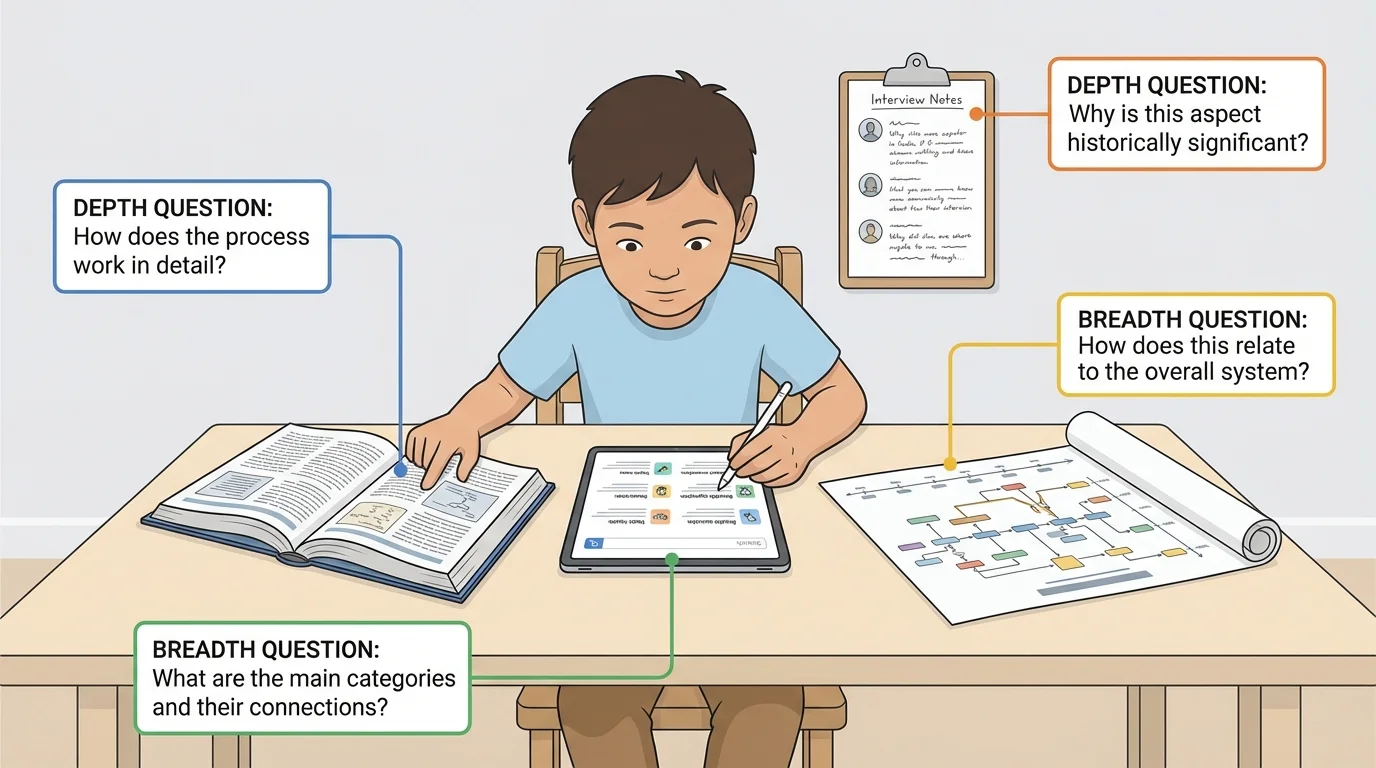
Primary questions, depth questions, and breadth questions all help you choose what to look for in a resource. When students use several resources, they can gather more complete information. One book may explain, a photo may show details, and a chart may help compare.
| Question Type | Example Question | Helpful Resource |
|---|---|---|
| Primary question | How do animals survive in winter? | Nonfiction book |
| Depth question | Why do some animals hibernate? | Book and video |
| Breadth question | What different ways do animals survive winter? | Chart, book, and pictures |
Table 1. Examples of question types and the resources that can help answer them.
Later, when you organize your notes, the match between question and resource becomes even more useful. The resource plan in [Figure 4] reminds us that not all questions are answered in the same way.
Research is often done with partners, small groups, or a whole class. When students work together, they share ideas and help each other make better questions. One student may think of a depth question, and another may add a breadth question. Together, the group learns more.
Respectful questioning matters. Listen when others speak. Wait for your turn. Build on ideas by saying things like, "I want to add to that," or "What if we also ask...?" If someone asks a question that seems unclear, help improve it kindly. You might say, "Can we make that more specific?" or "Should we ask why that happens?"
Remember that good listening is part of good research. When you listen closely, you can notice what your group already knows, what still needs to be learned, and which questions will help most.
Shared research also works best when everyone stays on topic. If the class is researching oceans, a sudden question about soccer may be interesting, but it does not fit the purpose. Useful questions connect to the main topic and help answer the primary question.
Sometimes you need a depth question. Sometimes you need a breadth question. The best choice depends on your goal. If you want to explain one thing clearly, choose depth. If you want to compare many parts of a topic, choose breadth.
For example, if your class is studying bridges, "How does a bridge hold heavy weight?" is a depth question. It focuses on one idea. "What kinds of bridges are used in different places?" is a breadth question. It helps you compare. Both are strong, but they do different jobs.
A smart researcher may use both kinds. First, ask a breadth question to see the big picture. Then ask a depth question about one important part. Or begin with a depth question and later ask breadth questions to compare what you learned with other examples.
One common mistake is asking a question that can be answered with only "yes" or "no." Those questions usually stop the thinking too quickly. Another mistake is asking a question that is too big, such as "What is everything about animals?" No one can answer that well in one project.
A third mistake is asking a question that does not match the topic. If the class is researching rivers, the main questions should help students learn about rivers, not about random things that are unrelated.
A final mistake is stopping after one question. Strong researchers often ask a primary question first, then add depth and breadth questions. This helps them gather information from a variety of resources and understand the topic more fully.
