Have you ever noticed that one tiny word can change a whole picture in your mind? If a poet writes, "The dog walked," you get one idea. But if the poet writes, "The dog padded softly through the wet grass," you can almost see and hear it. That is the magic of poetry. Poets do not just use any words. They choose words with great care.
Poetry is full of words that help readers think, feel, and imagine. Some words make a poem sound gentle. Some make it sound exciting. Some help us picture a bright sun, a crunchy leaf, or a cold raindrop. When we read a poem, we pay attention to the poet's word choice because those words help us understand the poem's meaning.
Word choice means the exact words an author or poet decides to use. In poetry, word choice matters a lot because poems are often short. Each word has a job to do. A poet may choose a word because it gives a clear picture, makes a sound, shows a feeling, or suggests a deeper idea.
Word choice is the use of specific words to create meaning. In poetry, carefully chosen words can help the reader imagine, feel, and understand more.
For example, look at these two lines: The bird sang. Then: The bird trilled sweetly at sunrise. The second line gives us much more. We can hear the bird better. We can imagine the time of day. We may even feel calm because of the word sweetly. That is how word choice enhances, or improves, meaning.
When poets write, they often ask themselves questions like these: Which word sounds best? Which word shows the strongest feeling? Which word helps readers make the clearest picture? A poet might choose glow instead of shine, or whisper instead of say. These choices are not random. They are made on purpose.
Sometimes a poem uses simple words, but they are still powerful because they are just right. A poet does not need long or fancy words. A small word like drip, crash, fuzzy, or icy can do a big job. These words help the reader feel close to what is happening in the poem.
As you read poetry, try to notice words that stand out. Ask, "Why did the poet choose this word?" That question helps you discover more meaning.
One important kind of word choice is sensory details. Sensory details are words that help us use our senses. They help us see, hear, smell, taste, and feel what is happening in a poem. When poets use sensory details, the poem becomes more alive in our minds.
[Figure 1] Words for sight might include golden, sparkly, or shadowy. Words for sound might include buzzing, clatter, or hush. Words for touch might include silky, rough, or freezing. Words for smell might include fresh or stinky. Words for taste might include sweet, sour, or salty.
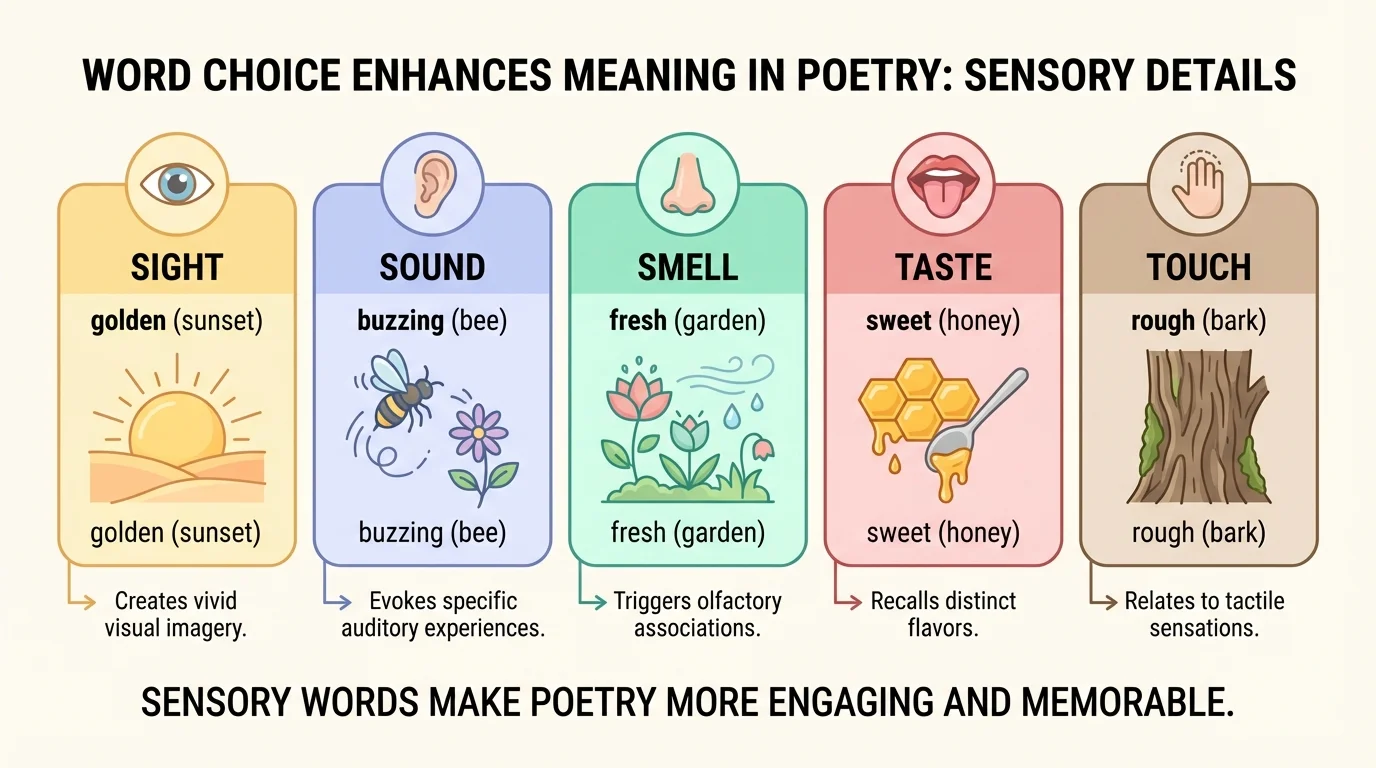
Read this line: Warm cookies filled the room with a buttery smell. This line gives sensory details. We can almost smell the cookies. The word warm helps us feel them, and buttery helps us imagine the smell and taste. These words make the line richer than simply saying There were cookies in the room.
Example: plain words and sensory details
Step 1: Read the plain line.
The rain fell.
Step 2: Read the line with sensory details.
Cold rain tapped on the window and splashed on the muddy ground.
Step 3: Notice the difference.
The second line helps us feel the cold, hear the tapping, and see the muddy ground.
Sensory details help readers step inside the poem. Later, when you read a line with vivid words, you can remember the five senses chart in [Figure 1] and ask which senses the poet is using.
Another important kind of word choice is figurative language. Figurative language uses words in a creative way. It may not mean exactly what the words say in a literal way. Instead, it helps us imagine something in a stronger or more surprising way, as [Figure 2] illustrates.
One kind of figurative language is a simile. A simile compares two things using the words like or as. For example: The moon was like a silver coin. The moon is not really a coin, but this comparison helps us picture its shape and shine.
Another kind is a metaphor. A metaphor compares two things by saying one thing is another thing. For example: The classroom was a zoo. The classroom is not truly a zoo, but the metaphor tells us it was noisy and wild.
A third kind is personification. Personification gives human actions or feelings to animals, objects, or nature. For example: The wind danced through the trees. Wind cannot really dance, but the poet uses personification to make the wind seem lively.
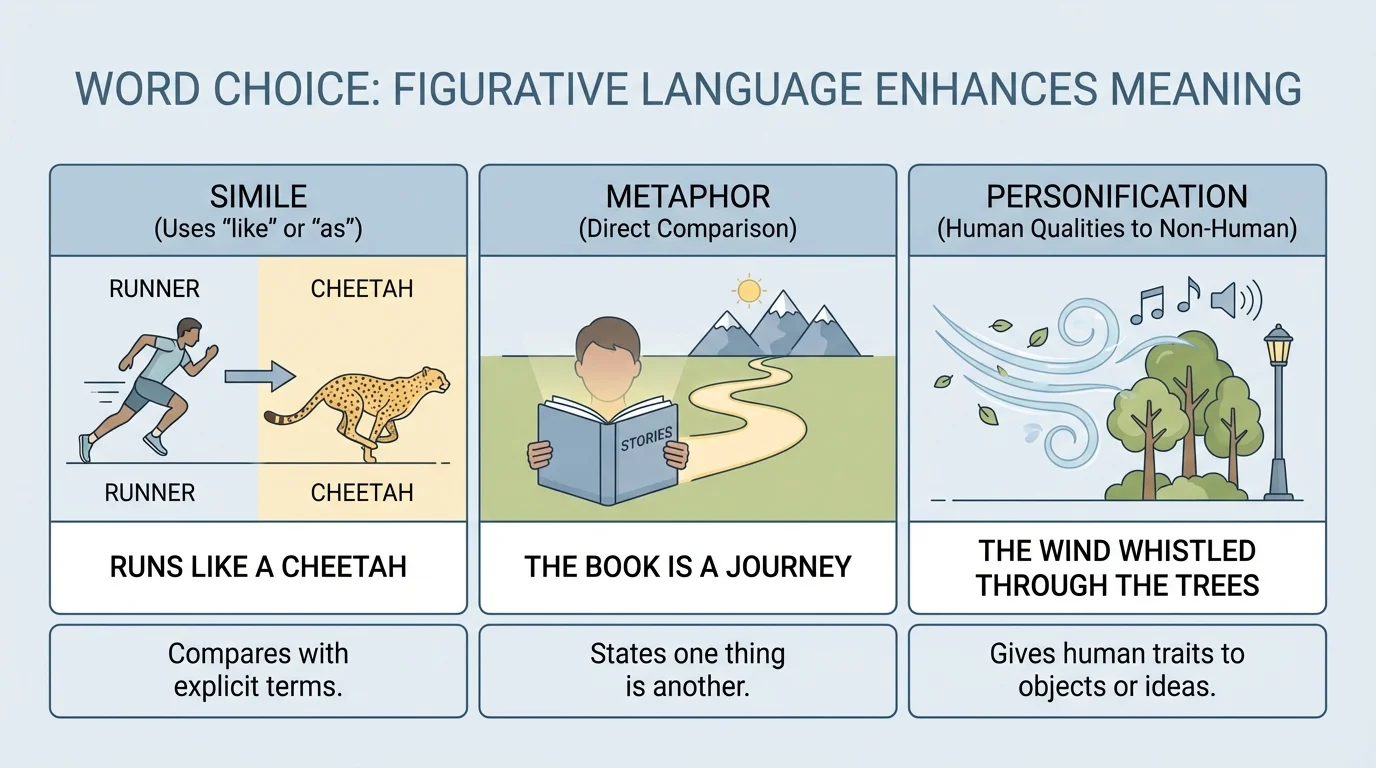
Figurative language helps a poem say more than plain words alone. If a poet writes, The sun smiled down on us, we know the sun does not really smile. But we understand the feeling: the day seems cheerful, bright, and kind. That is enhanced meaning.
How figurative language works
Figurative language helps readers connect one idea to another. A simile and a metaphor make comparisons. Personification makes something nonhuman seem alive. These choices can make feelings and pictures stronger.
When you compare literal language and figurative language, you can see how much stronger the poetry becomes. The figure in [Figure 2] makes this easy to notice because it places different types of figurative language side by side.
Mood is the feeling a poem gives the reader. Word choice can make a poem feel happy, spooky, peaceful, or exciting. For example, words like glow, soft, and gentle can create a calm mood. Words like crash, howl, and dark can create a scary mood.
Look at these two lines about the same thing: The night came. Then: The dark night crept in on quiet feet. The second line creates a stronger mood. The word crept sounds sneaky. The words quiet feet make the night seem almost like a person moving softly. The meaning feels more mysterious.
Word choice can also show how the speaker in a poem feels. If a poet describes snow as sparkling diamonds, the speaker may love the snow. If the poet calls snow an icy blanket trapping the street, the speaker may feel frustrated or cold. The words tell us the attitude.
Many songs use poetry techniques too. When songwriters choose words like thunder, whisper, or golden, they are using word choice to help listeners feel something strongly.
That is why it is helpful to ask not only "What does this poem say?" but also "How do the words make me feel?" The answer often leads to the poem's meaning.
Let's read a short poem line by line: Morning stretches pink and wide. Dewy grass cools sleepy toes. A robin stitches songs in air. This poem uses careful word choice in every line.
In the first line, stretches makes morning seem like it is waking up. Pink and wide gives a picture of the sky. In the second line, dewy grass and cools sleepy toes give sensory details. We can feel the coolness. In the third line, a robin stitches songs in air uses figurative language. A robin cannot really stitch, but this metaphor helps us imagine the bird's song moving neatly through the morning.
Now read another short poem: The leaves whispered secrets. The tired sun sank low. Autumn tiptoed through the yard. Here, whispered helps us hear soft sounds. Tired sun gives the sun a human quality. Tiptoed makes autumn seem quiet and gentle. These choices make the poem peaceful and a little dreamy.
Example: finding enhanced meaning in a poem
Step 1: Read the line.
The river raced over shiny stones.
Step 2: Notice important words.
Raced suggests fast movement, and shiny stones gives a clear picture.
Step 3: Explain the meaning.
The poet helps us imagine a quick, bright river instead of just saying that water moved over rocks.
When you look closely, you see that poems often use only a few words to do a lot of work. Strong word choice helps a poem become bigger in our minds than it is on the page.
Poets use special word choice because they want readers to do more than understand facts. They want readers to imagine, feel, and think. A poem about a storm is not only about weather. With words like roaring, flashing, and pounding, it can also be about fear, power, or excitement.
Poets also use word choice to make a poem memorable. A line like the stars blinked awake stays in your mind because it is surprising and vivid. Carefully chosen words can make a reader stop, smile, wonder, or feel.
Even when a poem is simple, each word may carry extra meaning. The best readers of poetry slow down. They notice words that appeal to the senses, compare things in new ways, and build a mood. Then they ask what those words add to the poem.
Remember that poems do not always explain everything directly. Readers often use clues from important words to understand what the poem means and how it feels.
When you read a poem, try listening for sound, looking for picture words, and noticing surprising comparisons. Those clues help you understand how word choice enhances meaning.
Poetry is powerful because it uses language in special ways. Sensory details help us experience the poem with our senses. Figurative language helps us imagine more than the literal words say. Together, these choices help a poem mean more and feel more alive.
A poet may use only a few lines, but those lines can hold color, sound, feeling, movement, and imagination. That is why paying attention to word choice is one of the best ways to understand poetry.
