Good readers are much like detectives. They do not solve a mystery by guessing. They look for clues. When you read a story or another literary text, you also look for clues. Then you ask questions and answer them to show what you understand. Strong readers can prove their answers by pointing to the text itself.
Asking questions helps you stay active while you read. Instead of letting your eyes slide over the words, you stop and think. You may ask, "Who is this character?" "Why did she do that?" "What happened first?" "How do I know?" These questions help you notice important details, understand characters, and follow the events in order.
Answering questions is just as important. When you answer, you show what you learned from the text. A strong answer is not only correct. It is also connected to what the author wrote. That means you can explain, "I know this because the text says..." or "The story shows this when..."
Question means something you ask to help you understand more. Answer means a response to that question. Text evidence means the words, details, or events from the reading that support your answer.
Sometimes students know a lot about a topic, and that is helpful. But when a question asks about a text, the best answer must come from the text. Your own ideas can help you think, but the reading is the main source for your answer.
To refer explicitly to the text means to point clearly to something the text says or shows. Readers do this by using exact details from the story, as [Figure 1] shows in the difference between a guess and a text-based answer. You might mention a character's words, a setting detail, or an event that happened in the story.
For example, suppose a story says, "Luis pulled his hood tight and ran through the rain to get the puppy out of the yard." If someone asks, "What kind of person is Luis?" a weak answer might be, "He is nice." That may be true, but it is stronger to say, "Luis is caring because he ran through the rain to get the puppy out of the yard." Now the answer points directly to the text.
When readers use the text in this clear way, they are not just saying what they think. They are showing how they know. That is what makes an answer strong.
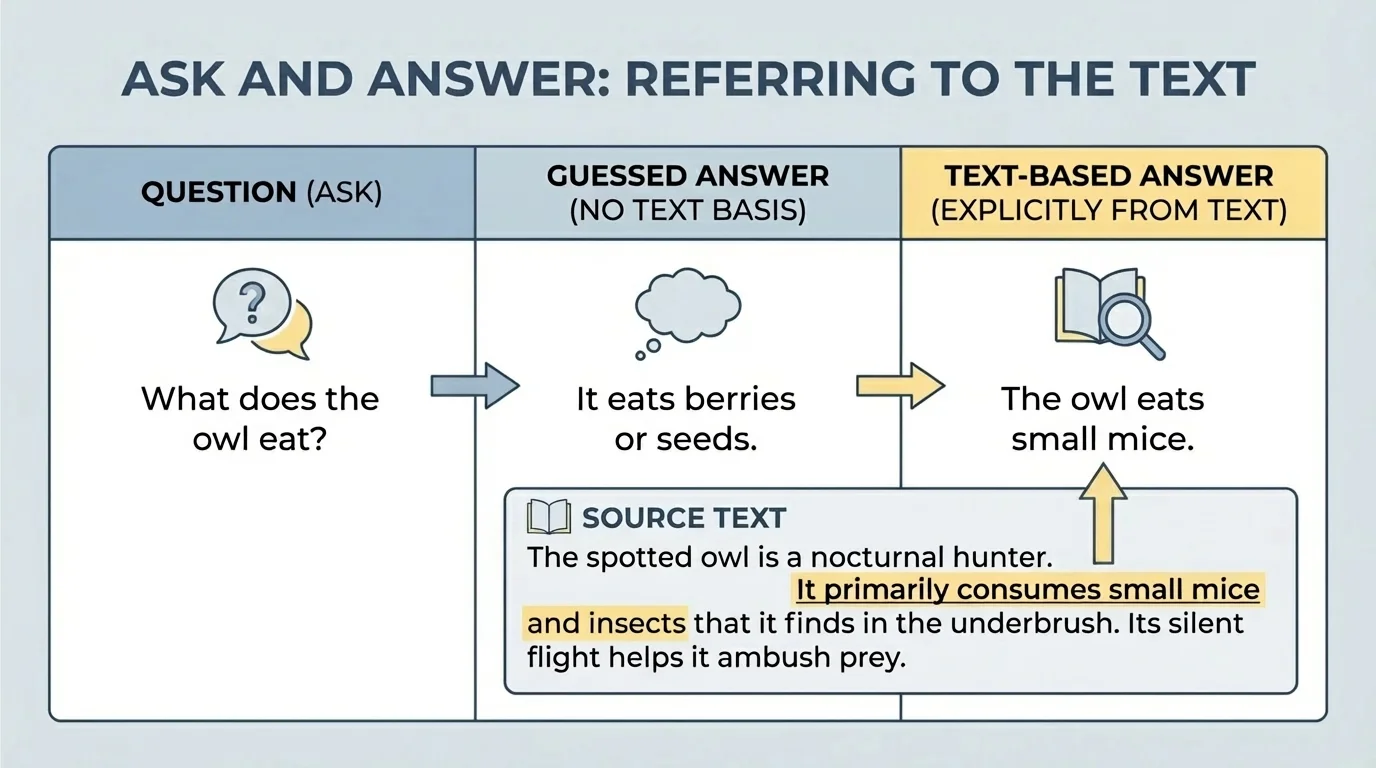
You do not always have to copy the exact sentence from the text. Sometimes you can put the idea into your own words. But even when you use your own words, the answer still needs to match the text closely.
Readers answer many kinds of questions. Some questions ask for facts or details that are stated clearly in the story. These are often called literal questions. A literal question might ask, "Where did the children go?" or "What did the fox find?" You can usually find the answer in one part of the text.
Other questions ask you to think more deeply. These may ask why a character acted a certain way or what lesson the story teaches. You still need the text to answer these questions, but you may have to connect clues. For example, a story may never say, "Nina felt lonely." But if it says she sat alone, looked out the window, and did not join the game, those clues support the answer.
Question words help readers know what to look for:
| Question word | What it often asks about | Example |
|---|---|---|
| Who | a character or group | Who helped the main character? |
| What | an event, object, or idea | What did the boy lose? |
| Where | place or setting | Where did the story happen? |
| When | time | When did the storm begin? |
| Why | reason or cause | Why did the girl hide the letter? |
| How | manner, process, or feeling | How did the team solve the problem? |
Table 1. Common question words and what readers usually look for when answering them.
Asking the right kind of question helps you search for the right kind of answer. A "who" question needs a person or character. A "why" question needs a reason that the text supports.
When you answer a question, you should look back at the reading for text evidence, as [Figure 2] illustrates. Good readers often reread a sentence, a paragraph, or even a whole page to find the clue that matters most.
You can look for several kinds of evidence. One kind is actions. What a character does can tell you a lot. Another kind is dialogue, which means what a character says. You can also look at descriptions of the setting, objects, and events. All of these help answer questions.
Suppose a story says, "Tara checked the window twice, packed extra batteries, and placed three blankets by the door before the snow arrived." If the question is, "How do you know Tara was preparing carefully for the storm?" the evidence is in her actions. She checked the window, packed batteries, and placed blankets by the door.
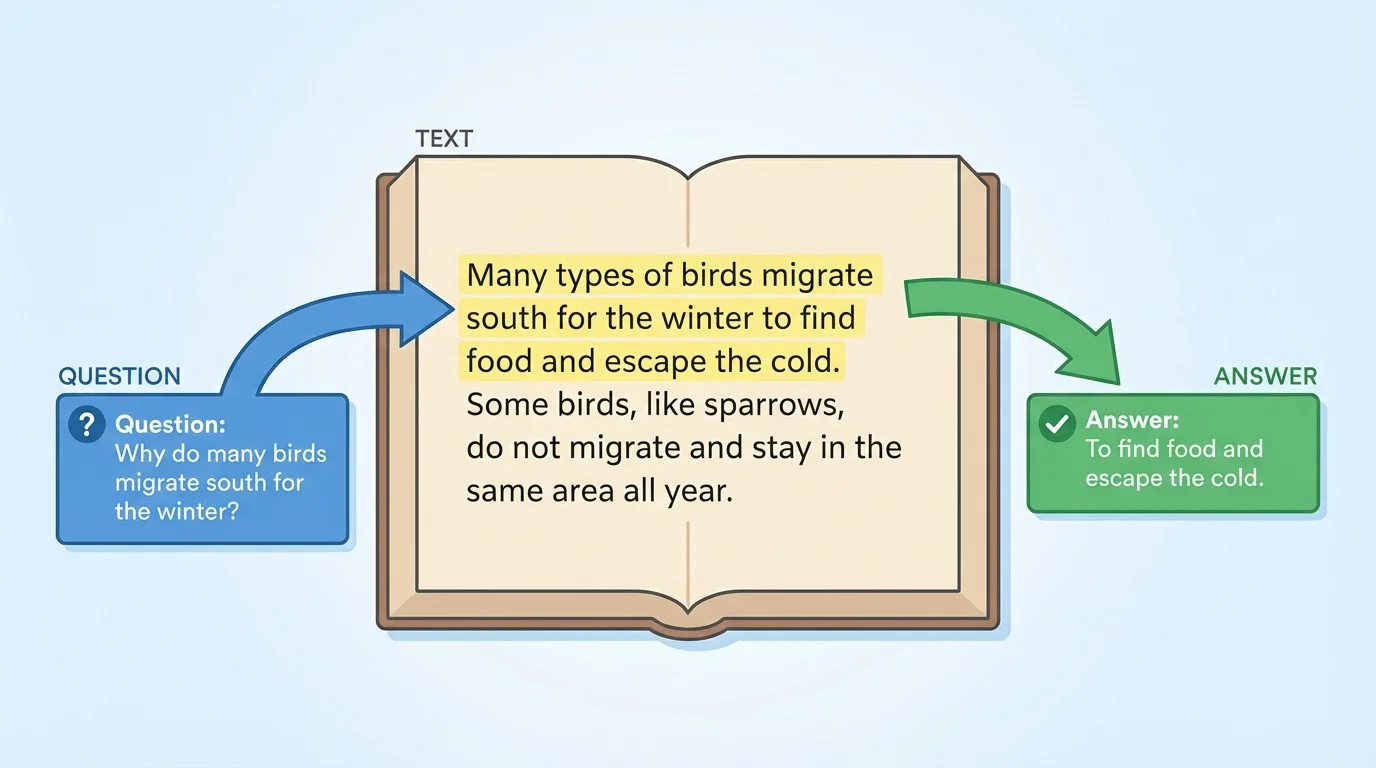
Sometimes the evidence is near the beginning of the text. Sometimes it is near the end. Sometimes it appears in more than one place. That is why readers should not rush. They should scan, reread, and think about which details matter most.
How text evidence works
Text evidence acts like proof. If you say a character is brave, you need to show what the character did or said that proves bravery. If you say the setting is important, you need to point to a part of the text that shows how the setting affects what happens.
As you become a stronger reader, you will learn to choose the best evidence, not just any detail. The best evidence matches the question closely.
A strong answer usually does three things. First, it answers the question clearly. Second, it uses a detail from the text. Third, it explains the connection between the detail and the answer.
Here is a simple pattern you can use:
Answer + evidence + explanation
For example, if the question is "Why was Ben nervous?" a weak answer is "Because he was scared." A stronger answer is "Ben was nervous because he had to speak in front of the class for the first time. The text says his hands shook as he walked to the front of the room."
Notice how the stronger answer does not stop after the first idea. It adds a detail from the story. That detail helps prove the answer.
Turning a short answer into a strong answer
Question: Why does Elena trust her grandfather?
Step 1: Start with a clear answer.
Elena trusts her grandfather because he has always helped her.
Step 2: Add evidence from the text.
The story says he walked with her to school every morning and taught her how to fix her broken kite.
Step 3: Put the ideas together.
Elena trusts her grandfather because he has always helped her. The story says he walked with her to school every morning and taught her how to fix her broken kite.
Complete sentences make your thinking easier to follow. They also help you sound clear and confident when you answer questions aloud or in writing.
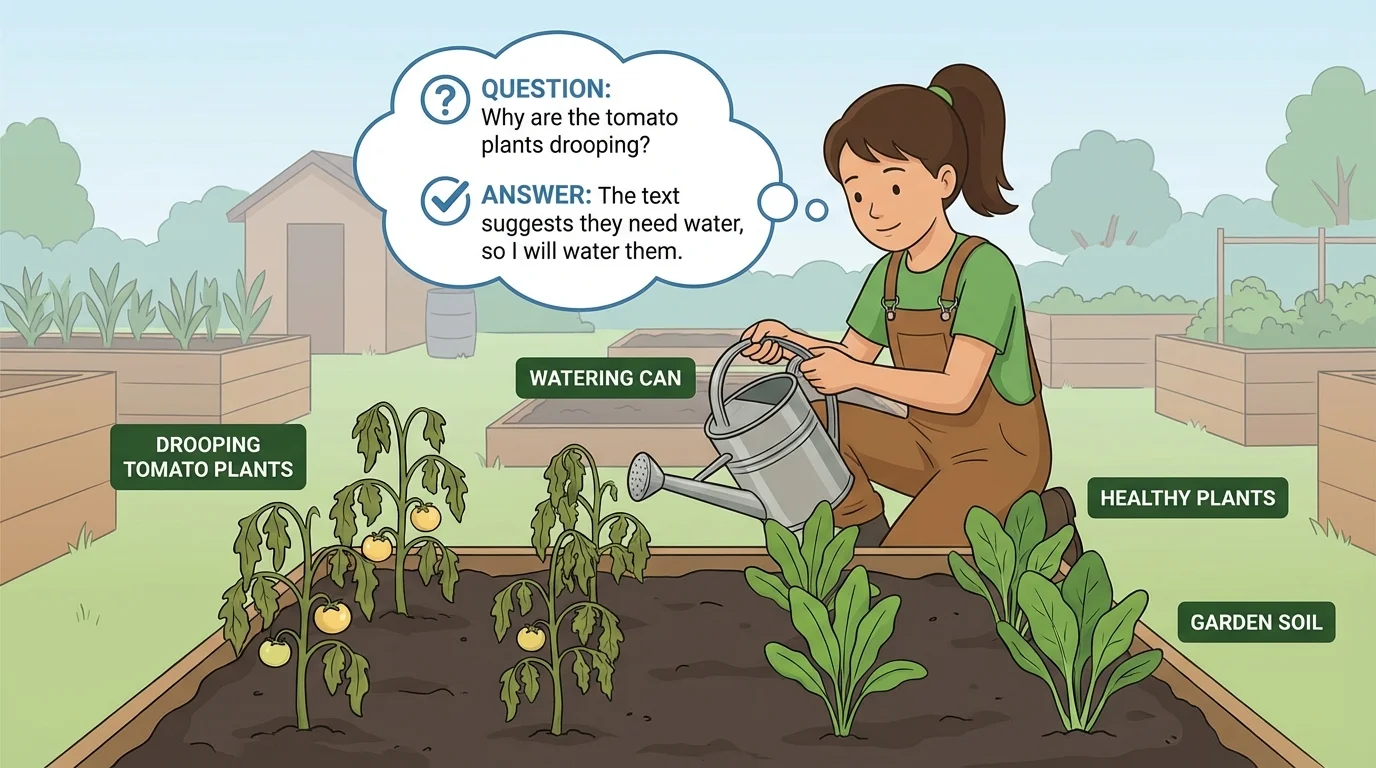
Now read this short literary passage. The important details in the scene, as [Figure 3] shows, help answer questions about what the character does and why it matters.
Maya hurried to the community garden after school. The tomato plants looked droopy, and the soil felt dry under her shoes. She remembered that the weather report had warned of a hot day, so she filled two watering cans and moved from row to row. When her friend Jonah arrived, Maya handed him a can and pointed to the smallest plants first. "These need the most help," she said. By sunset, the leaves stood taller, and Maya smiled when she saw a tiny yellow flower open on one vine.
This short passage gives us several useful clues. We learn where Maya goes, what problem she notices, what she does, what she says, and what happens at the end.
Model questions and answers from the passage
Question 1: Where does Maya go after school?
Answer: Maya goes to the community garden after school. The text says, "Maya hurried to the community garden after school."
Question 2: What problem does Maya notice?
Answer: Maya notices that the tomato plants need water. The text says the plants looked droopy and the soil felt dry.
Question 3: Why does Maya start watering the plants?
Answer: Maya starts watering the plants because the day is hot and the plants are drying out. The text supports this by saying the weather report warned of a hot day and the soil felt dry.
Question 4: How do you know Maya is caring?
Answer: Maya is caring because she quickly works to help the plants. She fills two watering cans, waters the rows, and tells Jonah to help the smallest plants first because they need the most help.
Each answer uses the passage. Some answers use exact words from the text. Others use the reader's own words, but still point back to the details the author gave.
Notice that question 4 asks more than just "what happened." It asks you to think about Maya's character. You can answer it only by using her actions and words as evidence.
Sometimes a question cannot be answered with one line from the story. Readers have to make an inference, which means using clues from the text to figure something out. Readers may need to gather two or more clues and connect them.
As [Figure 4] illustrates, suppose a story says, "Owen kept the trophy in his closet instead of on his shelf. When his teammates visited, he changed the subject whenever they mentioned the final game." A question might ask, "How does Owen probably feel about winning the trophy?" The text does not say, "Owen felt embarrassed" or "Owen felt uncomfortable." But his actions give clues. He hides the trophy and avoids talking about the game.
A strong answer could be: "Owen probably feels uncomfortable about winning the trophy because he keeps it in his closet and changes the subject when others talk about the game." This answer combines details from two places.
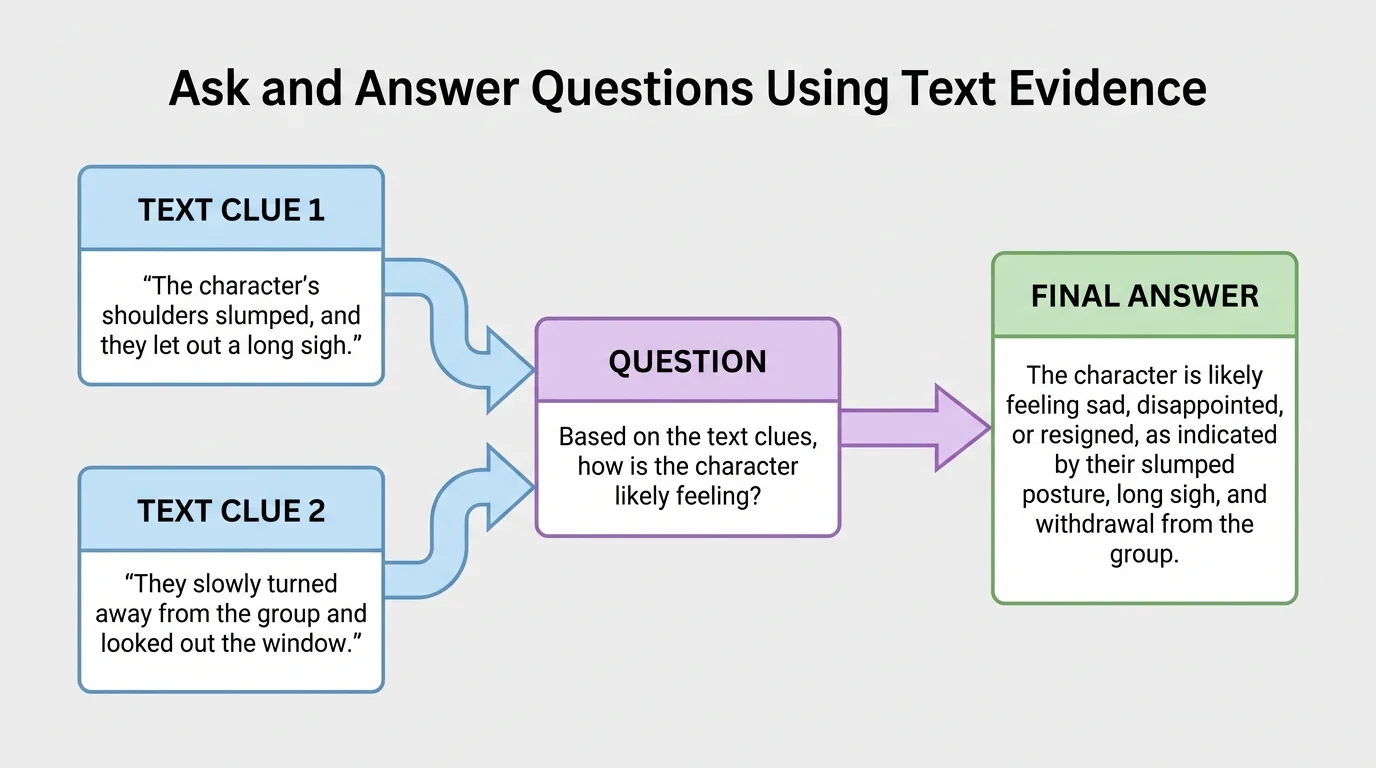
That kind of thinking is still based on the text. It is not a random guess. The clues lead you to the answer.
Strong readers often move back and forth through a passage instead of reading straight through only once. Rereading is not a sign that you are weak at reading. It is a sign that you are reading carefully.
Later, when you answer deeper questions about characters or themes, the same skill matters. Just as [Figure 4] shows clues joining together, details from different parts of a story can work together to support one thoughtful answer.
One common mistake is giving an answer with no support. For example, if asked, "Why did the character leave?" a student might say, "Because she wanted to." That answer may be too short and may not use the text. A better answer would include the reason shown in the story.
Another mistake is using only background knowledge. Suppose a story is about a dog hiding under a table during a storm. A student might answer, "Dogs hate thunder." Maybe some dogs do, but the answer should point to the story. A stronger answer is, "The dog is scared because the text says it trembled under the table when the thunder started."
A third mistake is answering the wrong question. If the question asks "why," do not answer "where." If it asks "how do you know," do not give only a short opinion. Always look closely at the question word before answering.
Good readers already know how to retell events and talk about characters. This skill builds on that knowledge. Now, instead of only saying what happened, you also show which parts of the text prove your answer.
As shown earlier in [Figure 1], the difference between a weak answer and a strong answer is proof. Strong answers sound clear because they are built on the text, not only on opinion.
Certain habits make it easier to ask and answer questions well. One helpful habit is to pause after an important event and ask yourself a quick question. You might ask, "What just happened?" or "Why is this important?"
Another habit is to reread when something seems confusing. The first reading helps you know the story. The second reading helps you notice details. This is the kind of close reading we saw in [Figure 2], where the reader searches a paragraph for a clue that matches the question.
It also helps to pay attention to characters' actions, words, and feelings. In many literary texts, these details are the best clues for answering questions. Setting can matter too. A dark forest, a crowded classroom, or a windy beach may change what happens in the story.
Finally, get into the habit of checking your answer. Ask yourself: "Did I answer the whole question?" "Did I use the text?" "Would another reader see how I know?" If the answer is yes, your response is probably strong.
