Have you ever learned how a volcano erupts, why people moved west long ago, or how to build something by following directions? Those are all examples of reading that teaches you about the real world. Informational texts are everywhere: in books, magazines, websites, signs, directions, and even game instructions. Strong readers do more than just say the words. They understand the ideas, notice how the text is organized, and keep going even when the reading gets harder.
An informational text is writing that gives facts, explains ideas, or teaches how something works. Unlike a story, it usually does not focus on made-up characters and a plot. Instead, it helps readers learn about a topic in the world around them.
You might read an informational text about whales, weather, ancient Egypt, magnets, maps, or how to recycle. Some informational texts tell about things that happened in the past. Others explain science ideas. Some give clear directions for doing a task.
Informational text is nonfiction writing that teaches readers about real people, places, events, objects, or ideas.
Comprehend means to understand what you read well enough to explain it, use it, or connect it to other learning.
To read informational text well, you need to do two things together: read the words fluently and understand the meaning. If you read too slowly, it can be hard to remember the ideas. If you read fast but do not think about the meaning, you miss the point. Good readers balance both.
In school, you read different kinds of nonfiction for different subjects. In history/social studies, texts often tell about communities, leaders, inventions, maps, or important events from long ago. These texts may explain what happened, when it happened, and why it mattered.
In science texts, writers explain animals, plants, weather, space, forces, energy, habitats, and many other topics. Science reading often includes careful descriptions, cause-and-effect ideas, and words that name parts, processes, or changes.
In technical texts, the writer tells how to do something. A recipe, directions for a craft, instructions for a science tool, or rules for a game are technical texts. These texts must be read carefully because the order of the steps matters.
| Type of text | What it often includes | Example |
|---|---|---|
| History/social studies | Events, people, places, timelines, maps | A passage about the first railroads |
| Science | Facts, explanations, observations, diagrams | An article about the water cycle |
| Technical | Directions, steps, warnings, labeled parts | Instructions for planting seeds |
Table 1. Types of informational texts and the kinds of information they usually contain.
Even though these texts are different, strong readers use many of the same habits in all of them. [Figure 1] They look for the topic, notice important details, and think about how the parts fit together.
Informational texts often contain special parts called text features. These features help organize information and guide the reader. Text features are like road signs: they tell you where to look and what matters most.
A heading tells what a section is mostly about. A subheading breaks a big topic into smaller parts. Captions explain pictures. Labels name the parts of a diagram. Bold words point out important vocabulary. A glossary gives meanings of special words. A table of contents helps you find chapters, and an index helps you locate exact topics.
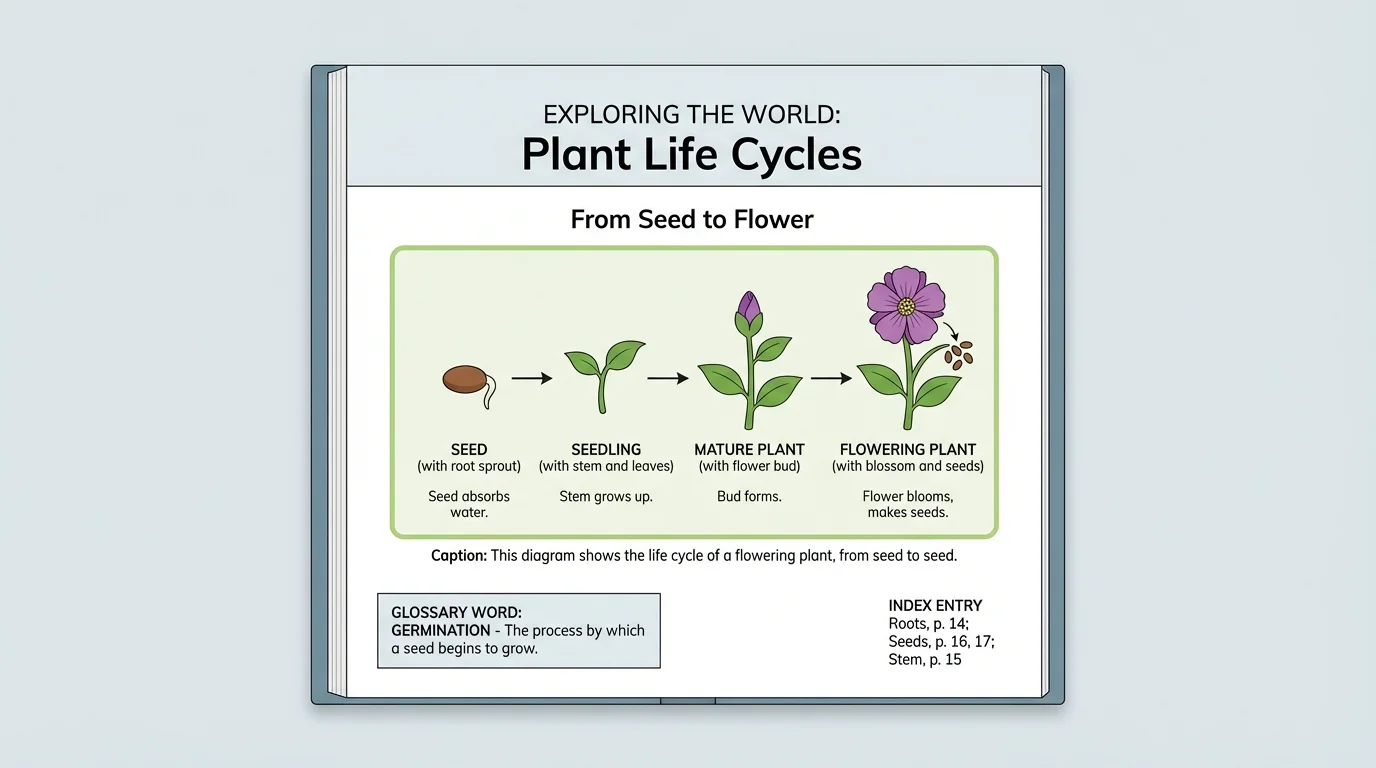
If you skip these features, you may miss useful information. For example, a picture of a frog's life cycle becomes much more helpful when you also read the labels and caption. A heading like How Frogs Change prepares your brain for what is coming next.
Readers also pay attention to charts, maps, and diagrams. These are not decorations. They carry meaning. Sometimes a diagram explains something faster than a whole paragraph. Later, when you compare information across texts, the same skill matters again, and [Figure 1] reminds us to use every part of the page, not only the main paragraphs.
Some nonfiction books can be read in more than one way. A reader might start with headings and captions to get the big idea first, then go back and read every paragraph closely.
Knowing how a text is built helps you read with confidence. Instead of feeling lost on a busy page, you can use the features to guide your attention.
Strong readers do not just begin at the first word and hope for the best. They use strategies before, during, and after reading. Before reading, preview the title, headings, and pictures. This helps you predict the topic.
While reading, ask yourself questions: What is this section mostly about? What new fact did I learn? Which details support the main idea? If something does not make sense, slow down and reread. Good readers know that rereading is not a mistake. It is a smart tool.
Main idea and key details work together in informational reading. The main idea is the most important point the author wants you to understand, and key details are the facts, examples, or explanations that support that point.
Another useful strategy is noticing signal words. Words such as because, as a result, first, next, and finally tell how ideas connect. These words can show cause and effect, sequence, or explanation.
Readers also use context clues. If you meet a tricky word, look at the words and sentences around it. The author often gives hints. You can also use a glossary, caption, or diagram to figure out meaning.
After reading, stop and think. [Figure 2] Can you explain the main idea in your own words? Can you tell two or three important details without looking back right away? This quick self-check helps you know whether you truly understood the text.
History and social studies reading teaches about people, places, governments, communities, and events from the past. In these texts, readers often track when things happened and what changed over time through a timeline. The order of events matters because one event often leads to another.
When you read historical writing, pay attention to names, dates, places, and causes. If a text says a bridge was built after a river made travel difficult, the river problem is a cause and the bridge is an effect. Understanding these relationships helps the whole passage make sense.
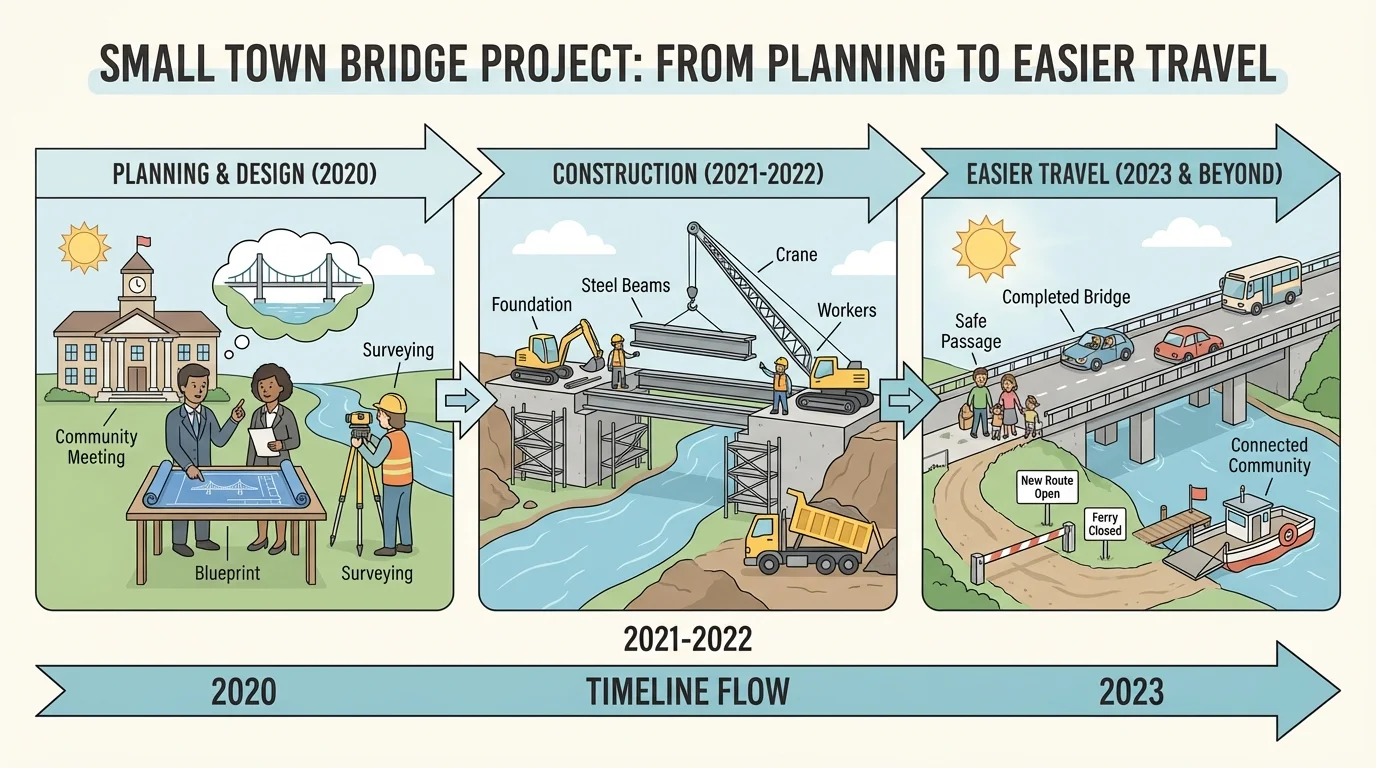
Some history texts include timelines, maps, and primary or secondary sources. A primary source is something from the time being studied, like a letter, photo, or speech. A secondary source is written later and explains the event. Both can teach us, but they do so in different ways.
Readers of social studies texts also notice point of view. Different people may describe the same event differently depending on their experiences. Facts matter, but perspective matters too. Looking closely at details helps you tell what the text clearly states and what the writer thinks is important.
Example: Reading a short history paragraph
Suppose a paragraph says that a town had trouble crossing a river, then workers built a bridge, and later trade became easier.
Step 1: Find the sequence.
First there was a problem, next the bridge was built, and after that travel and trade improved.
Step 2: Find cause and effect.
The hard river crossing caused trouble. Building the bridge led to easier travel.
Step 3: State the main idea.
The bridge changed the town by making movement and trade easier.
As you keep reading texts about communities and the past, [Figure 2] remains useful because it shows how sequence helps readers understand change over time.
Science reading often answers questions about how the world works. A science article may explain why shadows change, how plants make food, or what animals need to survive. These texts are full of facts, but they are also full of relationships: parts and wholes, cause and effect, problems and solutions, and sequences of steps.
When reading science, look carefully at diagrams, labels, and precise words. A science author chooses words carefully because each one has a job. If a passage says that a cactus stores water in its stem, that detail is important. If a diagram labels the roots, stem, and spines, those labels help you understand the explanation.
Science texts often include observations and explanations. An observation tells what can be noticed, such as leaves turning toward sunlight. An explanation tells why that happens. Good readers connect the two. They ask, "What did the author notice?" and "How does the author explain it?"
You already know how to find the main idea and supporting details in a paragraph. Science reading uses the same skill, but the details may include special vocabulary, diagrams, and exact descriptions.
Sometimes science writing includes a process. For example, a text about the water cycle may explain evaporation, condensation, and precipitation in a sequence. If you lose track of the order, reread and use the headings or illustrations to rebuild the process in your mind.
Science texts can also compare things. [Figure 3] A passage may explain how mammals and reptiles are alike and different, or how solids, liquids, and gases behave. Comparison words such as both, however, and unlike help readers follow these ideas.
Technical texts tell readers exactly how to do something. The steps must be followed in order, and details matter. If you skip a step or read carelessly, the task may not work.
These texts often include numbered directions, bullet points, warnings, and diagrams. You might read how to use a thermometer, how to log into a computer program, or how to plant a bean seed in a cup. Every part has a purpose.
When reading technical text, first gather what you need. Then read all the steps before you begin. Notice words that signal sequence, such as first, next, after, and last. Also notice safety words like warning, caution, or do not.
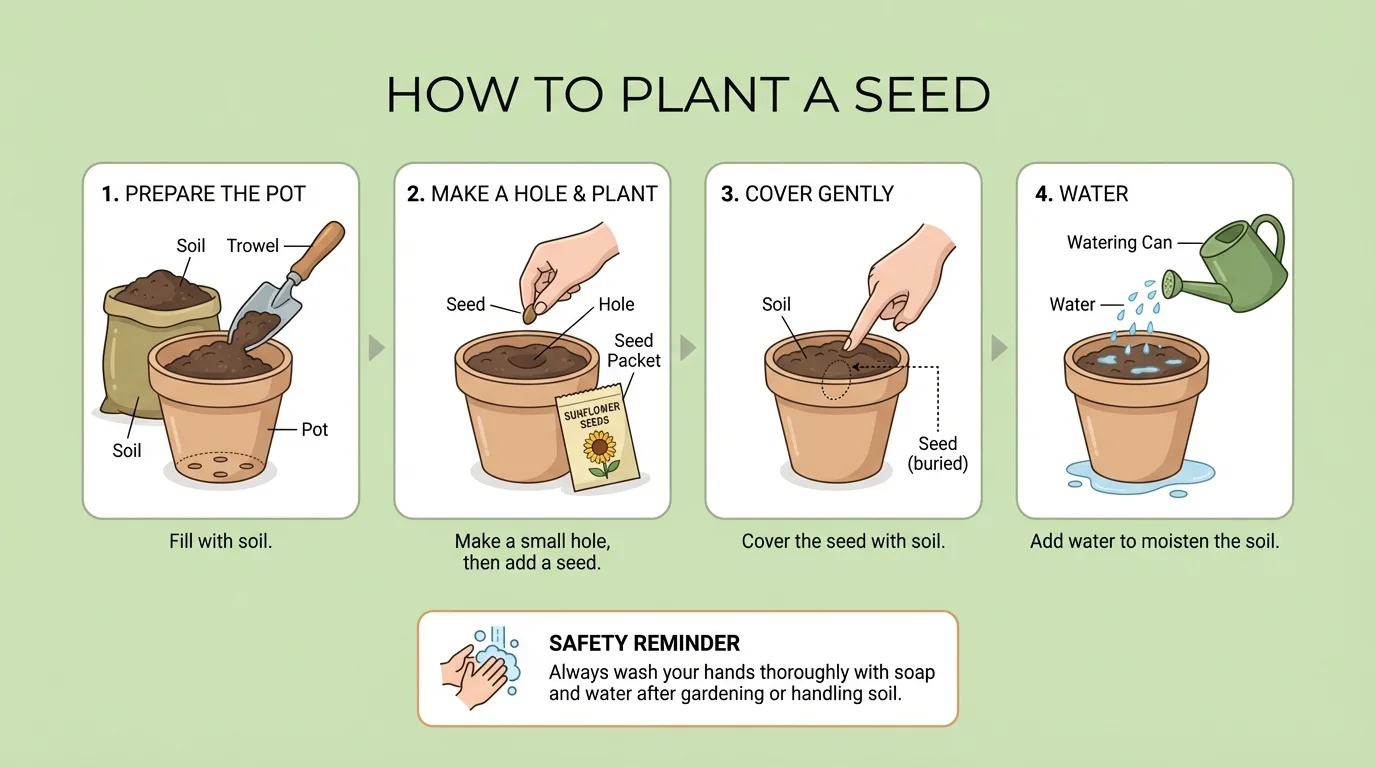
Technical reading is a great place to practice precision. If directions say to add two spoonfuls of soil before placing the seed, the order matters. If the text says to keep the cup near sunlight, that detail matters too. In technical texts, little details often make a big difference.
Example: Reading directions for planting a seed
A short set of instructions says: fill a cup partway with soil, place one seed in the center, cover it lightly, and water gently.
Step 1: Identify the materials.
You need a cup, soil, a seed, and water.
Step 2: Follow the sequence.
The seed is not placed first. The cup gets soil before the seed goes in.
Step 3: Watch for exact words.
The direction says cover it lightly, so too much soil would not match the instructions.
Later, when you read any set of classroom directions, [Figure 3] helps you remember that order, tools, and warnings are all part of understanding the text.
Reading independently means you can handle a text on your own most of the time. You may still meet hard words or tricky ideas, but you use strategies instead of giving up. You preview, read carefully, reread when needed, and check whether the text makes sense.
Reading proficiently means reading with skill. A proficient reader reads accurately, at a good pace, and with understanding. That reader can explain the main idea, find key details, use text features, and learn new information from grade-level texts.
Independence grows little by little. At first, a long article may feel challenging. But each time you use headings, diagrams, context clues, and careful thinking, your brain becomes stronger at handling complex text.
"Reading is not just saying the words. Reading is making meaning."
One way to build independence is to notice when your mind wanders and bring it back. Another is to pause after each section and think, "What was this mostly about?" These habits make reading stronger even when the topic is unfamiliar.
Fluency matters too. Reading smoothly helps your brain hold onto ideas. But smooth reading does not mean rushing. It means reading with enough accuracy and expression that the meaning stays clear.
Sometimes you will read more than one informational text about the same topic. One text may have a map, another may have a diagram, and a third may tell a true story about a person connected to the topic. Strong readers compare what they learn.
If two texts are about storms, ask: What ideas do both texts explain? What details are different? Does one text focus more on safety while another explains the science? Comparing texts helps you see the topic more completely.
This skill matters in every subject. In social studies, you may read a map and a short article together. In science, you may read a diagram and a paragraph together. In technical reading, you may use both words and pictures to complete a task. Understanding grows when you connect information from more than one source.
As you become a stronger reader, remember that hard texts are not meant to stop you. They are meant to stretch you. With attention, strategy, and practice, you can read informational texts at a high level for your grade and understand them well on your own.
