Have you ever read a science book and found a word that felt like a locked door? One word can stop the whole sentence from making sense. But strong readers are like detectives. They look for clues, test ideas, and unlock meaning. When you learn how to figure out hard words in informational texts, you do more than read better—you learn more about animals, weather, communities, history, and the world around you.
Informational texts teach real facts. You read them in science, social studies, health, and even in directions for projects. These texts often include words that help explain ideas clearly. Some of those words are used in many subjects, and some belong mostly to one subject. Knowing how to determine the meaning of these words helps you understand the whole text, not just one sentence.
When readers understand important words, they can follow the author's ideas. For example, if a science text says, "Plants absorb water through their roots," the word absorb matters because it tells what the plant does. If a social studies text says, "A community works together to solve problems," the word community matters because it tells who is involved.
Sometimes a word is new, but the text gives enough clues to help. Other times, a reader must use the topic, a diagram, or even parts of the word itself. Good readers do not give up when they see a hard word. They stop, think, and gather clues.
General academic words are words that appear in many school subjects. They help readers talk about ideas, explain thinking, and compare information. Words like compare, describe, and result are general academic words.
Domain-specific words are words that belong mostly to one topic or subject area. Words like habitat in science, continent in geography, and citizen in social studies are domain-specific words.
These two kinds of words work together. General academic words help readers think about information. Domain-specific words help readers learn the special language of a topic.
Informational texts often contain two important kinds of words, as [Figure 1] shows. A word like compare can appear in science, reading, math, or social studies. You might compare two animals, compare two places, or compare two stories. That makes it a general academic word.
A word like habitat is different. You usually see it in science texts about living things. It names the place where a plant or animal lives. That makes it domain-specific. Another example is continent, a word often used in geography and social studies.
Readers should notice whether a word is useful across many subjects or tied closely to one topic. This helps them know what kind of meaning to expect. A general academic word often tells what the author is doing with ideas. A domain-specific word often names something special in the subject.
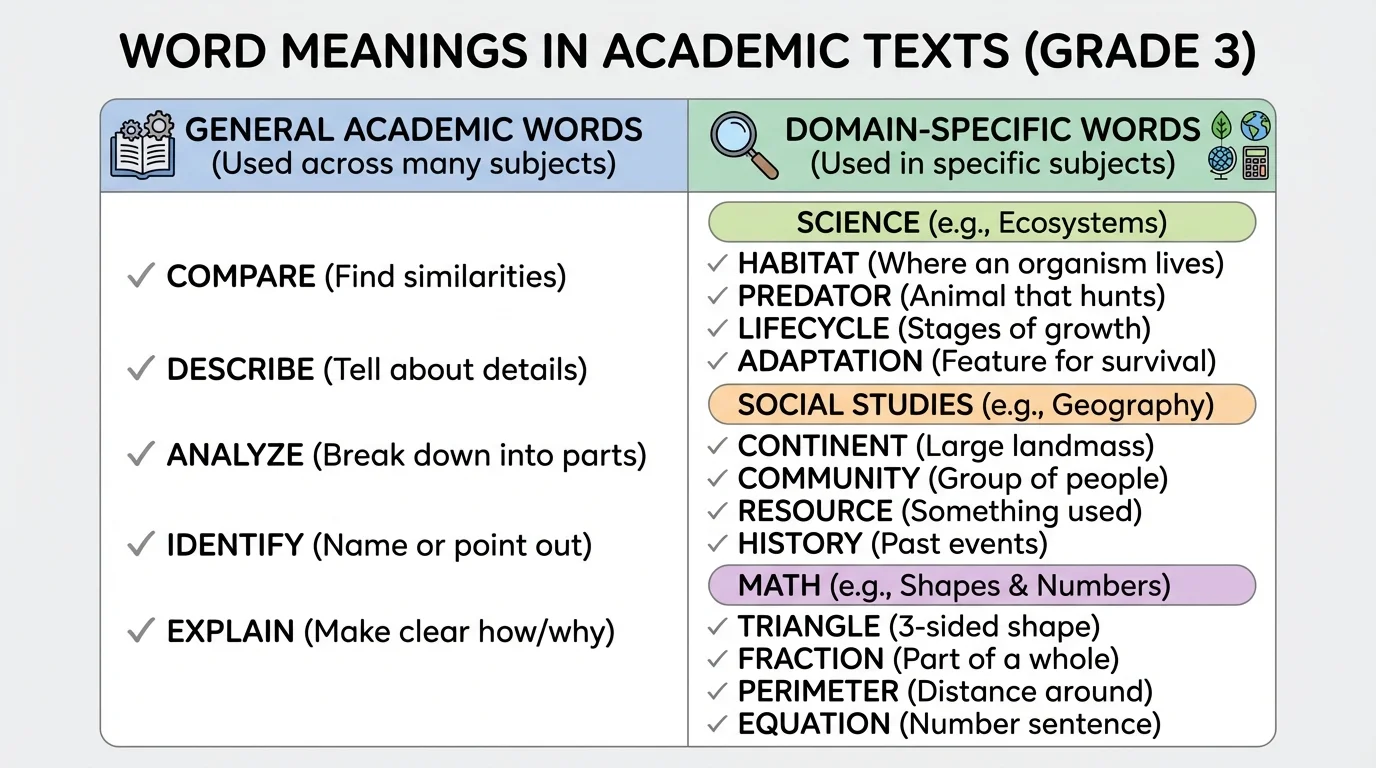
Suppose you read, "Scientists compare the habitats of desert animals and forest animals." In that sentence, compare is a general academic word because it means to tell how things are alike and different. Habitats are domain-specific words because they belong to the study of living things.
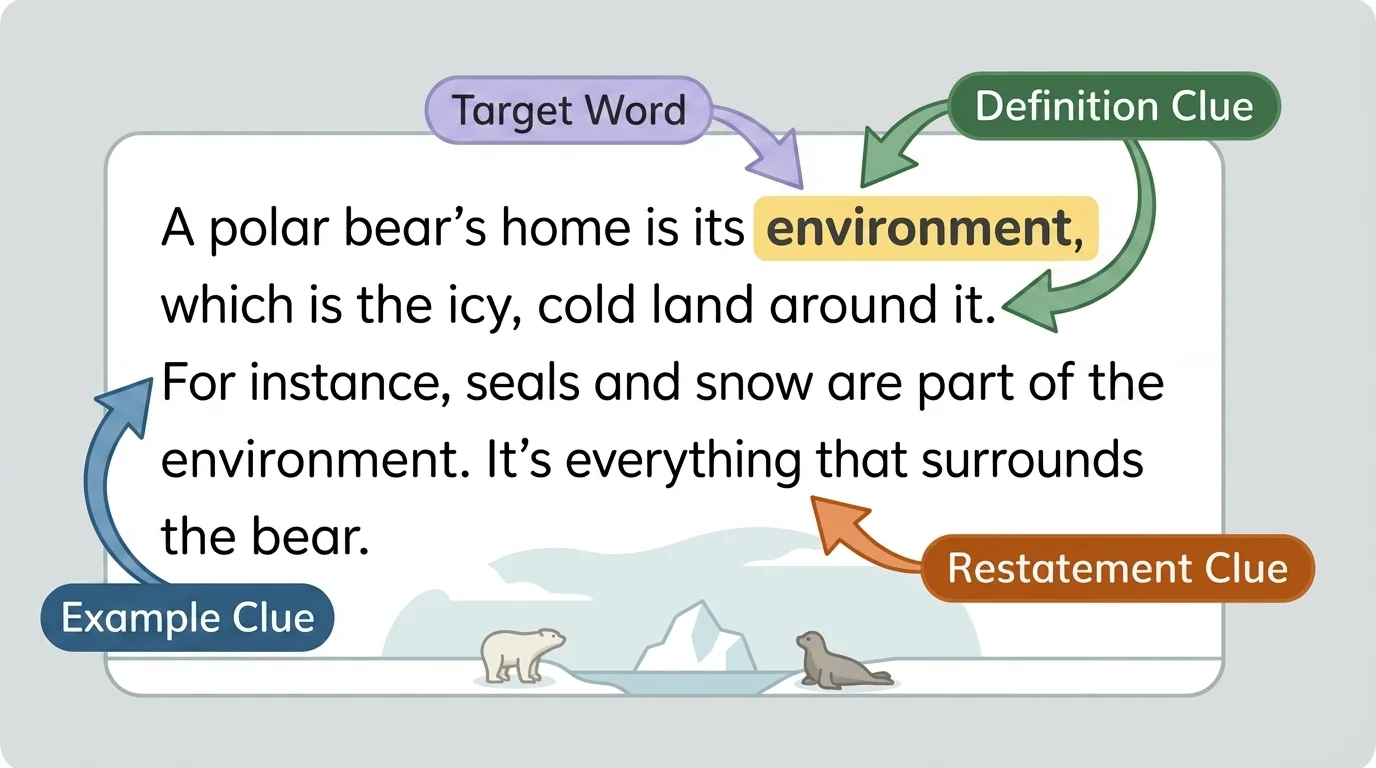
One of the best reading strategies is to use context clues, as [Figure 2] illustrates. Context clues are hints in the words and sentences around an unknown word. Authors often help readers by giving a definition, an example, a restatement, or details that point to the meaning.
Here are some common kinds of context clues. A definition clue tells the meaning directly. An example clue gives examples. A restatement clue says the idea in a different way. A detail clue gives information that helps the reader infer the meaning.
Read this sentence: "A nocturnal animal is active at night and sleeps during the day." The phrase "active at night" is a definition clue. It helps you understand that nocturnal means awake or busy at night.
Now read this one: "Some animals migrate, such as geese flying south in winter." The example of geese flying south helps readers understand that migrate means moving from one place to another during a season.
Sometimes the clue is not in one sentence alone. You may need to read the sentence before and after it. If a paragraph says, "The soil was dry and cracked. After the rain, it became moist," the contrast helps you infer that moist means a little wet.
Finding meaning with context clues
Read the sentence: "The volcano was dormant. It was quiet and had not erupted for many years."
Step 1: Notice the unknown word.
The word dormant may be unfamiliar.
Step 2: Look for nearby clues.
The text says the volcano was "quiet" and "had not erupted for many years."
Step 3: Choose the meaning that fits.
Dormant means not active right now.
Context clues help the reader figure out the word without needing anyone to tell them first.
When you use context clues, ask yourself: "What is happening in this sentence? Which words around the unknown word give me hints?" That habit makes reading smoother and stronger.
Readers do not only use sentences. They also use text features, as [Figure 3] shows. Informational texts often include headings, captions, labels, maps, charts, bold words, sidebars, and glossaries. These features are built to help readers understand ideas and vocabulary.
A glossary is a short dictionary at the back of a book. It gives definitions for important words. A caption under a picture can also help explain a word. Labels on a diagram may show the names of parts. A bold word may signal, "This word is important."
For example, if a page heading says "Parts of a Plant" and a labeled diagram shows roots, stem, and leaves, then those labels help define the words. If a caption says, "The roots absorb water from the soil," the caption gives an extra clue for the meaning of absorb.
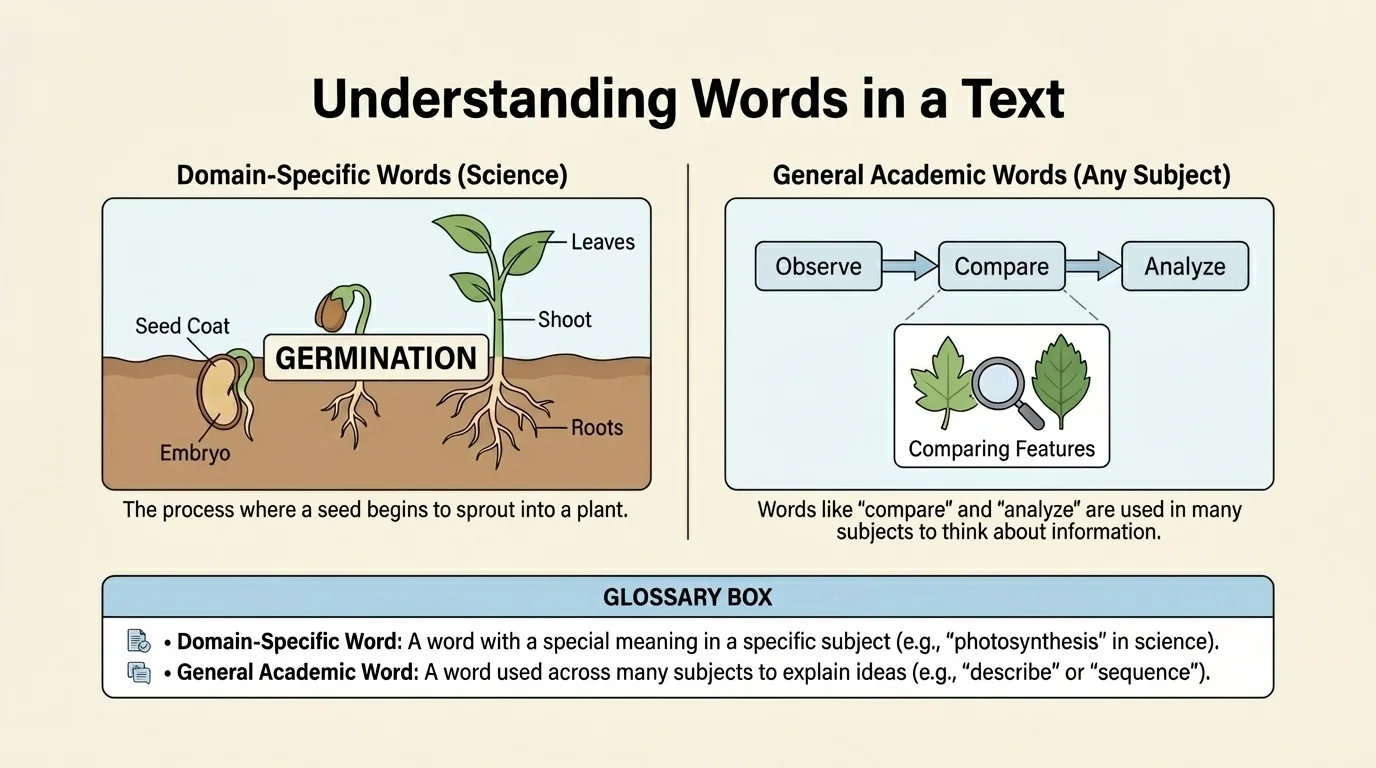
Text features are especially helpful when the topic is new. A student may not know a science word at first, but the diagram, heading, and glossary can work together to explain it. As you look at more examples, [Figure 3] remains useful because it reminds us that pages often teach vocabulary in more than one way.
Many nonfiction books are designed so readers can learn even before they read every sentence. Headings, labels, and captions often teach key words quickly.
Whenever you meet a tricky word, look all around the page, not just at the line where the word appears.
Words can be like puzzles. Their parts can give clues, as [Figure 4] illustrates. A prefix is a word part added to the beginning of a word. A suffix is added to the end. The base word is the main part that carries the core meaning.
For example, in the word unhappy, the prefix un- means not. The base word happy means feeling good. So unhappy means not happy. In the word careful, the suffix -ful means full of. So careful means full of care.
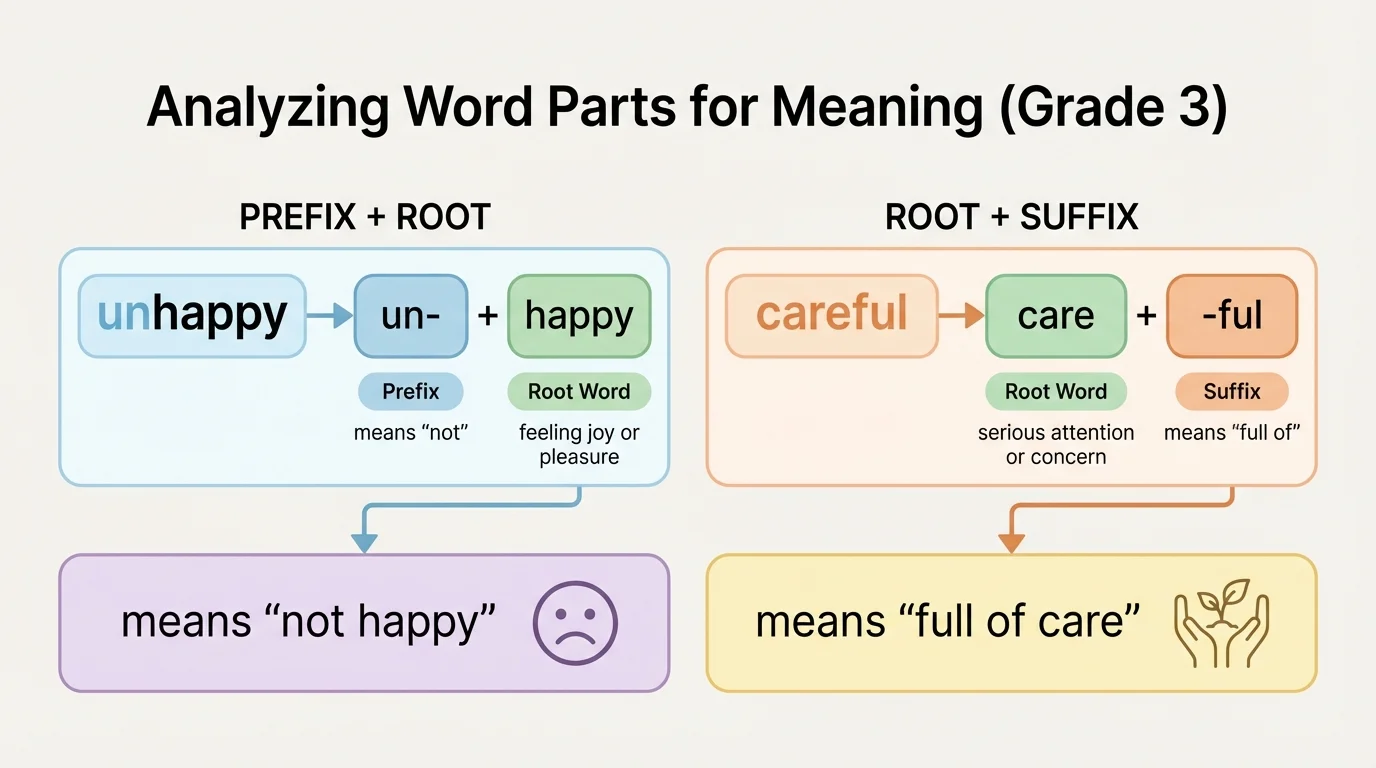
This strategy does not work for every word, but it often helps. If you read the word rebuild, you may know that re- can mean again. That gives you the idea of building again. If you read hopeful, the suffix -ful helps you understand that it means full of hope.
Word parts can support the other strategies you use. If the context is about weather and you read rainfall, the parts rain and fall already suggest something about rain coming down. Then the rest of the sentence can help confirm the meaning.
You already know many base words from everyday reading. When a longer word looks hard, check whether you can spot a smaller word inside it.
Readers do not need to know every prefix and suffix in the world. Even knowing a few common ones can make a big difference.
The topic of a text can help you decide what a word means. If a word appears in a passage about oceans, animals, or maps, that subject gives a strong clue. A word should make sense in the sentence and in the whole paragraph.
For example, the word current can mean happening now, but in a science text about rivers, it can mean the moving water. A reader must ask, "Which meaning fits this topic?" If the paragraph talks about boats floating and water moving fast, then current means flowing water.
This is why strong readers do not choose the first meaning they think of. They check whether the meaning matches the subject, the sentence, and the paragraph. That extra check helps avoid mistakes.
Let's look at how these strategies work in real informational text. In science and social studies, domain-specific words often carry the most important ideas. But general academic words help readers understand how those ideas connect.
Science example
Read the passage: "A cactus stores water in its stem. This helps it survive in a dry desert habitat."
Step 1: Find the word that may be unfamiliar.
The word habitat may be new.
Step 2: Use the topic.
The passage is about a cactus living in the desert.
Step 3: Use context clues.
The sentence explains that the cactus survives in a dry desert habitat. That tells where it lives.
Step 4: State the meaning.
Habitat means the place where a plant or animal lives.
Notice how the sentence gives enough information to infer the meaning. The word belongs especially to science, so it is domain-specific.
Social studies example
Read the passage: "People in a community share spaces such as parks, schools, and libraries."
Step 1: Notice the examples.
Parks, schools, and libraries are all places people use together.
Step 2: Connect the examples to the word.
The word community must have something to do with people living or working together in one place.
Step 3: Choose the meaning.
Community means a group of people who live in the same area and share places and services.
Now think about a sentence with a general academic word: "The author will compare two kinds of storms." The topic may be weather, but the word compare is useful in many subjects. It tells what the author is about to do—look at how the storms are alike and different.
As we saw earlier in [Figure 1], knowing whether a word is general academic or domain-specific can help you decide how to understand it and where else you might see it.
Some words have more than one meaning, as [Figure 5] shows. A reader must choose the meaning that fits the text. This is especially important in informational reading because the topic often points to one exact meaning.
Take the word trunk. In a passage about elephants, trunk means the elephant's long nose. In a passage about travel or storage, trunk could mean a large box or storage space. The same word looks the same, but the topic changes the meaning.
Another example is bat. In a science text about animals, it means a flying mammal. In a sports text, it means the tool used to hit a ball. Readers must look at the whole sentence and the subject area before deciding.
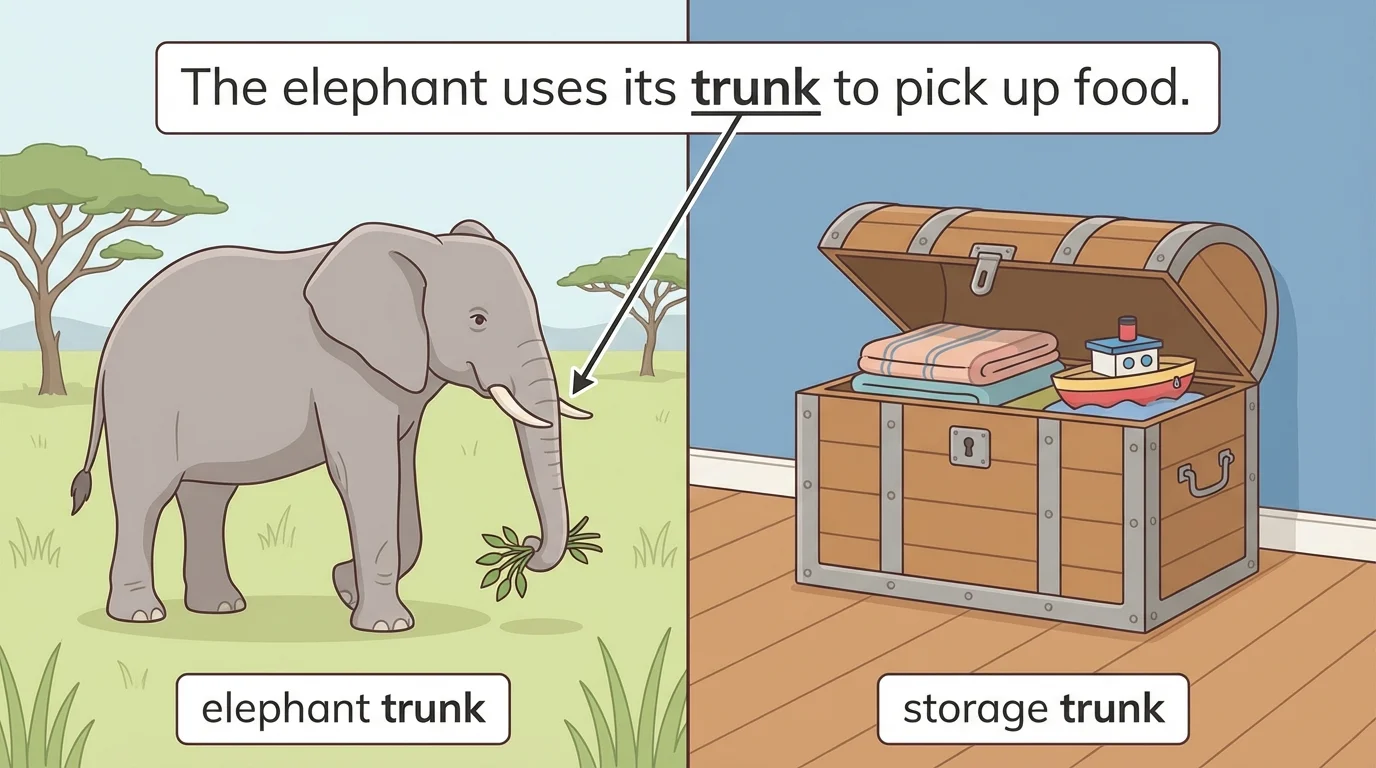
If you are unsure, try putting your guessed meaning into the sentence. Does it make sense? Does it fit the paragraph? If yes, your meaning is probably correct.
This same kind of thinking works with phrases too. If a text says, "The clouds gathered, and the sky grew dark," the phrase grew dark does not mean the sky was growing like a plant. It means the sky became dark. Readers use the whole sentence to understand the phrase.
Strong readers use more than one strategy at a time. They look at context clues, text features, word parts, and the topic. If one clue is weak, another clue may help. For example, a science diagram may support what the sentence suggests, just as [Figure 3] reminds us. A multiple-meaning word may become clear when you think about the topic, like the examples in [Figure 5].
When you come to a hard word, slow down for a moment. Ask: "What is the text about? What do the other words tell me? Is there a heading, picture, label, or glossary entry? Do I notice any word parts I know?" These questions turn confusion into understanding.
Putting the clues together
Determining word meaning is not guessing randomly. It is using evidence from the text. Readers collect clues, think about what fits best, and then check whether the meaning makes sense in the whole passage.
The more informational texts you read, the easier this becomes. Over time, many domain-specific words become familiar, and many general academic words become part of your reading toolbox. That helps you learn faster in every subject.
