Have you ever heard someone say, "It's raining cats and dogs," and looked outside expecting pets to fall from the sky? That would be very strange. Phrases like this are interesting because the words say one thing, but the speaker means another. Good readers learn to notice when words are meant exactly as they are said and when they mean something different.
When you read, you do not just look at single words. You think about the whole sentence, the whole paragraph, and what is happening in the text. Sometimes words and phrases have a meaning that is plain and direct. Other times, they are used in a special way. Readers need to know the difference so they can understand the author's message correctly.
A phrase is a group of words that works together to express an idea. Some phrases are easy to understand because they mean exactly what they say. Other phrases are trickier because they mean something more than the exact words.
Literal meaning is the exact, ordinary meaning of words.
Nonliteral meaning is a meaning that is different from the exact words. The speaker or writer means something beyond the direct meaning.
Understanding both kinds of meaning is an important reading skill. It helps you enjoy stories, understand characters, and make sense of expressions people use every day.
Literal meaning is what the words really say. If a sentence says, "The dog is under the table," the dog is actually under the table. There is no hidden meaning. The words match the real action or real object.
Here are some literal examples:
Literal language is common in directions, facts, and clear descriptions. If a recipe says to stir the soup, it means to stir the soup. If a science book says that frogs live near water, it means exactly that.
You already use this skill when you follow directions. If a teacher says, "Put your paper on the desk," you know that means exactly what the words say. That is literal language.
Literal meaning is usually easier to understand because it does not ask you to search for a hidden idea.
Nonliteral meaning happens when the words do not mean exactly what they say. Instead, they stand for another idea. For example, if someone says, "My brother is a couch potato," that does not mean he is a vegetable sitting on the couch. It means he spends a lot of time sitting around and not moving much.
Writers and speakers use nonliteral language to make ideas stronger, funnier, more vivid, or more interesting. It can help readers picture a scene or understand a feeling in a powerful way.
One common kind of nonliteral language is an idiom. An idiom is a phrase whose meaning is different from the exact meanings of the individual words. When someone says, "Hold your horses," they do not usually mean to grab actual horses. They mean "wait."
Many idioms have been used for a very long time. People keep saying them because the expressions are colorful and easy to remember, even when the words sound silly.
Here are some nonliteral examples:
Nonliteral language appears often in stories, poems, conversations, songs, and even news headlines. Readers need to slow down and think when the exact words do not seem to make sense.
Context, as [Figure 1] shows, is the set of words, sentences, and ideas around a word or phrase that helps you figure out its meaning. Context is like a flashlight. It helps you see what the author really means.
Suppose you read the phrase "take steps." If the sentence says, "Jalen took steps toward the door," the phrase is probably literal. Jalen is actually walking. But if the sentence says, "Jalen took steps to solve the problem," the phrase is nonliteral. It means Jalen did things in order to fix the problem.
When you use context, ask yourself questions like these: What is happening? Who is speaking? Does the exact meaning make sense? Is the author talking about actions, feelings, or ideas? The answers help you decide whether the language is literal or nonliteral.
Context clues can come from nearby words. They can also come from the whole situation in the story or article. If a character is studying late for a test, the phrase "hit the books" probably means "study." If the character is in a library and books actually fall to the floor, then "hit the books" could describe a real action.
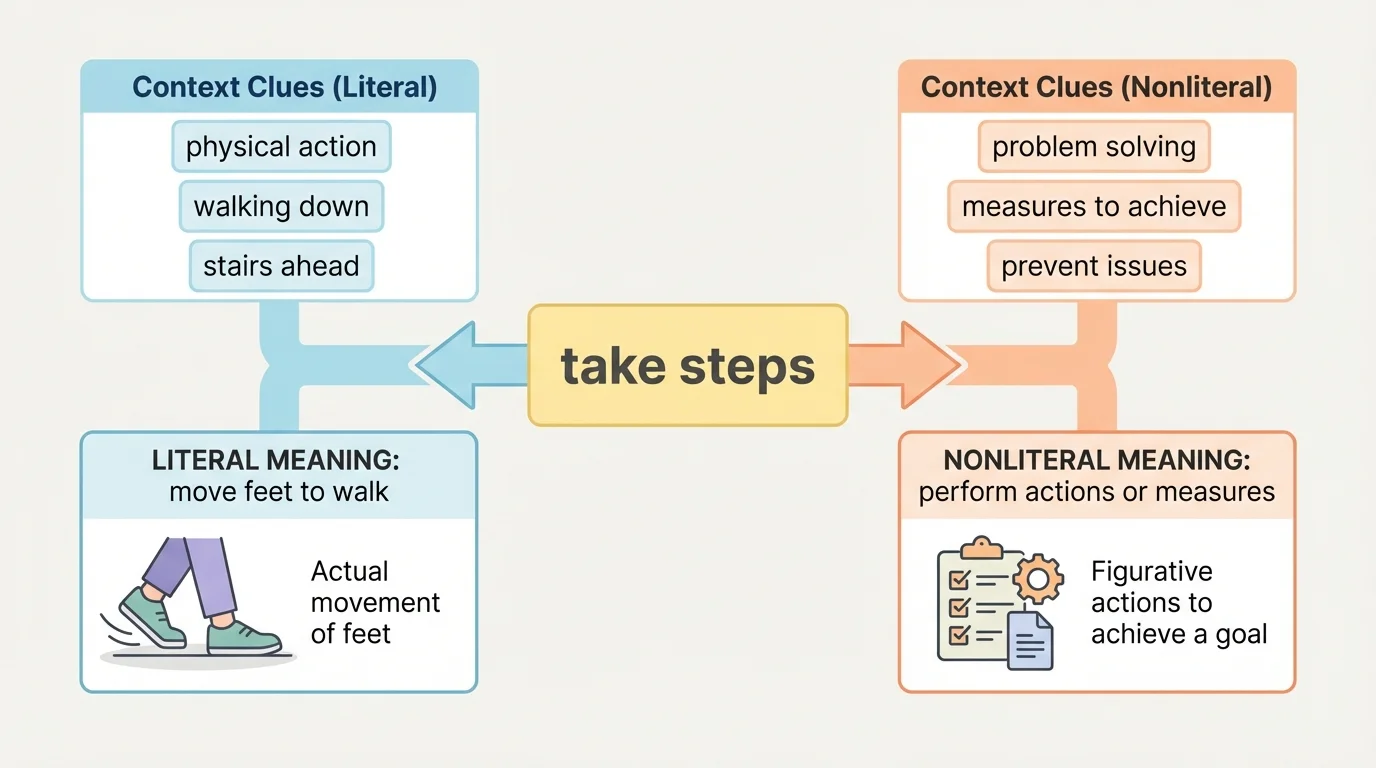
Sometimes readers make mistakes because they stop too early. They see a familiar word and think they know the meaning. Strong readers keep checking the sentence and the whole text to make sure the meaning fits.
One of the best ways to understand this skill is to compare meanings side by side. The phrase "take steps," as [Figure 2] illustrates, can describe real walking steps or it can mean doing something in a planned way.
Look at these pairs of sentences:
| Phrase | Literal Meaning in a Sentence | Nonliteral Meaning in a Sentence |
|---|---|---|
| take steps | "Lena took steps up the porch." | "Lena took steps to improve her reading." |
| break the ice | "We used a stick to break the ice on the puddle." | "The joke helped break the ice at the party." |
| hit the books | "The falling shelf hit the books." | "I need to hit the books before the quiz." |
| spill the beans | "He spilled the beans on the kitchen floor." | "She spilled the beans about the surprise." |
Table 1. Comparison of literal and nonliteral meanings for common phrases.
Notice what changes the meaning: the context. In each pair, the same phrase appears, but the sentence around it tells you what the author means.
Sometimes the literal meaning and the nonliteral meaning are very far apart. "Spill the beans" literally means to drop beans, but nonliterally it means to tell a secret. That is why readers should not depend only on the dictionary meaning of each separate word.
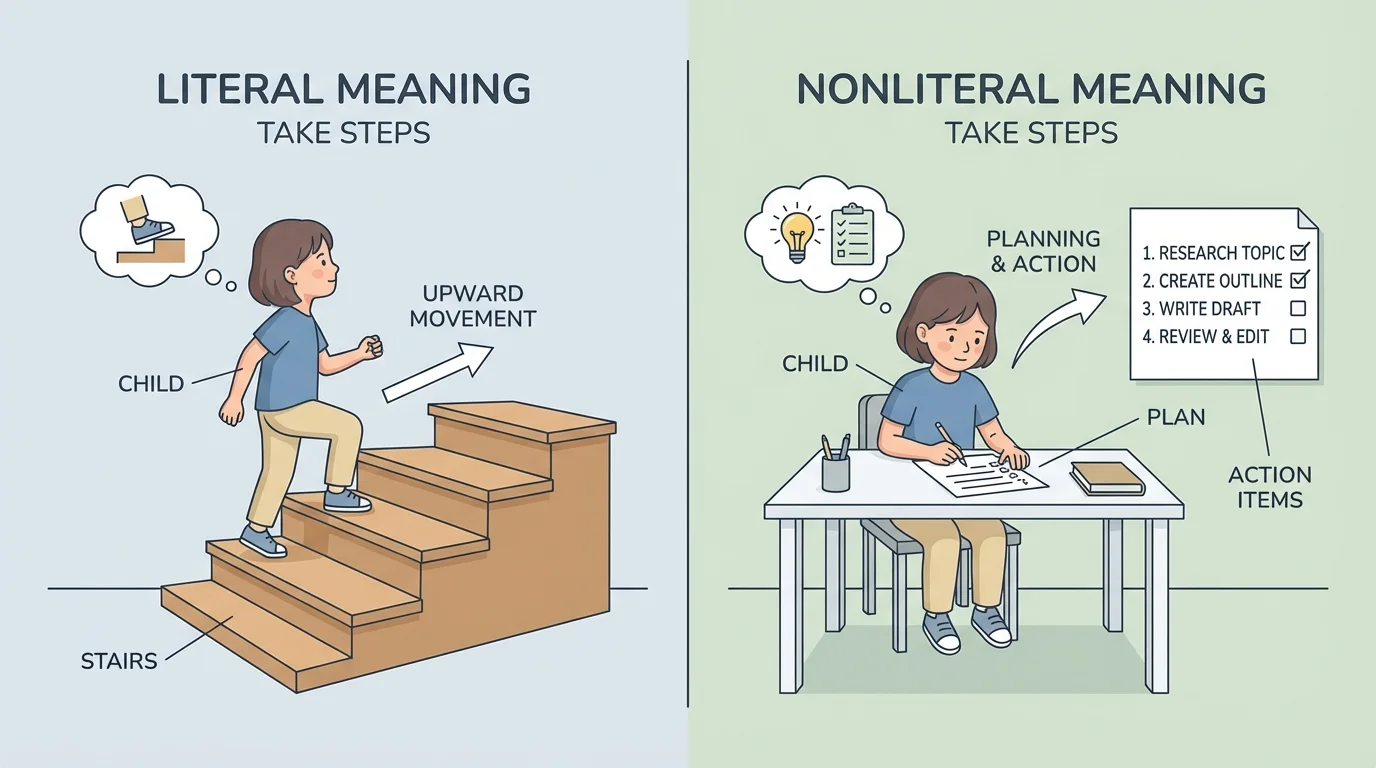
We can return to "take steps" later in reading, and [Figure 2] keeps the contrast clear: one side is physical movement, and the other side is making progress through actions. This is a useful reminder that phrases may work in more than one way.
Reading examples in context
Step 1: Read the sentence: "After talking with her teacher, Ana took steps to become a better speller."
The words "after talking with her teacher" and "become a better speller" suggest a goal or plan.
Step 2: Ask whether the exact meaning makes sense.
Is Ana simply walking somewhere? That does not match the idea of improving spelling.
Step 3: Decide the meaning.
"Took steps" means Ana did things to improve, such as practicing words.
This phrase is nonliteral in this sentence.
Now read this sentence: "Ana took steps across the stage to get her award." Here, the phrase means actual walking. The words "across the stage" tell you that the meaning is literal.
Authors do not choose nonliteral language by accident. They use it because it creates a stronger effect. A writer might say, "The classroom was a zoo," to show that the room was noisy and wild. That sounds more vivid than just saying, "The classroom was loud."
Nonliteral language can also help reveal a character's feelings. If a character says, "I have butterflies in my stomach," readers understand that the character feels nervous. The phrase gives a stronger picture than simply saying, "I am nervous."
Why nonliteral language matters
Nonliteral language helps writing sound lively and expressive. It can create humor, show emotion, paint a mental picture, and make a sentence more memorable. Readers who understand nonliteral language understand stories more deeply because they catch the author's full meaning.
In poems and stories, authors often want readers to feel something as well as understand something. Nonliteral language helps them do both.
Even in everyday speech, people use nonliteral expressions all the time. Someone might say, "I'm all ears," meaning "I am listening carefully." Nobody expects actual giant ears. The listener uses context to understand the real meaning.
Sometimes it is hard to tell whether a phrase is literal or nonliteral at first. That is normal. Some expressions can work both ways depending on the sentence.
For example, "cold feet" can mean actual cold feet if someone walks barefoot in snow. But "cold feet" can also mean feeling nervous about doing something important, like going on stage or trying something new.
A common mistake is deciding too quickly. Another mistake is thinking every unusual phrase must be nonliteral. Sometimes the exact meaning really is the correct one. Readers need to use all the clues.
Another comparison
Step 1: Read the sentence: "Before the race, Malik got cold feet."
The phrase appears near "before the race," which suggests feelings and nerves.
Step 2: Test the literal meaning.
Could it mean his feet were chilly? Maybe, but nothing else in the sentence points to temperature.
Step 3: Choose the best meaning from context.
Here, "cold feet" means Malik became nervous.
This phrase is nonliteral because the context points to emotion, not temperature.
Now compare that with: "After stepping in the stream, Malik had cold feet." In this sentence, the meaning is literal because the stream explains why his feet were actually cold.
This skill is especially important in stories. Characters often speak in expressions, jokes, and colorful phrases. If you understand those phrases, you understand the character better. When a character says, "That test was a piece of cake," you know the character thought the test was easy.
Informational texts usually use more literal language because they are meant to teach facts clearly. Still, even informational writing may include nonliteral phrases in titles, introductions, or examples. A book about recycling might say, "Small actions can snowball into big change." That does not mean real snow. It means one action can grow into something larger.
As you read, keep using context, just as we saw with sentence clues in [Figure 1]. Ask what kind of text you are reading and what meaning fits the topic best.
You can also think about the author's purpose. Is the author trying to explain clearly, tell a story, make you laugh, or create a strong picture in your mind? The purpose often helps you figure out whether language is literal or nonliteral.
"Good readers do not just read the words. They think about what the words mean in that exact place."
When you understand literal and nonliteral meanings, reading becomes richer. You catch jokes, understand characters, and notice how authors make language interesting and powerful.
