Have you ever looked at a picture in a story and understood something before you even read the next sentence? That happens because illustrations are not just decorations. In many stories, the pictures and the words work as a team. The words tell the story, and the pictures help show feelings, people, places, and important details in a powerful way.
When you read a story with illustrations, you are using two kinds of clues. The words tell you what is happening. The pictures help you see it. Sometimes the illustration matches the words exactly. Other times, it adds extra information that the words only hint at.
For example, a sentence might say, "Maya walked into the classroom." Those words tell the action. But a picture can show much more. Maya might be smiling proudly, clutching a project, while other students stare at her. Now the reader understands that this moment feels important. The illustration adds meaning to the words.
Strong readers pay attention to both parts. They ask, "What do the words say?" and "What does the picture show me?" When those two answers are put together, the story becomes clearer and richer.
Illustration is a picture that goes with a text. It helps readers understand ideas, characters, actions, feelings, or settings in the story. Mood is the feeling a story gives the reader, such as happy, spooky, calm, or exciting. Setting is where and when a story happens. Emphasize means to make something stand out as especially important.
Illustrations can also help readers who are still building reading strength. A picture may confirm what a sentence means. If the words say that a dog "crept" under a table, the picture may show the dog moving low and slowly with wide eyes. That helps the reader understand the action word more clearly.
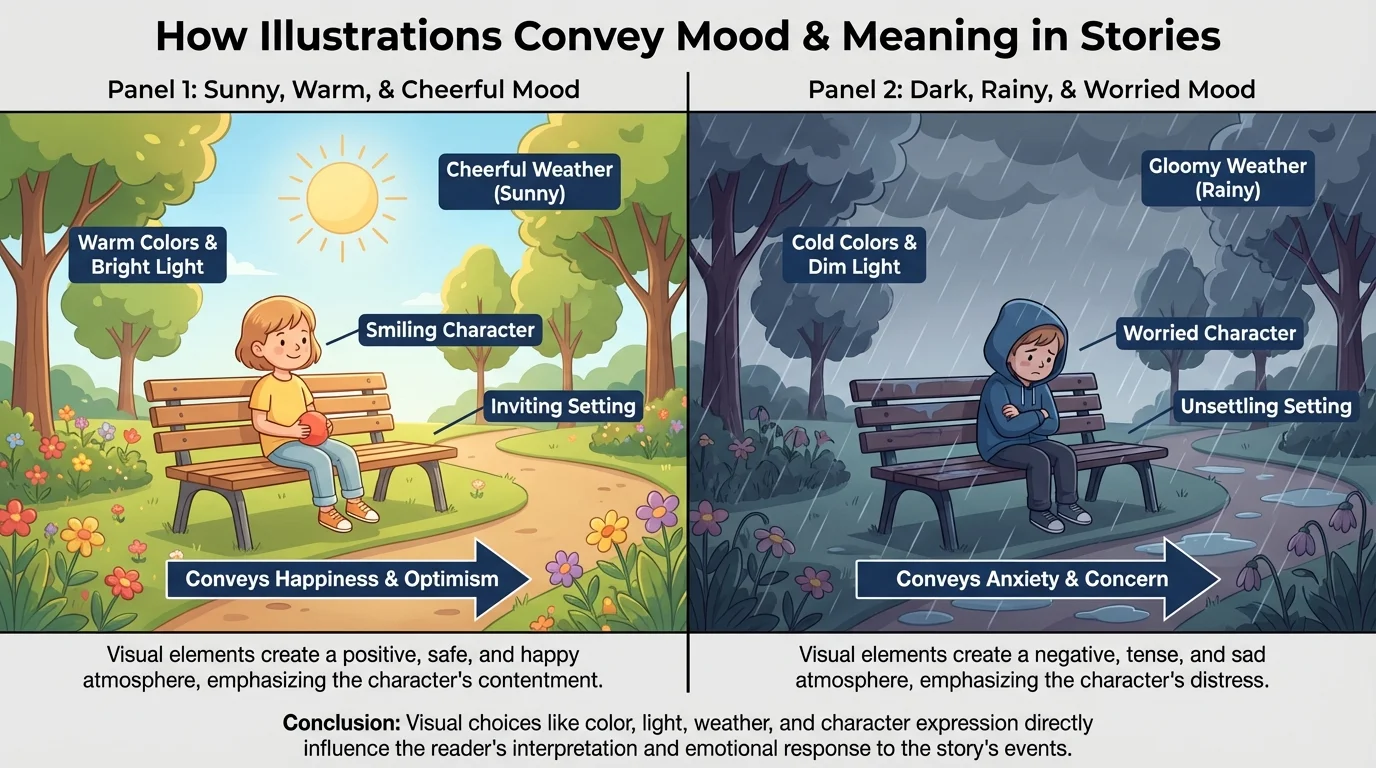
One important job of an illustration is to help create mood. Color, light, weather, and the way faces look can all affect how a story feels, as [Figure 1] shows with the same place drawn in two very different ways. A bright picture with sunshine, open space, and smiling characters often feels cheerful. A dark picture with shadows, rain, and worried faces may feel serious or scary.
Think about a story that says, "The children entered the old house." That sentence does not tell you exactly how to feel. But if the picture shows a crooked staircase, dusty windows, and dim gray light, the mood becomes spooky. If the same words are paired with a warm lamp, a friendly cat, and cozy furniture, the mood changes completely.
Artists often use colors on purpose. Warm colors like yellow, orange, and light red can make a scene feel lively or comfortable. Cool or dark colors like gray, navy, and dark green can make a scene feel quiet, lonely, or tense. The words and pictures together help readers know what kind of emotional world the story is building.
Facial expressions matter too. A character with wide eyes and a tight mouth may seem nervous even if the words do not directly say, "He was nervous." A character laughing with arms open gives the page a joyful feeling. Illustrators use these details to help readers feel the story, not just understand the events.
Later in a story, the mood may change. A story can begin with sunny pages and then turn darker when a problem appears. When readers notice that shift in the illustrations, they understand that the story is changing even before the words explain everything.
Many picture book artists choose colors very carefully because color can act almost like background music in a movie. Without saying a single word, color can make a page feel peaceful, exciting, or mysterious.
That is why readers should look closely at the sky, the shadows, the colors, and the faces in a scene. These details help answer the question, "How is this part of the story supposed to feel?"
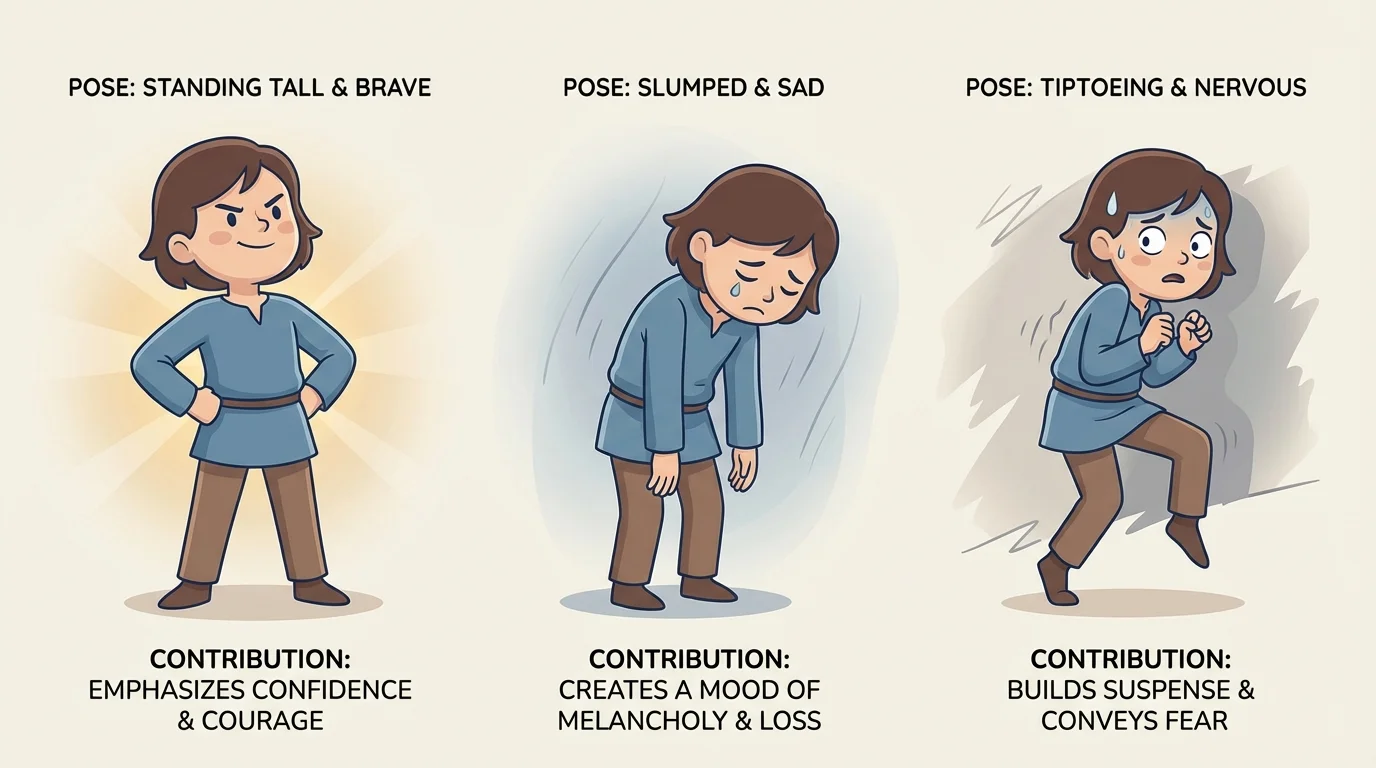
Illustrations also help readers understand characters. A character trait is something that tells what a character is like, such as brave, shy, kind, or impatient. Pictures can reveal those traits before the words say them, as [Figure 2] makes clear through posture and facial expression.
Suppose the story says, "Leo stepped forward." That does not tell much by itself. But if the picture shows Leo standing tall, chin up, with other children hiding behind him, the illustration emphasizes that Leo may be brave or confident. If the picture shows him biting his lip and looking back nervously, the same action feels very different.
Artists use body position, clothing, and expression to tell readers more. A neat backpack, polished shoes, and careful posture may suggest a character who likes order. Messy hair, a big grin, and knees covered in mud may suggest a playful character who loves adventure.
Illustrations can also show how characters feel toward one another. If two sisters are sitting close together and smiling, the picture suggests warmth and trust. If they are turned away from each other with crossed arms, the reader sees tension. The words may say only, "They sat at the table," but the illustration gives important clues about their relationship.
Sometimes an illustrator emphasizes one part of a character to make a point. A giant smile may show excitement. Extra-large boots may make a character look clumsy or funny. Wild hair may emphasize surprise. These choices help readers notice what matters most about the character in that moment.
Example: Understanding a character through illustration
Text: "Nina held the seed in her hand."
Step 1: Read the words carefully.
The words tell us that Nina has a seed. They do not tell us much about how she feels.
Step 2: Look at the illustration.
If Nina is smiling gently, cupping the seed carefully, and kneeling beside fresh soil, the illustration suggests that the seed matters to her.
Step 3: Put the clues together.
The reader can infer that Nina feels hopeful, caring, or excited about planting and growing something.
The picture adds feeling and importance to the simple sentence.
As the story goes on, changes in a character's appearance can show growth. A shy character might begin with hunched shoulders and lowered eyes, but later stand straighter and smile more. Readers can trace that change through the illustrations.
When you think about characters, ask yourself: "What does the picture show about this person that the words do not fully explain?" That question helps you read more deeply.
The setting of a story is not just a place name. It includes details about time, weather, season, and surroundings. Pictures help readers see where and when events happen, as [Figure 3] illustrates by changing the same street from one season and time of day to another.
A sentence might say, "Ben hurried home." The illustration may show whether "home" is in a busy city, a quiet farm, a snowy village, or a desert town. That changes how the reader understands the story world. A crowded city street gives a different feeling from a lonely country road.
Illustrations can also reveal time. A page with gas lamps and horse-drawn wagons suggests the story happens long ago. A page with buses, apartment buildings, and phones suggests a more modern time. Even if the text does not explain every detail, the picture gives important information.
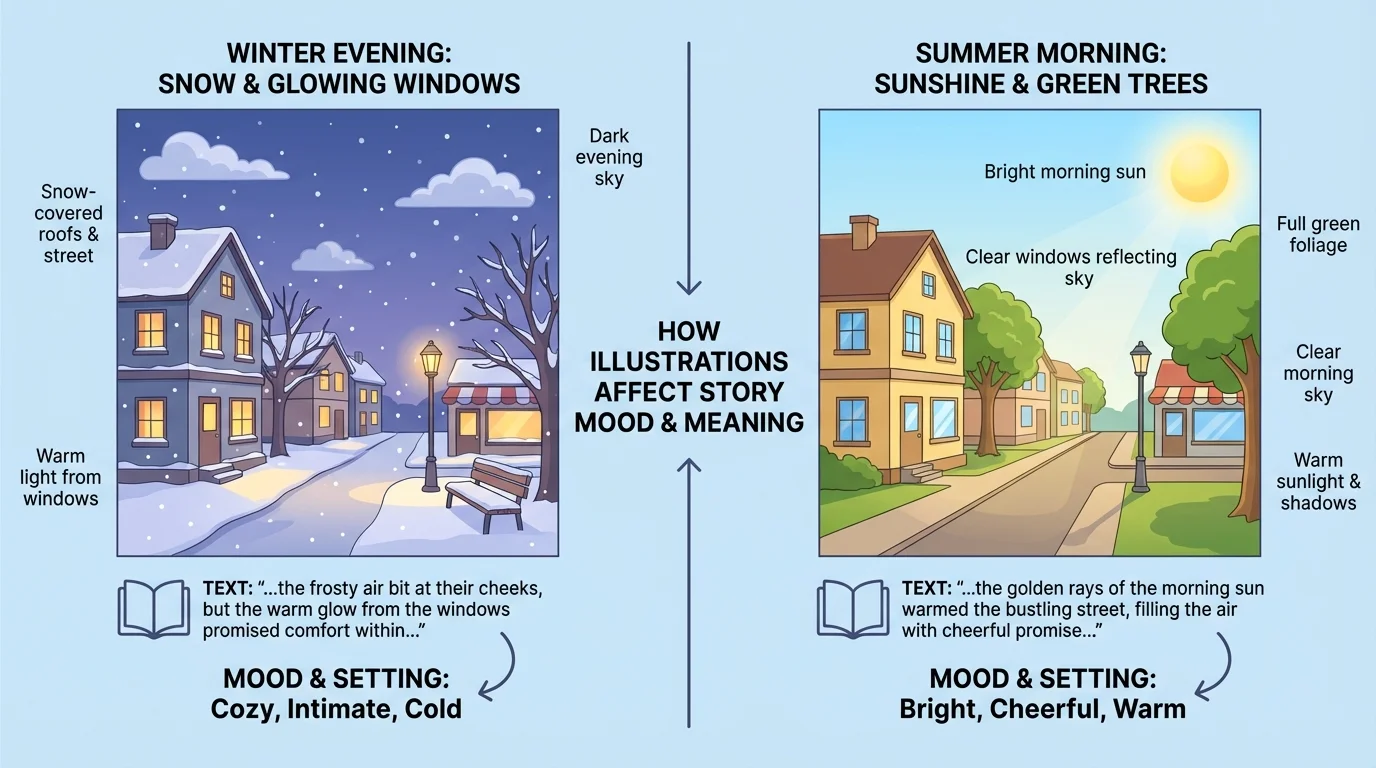
Season matters too. Falling leaves suggest autumn. Snow and bare trees suggest winter. Bright flowers and puddles may suggest spring. These details can help explain characters' actions. A child wearing boots and mittens will move through the story differently from a child in shorts and sandals.
Setting can affect the mood as well. A moonlit forest feels different from a sunny playground. This shows how illustrations can do more than one job at once. They can reveal setting and create mood together.
How setting and mood connect
Illustrations often blend place and feeling. A stormy sea may show both where the action happens and how tense the moment feels. A bright kitchen with warm light may show both the setting and a safe, loving mood. Readers learn more when they notice how these two ideas work together.
Later in the story, a return to the same setting can look different. A house that seemed dark and scary at the beginning may look warm and welcoming at the end. The place stayed the same, but the illustration changed how the reader feels about it.
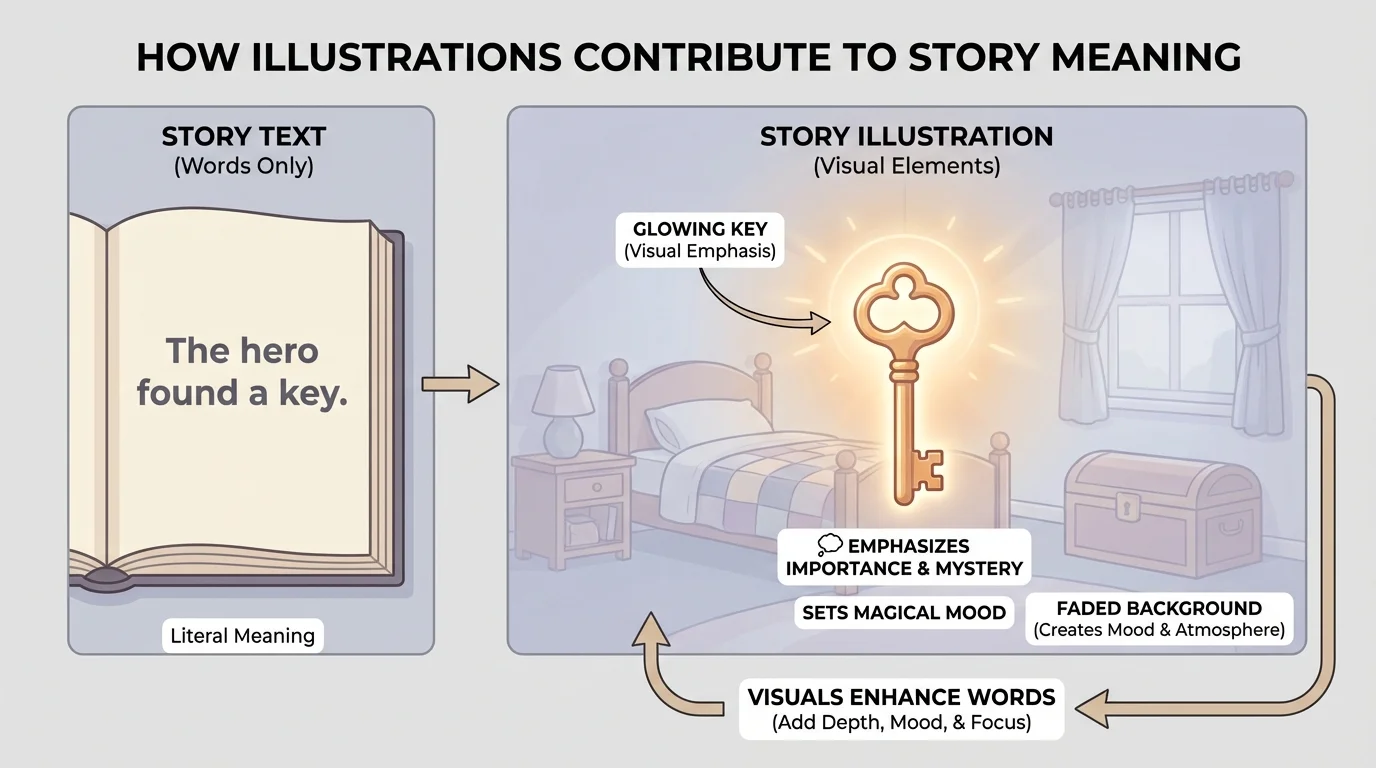
Sometimes an artist wants the reader to notice one detail right away. This is called emphasis. Illustrators guide the reader's eyes by making something bigger, brighter, closer, or more centered on the page, as [Figure 4] demonstrates with one object standing out from the rest.
If a story includes a key that will matter later, the key might appear larger than expected, shining in the center of the page. Even if the words mention it only once, the picture signals, "Pay attention to this." Readers learn that the object may be important.
Artists can emphasize action too. If everyone on the page is still except one running child, your eye goes to the movement. If one face is shown close-up while the background is small, that face becomes the most important part of the scene.
Repeated visual details can also emphasize meaning. A red scarf appearing again and again may help readers track one character. A small bird in the corner of several pages may become an important symbol in the story. These repeated images help tie the story together.
When readers notice emphasis, they understand what the illustrator thinks matters most. This supports comprehension because it points to important objects, feelings, or actions.
Think about a page where a tiny mouse is hidden in a large kitchen. If the mouse is bright white against dark cupboards, the artist emphasizes it even though it is small. Size is one way to emphasize, but contrast and placement matter too.
Sometimes the words tell only part of the story, and the picture adds new clues. This means readers must infer, or figure out something that is not directly stated. For example, the text might say, "Dad said he was fine." But if the picture shows drooping shoulders and a tired face, readers may infer that Dad is not really fine.
This is an important reading skill. Stories do not always explain every feeling in exact words. Readers gather clues from dialogue, actions, and illustrations. Then they put those clues together.
When you infer, you combine what the text says, what the picture shows, and what you already know. Good readers do this all the time, even when they do not realize it.
Pictures can also show things happening in the background. The words may focus on one child speaking, while the illustration shows another child dropping a lunch tray behind her. That background detail may set up a surprise on the next page.
In some books, illustrations even add humor. The words may be serious, but the picture may show a pet doing something silly in the corner. Readers who only listen to the words miss part of the story. Readers who study the picture catch the extra meaning.
We saw earlier in [Figure 2] that posture and expression tell us about feelings. The same kind of close looking helps readers notice hidden ideas throughout a story, especially when the words stay simple.
Readers can use a simple way of thinking when they study illustrations. First, notice what you see. Next, connect it to the words. Then, ask what extra meaning it adds. This helps you move beyond saying, "It is a nice picture," to saying, "This picture helps me understand the story better."
You might ask these questions while reading:
These questions help readers explain their thinking. Instead of giving a short answer like "The picture is sad," a stronger answer would be, "The illustration creates a sad mood because the colors are dark, the rain is falling, and the character is alone on the bench."
Example: Explaining how an illustration supports the text
Text: "The boat moved away from the shore."
Step 1: Identify what the words tell.
The words tell us that the boat is leaving.
Step 2: Identify what the picture adds.
If the illustration shows gray waves, a tiny boat, and a child on shore reaching out, the picture adds loneliness and worry.
Step 3: Explain the connection.
You could say, "The illustration adds to the words by creating a worried mood and emphasizing how far apart the child and boat are."
This kind of explanation shows real understanding.
As shown earlier in [Figure 1], even the same place can feel different depending on light and color. Strong readers use that kind of visual evidence when they talk or write about a story.
Two artists can illustrate the same sentence in different ways. That means illustrations are choices, and those choices affect meaning. A funny artist may draw round shapes, lively motion, and exaggerated faces. Another artist may use softer colors and realistic details. The words may stay the same, but the reader's experience changes.
For example, the sentence "The giant entered the village" can be illustrated as silly or frightening. A giant with a goofy grin and floppy hat may seem friendly. A giant with sharp shadows and towering boots may seem dangerous. The illustration guides the reader's reaction.
This is why it is important not to ignore pictures in a story. They are part of the author's and illustrator's message. They help shape tone, mood, and meaning.
"Sometimes a picture tells you what the words whisper."
Even small choices matter. A close-up view makes a moment feel bigger and more intense. A faraway view can make a character seem small, lonely, or lost. Looking up at a character can make that character seem powerful. Looking down at a character can make that character seem weak or young.
That is another reason illustrations deserve close attention. They are carefully made to help readers understand more than the printed words alone can say.
When you read a story, pause sometimes and look carefully at the illustration before racing ahead. Notice the colors, faces, background, and objects. Ask how those details support the sentence or page you just read.
For example, if a story introduces a new house and the illustration shows peeling paint, broken shutters, and weeds, the picture may prepare you for trouble or mystery. If the same house later appears bright and repaired, the illustration shows change in the story world. This connects to our earlier discussion of setting in [Figure 3], where the same location can feel very different depending on visual details.
If an object stands out sharply in the center, remember what we noticed in [Figure 4]: artists use emphasis to guide your attention. That clue can help you predict what might matter later.
Reading words and pictures together makes comprehension stronger. It helps you understand mood, character, setting, and important ideas in the story. That is what skilled readers do: they gather every clue the text gives them, including the visual ones.
