Have you ever finished one piece of writing in just a few minutes, but needed several days to finish another? That happens to real writers all the time. A quick answer in class and a full report about animals are both writing, but they do not need the same amount of time. Strong writers learn how to write in both ways: sometimes quickly, and sometimes slowly and carefully.
Writing is not only for language arts class. You write when you explain a science observation, answer a question about a story, describe a place in social studies, or tell how you solved a math problem. Good writers know that different jobs need different amounts of time, different kinds of planning, and different ways of sharing ideas.
Some writing happens in a shorter time frame. That means you may finish it in one sitting, in one class period, or in a day or two. This kind of writing helps you respond to a question, explain an idea, or record your thinking while it is fresh.
Other writing happens over an extended time frame. That means you work on it over several days or longer. You may need time to gather facts, think carefully, organize your ideas, improve your words, and check your work. Longer writing gives you more chances to make your writing stronger.
Both kinds of writing matter. Quick writing helps you practice often. Longer writing helps you dig deeper. When you do both, you grow as a writer.
Shorter time frame means writing that is completed in one sitting or in a day or two. Extended time frame means writing that takes longer because the writer may need time for research, reflection, revision, and editing.
Being able to do both is part of writing well. A strong writer does not always ask, "How long is this?" A strong writer asks, "What kind of writing is this, and what does it need?"
To write routinely means to write regularly, not just once in a while. Writers improve by practicing often. Just like athletes build skills by training again and again, writers build skill by writing again and again.
Routine writing can happen every day or every week. It might be a reading response on Monday, a science notebook entry on Tuesday, and a longer personal narrative over several days. Writing often helps students become more comfortable putting ideas into words.
Routine writing also teaches flexibility. One day you may write a quick opinion paragraph. Another day you may work on a report and revise it. The more kinds of writing you try, the more prepared you are for new tasks.
Professional authors, scientists, reporters, and teachers rarely write just one draft. Many of them write a little at a time, come back to it later, and improve it again and again.
Writing routinely does not mean every piece must be long. It means you keep using writing as a tool for thinking, learning, and communicating.
Good writing usually follows a recursive process, which means writers can move back and forth between steps, as [Figure 1] shows. Writers do not always finish one step forever before starting the next. Sometimes they plan, draft, revise, then go back to planning again.
The main parts of the writing process are planning, drafting, revising, and editing. These steps help writing become clearer and stronger. They are useful in both short and long assignments, even though longer pieces usually need more time in each step.
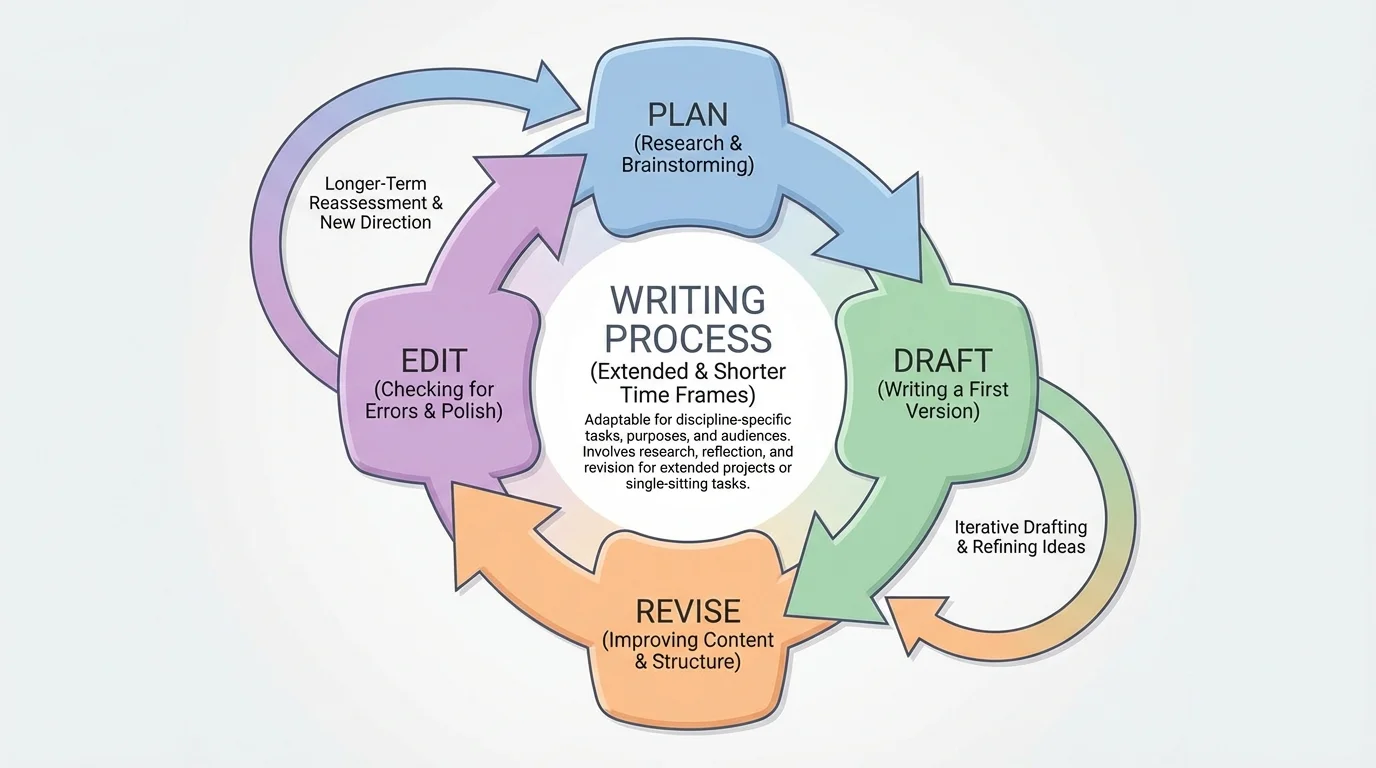
During drafting, a writer gets ideas down on paper or on a screen. A draft does not need to be perfect. It is a beginning version. The writer focuses on the main ideas first.
During revising, the writer improves the writing. Revising is more than fixing tiny mistakes. It can mean adding details, moving sentences, choosing better words, or making ideas easier to understand. Revising changes the message so it works better.
During editing, the writer checks for conventions such as grammar, capitalization, punctuation, and spelling. Editing helps the reader understand the writing without confusion.
Why the writing process loops
A writer may notice during editing that a sentence is unclear and decide to revise it. While revising, the writer may think of a better idea and return to planning. That is why writing is called recursive: the steps connect and often repeat.
When you understand this process, mistakes no longer feel like failure. They become part of how writing grows. As we saw in [Figure 1], strong writing is built step by step, and writers often circle back to improve their work.
Short writing asks you to think and respond clearly without spending many days on one piece. You may write a sentence, a paragraph, or a short response. This kind of writing is useful when a teacher wants to see what you know right now.
Examples of writing in a shorter time frame include answering a question after reading, writing a science observation, explaining classroom rules, making a journal entry, or writing a thank-you note. These tasks are often finished in one sitting.
Even quick writing still uses the writing process. You may plan in your head, write a draft, reread once, and fix a few errors. The steps happen faster, but they still matter.
Example of shorter-time writing
A class reads a story and the teacher asks, "Why did the main character change by the end?"
Step 1: Think before writing.
The writer remembers the beginning, middle, and end of the story.
Step 2: Draft a short response.
The writer answers the question with a clear reason and one detail from the story.
Step 3: Reread and edit.
The writer checks that every sentence makes sense and fixes capitals, punctuation, and spelling.
This piece is short, but it is still careful writing.
Short writing helps build speed, confidence, and clear thinking. It teaches you to organize ideas quickly and say what matters most.
Extended-time writing gives you time to explore a topic more deeply. You may gather facts, sort ideas, ask questions, and improve your work over several days. This kind of writing is common when the topic is important or has many parts.
In an extended project, research may come first. Research means finding information from books, articles, trusted websites, observations, or interviews. After research, a writer takes time to think about what the information means and which details matter most.
Another important part of longer writing is reflection. Reflection means stopping to think carefully. A writer may ask, "Does this part make sense?" "What did I learn?" or "What else should I explain?" Reflection helps writing become thoughtful, not rushed.
Then the writer revises and edits. Longer assignments often need more than one revision because there is more writing to improve. Writers may add facts, rewrite introductions, combine short sentences, or remove parts that do not fit.
Example of extended-time writing
A student writes an informational report about frogs over several days.
Step 1: Gather information.
The student reads books and notes facts about habitats, food, life cycle, and predators.
Step 2: Plan the report.
The student groups facts into sections and decides the order.
Step 3: Write the draft.
The student writes each section using complete sentences and details.
Step 4: Revise.
The student adds stronger facts, removes repeated ideas, and makes the report easier to follow.
Step 5: Edit.
The student checks capitalization, punctuation, grammar, and spelling before sharing the final copy.
This writing takes longer because the topic needs more information and more careful shaping.
Extended writing teaches patience. It also teaches that good work often grows through many small improvements.
Writers make choices based on the task, the purpose, and the audience, as [Figure 2] explains. The task is what you have been asked to do. The purpose is why you are writing. The audience is who will read it.
If your task is to explain how to care for a class plant, your writing should be clear and organized. If your purpose is to persuade the principal to add more recess equipment, your writing should include reasons. If your audience is younger students, your words should be simple and easy to follow.
The same topic can sound very different for different audiences. A note to a friend about a lost kitten might sound warm and personal. A report for a teacher about kittens would sound more formal and detailed. A sign for the hallway would be short and direct.
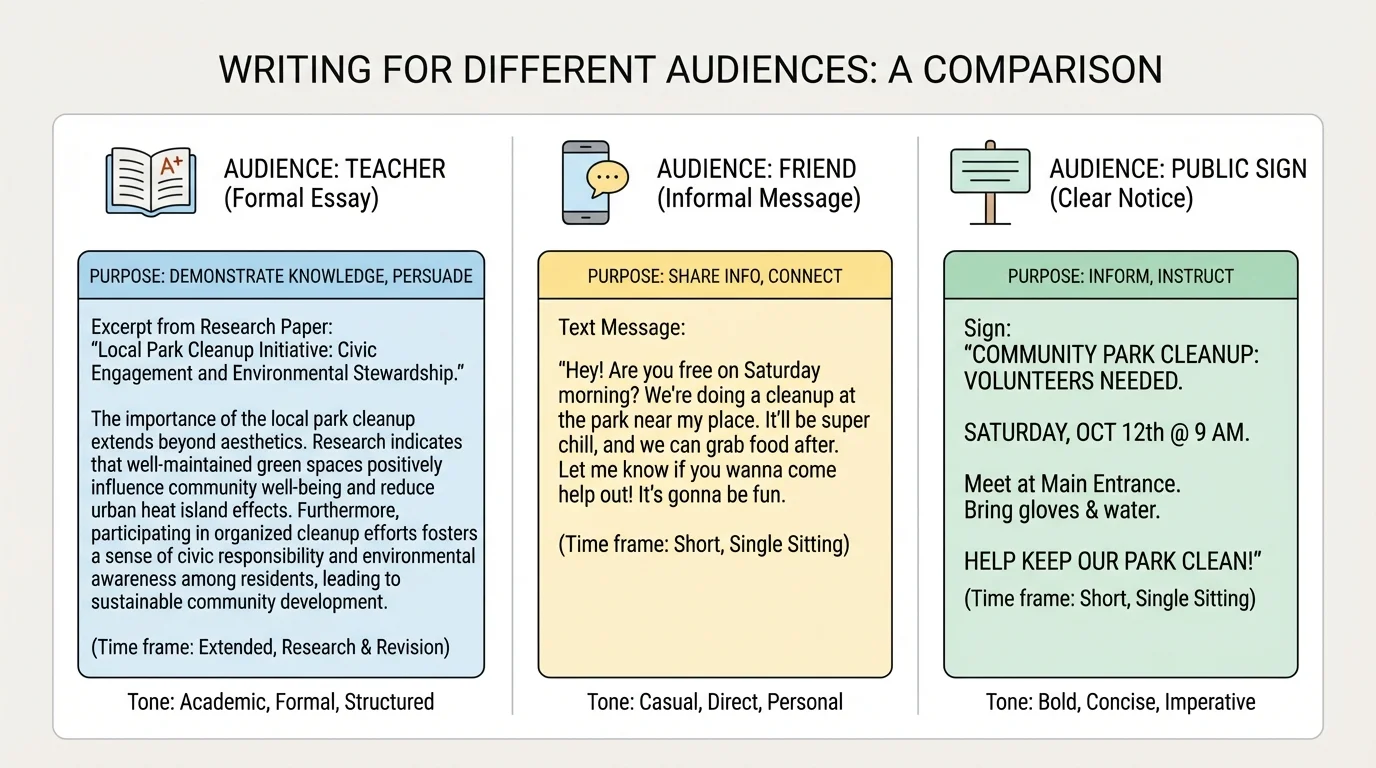
Thinking about audience helps you choose the right words. Thinking about purpose helps you decide what details to include. Thinking about task helps you stay on topic.
Later, when you revise, you can ask important questions: "Did I do the task?" "Does my writing fit my purpose?" "Will my audience understand me?" The comparisons in [Figure 2] remind us that writers do not use the exact same style every time.
| Writing situation | Purpose | Audience | How the writing may sound |
|---|---|---|---|
| Answering a reading question | Explain thinking | Teacher | Clear and focused |
| Writing a thank-you note | Show appreciation | One person | Friendly and kind |
| Making a poster about recycling | Teach others | Classmates or school | Short, direct, informative |
| Writing an animal report | Inform | Teacher and classmates | Organized and detailed |
Table 1. Examples of how purpose and audience affect the way writing sounds.
Every subject uses writing in a special way, and [Figure 3] highlights how students may write differently in science, social studies, reading, and math. This is called discipline-specific writing because each discipline, or subject area, has its own kinds of tasks.
In science, students may write observations, record results, explain what they notice, and describe steps in an investigation. Science writing often uses facts and careful details. For example, a student might write, "The seedling in sunlight grew taller than the seedling in shade."
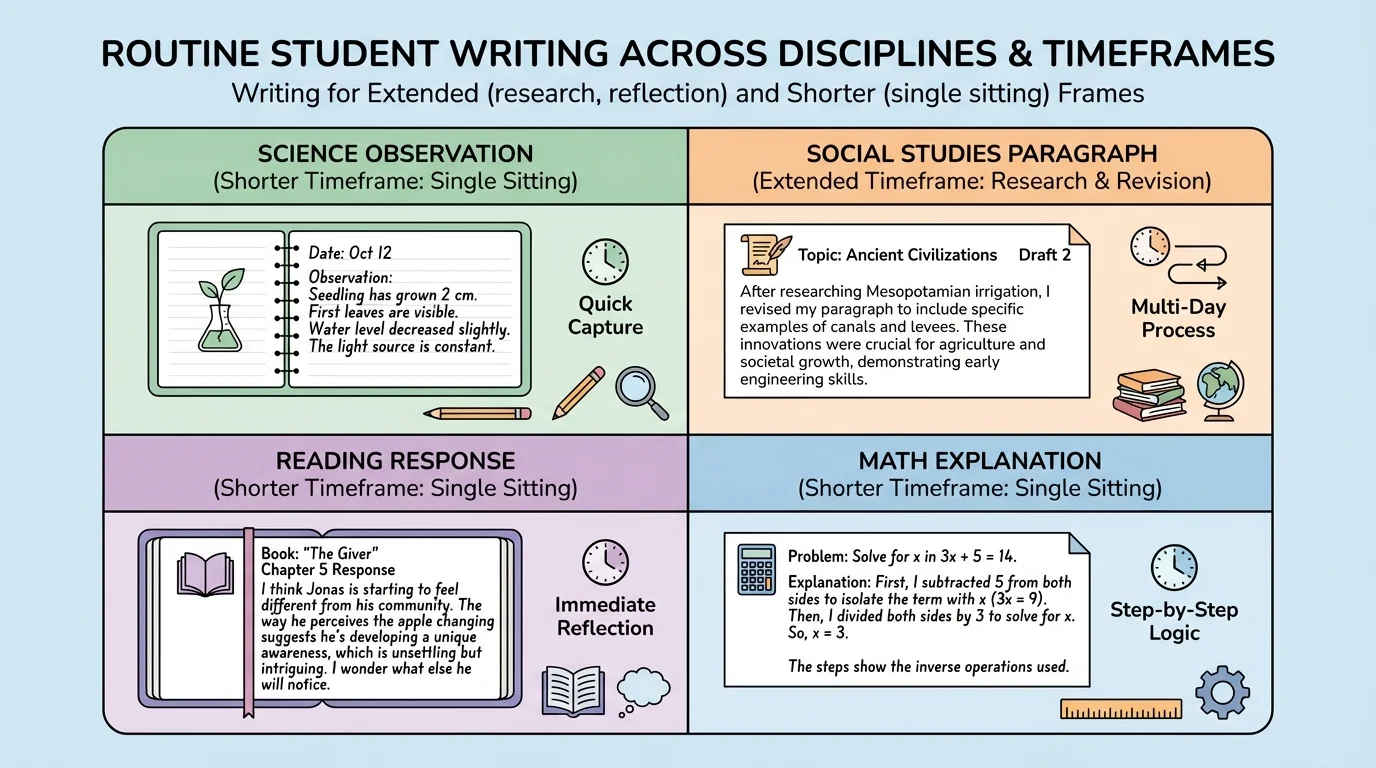
In social studies, students may write about communities, maps, important people, or events from the past. The writing may explain what happened, where it happened, and why it mattered.
In reading or literature, students may write about characters, setting, plot, theme, or favorite parts of a book. They might answer questions with evidence from the story.
In math, students may explain how they solved a problem. Even when the numbers matter, words matter too. A student might write, "First I added the tens, then I added the ones." That explanation helps others follow the thinking.
You already know that complete sentences, clear ideas, and correct punctuation are important in language arts. Those same skills help in every subject, even when the topic changes.
Discipline-specific writing helps you learn the subject better. When you explain a science result or a reading idea in writing, you organize your thinking. The examples in [Figure 3] show that strong writing is a learning tool in every class.
Writing becomes easier to read when you use the conventions of written language. Conventions include grammar, capitalization, punctuation, and spelling. These rules help your reader understand your meaning.
Grammar helps words fit together in sensible sentences. Capitalization helps show the beginning of sentences and proper names. Punctuation helps readers know when to pause, stop, ask, or show excitement. Spelling helps readers recognize words quickly.
Conventions matter in both short and long writing. In a quick response, they help your teacher understand your idea right away. In a longer report, they make your writing look polished and trustworthy.
From unclear to clear
Here is a sentence before editing: my class planted beans they grew fast
Step 1: Add capitalization.
My class planted beans they grew fast
Step 2: Add punctuation.
My class planted beans. They grew fast.
Step 3: Check if more detail is needed.
My class planted beans. They grew fast in the sunny window.
The final version is much easier to understand.
Editing does not mean making writing fancy. It means making writing correct and clear enough for your reader to follow easily.
Strong writers develop habits that help them in both short and extended time frames. One habit is starting with a plan, even a simple one. Another habit is rereading after writing. A third habit is being willing to improve a draft instead of keeping the first version forever.
Writers also learn to use feedback. A teacher, classmate, or family member may point out a part that is confusing. Listening to feedback can help the writer revise in useful ways.
Another smart habit is setting a goal. A writer might say, "Today I will finish my first draft," or "Today I will fix punctuation and spelling." Small goals make large assignments feel manageable.
"Good writing gets better when writers go back and make it clearer."
Over time, writing routinely helps these habits become natural. You begin to know when a quick response needs only a short reread and when a longer project needs deeper revision.
Whether you are writing for one class period or several days, the most important idea stays the same: think carefully, write clearly, and improve your work so your reader can understand it.
