Have you ever written a note to a friend, directions for a game, or a story about something exciting that happened? Those pieces of writing may all use words and sentences, but they are not built the same way. A story should sound different from directions. A letter should sound different from a report. Good writers learn that writing has a purpose, and the way they write should match that purpose.
When you write with guidance and support from adults, you learn how to make your writing fit the task and purpose. That means your writing should make sense for what you are trying to do. If you want to tell a story, you need events in order. If you want to teach, you need facts and clear explanations. If you want to share an opinion, you need reasons. Adults such as teachers, parents, or caregivers can help you think, plan, reread, and improve your work.
Before writing, it helps to stop and think. Good writers ask questions like these: What am I writing? Why am I writing it? Who will read it? These questions help a writer understand the task, the purpose, and the audience.
The task is the kind of writing you are doing. You might be writing a story, a paragraph that teaches facts, a response to a book, a thank-you note, or directions for a class project. The purpose is the reason for writing. You may want to entertain, explain, describe, persuade, or inform.
Task means the kind of writing you are asked to do. Purpose means the reason you are writing. Audience means the people who will read or hear your writing.
An adult can help you think about these questions before you begin. For example, if the class is writing about animals, a teacher might ask, "Are you writing a factual paragraph or a fictional story about an animal?" That question helps you choose the right kind of writing. A parent might say, "Who will read this card?" That reminder helps you choose words that match your reader.
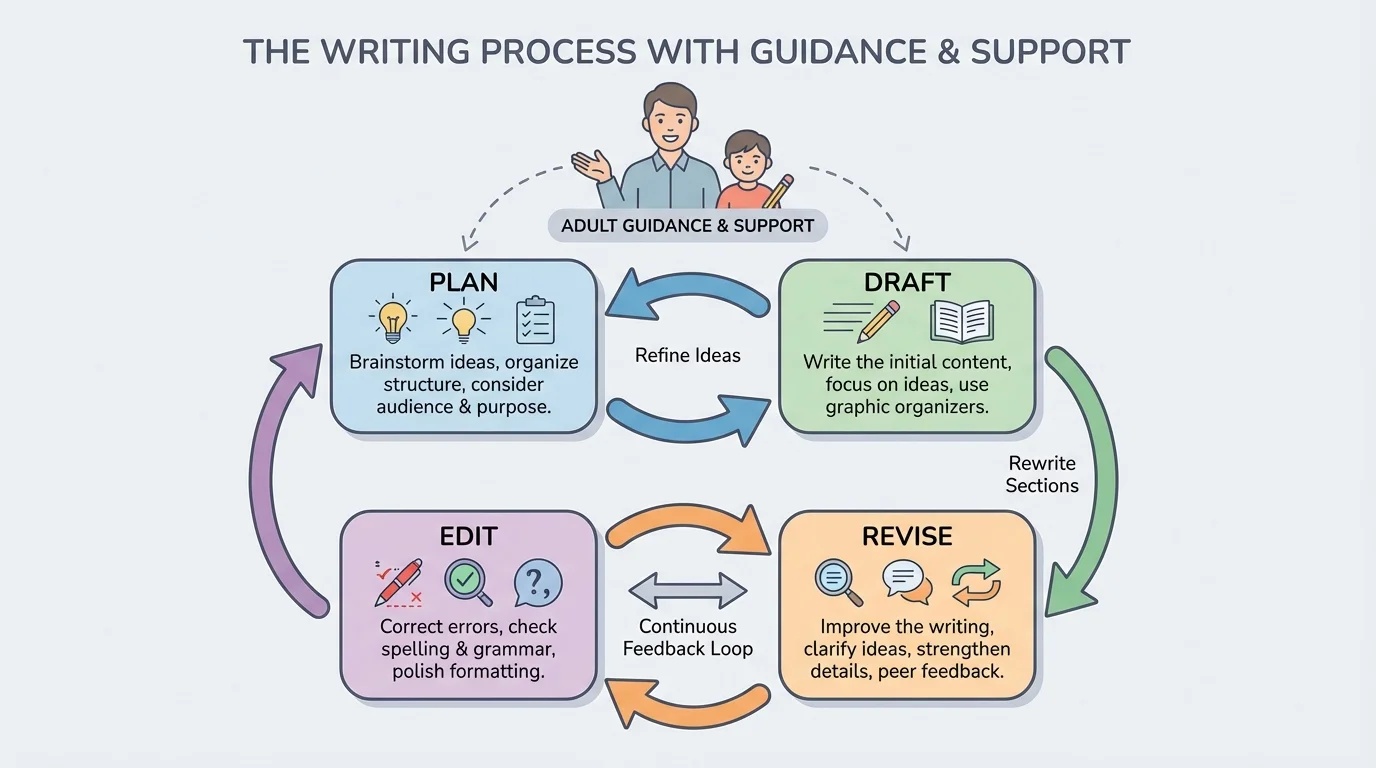
Writing does not always move in a straight line. Writers often plan, write, change ideas, add more, and fix mistakes, as [Figure 1] shows. This kind of back-and-forth way of working is called a recursive process.
You might start with a plan, write a draft, and then notice that a detail is missing. Then you go back and add it. You might edit a sentence and realize you need a better beginning. Then you return to an earlier step. That is normal. Strong writers do not expect the first version to be perfect.
How the writing process works
Writers usually move through four big parts: plan, draft, revise, and edit. But they may return to any part when needed. Planning helps gather ideas. Drafting gets the ideas onto the page. Revising improves meaning and organization. Editing fixes mistakes in language conventions.
During planning, you collect ideas. You may talk with an adult, make a list, draw a web, or use a simple organizer. During drafting, you write your ideas in sentences and paragraphs. During revising, you make your writing clearer and stronger. During editing, you correct mistakes in grammar, capitalization, punctuation, and spelling.
Adult support matters at every step. A teacher may help you narrow a topic. A parent may listen while you read your writing aloud. An adult may ask, "Does this part belong here?" or "Can you tell more about this?" These questions help you grow as a writer.
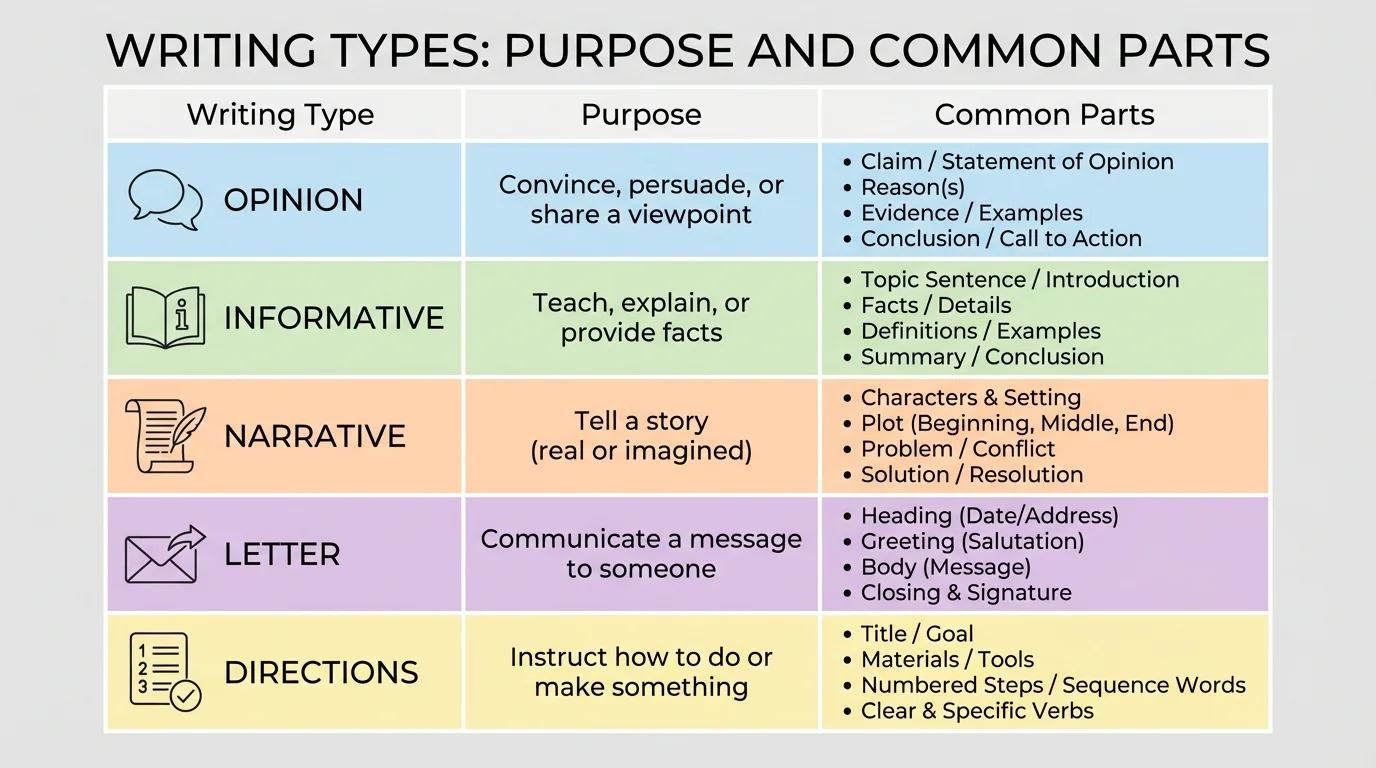
Different kinds of writing have different jobs, and [Figure 2] makes that easy to compare. If you use the same style for every task, your writing may not do its job well.
Suppose you are writing an opinion paragraph about longer recess. You should clearly state what you think and give reasons. If you are writing an informative paragraph about frogs, you should include facts and important details. If you are writing a narrative, you should tell events in order and describe what happens.
Here are some common writing tasks in grade 3:
| Type of writing | Main purpose | What it often includes |
|---|---|---|
| Opinion | Tell what you think | An opinion and reasons |
| Informative | Teach or explain | Facts, definitions, examples |
| Narrative | Tell a story | Characters, setting, events |
| Letter or note | Communicate with someone | Greeting, message, closing |
| Directions | Tell how to do something | Steps in order |
Table 1. Common types of writing and the purpose of each one.
A writer must choose what belongs in the piece. For example, a story about a lost puppy might include dialogue and feelings. Directions for planting seeds should not sound like a story. They should have steps in order, such as first, next, then, and last.
Adults can guide you by helping you notice the job of the writing. If a student starts an informative piece with made-up story events, a teacher can help the student decide whether to turn it into a narrative or return to true facts. That support helps keep the writing matched to its purpose.
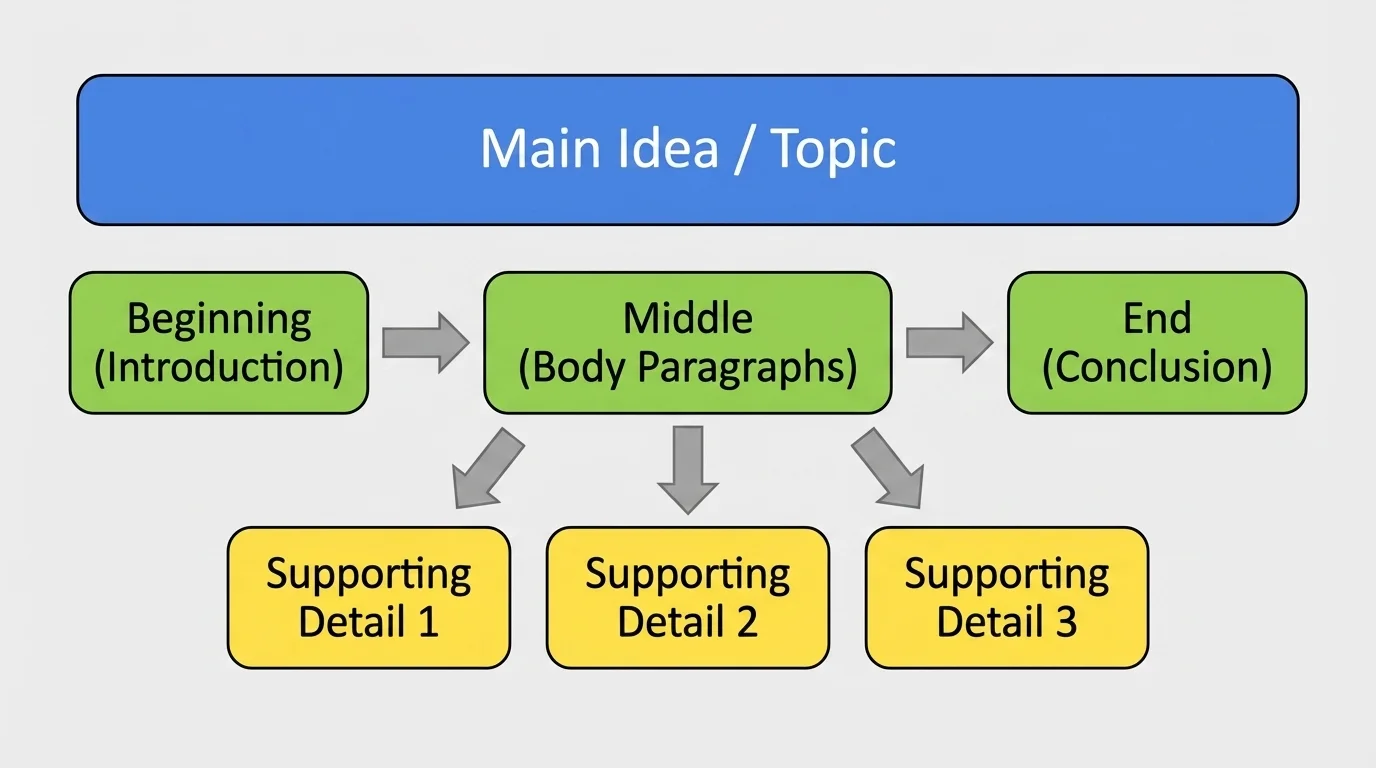
Even good ideas can become confusing if they are not placed in a clear order. Writers use organization to arrange ideas so the reader can follow them, and [Figure 3] shows a simple way to group ideas into parts.
Many pieces of writing have a beginning, middle, and end. In an informative paragraph, the beginning may tell the topic, the middle may explain details, and the end may wrap up the idea. In a narrative, the beginning introduces the characters and setting, the middle tells the events, and the end explains what happened last.
One helpful tool is an organizer. You might write the main idea at the top and details underneath. You might put story events in order. You might use boxes labeled beginning, middle, and end. Planning this way helps your draft stay focused.
Example: organizing an informative paragraph
Topic: Why bees are important
Step 1: Write the main idea.
Bees are important because they help plants grow.
Step 2: Add supporting details.
Bees move pollen from flower to flower. Many fruits and vegetables grow because of pollination. Farmers and gardens depend on bees.
Step 3: Add an ending.
That is why bees are helpful to people and nature.
This organization helps the reader understand the paragraph from start to finish.
Transitions also help organization. Words such as first, next, later, because, and finally connect ideas. They show order and relationships between parts. In stories, transitions can show time. In explanations, they can show cause and effect.
A strong piece of writing does more than name a topic. It gives enough information for the reader to understand. This is called development. Development means growing your writing by adding useful details.
If your sentence says, "My trip was fun," the reader learns very little. But if you write, "My trip to the lake was fun because I caught my first fish, skipped rocks, and ate lunch under a shady tree," your writing is more developed. The details help the reader picture the experience.
The kind of details you add depends on your purpose. In informative writing, add facts, examples, and explanations. In opinion writing, add reasons. In narrative writing, add actions, thoughts, feelings, and descriptions.
Many writers say the most interesting part of writing is not the first draft. It is the moment when a plain sentence becomes vivid because the writer adds just the right detail.
Adults can support development by asking questions that open your thinking. They may ask, "Can you tell more?" "What happened next?" "Why is that true?" or "What does it look like?" These questions do not do the writing for you. They help you discover what your reader still needs to know.
Revising means changing your writing to make the ideas stronger. It is not the same as fixing small mistakes. When you revise, you may add details, remove extra parts, move sentences, or rewrite confusing sections.
Reading your work aloud is one of the best ways to revise. When you hear your own writing, you may notice missing words, repeated ideas, or places where the writing jumps too fast. An adult listener can help by stopping and saying, "I am confused here," or "This part is really clear."
Suppose you wrote this beginning for a story: "I went outside. It was cool. Then something happened." An adult might ask what happened and why it mattered. After revising, the beginning might become: "I stepped outside into the cool morning air and heard a strange scratching sound under the porch." The second version gives the reader a reason to keep reading.
Writers also revise organization. Earlier, [Figure 1] shows that writers often return to drafting and planning while revising. You might notice that your best detail belongs near the beginning instead of the end, or that two sentences should switch places. That kind of change helps the whole piece work better.
After revising, writers edit. Editing means checking the writing rules that help readers understand your message clearly.
Grammar helps sentences sound correct and complete. A sentence needs a complete thought. For example, "The dog barked loudly" is complete, but "Because the dog barked" is not complete by itself. Grammar also includes correct verb tense and making words agree, such as "She runs" instead of "She run."
Capitalization means using capital letters in the right places. Capitalize the first word of a sentence, the word I, names of people, days of the week, months, and places. For example: "Maria went to Denver on Tuesday."
Punctuation helps readers know where to pause and how to understand a sentence. Use a period at the end of a statement, a question mark at the end of a question, and an exclamation mark for strong feeling. Commas can separate items in a list, and quotation marks show exact spoken words in dialogue.
Spelling matters because misspelled words can confuse the reader. Writers use what they know about letter patterns, word parts, and memory words to spell. Adults can help by encouraging you to reread slowly, use classroom word walls, or check a dictionary when needed.
When you revise, you improve the meaning. When you edit, you fix the writing rules. Good writers usually revise first and edit after.
Editing does not mean your writing must be perfect the first time. It means you carefully check your work. If an adult points out a missing capital letter or punctuation mark, that support helps you learn what to watch for next time.
Adult guidance is not a shortcut. It is a way to help you become a stronger writer. A teacher might model how to brainstorm. A parent might ask you to explain your idea before you write. An adult might help you notice that your paragraph needs a clearer ending. With practice, you begin to ask yourself these same questions.
For example, before writing, you may learn to ask, "What is my job as a writer?" During drafting, you may ask, "Do my ideas stay on topic?" During revising, you may ask, "Do I need more details?" During editing, you may ask, "Did I use capitals and punctuation correctly?" Support from adults helps build these habits.
Different tasks call for different choices. As [Figure 2] shows, writing a story is not the same as writing directions or facts. And as [Figure 3] illustrates, clear organization helps the reader move through your ideas in order. When you combine the right purpose, strong organization, clear development, and careful editing, your writing becomes more powerful.
Writing is a skill that grows over time. Each time you plan, draft, revise, and edit with support, you learn more about how to shape your words for a real reason. That is what writers do: they think about their job, make choices that fit that job, and keep improving their work until it says what they truly mean.
