People ask questions every day. Why do leaves change color? How do bees help flowers? What makes a bridge strong? A short research project helps us turn those questions into real learning. Instead of guessing, we look for facts, think carefully, and share what we discover. That is what researchers do, and students can do it too.
A short research project is a small study about one topic or question. It does not take months or years. It might take one class period, a few days, or a week. The goal is to learn more about something by gathering information, understanding it, and communicating it to others.
Research is more than just finding one fact. It means looking closely at a topic, asking questions, reading or listening carefully, and deciding which information matters most. A strong project helps you build knowledge step by step. By the end, you know more than you did at the beginning, and you can explain what you learned.
For third-grade students, a short research project may be about animals, weather, community helpers, inventions, plants, space, or an important place. The topic should be small enough to explore in a short time but big enough to teach several facts.
Research is the process of finding and learning information about a topic or question. Information includes facts, details, examples, and explanations. A source is where the information comes from, such as a book, website, article, video, or person.
When you research, you are not only collecting facts. You are also making sense of them. That means thinking about what the facts show, how ideas connect, and which details are most important.
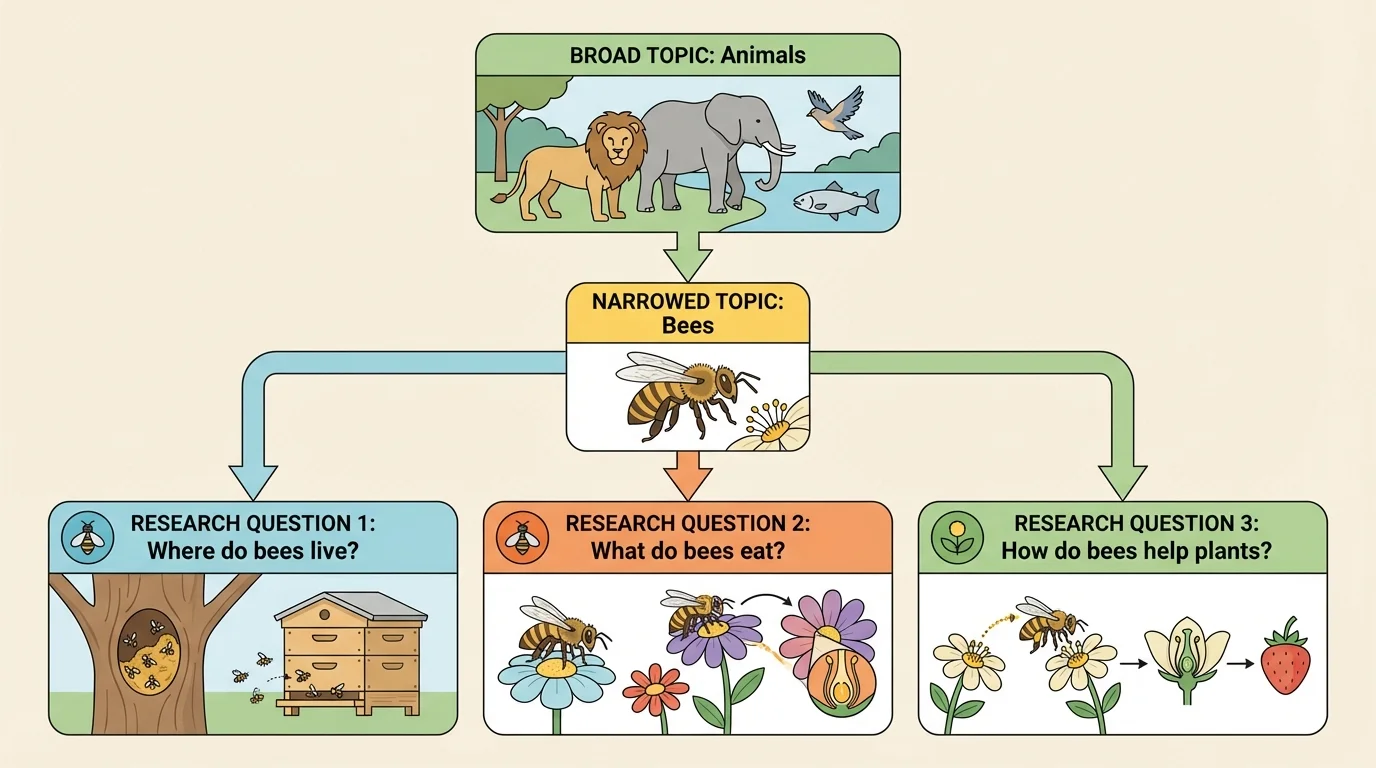
A good project begins with a topic that is not too big. Researchers often start broad and then narrow the idea, as [Figure 1] shows. For example, animals is a very broad topic. bees is smaller. A question such as How do bees help plants grow? is even more focused.
Good research questions are clear and answerable. They help guide your reading and note-taking. A question like Tell me everything about bees is too wide. A better set of questions might be: Where do bees live? What do bees eat? How do bees help flowers and crops?
Sometimes one topic can lead to several smaller questions. That is helpful because it gives your project parts. Instead of one giant pile of facts, you have groups of ideas to explore. This makes your work easier to understand and easier to share.
Choosing a strong topic also means choosing something important or interesting. You may want to learn about something in nature, in your community, or in history. Interest matters because curious researchers pay closer attention and ask better questions.
Some scientists begin with very simple questions that lead to important discoveries. A small question can open the door to a big idea.
When you ask questions before reading, your brain has a job to do. You are reading to find answers, not just staring at words. That makes research active instead of passive.
After choosing a topic, it helps to make a simple plan. A plan keeps the project organized. You can think about three things: what you want to learn, where you will look, and how you will keep track of your facts.
A simple plan may sound like this: "I want to learn how bees help plants. I will use a book about insects, a children's science website, and notes from a classroom video. I will write facts under headings such as food, pollination, and hive life." This kind of plan gives direction.
Planning also helps you avoid getting lost in too much information. Sometimes a source includes many interesting details that are not needed for your question. A plan reminds you to stay focused.
Big topic to focused question
Research works best when the topic becomes more specific. A broad idea like weather can be narrowed to thunderstorms, and then to a question such as How do thunderstorms form? This helps the researcher gather facts that fit together instead of collecting random details.
Researchers often return to their plan as they work. If a question is too hard, they may make it simpler. If the topic feels too small, they may add one more related question.
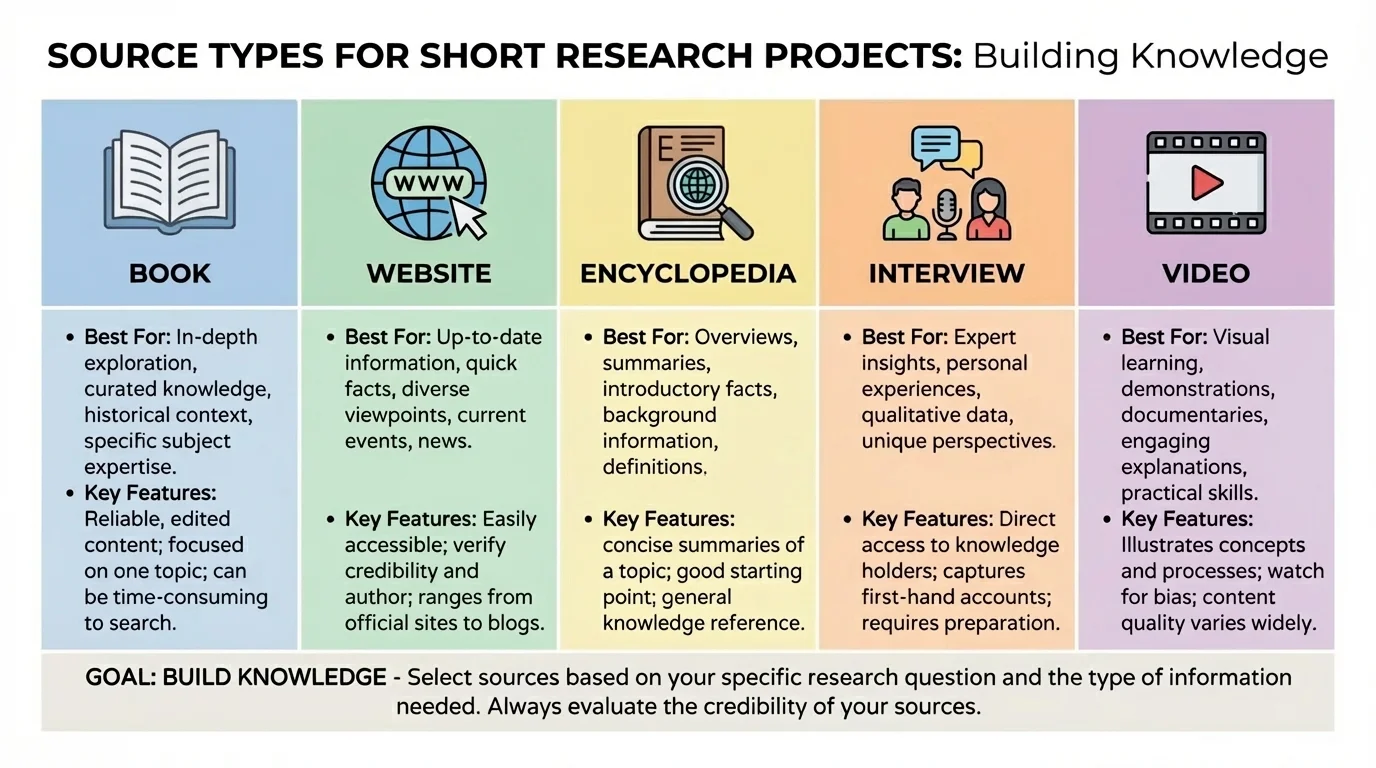
Researchers gather information from more than one source, and different sources can help in different ways, as [Figure 2] explains. A book may give detailed facts. A website may show updated information. A video may help you understand a process. An interview can give ideas from a real person with knowledge.
It is important to use sources that are safe, clear, and connected to the topic. Teachers, librarians, and trusted adults can help students choose websites and books. Good sources usually stay focused on the topic, use clear facts, and avoid confusing or silly information.
Researchers also use keywords. Keywords are important words you type into a search tool or look up in an index. For a project about bees, useful keywords might be bees, pollination, hive, and flowers. Better keywords help you find better information.
Using more than one source matters because one source may give only part of the answer. Another source may add a new fact or explain an idea more clearly. When two sources share the same fact, that can make the information seem stronger and more trustworthy.
You should also pay attention to whether a source gives facts or opinions. A fact is something that can be checked. For example, "Bees collect nectar" is a fact. An opinion is what someone thinks or feels, such as "Bees are the most interesting insects." Opinions can be meaningful, but research projects usually need facts to answer questions.
As young researchers grow, they learn that not every website or video is equally helpful. A trusted children's encyclopedia is usually more reliable than a random post online. That is why careful source choice is part of good research.
| Source Type | How It Helps | Example Use |
|---|---|---|
| Book | Gives detailed information | Learn parts of a bee's life |
| Website | Gives quick facts and pictures | Find how pollination works |
| Video | Shows actions and processes | Watch bees visit flowers |
| Interview | Gives information from a person | Ask a gardener about bees |
| Encyclopedia | Gives clear overview facts | Start learning basic information |
Table 1. Common source types and how each one can help in a short research project.
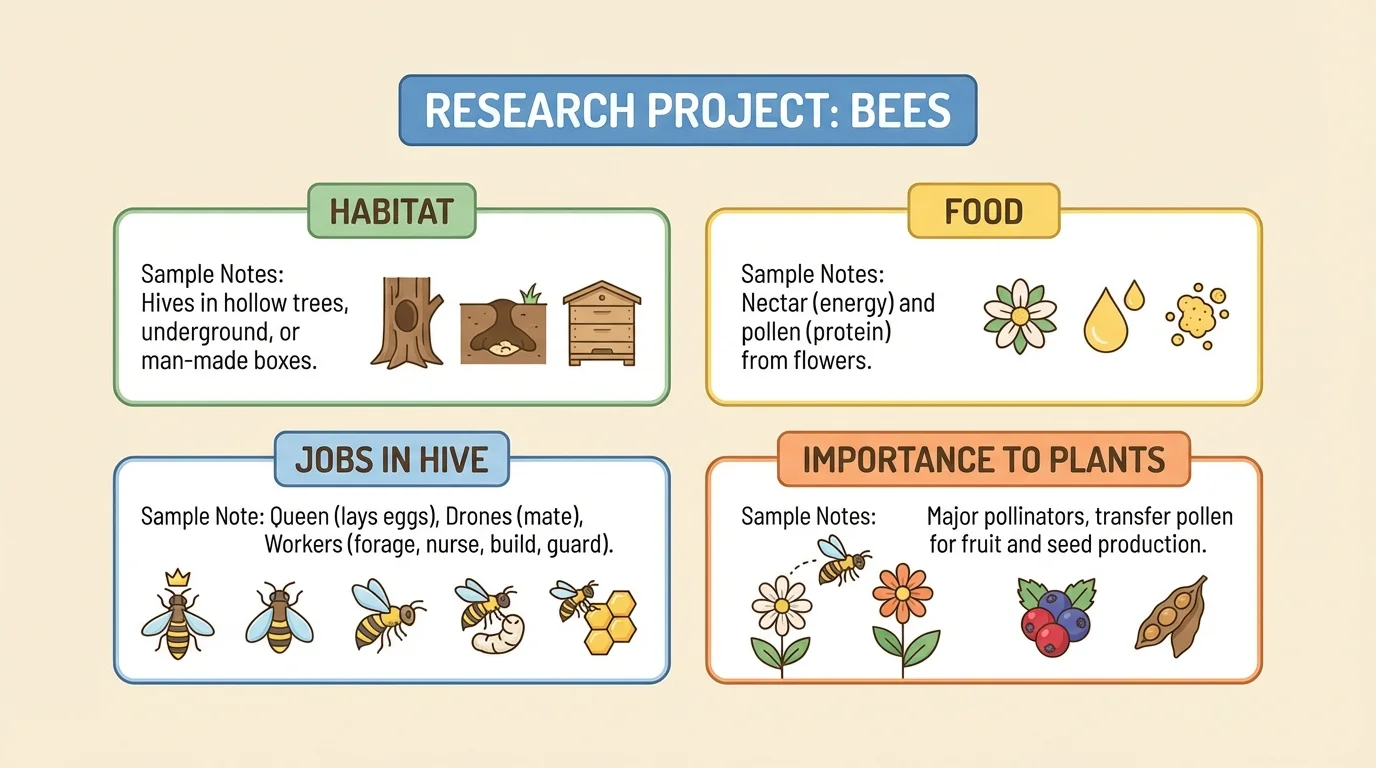
Finding information is only one part of research. You also need to remember and sort what you learn. That is why students take notes. Notes are short pieces of information written in a simple way. They are not meant to copy whole pages. They help you save important ideas, as [Figure 3] shows.
Good notes are brief and clear. Instead of writing every sentence from a source, write the key idea. For example, instead of copying a long paragraph about bees, you might write: "Bees drink nectar," "Bees carry pollen," and "Pollination helps plants make seeds."
Organizing notes into categories makes research much easier. If your project is about bees, you might sort facts under headings like body parts, food, home, and helping plants. Then, when you begin writing or speaking, your ideas are already grouped.
It also helps to keep track of which source each fact came from. You may not need a long formal list in third grade, but you should know whether your information came from a book, website, or video. That builds a good habit for later research.
Researchers often discover that some notes are more useful than others. A note that answers the main question belongs in the project. A note that is interesting but unrelated may need to be left out. Good researchers choose carefully.
You already use organizing skills in reading and writing. When you sort story details into beginning, middle, and end, or when you group words by meaning, you are practicing the same kind of thinking that helps in research.
Clear note-taking saves time later. When notes are messy, writing becomes hard. When notes are sorted and easy to read, the project becomes smoother from start to finish.
Researchers do not believe every sentence they read right away. They ask: Does this make sense? Does another source say something similar? Is this connected to my question? These habits help students become thoughtful readers.
One way to check information is to compare sources. If a book and a website both explain that bees move pollen from flower to flower, that fact becomes stronger. If one source says something strange and no other source agrees, that is a clue to be careful.
Another way is to think about whether the information is current and understandable. Some sources use very hard words. Others may be too simple and leave out important details. A good source matches the reader and the topic.
Checking a fact across sources
A student wants to know whether bees help food crops grow.
Step 1: The student reads a book that says bees pollinate many plants.
Step 2: The student watches a science video that explains bees help flowers make seeds and fruits.
Step 3: The student notices both sources support the same idea.
The student can be more confident that this fact belongs in the project.
Checking information also means separating important details from extra details. A source may tell you many things about bees, including colors, enemies, and kinds of hives. But if your question is about helping plants, you should focus most on pollination and plant growth.
After reading and taking notes, the next job is to explain what you learned in your own words. This is called paraphrasing. It means keeping the same meaning but changing the wording. Researchers do this so they show understanding instead of copying.
Suppose a source says, "Bees transfer pollen between flowers, allowing many plants to reproduce." A student might paraphrase it like this: "Bees move pollen from one flower to another, which helps plants make new seeds." The idea stays the same, but the sentence is different.
Putting ideas into your own words helps you learn more deeply. It shows that you understand the facts. It also makes your final report sound like your thinking, not someone else's writing.
Using notes instead of copying
When students write from notes, they are more likely to use their own words. Notes hold the main ideas, not every sentence. This makes it easier to explain information clearly and honestly.
Researchers often combine facts from more than one source into a single explanation. For example, one source may explain what nectar is, and another may explain what pollen does. A student can join those facts into one strong paragraph about how bees help plants.
Research is not finished until you communicate it. The path from notes to a finished product follows clear steps, as [Figure 4] shows. You gather facts, group ideas, draft your work, improve it, and then share it. Communication means showing others what you learned in a clear way.
You can communicate research in different forms. You might write a paragraph, make a small report, create a poster, label a diagram, or give a short presentation. No matter which form you choose, your work should answer the research question and include important facts.
Strong communication has a beginning, middle, and ending. The beginning tells the topic. The middle gives facts and explanations. The ending closes the piece by restating the main idea in a clear way. This structure helps the audience follow your thinking.
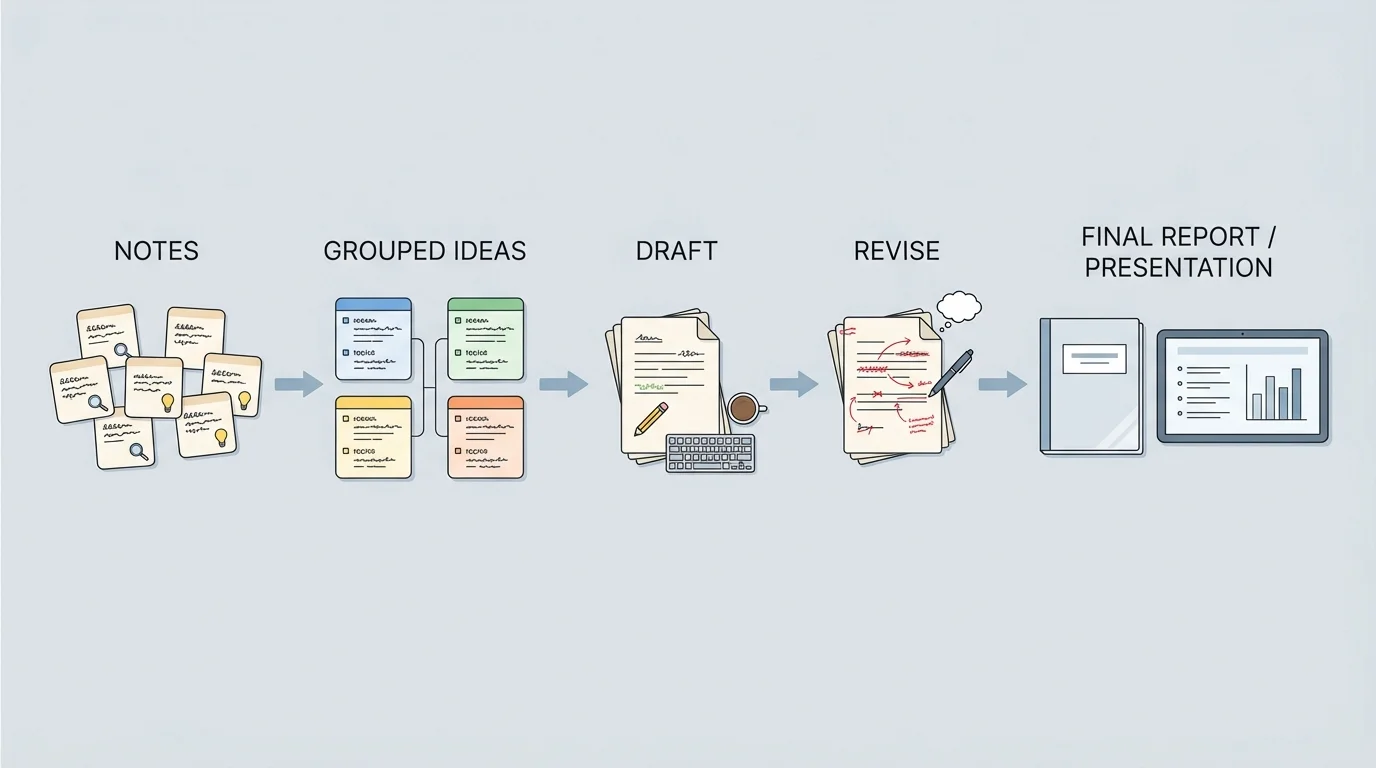
Good researchers also revise. That means they reread their work and improve it. They check for missing details, repeated ideas, or confusing sentences. Revising makes communication stronger.
Speaking is part of communication too. When giving a short presentation, a student should speak clearly, stay on topic, and use notes if needed. Looking at the audience and explaining facts in order helps listeners understand.
Later, when you think again about your categories from [Figure 3], you can see how organized notes make writing easier. The groups of facts can become body paragraphs, poster sections, or speaking points.
Here is one example of how a short research project might work. The topic is bees. The main question is: How do bees help plants?
Sample research project: Bees and plants
Step 1: Choose the question.
The student asks, "How do bees help plants?"
Step 2: Gather information.
The student reads a library book, uses a trusted children's website, and watches a classroom science video.
Step 3: Take notes.
The student writes short notes such as "Bees collect nectar," "Pollen sticks to bees," and "Pollination helps plants make seeds and fruit."
Step 4: Organize notes.
The notes are sorted into groups: what bees do, what pollen is, and how plants benefit.
Step 5: Communicate learning.
The student writes a paragraph explaining that bees move pollen from flower to flower, which helps many plants grow fruits and seeds.
This project is short, focused, and full of learning. It answers one question by using several sources and organized facts.
This example also shows why focused questions matter. If the student had chosen the question "What are all the facts about bees?" the project would have been much harder to finish well. A smaller question leads to clearer learning.
The same process works for many topics: how volcanoes erupt, why communities need firefighters, how crayons are made, or what penguins need to survive. The steps stay similar even when the topic changes.
Good researchers are curious, patient, and careful. They do not rush to the first answer. They look for information, think about it, and choose what matters. They also stay organized so that the project remains clear.
Another strong habit is asking follow-up questions. After learning one fact, a researcher may wonder something new. For example, after learning that bees help crops, a student may ask which crops depend on bees the most. New questions can lead to new research.
Researchers should also be honest. That means not making up facts and not copying from a source. Honest work shows real learning. It also builds trust between the writer and the reader.
"Research is asking questions and following the facts."
When you learn to conduct short research projects, you are practicing skills used in school and in real life. People research before building houses, treating patients, designing games, protecting animals, and making laws. Careful questions and careful facts matter everywhere.
Even a small project can teach powerful skills. It teaches you to wonder, to search, to compare, to organize, and to explain. Those are the habits of a learner who keeps growing.
