Have you ever finished reading something and thought, "What was that mostly about?" Good readers do more than read words correctly. They also figure out the big message the author wants them to understand. That big message is called the main idea, and finding it helps reading make sense.
When you read an informational text, you are a little like a detective. You look for clues. Some clues are repeated ideas. Some are facts and examples. Some are in the title or the first sentence. When you put those clues together, you can discover the most important point of the text.
Informational texts are texts that teach about a topic. They may explain animals, weather, history, sports, inventions, or places. In these texts, the author usually wants readers to learn something true and important. That is why finding the main idea and key details is such an important reading skill.
Main idea is the most important point the author wants readers to understand about a topic. Key details are the important facts, examples, or reasons that help explain and support the main idea.
The main idea is the "big picture" of a text. If a text has many sentences, the main idea tells what those sentences work together to teach. It is not just one small fact. It is the central message of the paragraph, section, or whole article.
Sometimes the main idea is written clearly in one sentence. For example: "Owls are well adapted for hunting at night." That sentence tells the big point right away. The rest of the paragraph may explain the owl's sharp hearing, large eyes, and quiet wings.
Sometimes the author does not say the main idea in one exact sentence. Then the reader has to think about all the important details and decide what they add up to. That is called figuring out the main idea from clues in the text.
Informational text includes many facts, but not every fact is equally important. Key details are the details that really help the reader understand the author's main point.
Key details can be facts, examples, descriptions, or reasons. If the main idea is "Penguins are built for life in cold places," then a key detail might be that penguins have thick layers of feathers. Another key detail might be that they have fat under their skin to keep warm.
A tiny detail is not always a key detail. If a text says one penguin at a zoo is named Pip, that may be interesting, but it probably does not help explain the big idea about how penguins survive in the cold. A key detail supports the main idea. An extra detail may not.
Some informational texts have many exciting facts, but strong readers still ask, "Which facts matter most?" That question helps you separate interesting details from important ones.
When you recount key details, you tell them again in your own words. You do not have to repeat every sentence from the text. You choose the most important details that help explain the big point.
A topic is simply what a text is about, but the main idea tells what the author says about that topic. This difference is important and becomes clearer when you compare a one-word topic with a full main-idea sentence and supporting details.
[Figure 1] For example, if the topic is "bees," that is not enough to be a main idea. "Bees help plants grow by carrying pollen from flower to flower" is a main idea because it tells something important about bees.
Look at another example. The topic might be "recycling." A main idea could be "Recycling helps reduce waste and saves materials that can be used again." The topic is short. The main idea is a complete thought.
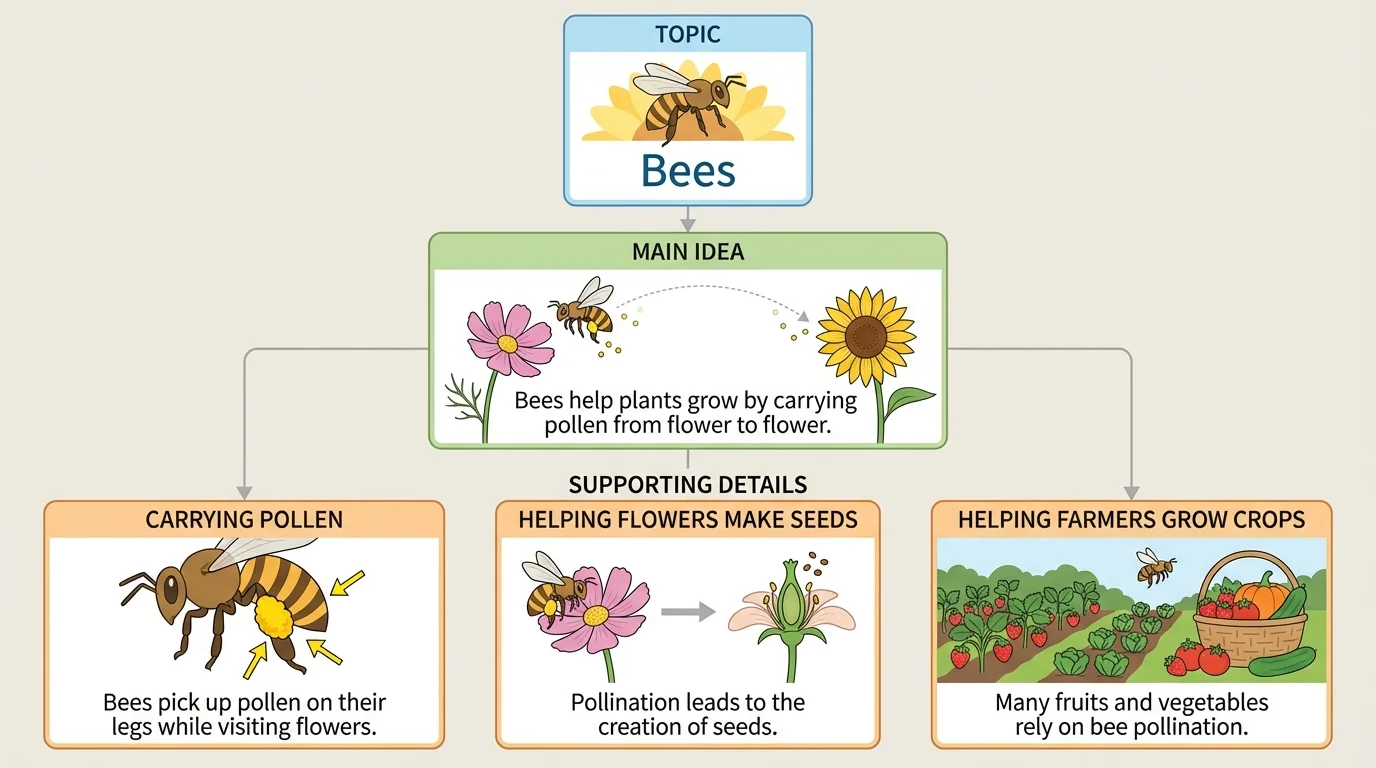
If you answer with only one word, you may have found the topic, not the main idea. If you answer with a full sentence that tells the most important message, you are probably much closer to the main idea.
Readers can use a simple strategy to find the main idea. These steps work especially well with informational texts because those texts are usually organized to teach one clear point.
[Figure 2] First, read the title and think about the topic. The title often gives the subject right away. A title such as How Seeds Travel tells you the text will probably explain ways seeds move from place to place.
Next, notice ideas that repeat. If several sentences talk about the same thing, that repeated idea is often important. Authors repeat important ideas on purpose.
Then, ask yourself, "What does the author want me to learn about this topic?" This question helps move from topic to main idea. Do not just ask what the text is about. Ask what the text is mostly teaching.
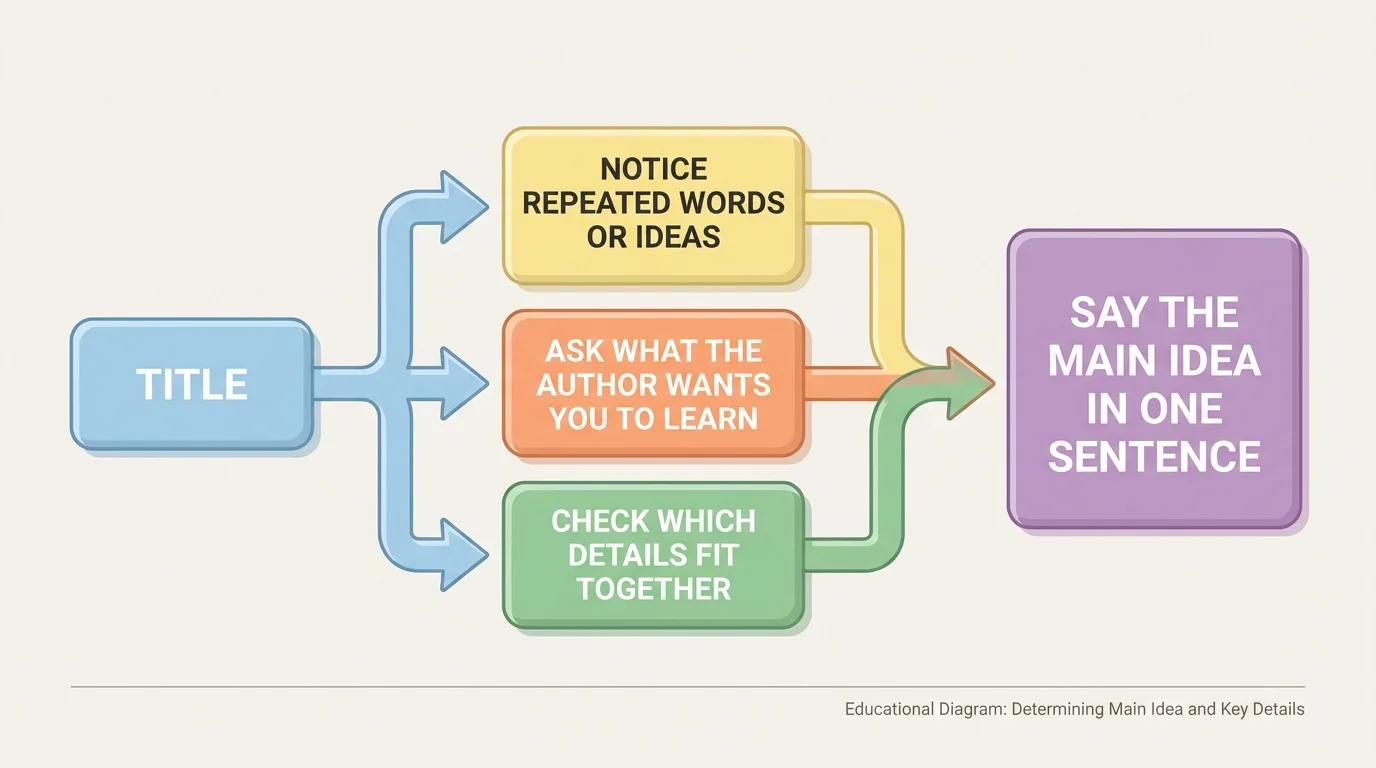
After that, check the key details. Do they all fit your idea? If most important details connect to your sentence, your main idea is probably correct. If they do not fit, think again.
Finally, put the main idea into your own words. You do not have to copy the text exactly. Good readers can state the main idea clearly and simply.
A smart way to test a main idea
Pretend the main idea is an umbrella. The key details should fit under it. If one detail does not fit, it may be a small side fact, not a key detail. If many important details do not fit, the umbrella is too small or points in the wrong direction.
This strategy is also helpful with longer paragraphs. You can pause after reading and quickly ask, "What was the most important point here?" Short thinking stops while reading can help you understand much more.
Key details act like helpers. They hold up the main idea and prove why it makes sense.
[Figure 3] Suppose the main idea is "Exercise helps kids stay healthy." One supporting detail might be that exercise makes muscles stronger. Another might be that exercise helps the heart work well. A third might be that exercise can improve mood and energy. Together, these details support the main idea.
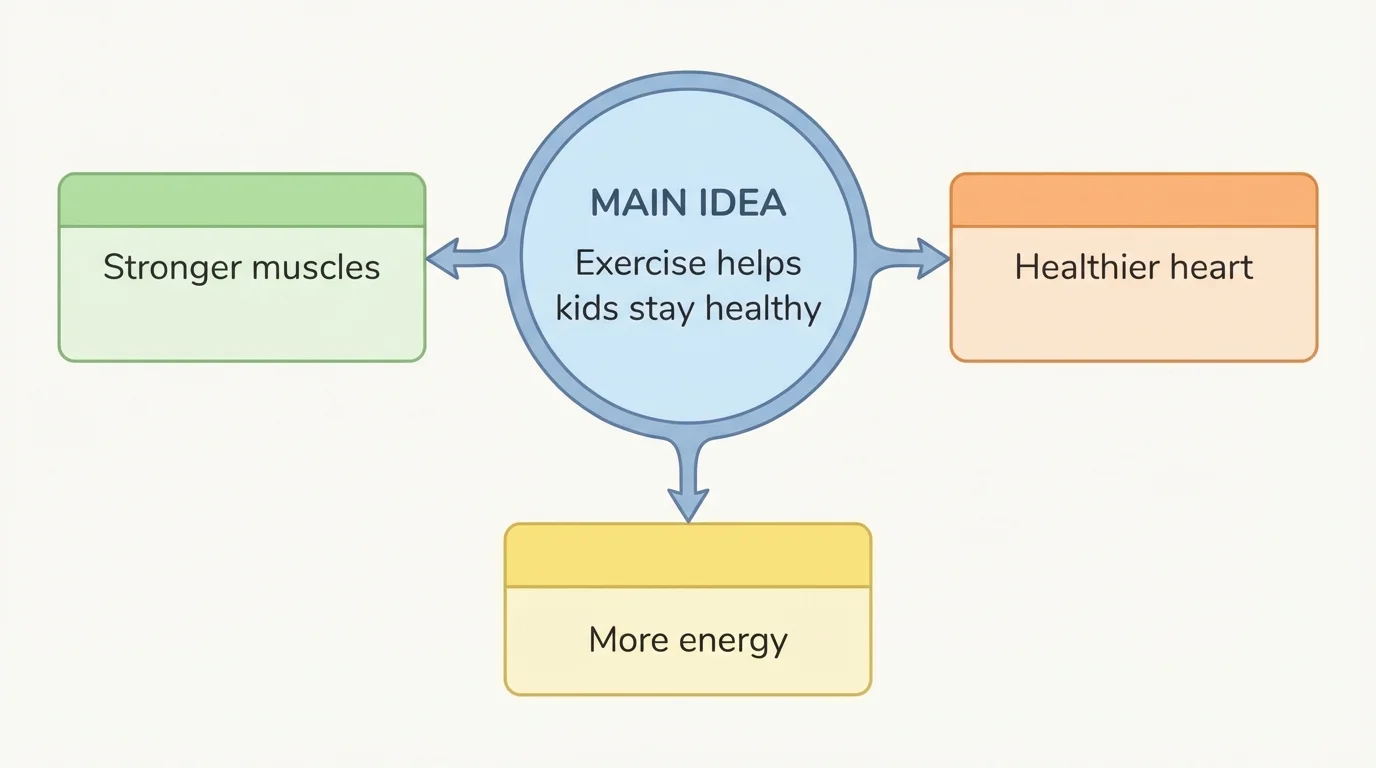
If a detail does not support the main idea, it is not a key detail for that text. For example, "A soccer ball can be black and white" does not explain why exercise helps kids stay healthy. It is related to sports, but it does not support the big idea.
When you explain how details support the main idea, use words like because, shows, explains, and proves. You might say, "The detail about strong muscles supports the main idea because it shows one way exercise keeps the body healthy."
To recount key details means to tell them again clearly. You are not retelling everything in the text. You are choosing the most important information and putting it in order.
When recounting details, start with the main idea in your mind. Then choose two, three, or more important details that support it. Say them clearly and leave out details that are not very important.
For example, if a text is mostly about how firefighters help a community, you might recount these details: firefighters put out fires, rescue people in danger, and teach safety rules. Those details all match the big idea.
A strong recount sounds organized. It might begin like this: "The text is mainly about how firefighters help people. One key detail is that they put out fires. Another key detail is that they rescue people. The text also explains that they teach fire safety."
Remember that reading carefully means noticing which ideas are most important. You may have practiced finding who, what, where, when, why, and how. Those questions still help, but now you are putting the answers together to understand the bigger point.
Recounting helps in class discussions, writing, and studying. If you can recount key details, you can show that you understand what you read instead of only reading the words aloud.
Sometimes an author states the main idea directly. This means the main idea is written clearly in the text. Often it appears near the beginning, but it can also appear in the middle or at the end.
For example, a paragraph may begin, "Maps help people understand where places are." The rest of the paragraph may explain that maps show roads, rivers, cities, and borders. In that case, the main idea is stated.
At other times, the main idea is implied. That means the reader has to infer it from the details. If a text says bats sleep during the day, fly at night, and use sound to find food, the author may never say the exact sentence "Bats have special behaviors that help them live at night." The reader figures that out.
Whether the main idea is stated or implied, the process is similar. Read carefully, notice important details, and ask what message those details work together to teach.
"Good readers do not just collect facts. They connect facts to find meaning."
This is why key details matter so much. They are the clues that lead to the big idea. Without them, the main idea would just be a guess.
One strong way to practice this skill is to look at a short text and test whether every important detail matches one central idea. The annotated paragraph in [Figure 4] demonstrates how a reader can spot one main idea and the details that support it.
Example 1: Sea turtles
Read this short text: "Sea turtles live in the ocean, but female sea turtles come onto beaches to lay eggs. After baby turtles hatch, they move toward the water. Sea turtles often travel long distances during their lives."
Step 1: Find the topic.
The topic is sea turtles.
Step 2: Notice the important details.
The text tells that females lay eggs on beaches, babies move toward the water, and sea turtles travel long distances.
Step 3: State the main idea.
A good main idea is: sea turtles have life patterns that connect land and ocean.
Step 4: Explain support.
The details support the main idea because each one tells something about how sea turtles live and move between beach and ocean.
Notice that the main idea is broader than any one detail. It includes the important information without becoming too narrow.
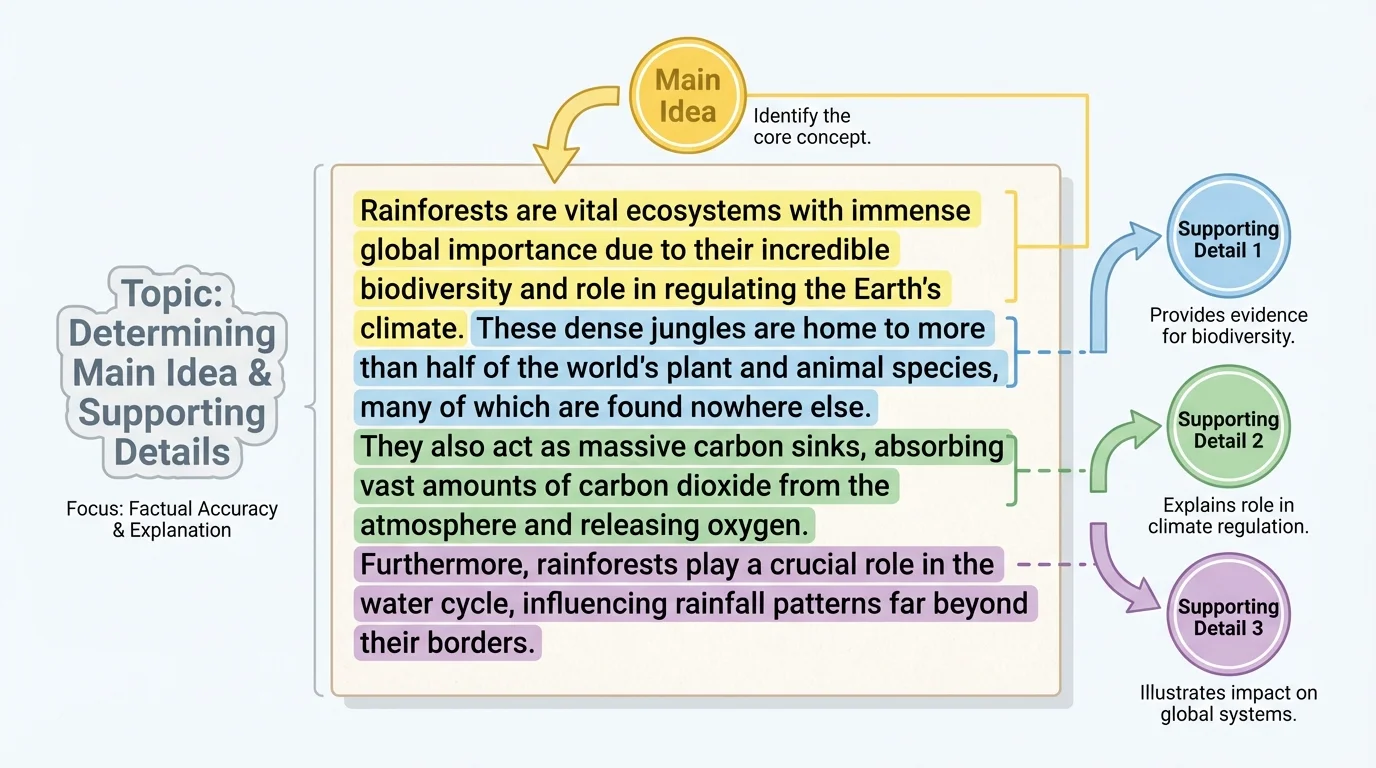
Here is another example. Read this text: "Rainforests are home to many kinds of plants and animals. Tall trees form a canopy. Monkeys, birds, insects, and frogs live in different layers of the forest. Rainforests also get a lot of rain each year." A good main idea is "Rainforests are rich habitats with many living things and special conditions." The details about layers, animals, and rainfall support that main idea, just as the color highlights in [Figure 4] separate the big point from its evidence.
Example 2: School gardens
Read this short text: "A school garden can help students learn in many ways. Students observe plant growth, practice teamwork, and learn where food comes from. Gardens can also make school spaces more beautiful."
Step 1: Identify the topic.
The topic is school gardens.
Step 2: Identify the key details.
Students observe plant growth, practice teamwork, learn where food comes from, and enjoy a more beautiful school space.
Step 3: Find the main idea.
A good main idea is: school gardens give students useful learning experiences and benefits.
Step 4: Explain support.
Each detail tells one benefit of the garden, so together the details support the main idea.
Now consider a text about storms: "Meteorologists study clouds, wind, and air pressure to predict storms. Their forecasts help people prepare for dangerous weather. Warnings can tell families when to stay indoors or leave an area safely." The main idea is not just "storms" or "weather." A stronger main idea is "Weather forecasts help keep people safe during storms."
When readers explain support, they might say that studying clouds, making forecasts, and giving warnings all show how weather experts protect people. That explanation connects details back to the big idea.
One common mistake is choosing a detail instead of the main idea. If a paragraph about desert animals includes the fact "camels can go a long time without water," that is an important detail, but it may not be the whole main idea. The bigger idea might be "Desert animals have adaptations that help them survive in dry places."
Another mistake is choosing a topic that is too broad. Saying "animals" is much too broad if the text is really about how desert animals survive heat and lack of water. Be specific enough to include the author's true message.
A third mistake is including personal opinions instead of ideas from the text. If you say, "I think turtles are cute," that may be true for you, but it is not a key detail unless the text is actually about people liking turtles.
Smart readers slow down when a text feels confusing. They reread important parts, look for repeated words, and ask what details fit together. They may even mentally picture the "umbrella" from [Figure 3] to test whether the details all belong under one big idea.
Finding the main idea helps in every subject. In science, it helps you understand what a passage teaches about plants, animals, weather, or space. In social studies, it helps you understand important ideas about communities, history, and geography.
It also helps outside school. When you read a sign, directions for a game, a news article for kids, or a website about animals, you need to know the most important message. That helps you remember what matters.
Strong readers do not try to remember every single word. They look for the big idea and the details that support it. This makes reading clearer, faster, and more meaningful.
As you keep reading informational texts, you will get better at noticing patterns. You will see that authors choose details for a reason. Those details are not random. They work together to teach one important idea.
