Stories travel all around the world. Some are whispered at bedtime, some are written in books, and some have been told for hundreds of years before anyone wrote them down. Even when stories come from different places, they often teach people how to act, how to think, or what to value. When you learn to retell these stories and find their messages, you are doing the work of a strong reader.
When readers recount a story, they tell it again in order. They include the most important characters, the main problem, the major events, and the ending. A good recount does not tell every tiny detail. It focuses on the parts that matter most.
Central message is the big idea a story teaches. A lesson is what a reader learns from what happens. A moral is a lesson about right and wrong behavior, often stated clearly in a fable.
As you read, it helps to ask: What happens first? What problem does the character face? What choices does the character make? What happens at the end? The answers to those questions help you retell the story and figure out what it is really teaching.
A recount is not a copy of the whole story. It is a clear retelling in your own words. If you recount well, someone listening to you can understand the story's main events without hearing every sentence from the original text.
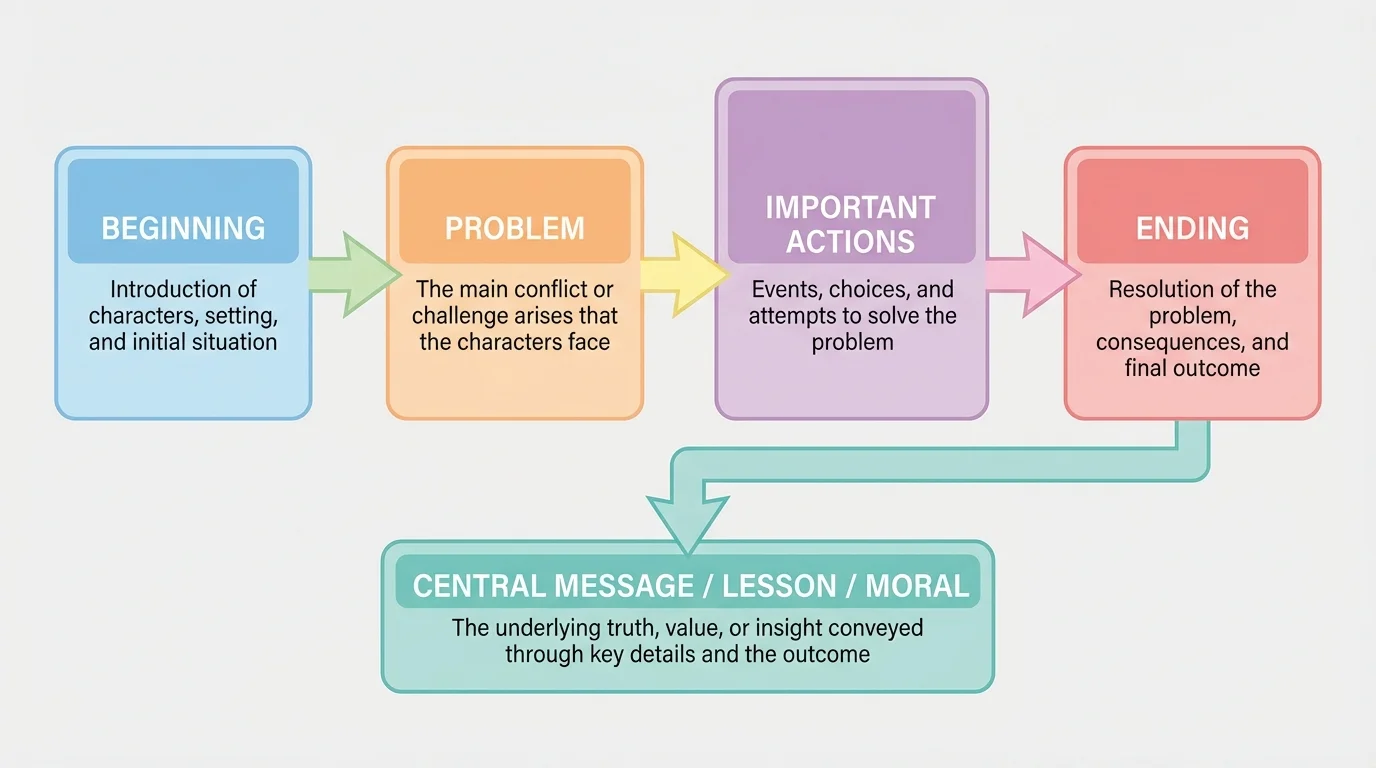
To recount, start with the setting and the characters. Then tell the problem. Next, explain the important events in the middle. Finally, tell how the story ends. This order matters because the message often becomes clear only after you know what the characters do and what results from those actions.
For example, if you recount a story by saying only, "A fox talked to a crow," that is too short and leaves out the important action. But if you say, "A fox wanted a piece of cheese from a crow, so he flattered her until she opened her beak and dropped it," your recount includes the key events that lead to the lesson.
Readers already know that characters, setting, problem, and solution are important story parts. Recounting uses those same parts, but now the goal is also to explain what the story teaches.
When you recount, you should keep the story in the same sequence as the text. If events are mixed up, the story may stop making sense. The order of events helps readers see causes and effects, and cause and effect often lead straight to the central message.
[Figure 1] Many traditional stories belong to special groups. The three important groups in this lesson are fables, folktales, and myths. These kinds of stories have patterns, and noticing those patterns helps readers understand what each story is trying to do.
A fable is usually short and often has animals that talk and act like people. Fables usually teach a clear moral. A folktale is a story passed down by people in a culture. It may explain values, celebrate cleverness, or entertain. A myth is a traditional story that often explains nature, the world, or the actions of gods and heroes.
| Story Type | Common Features | What It Often Teaches |
|---|---|---|
| Fable | Short, talking animals, simple plot | A clear moral or lesson |
| Folktale | Passed down in a culture, memorable characters, repeated patterns | Values, wisdom, or clever problem-solving |
| Myth | Gods, heroes, powerful events, explanations of the world | Beliefs about nature, people, or important values |
Table 1. Comparison of fables, folktales, and myths.
These groups can come from many places. Aesop's fables come from ancient Greece. Anansi folktales are famous in West Africa and the Caribbean. Myths about gods and heroes can come from Greece, Rome, Norse cultures, and many Indigenous cultures around the world. Even though the settings and characters differ, readers can still look for the same thing: the message.
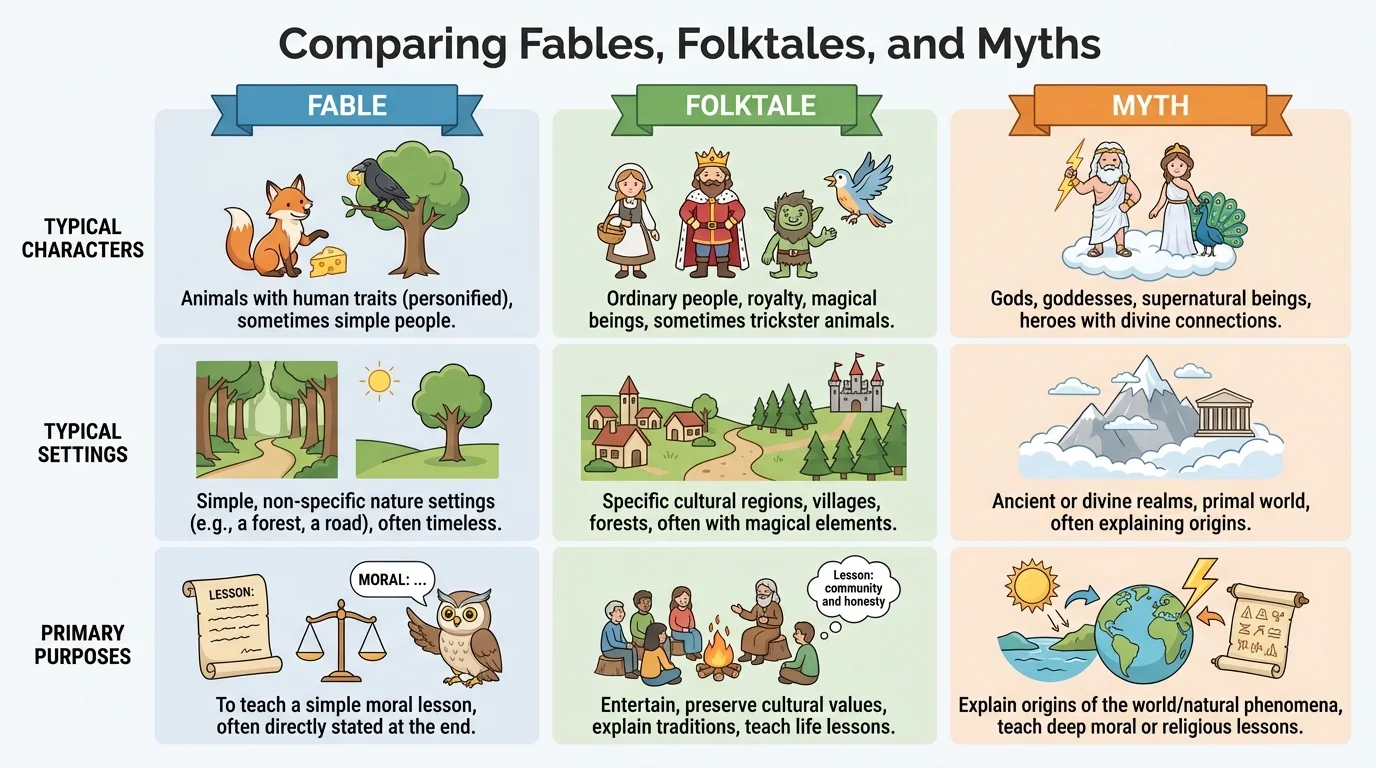
Knowing the story type can help you make predictions. If you are reading a fable, you can expect a moral. If you are reading a myth, you may look for an explanation of why something in the world happens. If you are reading a folktale, you may notice a culture's values through the choices characters make.
Some folktales have traveled so far that different countries tell their own versions of the "same" story. The details may change, but the lesson often stays similar.
Still, no matter what kind of story you read, you should not guess the message too early. You need the key details from the text to support your thinking.
The central message is bigger than one small event. It is the idea the whole story builds toward. Sometimes the lesson is stated clearly, but often readers must infer it by thinking about what happens and why it matters.
A story can be about one topic but teach a deeper message. For example, a story might be about a race, but its message could be that slow and steady effort can lead to success. The topic is what the story is mostly about. The message is what the story teaches about that topic.
Finding a message takes thinking across the whole story. Readers look at the beginning, middle, and end together. They notice the problem, the choices characters make, and what happens because of those choices. Then they ask what the author or storyteller wants us to learn from all of it.
To find the message, ask questions such as these: What does the main character learn? What does the ending show? Which action leads to success or trouble? What idea about life or behavior fits these details? These questions move you from retelling to understanding.
Sometimes there may be more than one lesson a reader can notice, but strong answers always match the key details in the text. If the details do not support your idea, it is probably not the central message.
Key details are the important parts of the story that help a reader understand the plot and the message. These details work together to move from the beginning of the story to the ending and finally to the lesson we learn.
[Figure 2] Readers pay close attention to what happens first, next, and last. A character may make a choice, face a consequence, and then learn something. Those connected details often reveal the lesson more clearly than any single sentence can.
Think of the story as a path. At the beginning, a problem appears. In the middle, the character responds to that problem. At the end, the results show whether the choice was wise, selfish, brave, lazy, honest, or kind. That chain of events helps explain the message.
For example, in many stories, a character lies to get attention. Later, other characters stop believing that person. The ending shows the consequence of lying. The message is not just "someone lied." The message is that dishonesty can cause people to lose trust.
Good readers use words from the story when they explain the message. They might say, "The message is that pride can cause mistakes because the crow believes the fox's praise and loses the cheese." That answer names both the message and the details that prove it.
Using details to explain a message
Story idea: A child refuses to help plant seeds. Later, the child is hungry when others harvest vegetables.
Step 1: Recount the important events.
The child chooses not to work while others plant and care for the garden.
Step 2: Notice the ending.
When the vegetables are ready, the child wants food but did not help grow it.
Step 3: State the lesson.
The story teaches that work leads to rewards, and refusing to help can bring unhappy results.
This kind of explanation is stronger than saying only, "It is about a garden." The garden is the topic. The lesson comes from the important events and the ending.
Let's look at three well-known traditional stories from different cultures and see how recounting helps us find the lesson.
One famous fable is The Tortoise and the Hare. In this story, a hare laughs at a tortoise for being slow. The hare is so sure he will win a race that he stops to rest. The tortoise keeps moving and finally wins. When we recount the story, the important details are the hare's pride, his careless choice to stop, and the tortoise's steady effort. The central message is that steady effort and persistence can beat overconfidence.
Notice how the lesson comes from the details. If the hare had stayed focused, the ending would be different. The message is conveyed by the contrast between the two characters' actions.
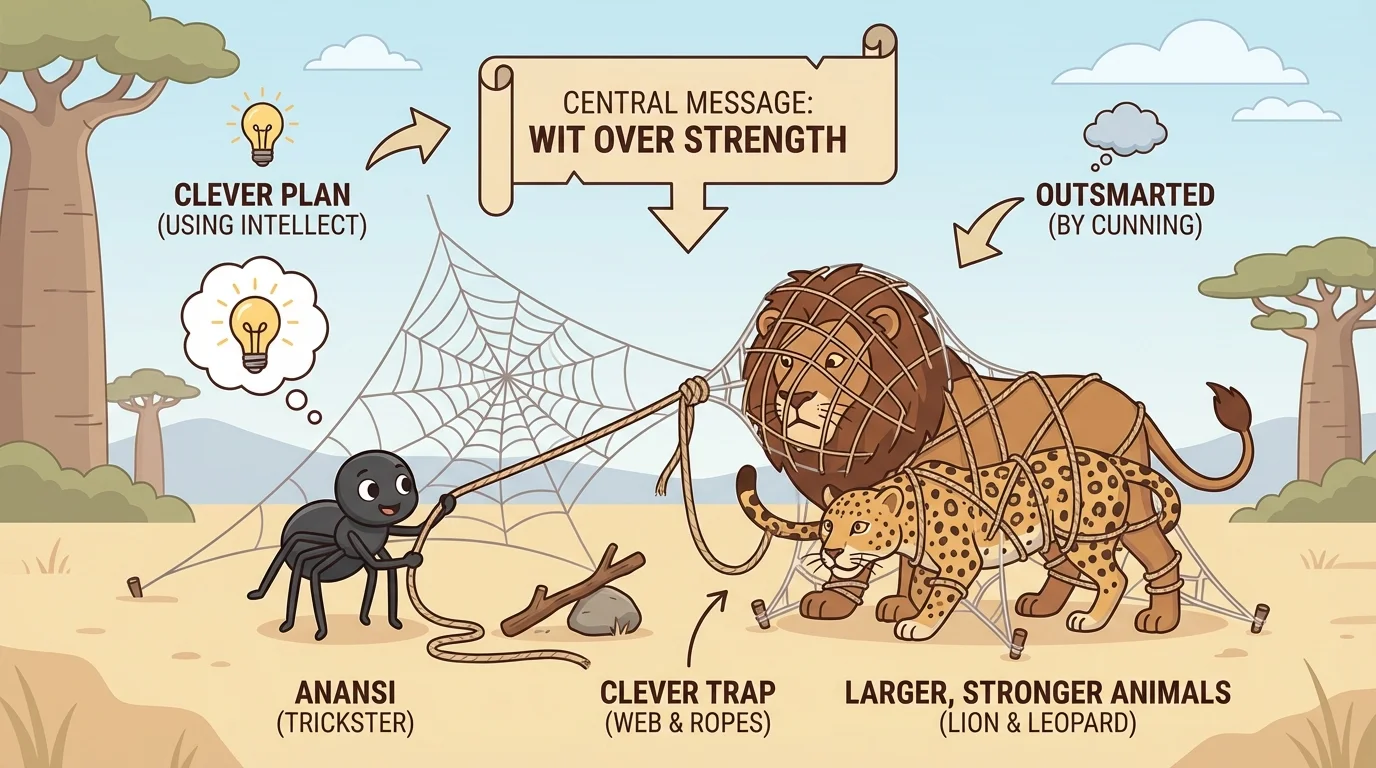
[Figure 3] A folktale about trickster Anansi from West African tradition often shows a small, clever character solving a problem through wit. In one story, Anansi wants something that seems too hard to get through strength alone, so he uses a smart plan. Anansi's role as a trickster helps readers see that brains can matter more than size.
When recounting an Anansi tale, readers should include the problem, the trick Anansi uses, and the result of his plan. A possible message is that clever thinking can solve problems. In some versions, though, Anansi's trick causes trouble, and the message may warn against selfishness. That is why the key details matter so much.
Now consider a myth such as the Greek story of Icarus. Daedalus makes wings from feathers and wax so he and Icarus can escape. Daedalus warns Icarus not to fly too close to the sun. Icarus does not listen. The wax melts, and he falls into the sea. The message comes from the warning, Icarus's choice, and the consequence. One central message is that ignoring wise advice can lead to disaster.
These three stories come from different cultures and times, yet all of them teach something important. Readers discover that lesson by recounting the story clearly and then asking what the important events show.
"Stories teach best when we pay attention to what characters do and what happens because of it."
Another example comes from Indigenous North American storytelling traditions, where certain tales explain natural events or teach respect, courage, and balance. In these stories, readers should be careful and respectful. The goal is not just to retell what happened, but to understand what values the story passes on.
Sometimes stories from different cultures teach similar lessons. The characters may look different, the setting may change, and the plot may not be exactly the same, but the messages can connect.
For example, one story may teach that boasting leads to failure, while another teaches that pride causes a person to ignore advice. Those messages are not identical, but they are related. Both warn readers about too much pride.
Readers can also compare how stories convey their lessons. A fable may make the moral very clear. A folktale may teach through repeated events or a clever ending. A myth may teach through a dramatic consequence. Earlier, [Figure 1] showed how these story types have different features, and those features can affect how directly the lesson appears.
Comparing stories helps readers think more deeply. It shows that people in many places care about honesty, courage, kindness, effort, wisdom, and respect.
One common mistake is mixing up the topic and the message. The topic is the subject of the story, such as friendship, racing, family, or animals. The message is what the story says about that subject.
Here are some examples. "A race" is a topic. "Slow and steady effort can lead to success" is a message. "A trick" is a topic. "Using cleverness can help solve problems" is a message. "Flying" is a topic. "Ignoring warnings can bring harm" is a message.
| Topic | Possible Message |
|---|---|
| Friendship | True friends help each other in hard times. |
| Work | Effort often leads to rewards. |
| Pride | Too much pride can cause mistakes. |
| Honesty | Lies can destroy trust. |
Table 2. Examples showing the difference between a story topic and a possible message.
When you answer a question about central message, make sure your answer sounds like a lesson someone could learn, not just a word or a subject.
Strong readers do more than name a lesson. They explain how the text shows that lesson. This means using evidence from the story.
You might say, "The lesson is that hard work pays off because the tortoise keeps going even when the hare rests." Or you might say, "The message is that ignoring wise advice can be dangerous because Icarus flies too close to the sun after his father warns him not to." In both answers, the lesson is connected to key details.
When you use evidence, your thinking becomes clear. You are not just guessing. You are showing how the story works. The sequence shown in [Figure 2] remains useful here because the lesson grows out of the problem, actions, and ending, not out of one random part.
In Anansi stories, readers also need evidence. As we saw in [Figure 3], the character's clever plan is often the key detail that reveals the message. If the trick helps solve a problem, the lesson may praise cleverness. If the trick hurts others, the lesson may warn against selfish behavior.
The more carefully you read, the better you can recount, explain, and compare stories. That skill helps with many kinds of reading, because stories are not only for entertainment. They are also ways people teach wisdom across time and across cultures.
