Have you ever read one book, loved a character, and then found that character again in another book? That can feel a little like meeting an old friend in a new place. Authors often write more than one story about the same characters because readers enjoy seeing what happens next. But each new story is not exactly the same. Strong readers look closely at what stays alike and what changes. When we compare stories by the same author, we learn more about the author's ideas, the characters, and the way stories work.
When you compare stories, you look for things that are similar. When you contrast stories, you look for things that are different. Good readers do both at the same time. They might notice that two stories have the same main character, but one story happens in summer and another happens in winter. They might notice that both stories teach a lesson about kindness, but the problems in the stories are not the same.
Reading more than one story by the same author helps you notice patterns. Some authors write characters who are brave in every book. Some authors like to place those characters into brand-new problems each time. When you compare stories, you do more than remember facts. You think about how the author builds meaning across different books.
For example, suppose an author writes two books about a girl named Maya and her dog, Pepper. In one book, Maya tries to help Pepper get home after he runs away. In another book, Maya enters Pepper in a neighborhood pet show. The same characters appear in both stories, but the adventures are different. A reader can compare the stories by asking: What lesson does each story teach? Where does each story happen? What problem starts the action?
Theme is the big idea or lesson in a story. Setting is where and when a story happens. Plot is the series of events that happen in the story. Character means a person or animal in a story. To compare means to tell how things are alike, and to contrast means to tell how they are different.
These words matter because they help you talk clearly about stories. Instead of saying, "These books feel the same," you can say, "These books have similar themes but different settings." That tells the reader exactly what you mean.
When readers compare books in a series, they often focus on three main parts: theme, setting, and plot. They may also look at characters because the characters connect the books. If the same author writes about the same children, animals, or families again and again, the reader can notice how those characters grow or face new challenges.
A series is a group of books that belong together. The books may have the same characters, the same world, or both. Some books in a series must be read in order, but many can stand alone. Even when the stories are separate, readers can still compare them.
You can also compare stories with similar characters. That means the characters are not exactly the same person, but they have a lot in common. An author might write two stories about curious children who solve mysteries, even if the children have different names.
A theme is not just one word like "friendship." It is a message or idea about life. For example, a story's theme might be "good friends help each other" or "telling the truth is important." Two books by the same author may share a theme, or they may have different themes.
Suppose an author writes two stories about brothers named Luis and Ben. In the first story, Luis helps Ben learn to ride a bike. The theme may be that patience and encouragement help others grow. In the second story, the brothers argue over a game but learn to share. The theme may be that working together is better than fighting. Both stories involve caring for each other, but the exact lesson is different.
Sometimes the same theme appears in more than one story. An author may return again and again to an idea such as courage, kindness, honesty, or teamwork. If that happens, readers should still look closely. The lesson may be similar, but it may be taught in different ways.
Theme is deeper than topic. A topic can be a broad subject such as family, school, pets, or friendship. A theme is what the story says about that subject. For example, "friendship" is a topic, but "true friends stay loyal during hard times" is a theme.
[Figure 2] To figure out theme, pay attention to what the characters learn. Ask yourself: What changes by the end? What message does the story seem to teach? If two books have the same characters, think about whether those characters learn the same kind of lesson in both stories or different lessons in each one.
The setting of a story can completely change the mood and action. Setting includes place and time. A story might happen in a classroom, on a farm, in a city, at the beach, in the past, or in the present.
[Figure 1] Think about two stories by the same author with the same two friends. One story happens during a snowy winter at school. Another happens during summer at a lake. Even if the characters are alike, the setting changes what they do, what problems they face, and how the story feels. A winter story may include icy sidewalks, heavy coats, and early sunsets. A summer story may include sunshine, swimming, and long outdoor days.
Setting can also affect the emotions of a story. A dark cave feels different from a bright playground. A noisy city feels different from a quiet country road. Readers compare settings by noticing clues in the words and in the illustrations. These clues include weather, buildings, clothing, seasons, and even sounds.
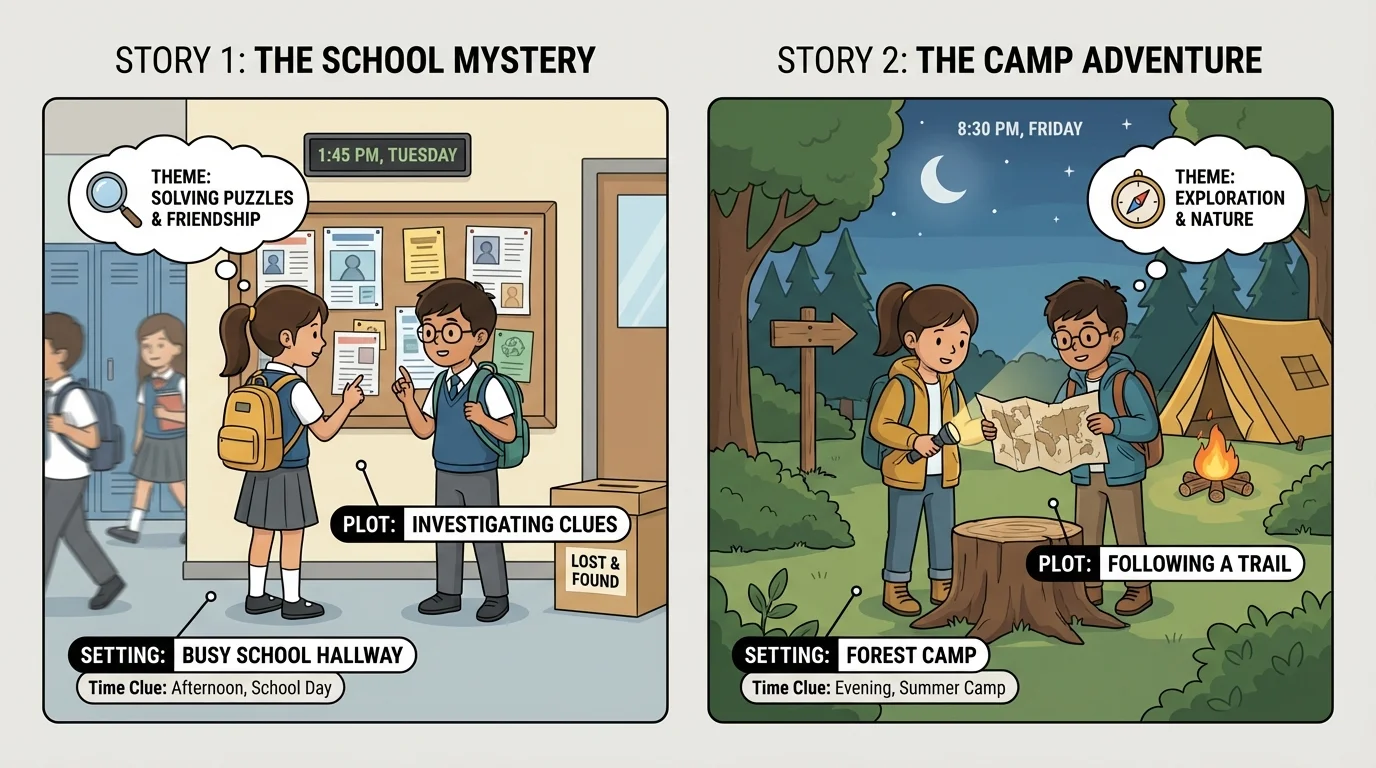
When comparing settings, ask: Where does each story happen? When does each story happen? How does the setting affect the characters' choices? Later, when you compare whole books, the setting may help explain why the plots are different even when the characters are the same.
For example, a child who solves a problem in a city apartment building may use elevators, neighbors, and stairways. The same child in a camping story may use maps, flashlights, and trails. New settings create new possibilities.
The plot is the order of events in a story. Two plots can have a similar shape even when the events are different. Many plots begin with characters and a setting, then a problem appears, events lead to a high point, and the story ends with a solution.
When you compare plots, think about the main problem in each story. Is one problem about finding something that is lost? Is another about winning trust, fixing a mistake, or working together? Stories by the same author often have different problems so the books do not feel repetitive.
Here is one example. In one story, Ana's kitten disappears before bedtime, and Ana searches the neighborhood. In another story, Ana wants to perform in a school play but is afraid to speak on stage. Both books may show Ana being determined, but the plot events are very different. One plot is a search. The other plot is about overcoming fear.
Plots can also be similar in certain ways. In both stories, Ana might first feel worried, then ask for help, then keep trying, and finally solve the problem. That means the events are not the same, but the author uses a familiar pattern.
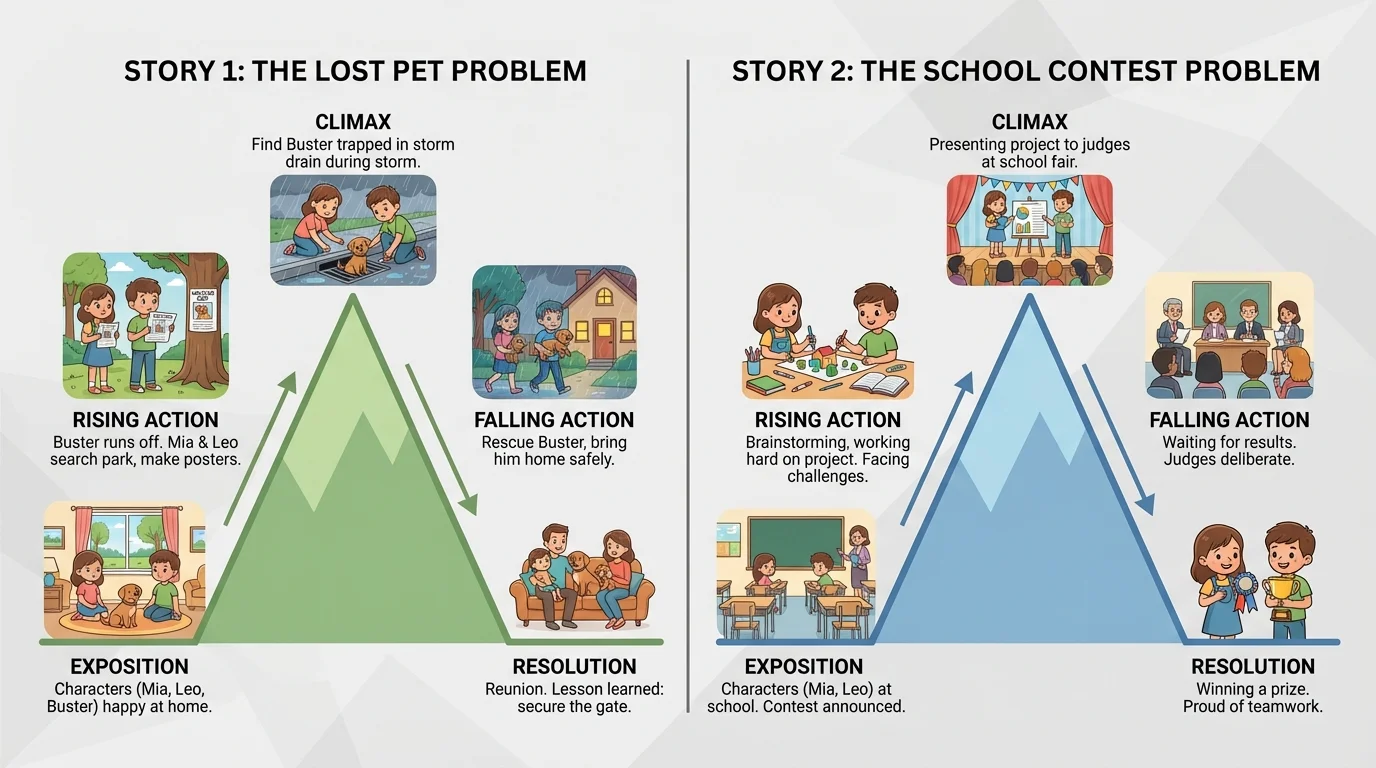
As readers grow stronger, they learn to compare not only what happens, but also how it happens. Does the author start with action right away in both books? Does the author build suspense in the middle? Does the ending feel funny, exciting, or thoughtful? These questions help readers compare plots in a deeper way.
[Figure 3] One helpful way to organize your thinking is with a chart. A chart helps you separate theme, setting, and plot so they do not get mixed together.
For example, you can write the two book titles across the top. Then make rows for theme, setting, plot, and character development. When you fill in the boxes, you can easily see which parts are alike and which are different.
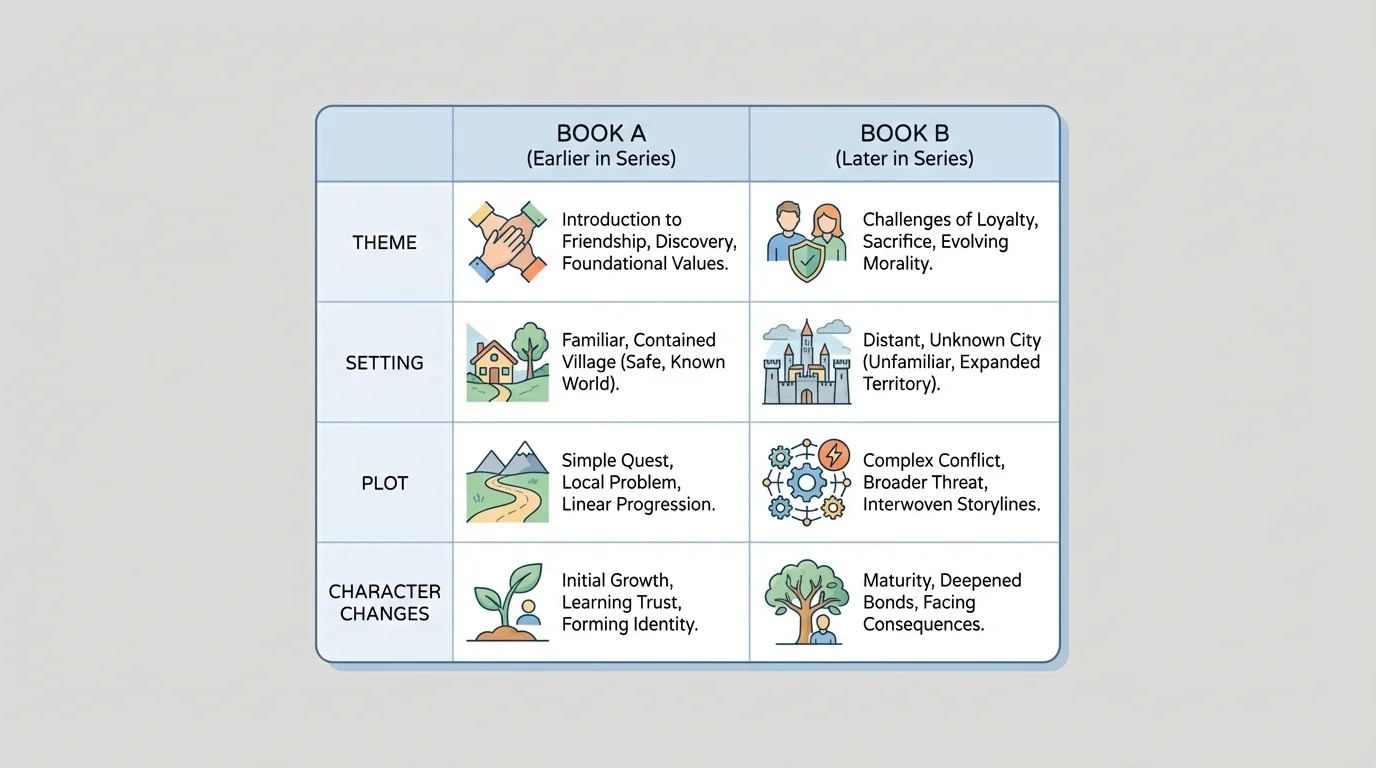
| Story Part | Book A | Book B |
|---|---|---|
| Theme | Helping others matters | Honesty builds trust |
| Setting | Neighborhood in summer | School in autumn |
| Plot | Friends search for a lost dog | Friends fix a classroom mistake |
| Character development | Same friends, still loyal | Same friends, more responsible |
A chart does not do the thinking for you. It helps you see your ideas clearly. When you look across a row, you compare one part of the stories. When you look down a column, you understand one whole book better.
Example: Comparing two books with the same characters
Suppose an author writes Sara and the Rainy Day Rescue and Sara and the Science Fair Surprise.
Step 1: Compare the theme.
In the first story, Sara helps a soaked puppy find its owner. The theme is that kindness can solve problems. In the second story, Sara's project fails at first, but she keeps trying. The theme is that persistence leads to success.
Step 2: Compare the setting.
The first story happens outside on a stormy afternoon in town. The second story happens mostly inside a school gym during a science fair.
Step 3: Compare the plot.
In the first story, Sara notices a lost puppy, asks neighbors questions, and reunites the puppy with its family. In the second story, Sara prepares an experiment, faces a mistake, fixes it, and presents her work.
Step 4: Compare the character.
Sara is caring in both stories. In the first, she shows care by helping an animal. In the second, she shows responsibility by not giving up.
These books are alike because they have the same main character and both show Sara solving a problem. They are different because the lessons, places, and events are not the same.
When readers use evidence like this, their comparisons are strong. They do not just say "both stories are good." They explain exactly what they notice.
One exciting part of reading books by the same author is watching characters change over time. A shy character may become more confident. A careless character may become more thoughtful. The character may still seem familiar, but new experiences can shape that character in each book.
This matters when you compare stories. If a character acts differently in Book B, ask whether the character has learned something from Book A. Sometimes authors show growth across a series. Other times, the character stays mostly the same, and the new interest comes from a new setting or plot.
For example, in an early story a child may need lots of help from adults. In a later story, that same child may make smart choices alone. Comparing these moments helps readers understand character development. It also helps explain why the same author can keep writing about the same characters without making every book feel alike.
Many authors give readers familiar characters because it creates comfort and excitement at the same time. Readers enjoy recognizing the character, but they also want to see what new challenge will appear next.
As you compare character actions, look closely at speech, decisions, and feelings. A character who jokes in every book may still change in bravery, honesty, or patience. Small details matter.
Strong comparisons come from strong evidence. That means you look back into the story for details. You may notice what the narrator says, what a character says, what the pictures show, or what happens at the ending.
If you want to compare theme, look for lessons, repeated ideas, and the changes in the character. If you want to compare setting, look for place words, season words, time clues, and description. If you want to compare plot, look for the main problem, important events, and how the problem gets solved.
Illustrations can help too, especially in books for younger readers. Pictures may show whether a story happens in the country or the city, during day or night, inside or outside. They may also show mood. In one story, the same character may stand confidently in bright colors. In another, the same character may look nervous in a darker scene. Those clues support your thinking.
Readers should be careful to use details correctly. If you say two stories have the same theme, be ready to explain why. If you say the setting changes the plot, point to the events that prove it.
One common mistake is mixing up theme and plot. Remember, plot is what happens. Theme is the lesson or message. A story about a lost bicycle and a story about a broken window may have very different plots, but both might share a theme about honesty.
Another mistake is confusing setting with plot. A forest is a setting. Getting lost in the forest is part of the plot. The place is not the same as the event.
A third mistake is focusing only on one small detail. Two books might both have a dog, but that does not mean they are mostly the same. Readers need to compare the bigger parts of the stories too. Looking back at a chart like the one in [Figure 3] helps you keep your ideas organized.
When you compare, think about alike. When you contrast, think about different. Good readers often do both in one answer.
You can use sentence patterns in your mind to help organize ideas: "Both stories have..., but only one story has..." or "In the first story..., while in the second story...." These patterns help you explain your thinking clearly.
When you read another book by an author you know, pay attention right away. Notice the characters, the setting, the problem, and the lesson. Then ask yourself what feels familiar and what feels new. That is how skilled readers compare and contrast stories in a thoughtful way.
