Have you ever listened to a story, watched a short video, or looked at a chart and thought, "What is this mostly about?" That question is powerful. It helps you find the main idea instead of getting lost in every small part. Strong readers and listeners do this all the time. They pay attention to what matters most, whether the information comes from a teacher reading aloud, a classmate speaking, a poster on the wall, or a chart with numbers.
When you understand the main idea, you can remember information better, talk about it more clearly, and work better with others. This is especially important during class discussions and group activities. In a group, everyone shares ideas, but good listeners notice the important point the group is building together.
Information does not always come from a book you read by yourself. Sometimes you hear it. Sometimes you see it in a picture, diagram, chart, or table. Sometimes you get it from a class discussion. Learning to find the main idea and the details that support it helps you understand all of these forms of communication.
If your teacher reads a paragraph aloud about bees, the main idea may be that bees help plants grow by pollinating them. If you look at a chart showing rainfall in different months, the main idea may be that some months are much wetter than others. If your group discusses how to keep the classroom clean, the main idea may be that everyone shares responsibility.
Being able to find the important message also helps you become a better speaker. When it is your turn to share, you can stay focused on your topic and include details that actually support your point.
Your brain is constantly sorting information. It notices patterns, repeated ideas, and important words to help you decide what matters most.
This means finding a main idea is not just a school skill. It is something people use in real life when they listen to directions, watch the news, follow a recipe, or work together on a team.
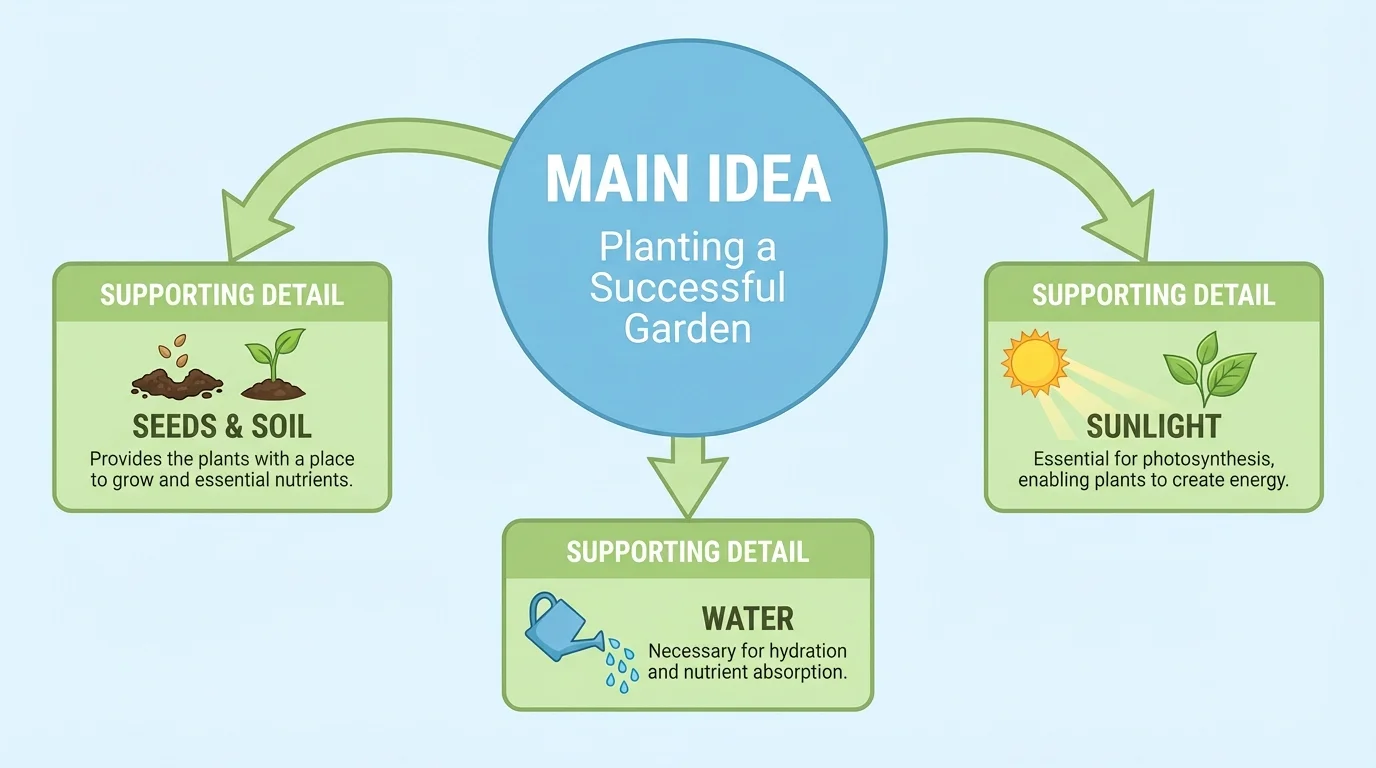
A main idea is what a text, talk, chart, or image is mostly about. It is the most important point. The smaller facts, examples, or reasons that help explain that point are called supporting details. One big idea holds the smaller parts together, as [Figure 1] illustrates with one central message and several details connected to it.
Think of the main idea as the trunk of a tree and the supporting details as the branches. The trunk holds the tree up. The branches grow from it. In the same way, the details grow from the main idea and help you understand it better.
For example, listen to this short read-aloud passage: "Turtles need special care. They need clean water, the right food, and a safe place to rest." The main idea is that turtles need special care. The details are clean water, the right food, and a safe place to rest.
Sometimes students confuse the topic with the main idea. The topic is the subject, like "turtles." The main idea says something important about the topic, like "turtles need special care." A topic is shorter and more general. A main idea is a complete thought.
Supporting details can be facts, examples, descriptions, reasons, or steps. They answer questions such as: What kind? How? Why? When? Where? Which one? If a detail helps explain the big message, it is a supporting detail. If it is interesting but does not really help explain the message, it is not one of the most important details.
Main idea is the most important message in a text, talk, image, chart, or other source of information.
Supporting details are the facts, examples, or descriptions that explain the main idea.
Topic is the general subject, not the full message.
When you practice separating the topic from the main idea, you become more accurate. This matters because in group work and listening activities, many ideas may be shared, but not all of them are equally important.
When information is read aloud or spoken, you cannot always go back and look at it again right away. That means careful listening is important. Good listeners listen for repeated words, ideas that are stressed, and what the speaker says at the beginning and end.
Often, a speaker starts by telling the subject and then gives details. A teacher might say, "Today I will explain why exercise is important for children." Right away, you know the talk will mostly be about the importance of exercise for children.
At other times, the main idea comes at the end. A speaker may list facts first and then say, "So, saving water at home is one way families can help the environment." In that case, the earlier facts are clues leading to the main idea.
Listen for signal words and phrases such as most important, for example, this shows, in all, or the reason is. These clues can help you tell the difference between a big message and a smaller detail.
Listening for importance means paying attention to what the speaker repeats, explains most fully, or says with extra emphasis. If several details point to the same message, that message is usually the main idea.
You can also ask yourself: "What does the speaker want me to understand most?" That question helps you focus on the central message instead of every single sentence.
Suppose a classmate says, "We should plant flowers in the school garden because they make the space beautiful, attract butterflies, and help bees." The main idea is that the school should plant flowers in the garden. The details are that flowers make the space beautiful, attract butterflies, and help bees. This kind of listening is useful when classmates share ideas during cooperative group activities.
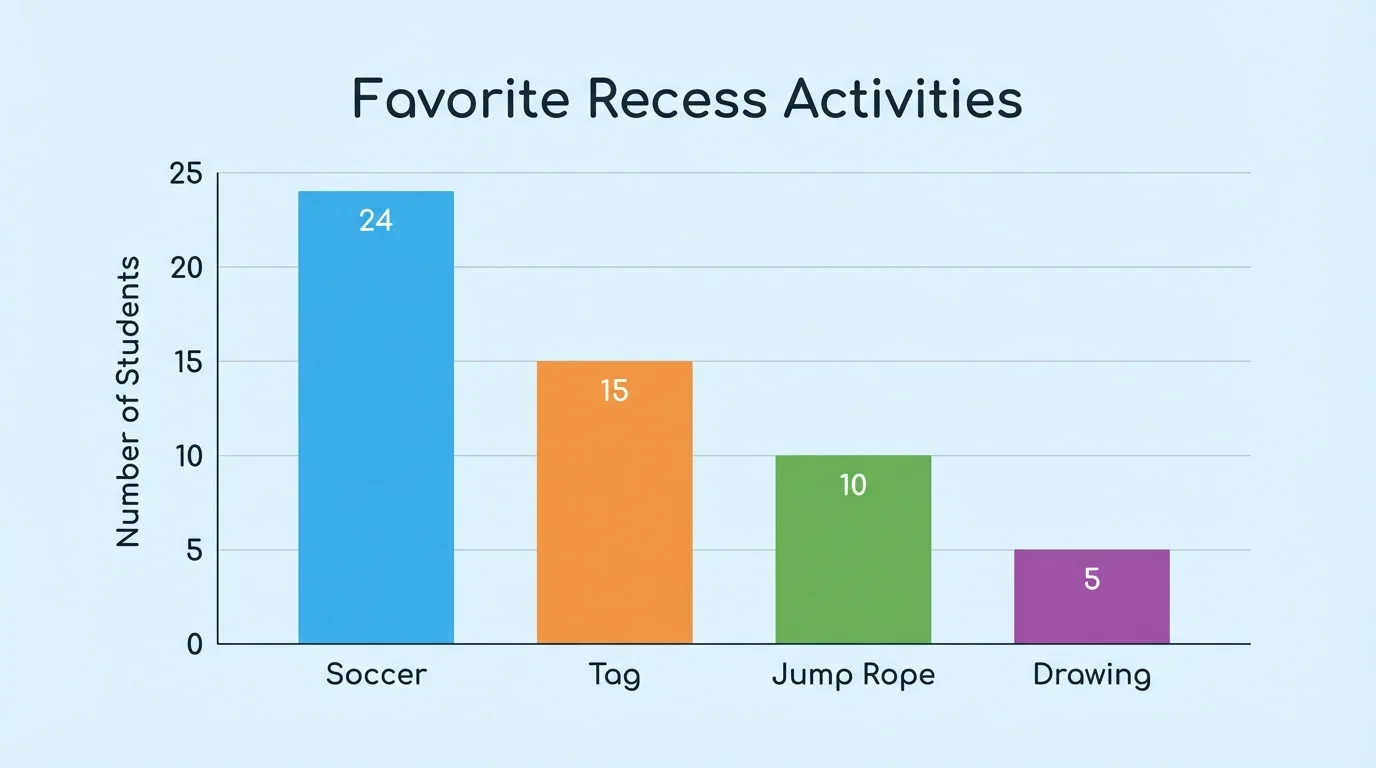
Information is not always shared in sentences. Sometimes it is shared through a picture, a diagram, a table, or a chart. Visual and number information can still have a main idea, as [Figure 2] shows with simple bars that reveal the biggest pattern quickly.
When you study a picture or chart, ask: "What do I notice first?" "What seems most important?" "What are the numbers or labels showing me?" The main idea in visual information often comes from a pattern, comparison, or change.
For example, imagine a bar chart showing favorite recess activities in one class. If the tallest bar is soccer, and the shorter bars are tag, jump rope, and drawing, the main idea may be that soccer is the most popular recess activity in the class. The heights of the bars are the details that support that main idea.
A picture can also show a main idea. If you see an illustration of children wearing coats, boots, hats, and gloves while snow falls, the main idea might be that the weather is cold and snowy, or that children need warm clothes in winter. The details are the snow, the clothes, and the icy ground.
Tables can show information in rows and columns. You can read across and down to find patterns. If a table shows that a plant grows taller each week, the main idea may be that the plant is growing over time. The numbers in each row are the supporting details.
| Source of Information | What to Look For | Possible Main Idea |
|---|---|---|
| Picture | Important objects, actions, setting | What the picture mostly shows |
| Chart | Highest, lowest, same, change | The overall pattern in the data |
| Table | Rows, columns, repeated results | What the numbers or facts mostly tell |
| Diagram | Parts and labels | How something is built or works |
Table 1. Clues students can use to find the main idea in different kinds of visual and quantitative information.
Visual information can be powerful because it helps you notice patterns quickly. Later, when you explain what you observed, you turn those patterns into words. That is one way reading, speaking, and listening work together.
Example: Finding the main idea in a table
A table shows how many books three students read in one month: Ana read 8, Luis read 6, and Maya read 9.
Step 1: Look at all the numbers together.
The numbers are close, and each student read several books.
Step 2: Ask what the numbers mostly show.
They show that all three students read many books during the month.
Step 3: Separate the details from the main idea.
The exact numbers, 8, 6, and 9, are supporting details.
The main idea is that the students did a lot of reading that month.
As with the bar chart in [Figure 2], the goal is not just to notice one number. The goal is to explain what the whole set of information means.
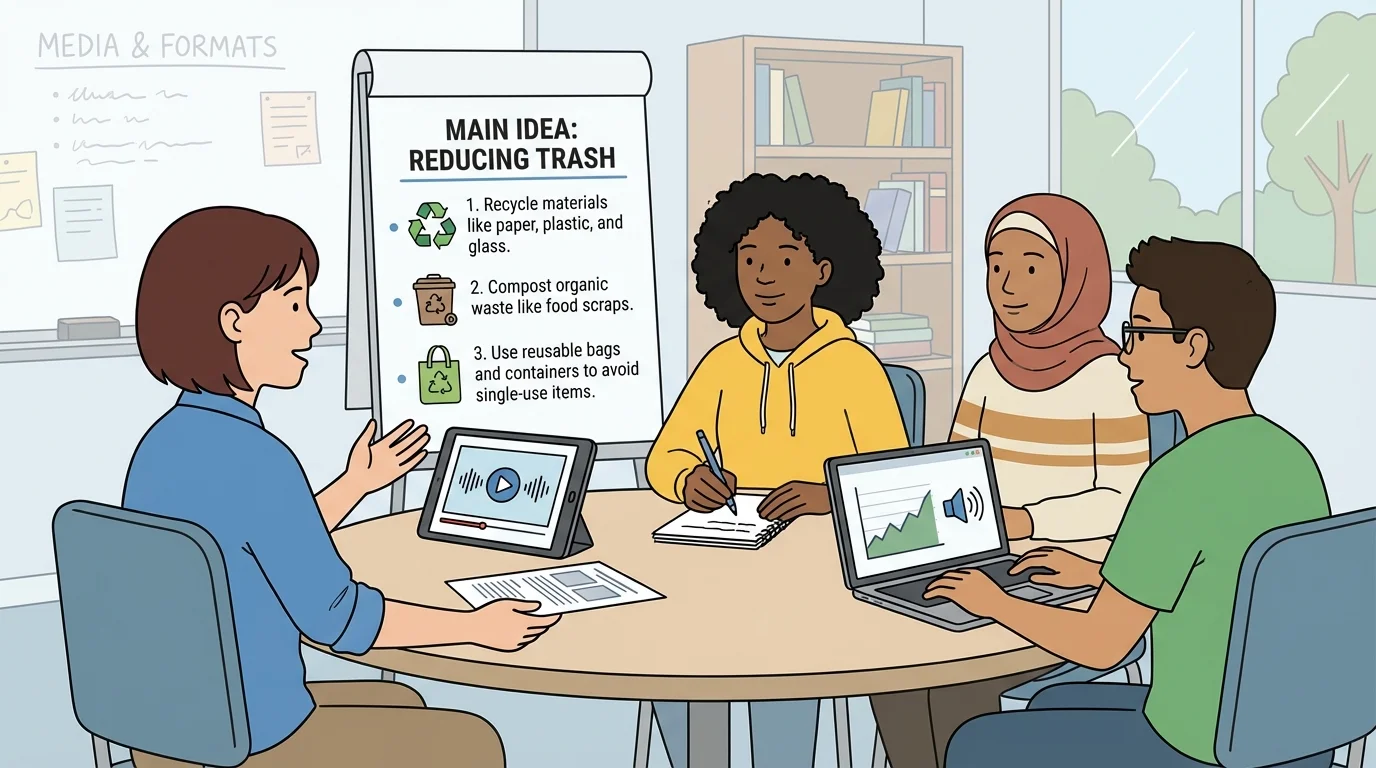
In group activities, students share ideas one at a time. Good group members listen carefully, let others speak, and build on what they hear. [Figure 3] shows how, in a cooperative discussion, the group's big message may come from many voices, with students listening, speaking, and recording one shared main idea.
Suppose a group is discussing ways to reduce trash at lunch. One student says to use reusable bottles. Another suggests reusable containers. A third says students should recycle paper and plastic. The main idea of the discussion may be that students can reduce lunch trash by making smarter choices. Each suggestion is a supporting detail.
To find the main idea in a group activity, listen for ideas that connect. If several classmates give examples that point in the same direction, that shared direction is often the main idea.
Being a strong listener in a group also means showing respect. Face the speaker. Wait your turn. Do not interrupt. Ask questions that help the group understand the message better. If you are not sure of the main idea, you can say, "So are we saying that...?" That kind of sentence helps the group check its thinking.
Sometimes the group needs one person to summarize. A summary is a short retelling of the most important points. A strong summary includes the main idea and the most helpful supporting details, but it leaves out less important information.
When you take turns, listen with care, and respond to what others say, you help your group learn more effectively. Speaking and listening work best together when everyone stays focused on the shared topic.
Later, if your group gives a class presentation, the same skill still matters. The audience listens for the main idea, and the speakers choose details that support that message clearly.
Strong readers and listeners ask themselves questions while they listen and observe. These questions help them stay focused and make sense of information.
Useful questions include: "What is this mostly about?" "What details help explain it?" "Which detail is most important?" "What pattern do I notice?" "What does the speaker, chart, or picture want me to understand?"
If a teacher reads aloud a passage about weather safety, you might ask, "Is the main idea that storms are dangerous, or that people can stay safe during storms?" The details will help you decide. If the passage gives many safety tips, the second idea is probably the main one.
Questions guide attention because they help your mind sort important information from extra information. Asking the right question turns listening and viewing into active thinking.
These questions are just as helpful when you are in a group. If several students are talking, your questions help you connect their ideas instead of treating each comment as separate.
The same skill works across many forms of information. A read-aloud text uses sentences and paragraphs. An oral presentation uses spoken words and voice. A visual source uses images, labels, or design. A quantitative source uses numbers to show patterns. In each case, you still ask what the information is mostly saying.
For example, a teacher reads a paragraph about recycling, a student gives a short talk about reusing materials, and a chart shows how much classroom paper was recycled over three weeks. Even though the forms are different, they may all have the same main idea: recycling helps reduce waste.
That is why this skill is powerful. You are not learning one rule for books and a different rule for charts and discussions. You are learning one thinking strategy that works in many places.
When students compare information from different sources, they often understand more. Group discussion shows that ideas become clearer when people listen to one another and organize related details under one shared message.
One common mistake is choosing a detail instead of the main idea. For example, if a passage says, "Dogs need exercise. Walks keep them healthy, help them use energy, and give them time outdoors," the detail is "walks keep them healthy." The main idea is "dogs need exercise."
Another mistake is giving only the topic. Saying "dogs" is not enough. That tells the subject, but it does not tell the important message about the subject.
A third mistake is trying to include everything. Not every detail belongs in your answer. Good thinkers choose the details that best support the big message.
Example: Fixing a mistaken main idea
A speaker says, "Plants need sunlight, water, air, and space to grow."
Step 1: Find the topic.
The topic is plants.
Step 2: Look for the full message.
The speaker is explaining what plants need in order to grow.
Step 3: Sort details from the main idea.
Sunlight, water, air, and space are supporting details.
The main idea is that plants need certain things to grow.
If you are unsure, try this simple check: Can the smaller details fit under your answer? If yes, your answer may be the main idea. If not, you may need to revise it.
Finding main ideas is connected to being a responsible member of a learning group. When others speak, your job is not only to stay quiet. Your job is to listen for meaning.
That means watching the speaker, thinking about the message, and responding in a way that matches the topic. If a classmate shares details about saving water, your answer should connect to that main idea. Off-topic comments can confuse the group.
You can use sentence starters to participate clearly: "I think the main idea is..." "One detail that supports that is..." "I agree because..." "Another detail is..." "Can we say the main point is...?" These speaking habits make group work more organized and more helpful.
As you grow as a listener, you also become better at sharing your own ideas. You learn to give a clear main idea first and then support it with details. That makes your classmates understand you more easily.
Whether information is read aloud, spoken in a group, shown in a picture, or displayed in a chart, the same important thinking skill helps you understand it: notice the big message, choose the details that support it, and explain it clearly.
