Have you ever listened to someone read a story so well that it felt like a movie in your mind? A strong audio recording can do that. When a reader speaks clearly, uses expression, and keeps a steady pace, listeners can understand the words and enjoy the meaning. Reading aloud is not just saying words on a page. It is a way of communicating ideas, feelings, and details to other people.
When you create an audio recording of a story or poem, you are both a narrator and a speaker. You want your audience to follow the text easily. That means your reading should be smooth, accurate, and expressive. Sometimes you may also add pictures or simple slides to help listeners notice important parts of the text.
People listen to recordings for many reasons. A class might listen to a story recording to enjoy literature. A family member might listen because they want to hear your reading. A recording can also help people focus on the sound of a poem, such as its rhythm and repeated words. Good oral reading helps listeners understand not only what the text says, but also how it feels.
Speaking clearly is part of good communication. In informal situations, such as sharing a funny story with classmates, your voice may sound friendly and relaxed. In more formal situations, such as recording a poem for a school presentation, your voice should still be warm, but your words should be especially clear and careful. In both situations, listeners need to understand you.
Fluent reading means reading smoothly, correctly, and with expression. Pace is the speed of your reading. Expression is the feeling you show with your voice. A visual display is a picture, slide, chart, or other image that helps the audience notice an important detail.
When you read fluently, your audience does not have to struggle to keep up. They can pay attention to the characters, the ideas, and the mood. That is why clear oral language matters so much in stories and poems.
Fluency is one of the most important parts of recording a story or poem. A fluent reader does not sound robotic or bumpy. The voice moves naturally through the sentence, slowing down at commas and stopping at periods.
[Figure 1] A good pace is not too fast and not too slow. If you rush, some words may be hard to understand. If you drag too much, the recording may lose energy. An understandable pace gives listeners time to think about what they hear. In a poem, pace can help the poem sound musical. In a story, pace can build suspense, excitement, or calm.
Fluent reading also includes accuracy. You should say the words correctly. If a word is difficult, practice it before recording. Misreading too many words can confuse the audience and interrupt the meaning.
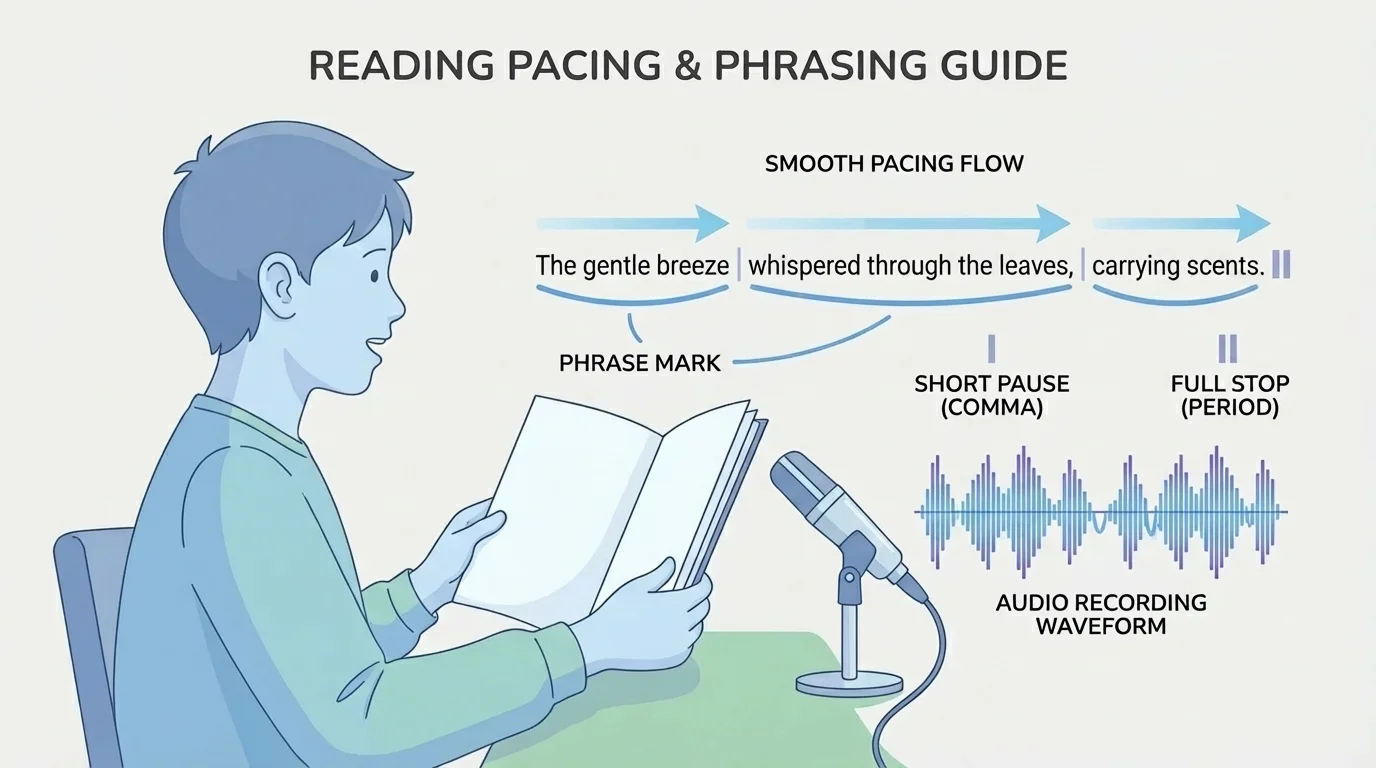
Another part of fluid reading is phrasing. Instead of reading one word at a time, read groups of words that belong together. For example, in the sentence The small rabbit hopped across the moonlit garden, the words should flow in meaningful parts, not sound broken apart. This makes the reading easier to understand.
Later, when you check your recording, think back to the smooth phrasing in [Figure 1]. If your reading sounds choppy, you may need to practice where to pause and where to keep moving through the sentence.
Your voice gives life to the words. One important part is expression. Expression means your voice matches the meaning of the text. A cheerful line should not sound sad. A scary moment should not sound flat. In a poem about rain, a soft, gentle voice may fit. In an exciting adventure story, a stronger and more energetic voice may work better.
Tone is the feeling your voice gives to the listener. Tone can be playful, serious, calm, proud, mysterious, or excited. You choose tone by changing how your voice sounds. You do not need to overact. Small changes can make a big difference.
You can also use volume, pitch, and pauses. Volume is how loud or soft your voice is. Pitch is how high or low your voice sounds. Pauses are short moments of silence. A pause before an important line can make listeners pay attention. A softer voice can show tenderness. A slightly louder voice can show surprise or danger.
Matching voice to meaning
When readers match their voice to the words, listeners understand more than the dictionary meaning. They hear emotion, mood, and importance. This is especially powerful in poems, where the sound of the language matters almost as much as the words themselves.
If a story has dialogue, you may change your voice slightly for different characters. Keep the differences simple so the recording still sounds natural. You do not need a completely different voice for each character. A small shift in tone or speed is often enough.
These voice choices help in both informal and formal communication. In an informal recording, expression can sound conversational and friendly. In a formal presentation, expression should still be meaningful, but not silly or distracting. The goal is always clear understanding.
Good recordings usually begin before the microphone is on. First, read the text silently and then aloud. Notice what is happening, who is speaking, and what feeling the author creates. When you understand the text, your reading sounds more natural.
Next, mark the text in a simple way. You might underline words you want to stress, circle hard words, or draw slashes where you plan to pause. This helps you remember your voice choices while you read.
It is also helpful to practice words that may be tricky to pronounce. If the story has names such as Isabella or Montgomery, say them several times before recording. If a poem uses repeated lines, practice making them sound connected but not exactly the same each time.
You already know that punctuation marks help readers understand sentences. Those same marks guide your voice when you read aloud. Commas often signal a short pause, periods signal a stop, and question marks may lift your voice at the end.
Another smart step is to decide your purpose. Are you trying to entertain, inform, or create a feeling? A funny folktale might need playful expression. A thoughtful poem about nature might need a calmer style. Purpose helps shape your pace and tone.
Before you begin recording, set up your space carefully. Try to record in a place with little background noise. Turn off sounds that may interrupt, such as a television or loud fan.
[Figure 2] Sit or stand upright so you can breathe comfortably. Hold the text where you can see it easily. If you are too cramped or too far from the page, your reading may become less smooth. Good breathing supports a steady voice.
Keep the microphone or device close enough to hear you clearly, but not so close that your breathing or popping sounds become too strong. Speak toward the microphone with a natural voice. You do not need to shout.
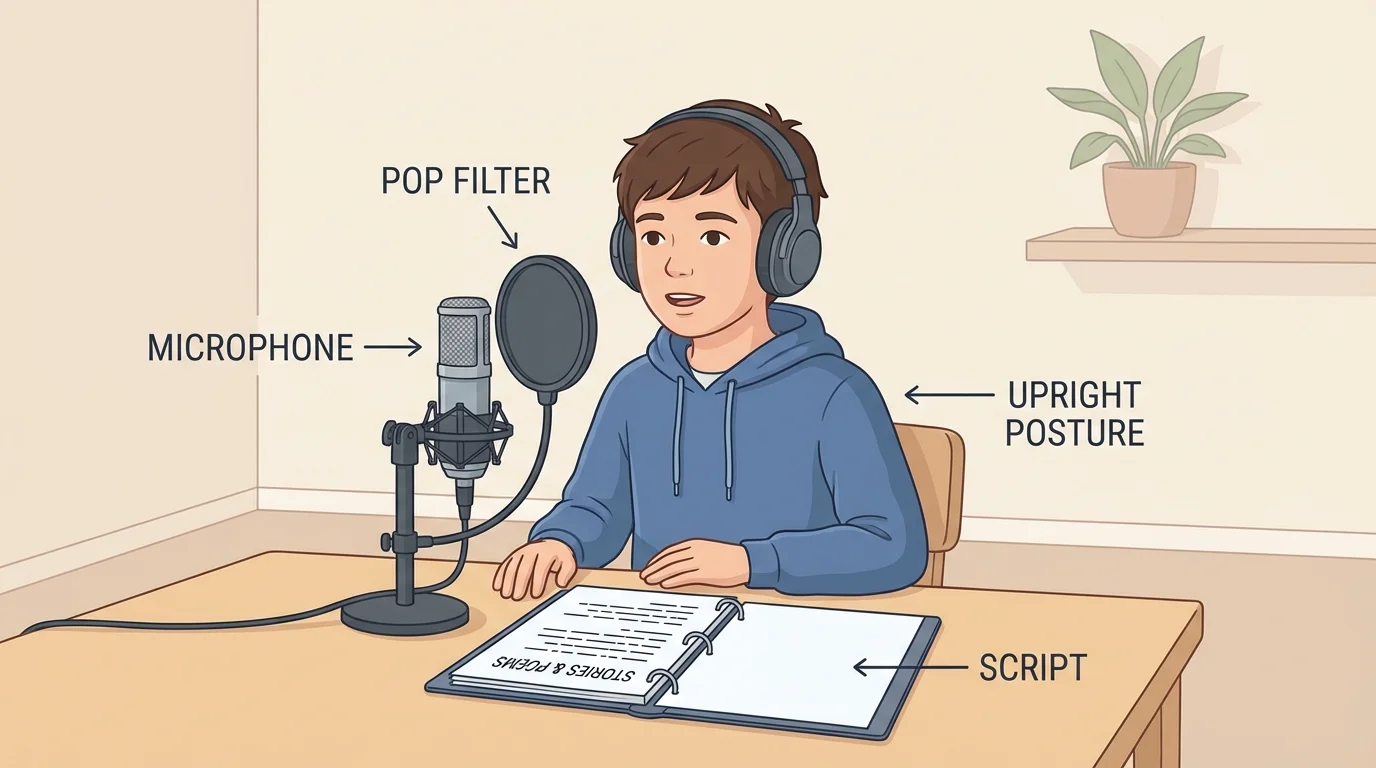
Start with the title and, if needed, the author's name. Then begin reading with calm focus. If you make a small mistake, you can stop and record that part again. Many good recordings are made by practicing and trying more than once.
After recording, listen back carefully. Ask yourself whether the words are easy to understand. Is your pace steady? Do you sound interested in the text? As you listen, compare your setup and delivery to the clear habits shown in [Figure 2]. This helps you notice what to improve.
Example: Checking a recording
A student records a short story opening: The wind pushed at the old gate, and Mia stepped into the silent yard.
Step 1: Listen for clarity.
Are all the words easy to hear, especially important words like old gate and silent yard?
Step 2: Listen for pace.
If the sentence rushes by, listeners may miss the spooky feeling. Slow slightly after gate and before silent yard.
Step 3: Listen for expression.
The voice should sound a little mysterious, not cheerful and bouncy.
With these changes, the recording becomes easier to understand and more engaging.
A strong recording does not need to sound perfect like a movie actor. It needs to sound clear, thoughtful, and matched to the text.
Sometimes an audio recording is even stronger with a visual display. Visual displays can emphasize important details. They are especially useful when the audience is also watching a screen.
[Figure 3] A visual display should have a clear purpose. You might show the title of the story, a picture of the setting, an illustration of an important object, or a slide with a key word or phrase from the poem. If a poem repeats the word thunder, a dark cloud image might help show the mood. If a story takes place in a forest, a forest scene can help listeners picture the setting.
The best visuals are simple. Too many pictures, colors, or words can distract the audience. The visuals should support your reading, not compete with it. If you add text on a slide, keep it short and easy to read.
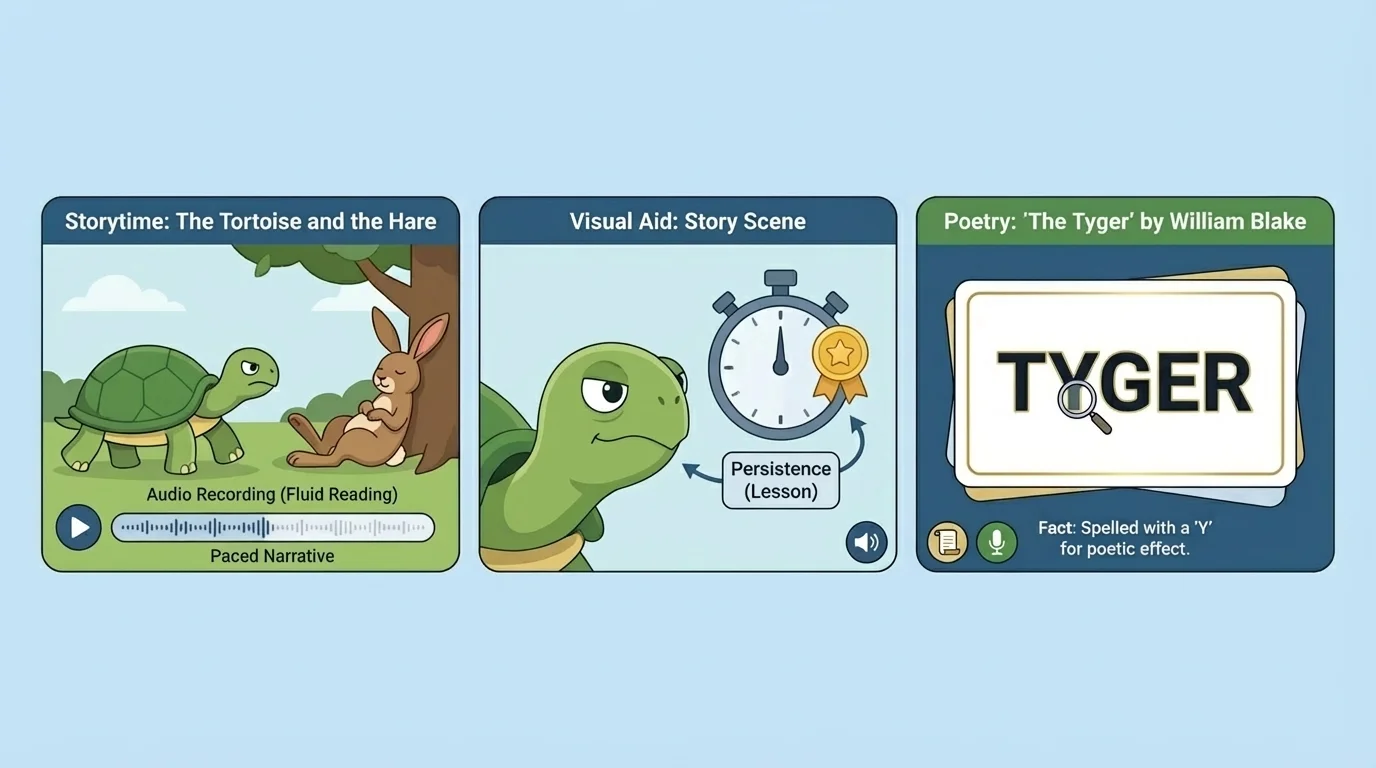
Visual displays can also highlight facts or details in a nonfiction poem or informational text. For example, if a poem mentions the moon, a picture of the moon can help the audience focus on that image. If a story mentions a lighthouse, showing a lighthouse can make that detail stronger.
When you design visuals, remember the balance shown in [Figure 3]. Each image or slide should connect clearly to the words you are reading. If a picture is random or too busy, it may confuse listeners instead of helping them.
| Helpful Visual Choice | Why It Works | Less Helpful Choice | Why It Distracts |
|---|---|---|---|
| Title slide with story name | Prepares the audience | Many spinning words | Takes attention away from the reading |
| One picture of the setting | Builds a clear image | Several unrelated pictures | Confuses the audience |
| Key word from the poem | Emphasizes an important idea | Whole paragraph on screen | Makes viewers read instead of listen |
Table 1. Comparison of visual choices that support a recording and choices that distract from it.
Suppose you are recording a story about a lost puppy. At the beginning, your voice may sound worried but hopeful. When the puppy is found, your tone can brighten. You might pause before the line There he was to build suspense. A simple picture of the puppy's red collar could be a helpful visual detail.
Now think about a poem about snow falling at night. Your pace might be slightly slower and softer. You may lower your volume on a quiet line and stretch a pause after a beautiful image. A picture of snowy trees could support the mood, but a busy slideshow with many animations would not fit the calm poem.
Professional audiobook readers often reread the same page many times to make sure the pace, expression, and pronunciation are just right. Good oral reading is a skill built through practice and careful listening.
Different texts ask for different choices. That is part of what makes reading aloud interesting. The same reader may sound lively in one text and gentle in another because the meaning changes.
When you communicate, you think about your audience. If you are making a recording for younger children, you might use a very clear pace and warm expression. If you are recording for a class presentation, your language should sound polished and respectful. The words in the text stay the same, but your delivery changes to fit the situation.
This is part of using appropriate language in informal and formal situations. In an informal setting, a natural, friendly style may fit best. In a formal setting, your speech should sound organized and careful. Even then, it should not sound stiff. Good speakers sound clear and confident.
For example, if you introduce your recording, an informal opening might be, Here's a fun poem I'd like to share. A more formal opening might be, Today I will present a poem called "Night Sky." Both can be correct, depending on the audience and purpose.
One common problem is reading too fast. If this happens, practice breathing at punctuation marks and slowing down on important words. Another problem is reading in a monotone voice, where everything sounds the same. To fix that, think about the feeling of each line before you say it.
Some readers pause in the wrong places, which makes the meaning unclear. Remember the phrasing pattern from [Figure 1]. Reading in word groups helps the sentence make sense. If a sentence is long, practice it several times until it sounds smooth.
Background noise is another problem. The clean setup in [Figure 2] reminds us that even a strong voice can be hard to hear if the room is noisy. You can also fix unclear speech by opening your mouth fully, pronouncing ending sounds, and keeping a comfortable distance from the microphone.
Example: Improving a poem recording
A student reads a poem too quickly and in the same flat tone from beginning to end.
Step 1: Mark the poem.
Underline strong words, circle repeated words, and mark short pauses.
Step 2: Choose the mood.
If the poem is peaceful, read more softly and more slowly.
Step 3: Record again.
This time, let your voice rise or fall where the meaning changes.
The new version sounds more fluent and helps listeners feel the poem's mood.
As you grow as a reader, you will notice that strong recordings combine many skills at once: understanding the text, speaking clearly, reading smoothly, and making smart choices for the audience. Those skills help not only with stories and poems, but with all kinds of speaking and listening.
