Great writing rarely appears perfectly on the first try. Even authors who write books need to go back, change words, move sentences, and fix mistakes. That means effective writers are not just people with good ideas. They are people who keep working on their writing until it says what they really mean.
Writing is a recursive process, which means writers do not always go in a straight line from start to finish. They may make a plan, write a draft, revise it, edit it, and then return to an earlier step again. The writing cycle in [Figure 1] shows that writers often loop back to improve their work instead of stopping after one draft.
When you write, you are building something with words. First, you gather ideas. Next, you shape those ideas into sentences and paragraphs. Then you make your writing stronger and clearer. Last, you fix mistakes so readers can understand it easily. Sometimes, while editing, you notice a sentence does not belong, so you revise again. Sometimes, while revising, you realize you need a better plan. That is normal.
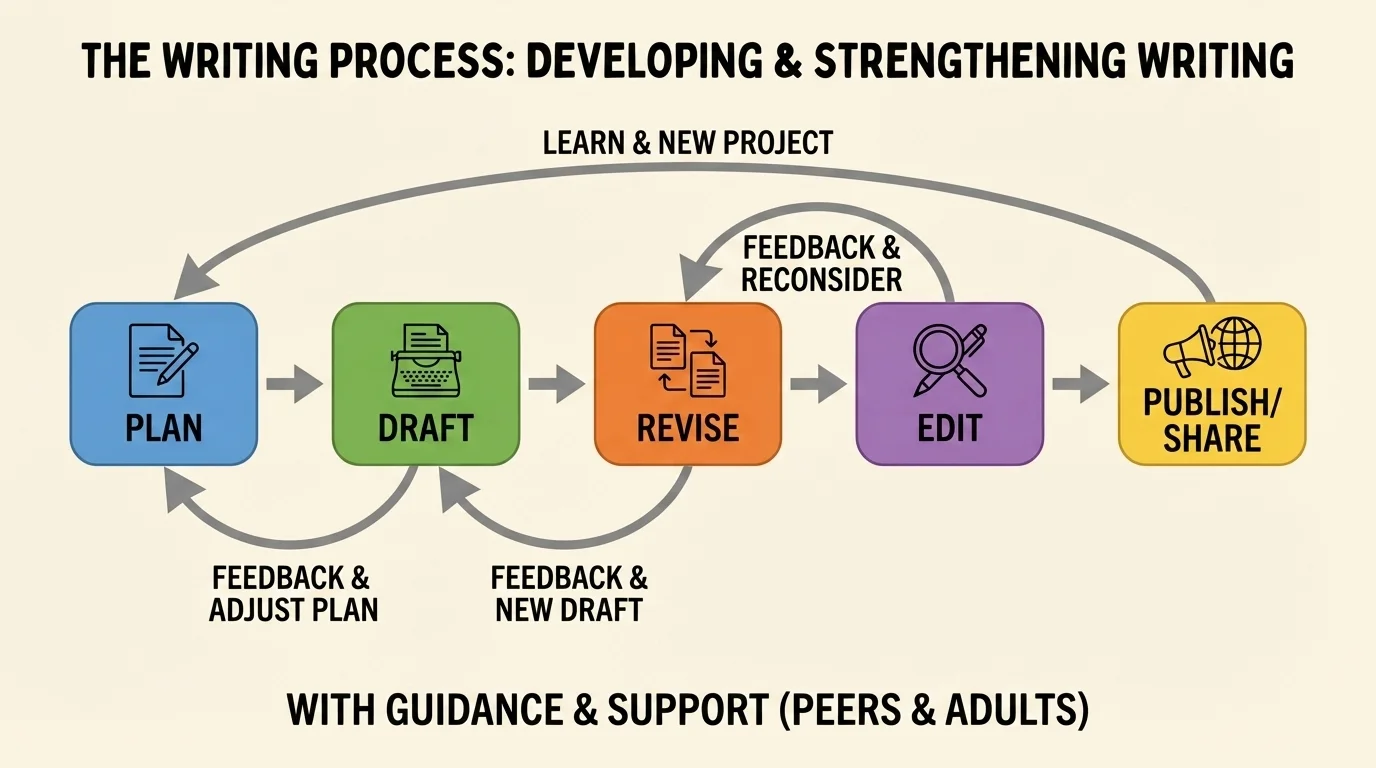
This is why guidance and support matter. A classmate might say, "I do not understand this part," and that tells you to revise. A teacher might point to a missing period or capital letter, and that helps you edit. Good writers use help wisely, but they also stay in charge of their own ideas.
Plan means to think about what you will write and how you will organize it. Draft is the first version of your writing. Revise means to improve the ideas, details, and order. Edit means to correct mistakes in grammar, capitalization, punctuation, and spelling.
These words are important because each one names a different job. If you only edit, you may fix a spelling mistake but still have a weak paragraph. If you only revise, you may improve the ideas but leave many errors. Strong writing needs both kinds of work.
[Figure 2] Before writing full sentences, it helps to make a plan. A plan can be a list, a quick sketch, or a simple organizer. A writer can start with one topic and branch out to important ideas and details. Planning helps you remember what to say and what order to say it in.
When you plan, think about three things: topic, purpose, and audience. The topic is what you are writing about. The purpose is why you are writing. Are you telling a story, explaining something, or sharing an opinion? The audience is who will read it. Writing for your teacher may sound different from writing a note to a friend.
A good plan does not need to be long. If you are writing about your best day at the park, your plan might say: beginning—arrived and saw the playground; middle—played soccer and had a picnic; end—watched the sunset before going home. You could also add details such as who was there, what you heard, and how you felt.
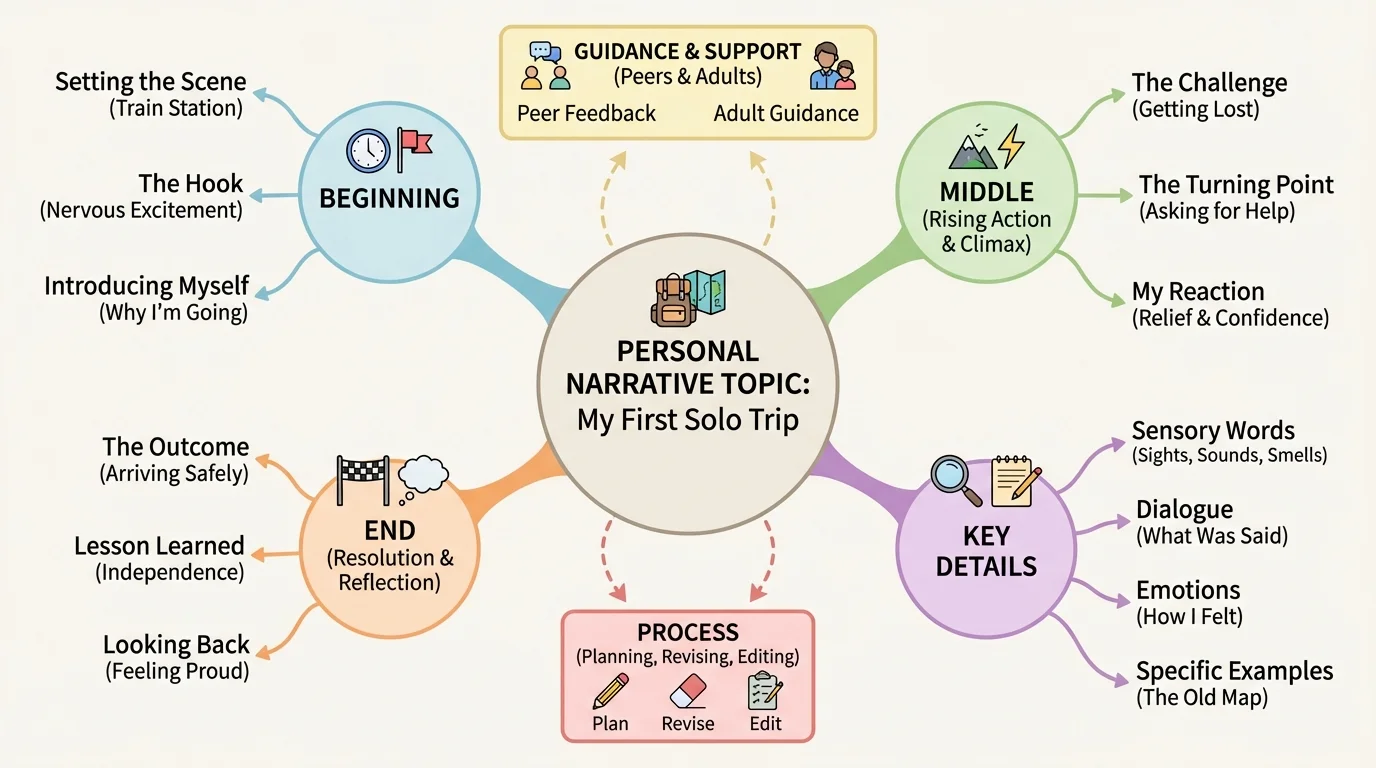
Planning also helps prevent confusion. Without a plan, a writer might jump from one idea to another and leave out important information. With a plan, the writing is easier to follow. Readers should not feel lost.
You already know that sentences share ideas and that paragraphs group connected ideas together. Planning helps you decide which ideas belong together before you begin writing the draft.
Some writers think planning slows them down, but it often saves time. A few minutes of planning can make drafting easier and revising less difficult later.
A draft is your first version. It does not need to be perfect. Its job is to get your ideas onto the page. Many young writers stop because they want every sentence to sound perfect right away. But drafting works better when you focus first on saying your ideas clearly.
When you draft, turn your plan into sentences and paragraphs. Use a beginning that introduces the topic, a middle that adds details, and an ending that gives a feeling of completion. If you are writing a story, include actions, thoughts, and events in order. If you are explaining something, include facts and steps that make sense.
Suppose your plan is about planting a seed. A draft might begin like this: "First, I filled a pot with soil. Next, I pressed one bean seed into the dirt. Then I watered it and put it by the window." This draft shares the main ideas. Later, the writer can revise to add stronger details, such as how the soil felt or how long the plant took to grow.
Professional authors often write many drafts. Some books begin with pages that later change a lot before the final version is published.
During drafting, it is fine if some parts are rough. You may repeat a word too often or forget a detail. That is why revision comes next.
[Figure 3] Revising means improving the writing so the meaning is clearer, stronger, and more interesting. It is more than fixing mistakes. The comparison illustrates how a simple sentence can become better when a writer adds details, chooses stronger words, and makes the order clearer.
When writers revise, they ask questions such as: Does this make sense? Did I include enough details? Are my ideas in the best order? Is there a better word I can use? Did I stay on topic? Revising may mean adding, removing, changing, or moving parts of the writing.
Look at this plain sentence: "I went outside and it was nice." A stronger revised sentence could be: "I stepped outside into the cool morning air and heard birds singing in the trees." The second sentence helps the reader picture the scene more clearly. It uses more exact words and richer details.
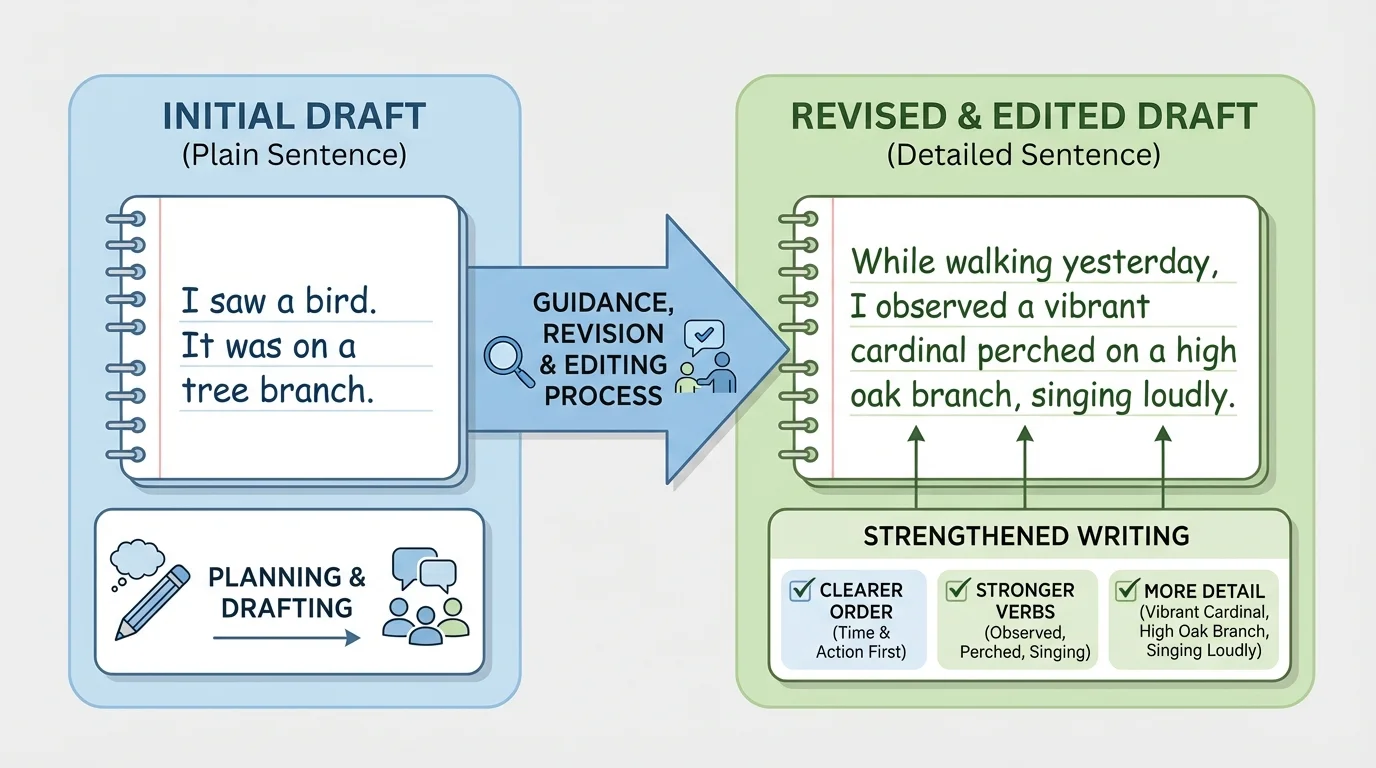
Writers can revise single sentences, but they also revise whole paragraphs. Maybe the ending comes too suddenly. Maybe the best detail belongs in the beginning. Maybe one sentence repeats an idea already given. Revising helps writing flow from one part to the next.
Revision changes meaning and quality. Editing corrects mistakes, but revision improves communication. A revised piece may have new details, stronger verbs, clearer order, or a better beginning and ending. Writers revise so readers can understand and enjoy the message.
Peers and adults are especially helpful during revision. A partner might say, "I want to know what happened after the game started," which shows you where to add details. A teacher may suggest a stronger opening sentence. As you saw earlier in [Figure 1], revision is one step in a cycle, and you may return to it more than once.
After revising, writers edit their work. Editing means checking the rules of writing so the piece is correct and easy to read. This includes grammar, capitalization, punctuation, and spelling.
Grammar helps sentences sound right. For example, "She run to the bus" should be "She runs to the bus" or "She ran to the bus," depending on the time of the action. Correct grammar helps readers understand exactly what the writer means.
Capitalization means using uppercase letters where they belong. The first word in a sentence starts with a capital letter. Names of people, days of the week, months, and places also need capitals. "my friend leo visited denver on monday" should be "My friend Leo visited Denver on Monday."
Punctuation includes marks such as periods, question marks, commas, and quotation marks. These marks help organize writing. Without punctuation, readers may not know where one idea ends and another begins. Compare "Lets eat Grandma" with "Let's eat, Grandma." One comma changes the meaning.
Spelling matters because readers need to recognize words quickly. If many words are misspelled, the reader may have to stop and guess. Writers can use classroom word walls, dictionaries, charts, or help from adults to fix spelling errors.
| Part of editing | What to check | Example |
|---|---|---|
| Grammar | Does the sentence sound right? | "He jump" becomes "He jumps." |
| Capitalization | Did I use capital letters correctly? | "friday" becomes "Friday." |
| Punctuation | Did I end and separate ideas clearly? | "Where are you" becomes "Where are you?" |
| Spelling | Are the words spelled correctly? | "becaus" becomes "because." |
Table 1. The table shows the main parts of editing and a simple example of each one.
Editing is easier when you go slowly. Many writers read their work aloud. When you hear the words, you may notice missing words, awkward grammar, or punctuation that needs to be fixed.
Feedback is information a writer receives from someone else about the writing. Helpful feedback is kind, clear, and specific. Instead of saying, "It's bad," a peer might say, "I like your beginning, but I do not understand what happened in the middle." That helps the writer know what to improve.
A classmate may notice whether your ideas make sense to another reader. An adult may help you find grammar or spelling problems you missed. Both kinds of support matter. Writers do not have to accept every suggestion, but they should listen carefully and think about what will improve the writing.
How to use feedback well
Step 1: Listen or read carefully.
Do not rush. Make sure you understand what the person is telling you.
Step 2: Ask questions.
You might ask, "Which part was confusing?" or "Can you show me where I need a capital letter?"
Step 3: Decide what changes will help.
Choose the suggestions that make your writing clearer, stronger, or more correct.
Step 4: Revise or edit.
Make the changes and reread your work to see if it improved.
It also helps to give good feedback to others. When students support each other, everyone becomes a stronger writer. Saying what works well is important too. A writer should know the strong parts to keep.
Let's look at how one short piece can grow stronger through planning, drafting, revising, and editing. Notice that revision changes ideas and details, while editing fixes mistakes.
The writer's plan is simple: topic—lost tooth; beginning—it felt loose at breakfast; middle—it fell out at school; end—I put it under my pillow. That plan gives the writer a clear path.
From first draft to stronger writing
Step 1: First draft
"I had a loose tooth. It came out at school. I was happy."
Step 2: Revised version
"At breakfast, my front tooth felt so loose that I could barely bite my toast. Later at school, it popped out while I was talking to my friend, and I grinned all afternoon."
Step 3: Edited version
"At breakfast, my front tooth felt so loose that I could barely bite my toast. Later at school, it popped out while I was talking to my friend, and I grinned all afternoon."
In this case, the revised version was already edited correctly, but many pieces need punctuation, capitalization, or spelling fixes after revision.
This example shows how much stronger writing can become. The first draft tells the basic idea. The revised version adds exact details and creates a clearer picture. That is the power of revision, just as the sentence comparison in [Figure 3] shows with a smaller example.
Sometimes editing changes the final version even more. If the student had written "at breakfast my front tooth felt loose later at school it popped out," editing would add capital letters and punctuation so the reader could follow the ideas.
Strong writers build habits over time. They plan before they draft. They reread what they write. They revise when something is unclear. They edit carefully before turning in their work. They ask for help when needed and use feedback to make good choices.
Another strong habit is patience. Writing can feel frustrating when a sentence does not sound right. But improvement often happens when a writer pauses, thinks, and tries again. Every change teaches something.
"Good writing is not just written. It is rewritten."
You do not have to write perfectly the first time. You do need to stay willing to improve. With support from peers and adults, your writing can become clearer, more detailed, and more correct. Over time, the process becomes more natural, and you begin to notice what your own writing needs.
