Have you ever needed to answer a question like, "What do rabbits eat?" or "Why do leaves change color?" You might already know a little from life, books, or videos. A researcher does something very much like that: first, the researcher thinks about what is already known, then looks for new facts, and then organizes those facts so they make sense. Even third graders can do real research when they work carefully and keep their ideas neat.
Short research projects help students become strong readers, thinkers, and writers. In a short project, you gather information from your own life and from trusted sources. Then you take short notes and sort them into groups. That makes it easier to answer a question, write a report, or share what you learned with a class.
Research means finding out about a topic by asking questions and collecting information. Research is not only for scientists and historians. People research when they choose a pet, learn about a storm, or figure out how plants grow best in a garden.
Good research has a purpose. You are trying to learn something true and useful. That means you should look for facts, not guesses. It also means you should keep track of where each fact came from, because strong learners can explain, "I found this in a book," or "This came from the zoo website."
Many nonfiction books, websites, and magazines are made especially to answer questions children ask every day, from animal behavior to weather to famous people.
When you research, you are really doing three big jobs. First, you gather information. Next, you take notes so you do not forget the important parts. Last, you sort your evidence into groups so it is easier to understand and communicate.
One place information comes from is your own experience. If you are researching butterflies, you may remember seeing one land on a flower. If you are researching community helpers, you may remember visiting a fire station. These memories can help you get started.
But memory must be used carefully. Sometimes we remember part of something and miss other parts. For example, a student may remember that all birds fly because the birds they often see can fly. Later, research may show that some birds, like ostriches and penguins, do not fly. So your own experience is helpful, but it is not the only evidence you should use.
You already know how to ask and answer questions while reading. Research uses that same skill, but now you collect information from more than one place and organize it.
A smart way to begin is to say what you think you know, then check it with sources. You might say, "I know frogs live near water," and then look for books or websites that confirm whether that is true and add more details.
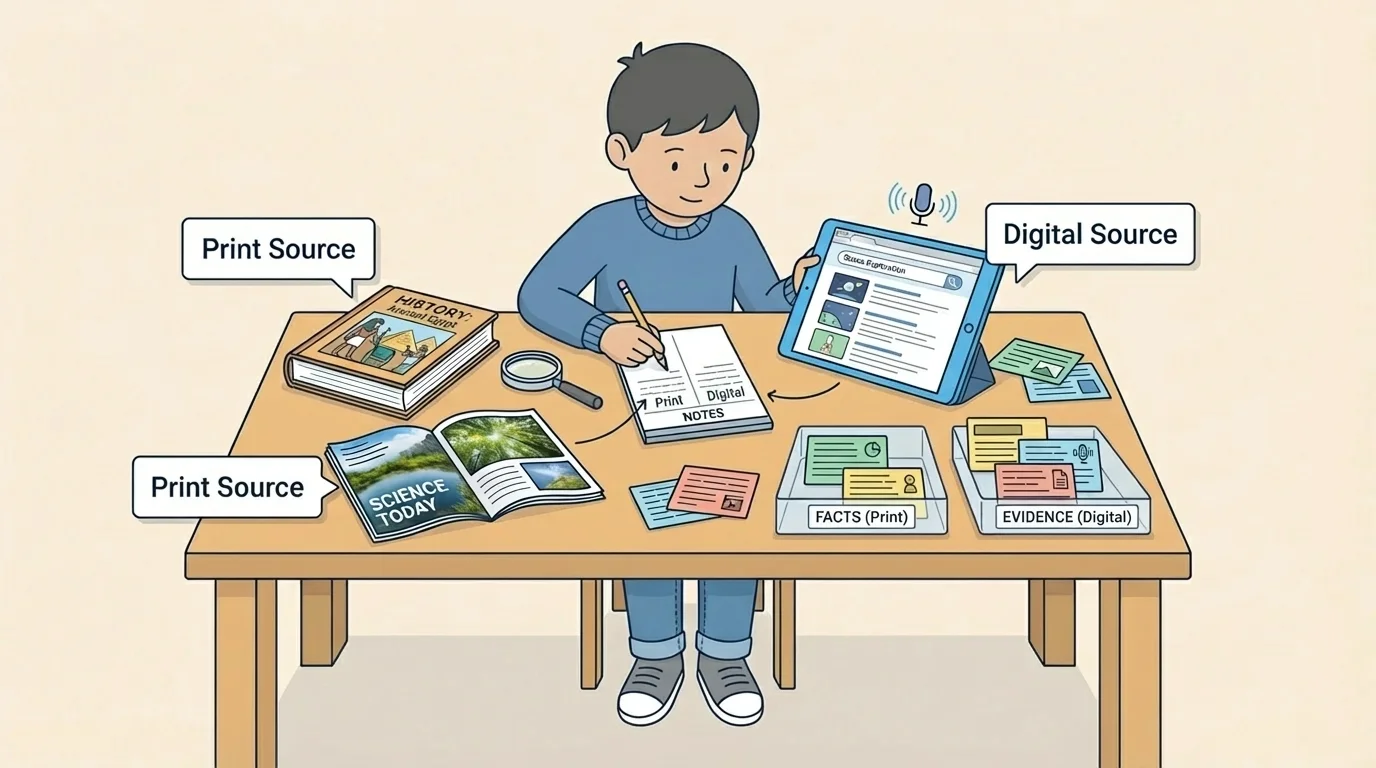
[Figure 1] A source is where information comes from. Sources can be things you read, view, or remember. In research, students often use books, articles, photos with captions, encyclopedias, and teacher-approved websites. Some sources are printed on paper and some are read on a screen, but both can teach you about a topic.
Print sources are sources you can hold in your hands. These include library books, classroom books, newspapers, magazines, brochures, and printed articles. Print sources are often easy to mark with sticky notes or bookmark tabs while you read.
Digital sources are sources you read or watch on a computer, tablet, or other device. These may include school websites, online articles, digital encyclopedias, or videos chosen by a teacher. Digital sources can be very helpful because they may have photographs, sound, and updated facts.
Not every source is equally helpful. A source should match your topic and answer your question. If your question is "What do sea turtles eat?" then a book about ocean animals may help, but a storybook about a family trip to the beach may not give enough facts.
Later, when you compare sources, [Figure 1] still matters because it reminds you that good information can come from more than one kind of text. A careful researcher does not depend on just one place.
Print source means information on paper, such as a book or magazine. Digital source means information on a screen, such as a website or online article. Evidence means facts or details that help answer a research question.
Sometimes people are also sources. A park ranger, nurse, or grandparent may share information from experience. In school research, though, students usually use their own memories plus print and digital texts, because those can be checked again later.
A topic is broad, but a research question is focused. "Sharks" is a topic. "How do sharks survive in the ocean?" is a research question. Questions help your reading stay on track. Without a question, it is easy to collect too many details that do not fit together.
Good research questions are clear and answerable. They often begin with words like how, why, what, or where. For third grade, the question should be small enough to answer with a few sources.
Here are some examples of broad topics and stronger questions:
| Broad Topic | Stronger Research Question |
|---|---|
| Bees | How do bees help flowers grow? |
| Volcanoes | What happens when a volcano erupts? |
| Owls | Where do owls live and hunt? |
| Recycling | Why is recycling important in a community? |
Table 1. Examples of broad topics changed into focused research questions.
Once you have a question, you can look for evidence that answers it. If a detail does not help answer the question, it may not belong in your notes.
Print sources have useful text features that help you find facts faster. The title tells the main topic. Headings tell what each section is about. Captions explain pictures. A table of contents helps you find chapters, and an index helps you find specific words near the back of a book.
If you are researching penguins, you might look in a nonfiction book and use the index to find the word food. Then you can turn to those pages and read just the parts connected to your question. This saves time and helps you stay focused.
Readers should also pay attention to diagrams, maps, labels, and sidebars. Sometimes a single caption gives a fact that is not written in the main paragraph. For example, a picture caption may tell you that emperor penguins huddle together to stay warm.
Reading like a researcher means you do not read every page in the same way. Sometimes you skim headings to find the right section. Sometimes you slow down and reread one sentence because it contains an important fact. Researchers choose what to read closely based on their question.
As you gather information, stop and ask, "Does this fact help answer my question?" If the answer is yes, it may belong in your notes. If the answer is no, leave it out so your work stays clear.
Digital sources can be excellent tools when they are chosen carefully. A teacher may give a list of safe websites, digital books, or kid-friendly databases. On a website, you can look for the title, the organization name, and the date if one is listed.
It is important to move slowly online. Screens can have many buttons, pictures, and links, which may distract you. A strong researcher stays with the topic and avoids clicking randomly. If you are researching bats, stay with the page that explains bat habitats instead of jumping to unrelated games or ads.
Videos can also be digital sources. When watching a short educational video, listen for facts that answer your research question. You can pause and jot down a few words. For example, a student learning about tornadoes might note: "forms from strong storm," "spinning wind," and "can damage buildings."
Whenever possible, record enough source information so you can remember where the fact came from later. For younger students, this may be as simple as writing the book title, website name, or article title.
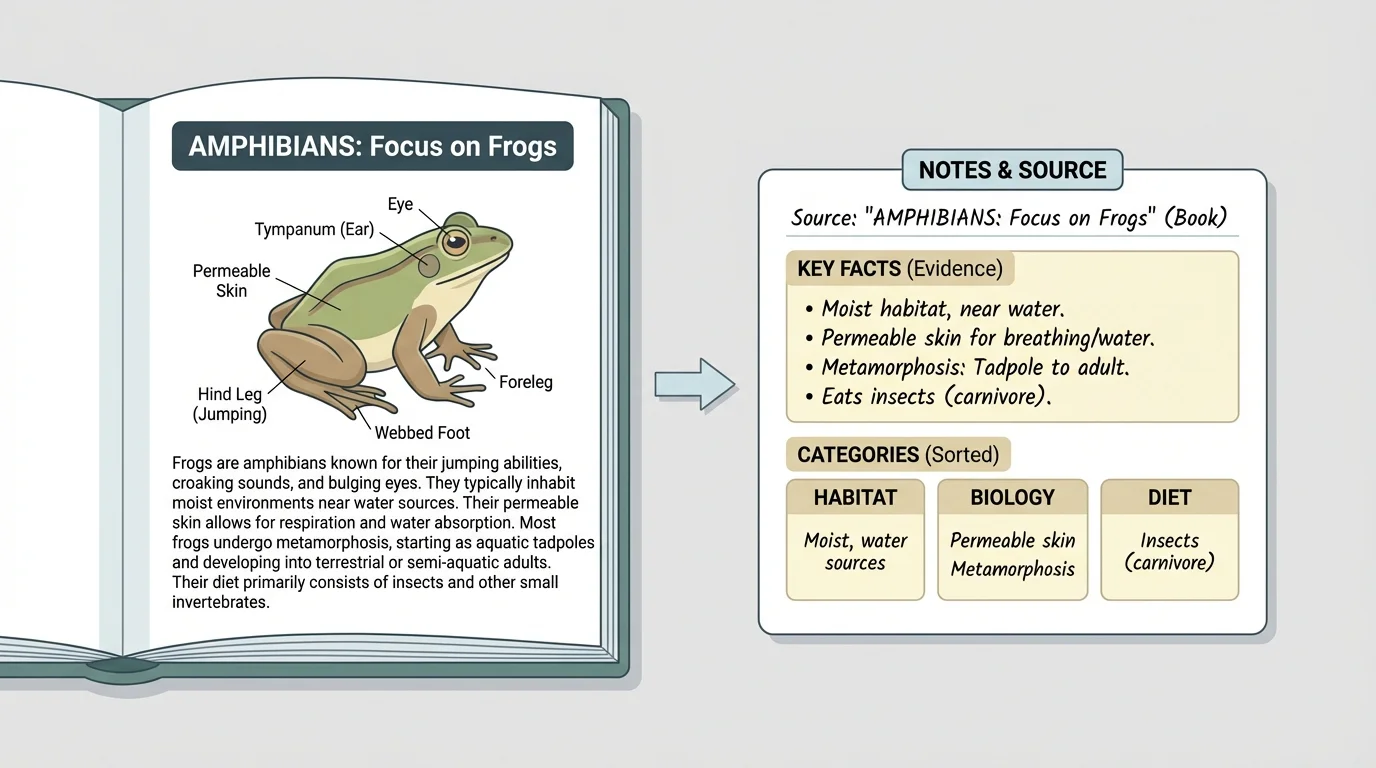
[Figure 2] Notes are short pieces of information you write down so you can remember important facts. Good notes are brief, clear, and connected to a source. Notes are not copied paragraphs. They are short words and phrases that help your brain remember the idea.
When taking notes, do not copy a whole page or even a whole sentence unless a teacher asks you to write an exact quotation. Most of the time, you should put the idea into your own short words. This helps you understand what you read.
For example, suppose a book says, "Frogs begin life as eggs in water and later develop into tadpoles." A brief note could say: "frogs start as eggs in water" and "tadpoles come next." Those notes are short, but they keep the important meaning.
It also helps to record the source next to the note. You might write something like: Book: Amazing Frogs or Website: National Zoo frogs page. Then, if you want to check the fact again, you know where to return.
Some students like to use note cards. Others use a chart, notebook, or digital document. The tool can change, but the rule stays the same: keep notes short and meaningful.
Example: Turning source sentences into brief notes
A student is researching polar bears.
Step 1: Read a source sentence.
The source says, "Polar bears have a thick layer of fat and dense fur that help them stay warm in the Arctic."
Step 2: Find the most important ideas.
The key ideas are fat, dense fur, and stay warm.
Step 3: Write a brief note in your own words.
Possible note: "thick fat + fur keep polar bears warm."
Step 4: Add the source.
Source note: Book: Arctic Animals
This note is short, easy to read, and linked to its source.
Later, when students sort their ideas, [Figure 2] helps remind them that neat, brief notes are easier to move into categories than long copied sentences are.
[Figure 3] Once you collect facts, you need to organize them. Category means a group for similar information. Sorting evidence into categories helps you see patterns and makes it easier to speak or write clearly about your topic.
Teachers often provide categories for students. If the topic is an animal, categories might be appearance, habitat, food, and behavior. If the topic is a famous person, categories might be early life, important work, and why the person is remembered.
Suppose you are researching turtles. A note that says "eats jellyfish" belongs in food. A note that says "lives in the ocean" belongs in habitat. A note that says "has a hard shell" belongs in appearance or body. Sorting helps you keep ideas from getting mixed up.
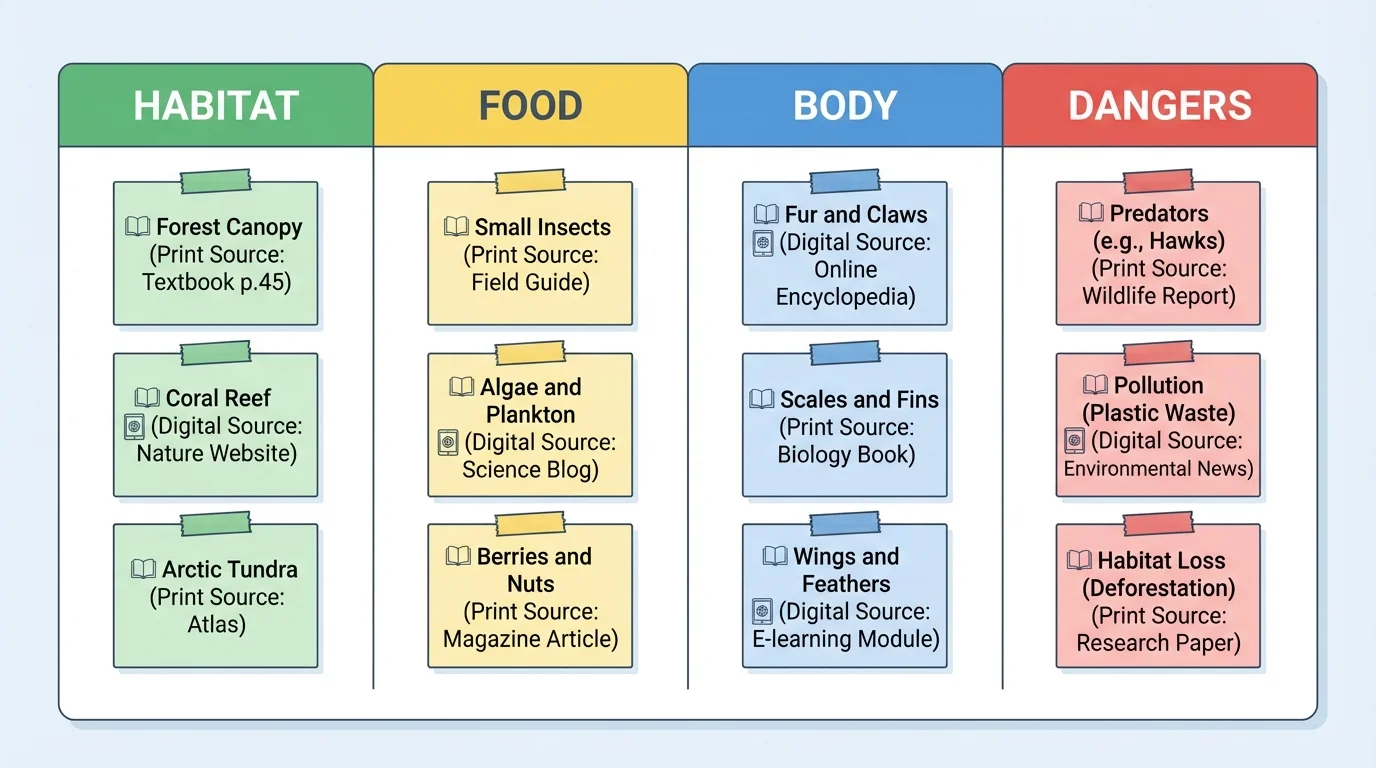
You can sort notes on paper, in a table, or by moving note cards into piles. Some students use a chart with category names across the top and place each note under the correct heading.
| Note | Best Category |
|---|---|
| Builds dams in rivers | Behavior |
| Eats bark and plants | Food |
| Has large front teeth | Appearance |
| Lives near water | Habitat |
Table 2. An example of evidence sorted into categories for a beaver research project.
Later, if you write a paragraph about where an animal lives, you can look only at the habitat notes. That is why [Figure 3] remains useful even after the sorting is finished.
Organizing evidence means putting facts where they belong so your ideas are easier to understand. When evidence is sorted well, a reader or listener can follow your thinking from one group of facts to the next.
Sometimes one note seems like it could fit in two categories. If that happens, think about your question and choose the best fit. You can also ask whether the teacher wants each note used only once or whether some facts can appear in more than one group.
Good researchers do not stop after gathering notes. They check their work. Ask yourself: Did I answer the question? Do my notes come from sources? Are my facts organized? Have I used more than one source when possible?
Checking is important because sources sometimes give different details. One book may say a cheetah can run up to a certain speed, and another source may give a slightly different number. Instead of guessing, a student can notice that sources may vary and choose the clearest, most trusted source available in class.
After checking, you communicate what you learned. You might write a paragraph, make a poster, share an oral report, or complete a chart. When you communicate, the categories help you present your ideas in a logical order.
Example: From notes to a short explanation
A student researched owls using categories.
Step 1: Look at the habitat notes.
Notes say: "forests," "grasslands," and "tree holes or nests."
Step 2: Turn the notes into connected sentences.
Possible explanation: "Owls live in places such as forests and grasslands. Many owls rest in tree holes or nests."
Step 3: Add another category if needed.
Food notes say: "mice," "small animals." The student adds, "They often hunt mice and other small animals."
The categories help the student build clear sentences with facts.
Sharing research is easier when every note has a job to do. Facts from sources answer the question, and the organized categories help the listener or reader understand the answer.
One common mistake is copying too much. When students copy long parts of a source, they may not really understand the information. Brief notes help you think about what matters most.
Another mistake is forgetting the source. If you write down a fact but do not record where it came from, you may not be able to check it later. Even a short source label is helpful.
A third mistake is writing details that do not answer the research question. If the question is about what pandas eat, then notes about how to draw a panda are off-topic. Staying focused saves time.
"Good researchers do not just collect information. They choose, check, and organize it."
Strong habits make research easier: ask a clear question, use more than one source when you can, take brief notes, label each source, and sort evidence carefully. These habits turn a pile of facts into learning you can actually use.
