Have you ever noticed that the same idea can sound very different depending on the words you choose? You might say, "It is getting dark," or you might say, "The sky grew dim at sunset." Both sentences make sense, but one paints a sharper picture. Strong readers and writers learn how to choose words that fit the moment. They use everyday words in conversations, school words in explanations, and special subject words when they talk or write about science, math, music, or other topics.
Words are tools. When you choose the right word, you help your listener or reader understand exactly what you mean. If your words are too simple, your meaning may feel fuzzy. If your words do not fit the topic, your ideas may sound confusing. Good vocabulary helps you speak clearly, read with understanding, and write with power.
Vocabulary also helps with reading. When you know more words, you can understand stories, directions, articles, and textbooks more easily. Sometimes a word is new, but you can still figure it out by using clues from the sentence, by noticing familiar word parts, or by thinking about other related words you already know.
Vocabulary is the set of words a person knows and uses. Context clues are hints in a sentence or paragraph that help readers figure out a word's meaning. Precise language means using words that say exactly what you mean.
When you build vocabulary, you are not just memorizing random words. You are learning how words work, how they connect, and when to use them.
Writers and speakers use different kinds of words for different jobs. One topic can be explained in several ways, as [Figure 1] shows with weather words. Knowing the difference helps you choose language that matches your purpose.
Conversational language includes the words and phrases people often use in everyday speech. These words feel natural in regular talk. For example, you might say, "It is really hot outside," or "I am tired after the game." These are clear, familiar ways to speak.
General academic words are useful in many school subjects. They are not just for one class. Words like compare, describe, predict, result, and observe appear in reading, science, math, and social studies. If a teacher says, "Compare the two characters," or "Describe what happened," those are academic directions.
Domain-specific words belong mostly to one topic or subject area. In science, you might hear habitat, evaporation, or mammal. In math, you might hear fraction, product, or equation. In music, you might hear rhythm or tempo. These special words help people talk exactly about that subject.
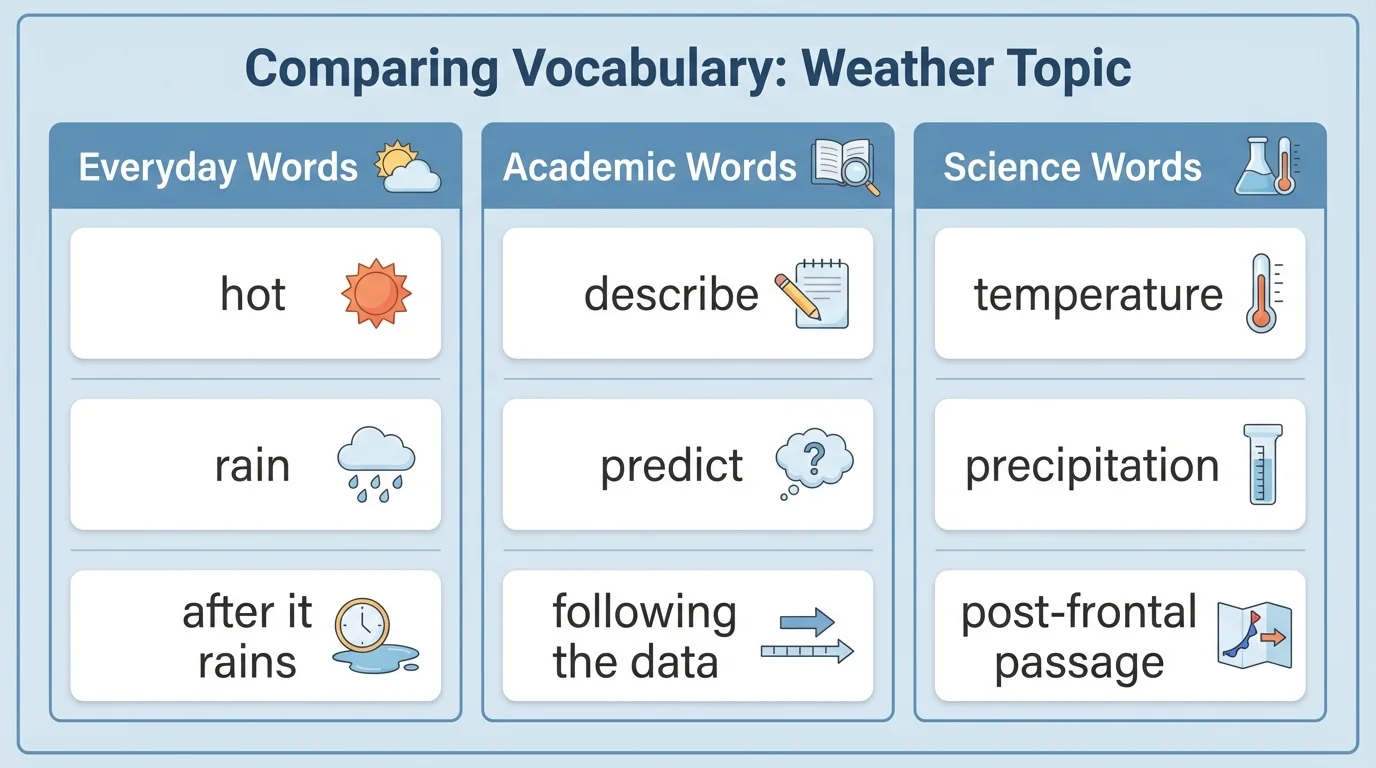
Here is one topic shown in three ways. A child might say, "It is hot today." In class, a student might say, "I observed that the weather is warmer than yesterday." In science, the student might say, "The temperature increased during the afternoon." The topic stays the same, but the vocabulary becomes more exact.
Strong learners can move between these kinds of words. They know when to sound relaxed, when to sound thoughtful, and when to use subject words that fit the lesson.
Many school directions use the same academic words again and again. Once you learn words like compare, sequence, and explain, you can understand instructions in many different subjects.
That is why vocabulary study matters in every class, not just during reading time.
Sometimes a new word looks tricky at first, but it may contain parts you already know. This is where word meanings and spelling patterns help. If you know the word help, then helpful may make sense because the ending -ful means "full of." If you know care, then careless may mean "without care."
Morphology is the study of word parts and meanings. A base word is the main part of a word. A prefix comes at the beginning, and a suffix comes at the end. For example, in replay, the prefix re- means "again." In hopeful, the suffix -ful adds meaning to the base word hope.
Spelling patterns can help, too. Words that look alike often have related sounds or meanings. If you can read light, you may more easily read bright or night. If you know sign, it may help with signal, even though the sounds change a bit. Paying attention to patterns helps you decode unfamiliar words and add them to your vocabulary.
How word clues work together
Readers often use more than one clue at the same time. They may notice a familiar prefix, recognize a spelling pattern, and look at the sentence for context clues. For example, in the sentence "The plants began to droop because they lacked moisture," a student may use context to understand that moisture has something to do with water.
Word relationships matter as well. Some words are synonyms, which means they have similar meanings, such as happy and glad. Some words are antonyms, which means they have opposite meanings, such as begin and end. Learning related words helps you pick the best one for each sentence.
Some words tell where something is. These are words and phrases that signal location, or spatial relationships. They act like clues that help readers picture space and position, as [Figure 2] illustrates with a scene full of objects in different places.
Words such as above, below, under, over, beside, between, behind, in front of, inside, and outside all tell where things are. Without these words, writing can feel flat and hard to picture.
Compare these sentences: "The cat sat." "The cat sat under the table." "The cat sat under the table beside the window." Each new phrase adds more location detail. The reader can picture the scene more clearly.
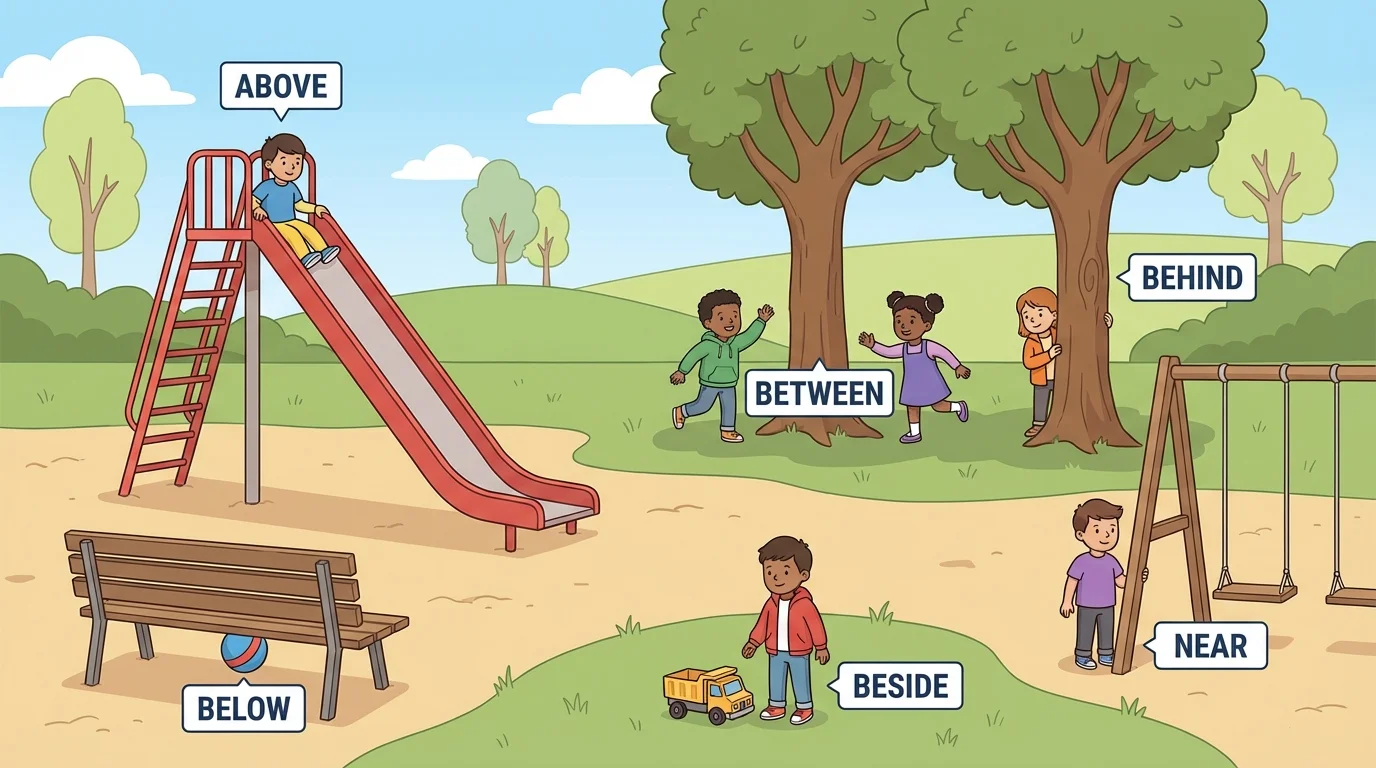
Spatial words are useful in stories, directions, and explanations. A story might say, "The treasure chest was buried beneath the old oak tree." Directions might say, "Put the glue beside the paper." A science book might explain, "The roots grow below the soil." In each case, location words make meaning stronger.
Later, when you describe a setting, explain steps, or read a diagram, these kinds of location clues help you understand exactly where people and objects are.
| Word or Phrase | What It Tells | Example |
|---|---|---|
| above | higher than something | The bird flew above the pond. |
| below | lower than something | The fish swam below the dock. |
| between | in the middle of two things | The puppy slept between the chairs. |
| behind | at the back of something | The backpack was behind the door. |
| beside | next to something | The helmet rested beside the bike. |
Table 1. Examples of words and phrases that show spatial relationships.
[Figure 3] Other words tell when something happens. These signal temporal relationships, or the order of events in time. They help readers follow a sequence in a timeline of events.
Words such as before, after, first, next, then, later, meanwhile, finally, yesterday, today, tonight, and at dawn tell when something happens or in what order it happens.
These words are powerful in stories. Read this sentence: "After dinner that night, we went looking for them." The phrase after dinner that night tells when the action happened. It gives the reader a place in time. Without that phrase, the sentence would feel less complete.
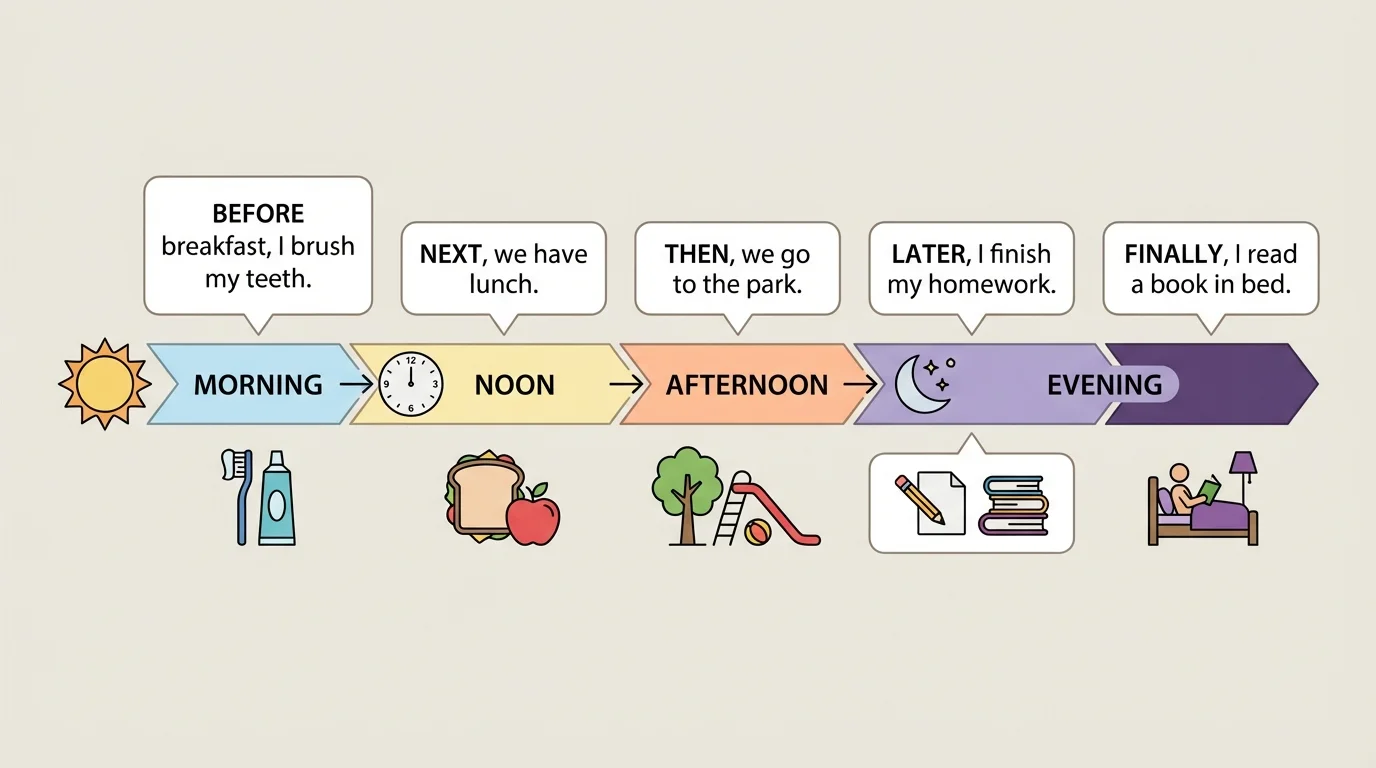
Temporal words also help in nonfiction. A writer may explain a process by saying, "First, the seeds are planted. Next, they are watered. Later, small sprouts appear. Finally, the plants bloom." These signal words guide the reader step by step.
When you retell a story or explain an experiment, sequence language helps your ideas stay in order and easy to follow.
Example: making a sentence clearer with time words
Weak sentence: "We cleaned the room. We played a game."
Step 1: Add a word that shows order.
Use after or then to connect the events.
Step 2: Rewrite the sentence with a temporal phrase.
"After we cleaned the room, we played a game."
The new sentence shows exactly when the second action happened.
Words that show time can be short, like then, or longer, like at the end of the afternoon. Both kinds help organize ideas.
Good speakers and writers think about audience and purpose. You might talk one way with a friend and another way in a report. Saying "That bug is weird" may work in conversation. In science writing, "The insect has unusual markings" sounds more exact.
This does not mean conversational words are bad. They are useful and important. It means each kind of language has a job. Everyday speech helps us connect naturally. Academic and subject words help us explain ideas carefully.
You already know that different books sound different. A fairy tale, a science article, and a set of directions do not all use the same kind of language. Vocabulary choices help create those differences.
When you choose words, ask yourself: Am I telling a story? Explaining an idea? Giving directions? Talking with a friend? The answer helps you decide which words fit best.
Learning a word is not enough by itself. You grow stronger when you use the word correctly in speech and writing. A strong sentence often includes a precise noun, a vivid verb, and helpful phrases that show time or place.
Instead of saying, "The thing moved," you might say, "The wagon rolled down the hill." Instead of saying, "We did it later," you might say, "We finished the poster after lunch." The second versions sound clearer because they use more exact vocabulary.
Example: improving word choice
Original sentence: "The animal went somewhere fast."
Step 1: Replace weak words.
Animal could become fox. Went could become dashed.
Step 2: Add a place phrase.
Use a spatial phrase such as through the tall grass.
Step 3: Put it together.
"The fox dashed through the tall grass."
The improved sentence is easier to picture and understand.
Signal words are especially helpful when joining ideas. Words like before, after, near, and between connect actions and places so the reader does not get lost.
Many words belong to the same family. For example, help, helpful, helpless, and helper are related. Learning one word can help you understand several others. This is one reason morphology matters so much.
Synonyms are useful, but they are not always exactly the same. Walk, stroll, march, and trudge all connect to moving on foot, but each one gives a different feeling. Stroll sounds easy and calm. March sounds strong and steady. Trudge sounds tired and heavy. These small differences are called shades of meaning.
Shades of meaning
Words can be close in meaning without being identical. Choosing the best word helps your sentence sound more accurate. Saying a character whispered is different from saying the character shouted, even though both are ways of speaking.
As your vocabulary grows, you become better at noticing these differences. That helps you understand what authors mean and helps you express your own ideas more clearly.
Every school subject has important words that unlock understanding. In science, words like habitat, organism, and evaporation help explain nature. In math, words like sum, equal, and fraction help explain numbers and operations. In social studies, words like community, citizen, and region help explain people and places.
Learning these words is like collecting keys. Each key opens a new idea. If you do not know the word evaporation, a science explanation may seem confusing. Once you know that it means water changing into vapor, the whole idea becomes clearer.
The same is true in reading about maps, art, sports, and technology. Special words help people in those areas communicate clearly. The more domain-specific words you know, the more confidently you can learn in every subject.
You build vocabulary a little at a time. Read often. Listen closely. Notice unfamiliar words. Look for prefixes, suffixes, and base words. Pay attention to where and when words are used. Ask yourself whether a word sounds conversational, academic, or domain-specific.
Try to notice signal words that show time and place whenever you read. In stories, they help you follow events and settings. In directions, they help you know what to do. In nonfiction, they help you understand explanations. These small words and phrases do big jobs.
As you keep learning, your speaking and writing become more precise, more interesting, and easier for others to understand. Strong vocabulary gives you more ways to think, explain, describe, and discover.
