Have you ever shouted at a book character in your mind, "Why did you do that?" That question is a powerful reading tool. Stories are exciting not just because things happen, but because characters make choices. A lost key, a secret, a brave decision, or even a mistake can change everything in a story.
When you read a story, you are not only learning what happens. You are also thinking about who makes things happen. A character may help, cause trouble, solve a problem, or learn an important lesson. If you understand the characters, you understand the story better.
Readers often ask questions such as: What kind of person is this character? What does the character want? How does the character feel? Why did the character act that way? These questions help you look closely at the details in the text.
Character is a person, animal, or creature in a story. Trait is a quality that describes what a character is like, such as kind, stubborn, brave, or selfish. Motivation is the reason a character does something. Sequence of events is the order in which things happen in a story.
Some characters are easy to understand right away. A story might tell you that a girl is cheerful or that a boy is shy. Other times, you must figure out what a character is like by paying attention to speech, thoughts, and actions.
A character can be the main person in the story or a less central character. The main character often faces the biggest problem. Side characters can still be important because they help, challenge, or teach the main character.
For example, in a story about Maya trying to win the school garden contest, Maya may be the main character. Her grandfather, her friend Luis, and even a grumpy neighbor may also matter. Each one can affect what happens next.
When readers describe a character, they often talk about three big ideas: the character's traits, motivations, and feelings. These ideas are connected, but they are not the same thing.
A trait tells what a character is like most of the time. Traits are not just quick moods. If a girl feels nervous before a race, nervous may be a feeling for that moment. But if she keeps trying even when she is nervous, determined may be a trait.
Traits can be outer traits or inner traits. Outer traits describe how a character looks, such as tall, messy, or quick. Inner traits describe personality, such as helpful, honest, or impatient. When readers talk about stories, inner traits are often more important because they help explain actions.
Look at this example: "Evan carried his little sister's backpack all the way home without being asked." From this detail, you might say Evan is caring or responsible. The text does not have to say, "Evan was caring." His action gives you the clue.
Traits are shown by patterns. One action can give a clue, but several actions together make a stronger idea. If a character shares supplies, comforts a friend, and includes others in a game, readers have good evidence that the character is kind.
Good readers choose trait words carefully. If a character forgets homework once, that does not always mean the character is careless. Maybe the character was distracted because of a family problem. You need enough details from the story before deciding on a trait.
A motivation is the reason behind an action. Motivation answers the question Why? A character may want to help someone, protect something important, win a prize, hide a mistake, or prove a point.
Suppose Talia climbs a steep hill during a storm to warn her family that a river is rising. Her action is climbing the hill. Her motivation is to keep her family safe. Understanding this reason helps you see why the action matters.
Characters can have more than one motivation at the same time. A boy may join the talent show because he loves music, but also because he wants his brother to notice him. Real characters, like real people, can have mixed reasons for what they do.
Sometimes a character's motivation changes during the story. At first, a child may enter a spelling contest to win a trophy. Later, the child may keep going because she discovers she enjoys learning new words. A change in motivation can lead to new actions and new events.
Readers also pay attention to feelings. Feelings are emotions such as happy, worried, frustrated, jealous, proud, or relieved. A feeling may last for only one part of the story, but it can still cause an important action.
You may not always read a sentence like, "Ben felt embarrassed." Instead, the story might say, "Ben looked at the floor, spoke in a whisper, and tugged at his sleeve." These details are clues. Readers use clues to infer how a character feels.
Readers often understand a character's feelings the same way they understand real people's feelings: by noticing expressions, body language, tone of voice, and actions.
[Figure 1] Feelings can push the story forward. If a character feels afraid, that character may run away. If a character feels guilty, that character may tell the truth. If a character feels proud, that character may take on a harder challenge.
The order of events in a story is called the sequence of events. Characters do not just stand still while events happen around them. Their actions often create the next event in a simple chain where one decision leads to another.
Think of a story like a row of falling dominoes. One character action can tip the next event into motion. If a child forgets her lunch, she may feel worried. Because she feels worried, she asks a friend for help. Because she asks for help, the friend shares food. Because the friend shares food, the child learns about kindness and decides to be more prepared the next day. One action connects to the next event.
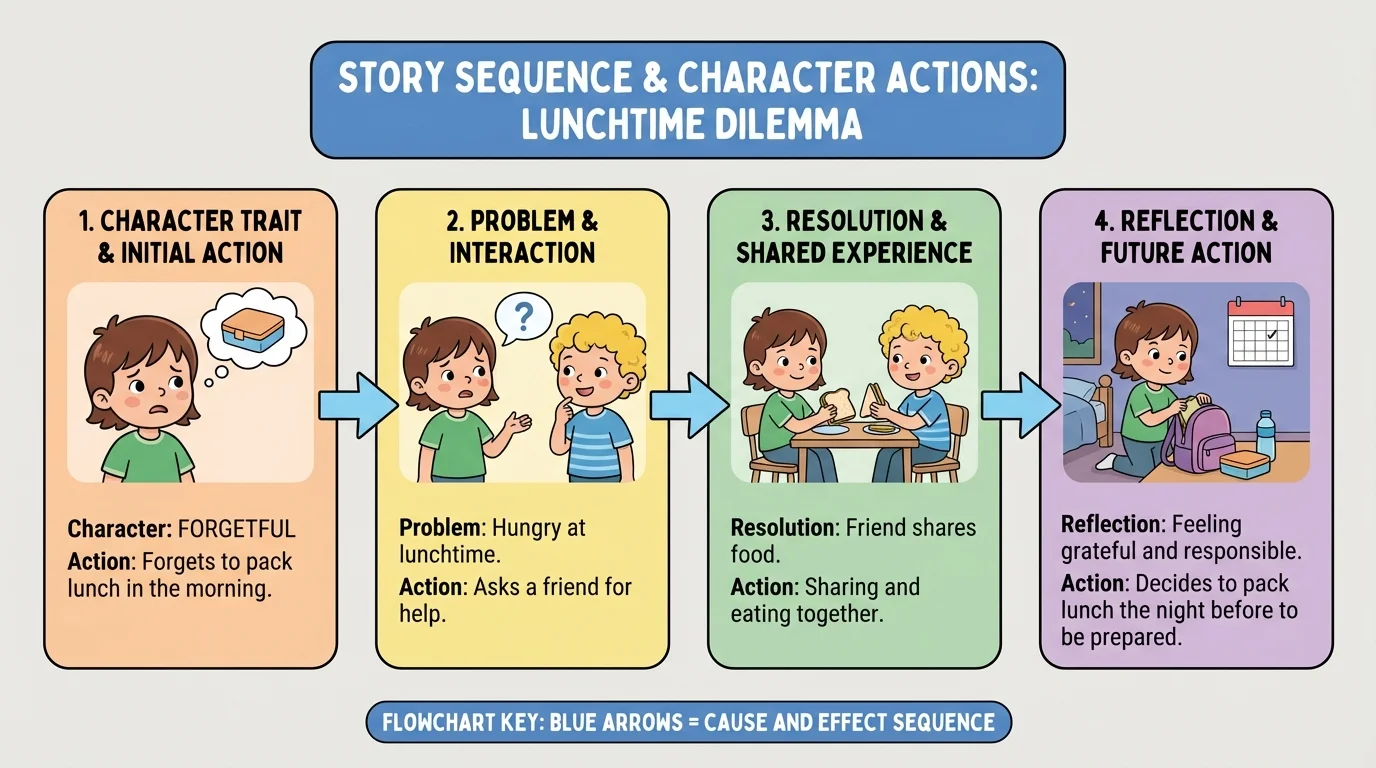
When you explain how actions contribute to the sequence of events, use words that show order. Words such as first, next, then, after that, and finally help you tell how one moment leads to another.
For example, in a story about a missing library book, you might explain it this way: First, Noah stuffs the book into his sports bag. Next, he cannot find it at school. Then, he becomes worried and retraces his steps. After that, he discovers the book under his soccer cleats. Finally, he returns it and learns to keep library books in a safer place. Noah's actions help create each event in order.
Example: connecting character and events
Story detail: "Lina saw dark clouds gathering over the picnic area. She quickly told everyone to pack up. A few minutes later, heavy rain poured down, but the family stayed dry inside the car."
Step 1: Name a trait or quality.
Lina seems observant and responsible.
Step 2: Explain the action.
She warns everyone and tells them to pack up.
Step 3: Connect the action to later events.
Because Lina acts quickly, the family leaves before the rain starts.
Lina's action contributes to the sequence of events by helping the family avoid getting soaked.
Sometimes a character's action causes a problem. Sometimes it solves one. Sometimes it does both. A character may tell a lie to avoid trouble at first, but that lie may create a much bigger problem later.
When you describe a character, try to say more than one-word answers. Instead of writing, "Jamal is nice," you can explain, "Jamal is generous because he gives his extra art supplies to a classmate who forgot hers."
Strong descriptions include evidence from the story. Evidence is the detail that supports your idea. If you say a character is brave, point to the action, thought, or words that prove it.
Here is a clear pattern you can use in your thinking: Character + trait or feeling + evidence + effect on events. For example: "Suri is determined because she practices every morning before school. Her determination helps her improve enough to perform in the concert."
When readers support an idea with evidence, they use details from the text instead of only giving an opinion. That makes the explanation stronger and clearer.
You can also describe a character by using speech. If a character says, "I'll help you clean up, even though the mess isn't mine," those words suggest responsibility and kindness. Thoughts are useful too. If a character keeps thinking, "I hope no one finds out," you can infer worry or guilt.
Stories often become more interesting because characters react to each other. One character may be patient while another is impulsive. One may want to cooperate while another wants to compete. These differences can shape the events of the story.
Suppose two friends, Ava and Zoe, find a stray kitten. Ava wants to take it home right away. Zoe wants to look for the owner first. Ava's impulsive action might create confusion, while Zoe's careful thinking may help solve the problem. By comparing the two characters, you can explain why the story moves the way it does.
| Character | Trait or Feeling | Action | Effect on Events |
|---|---|---|---|
| Ava | Impulsive | Takes the kitten home quickly | Creates a problem because the owner is still searching |
| Zoe | Careful | Makes flyers and asks neighbors | Helps return the kitten to its owner |
Table 1. A comparison of two characters and how their actions affect the story.
[Figure 2] Comparing characters helps you notice that not all actions have the same result. Different traits and motivations can lead to very different outcomes.
Some characters stay mostly the same, but many change during a story. A character may become more confident, honest, thoughtful, or brave. That change matters because new thinking often leads to new actions through a character who reacts differently later in the story than at the beginning.
Imagine a story about a boy named Marcus who is afraid of dogs after being startled by a loud bark. At the beginning, Marcus crosses the street whenever he sees a dog. Later, after learning about dog behavior and meeting a gentle puppy with an adult beside him, Marcus helps return a lost dog to its owner. His change from fearful to brave affects the ending of the story.
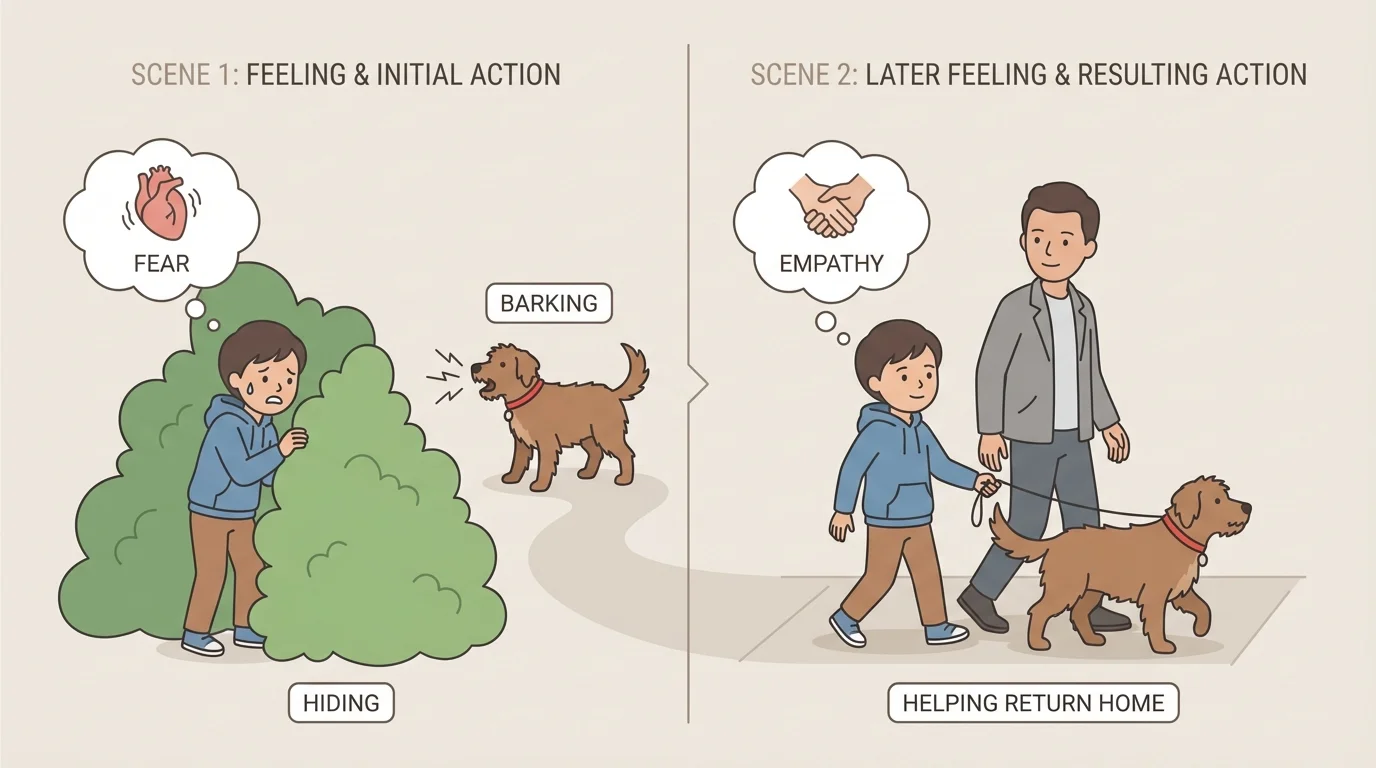
When you describe character change, think about before and after. What was the character like at the start? What happened to cause change? How do the character's later actions show this change?
Character change is often tied to a lesson. Marcus may learn that being careful is wise, but fear does not always need to control him. That lesson shapes his final choice. Later in the story, the pattern seen in [Figure 2] becomes clear because his brave action would not have happened at the beginning.
Good readers do not guess wildly. They use clues from the text. Story evidence can come from what a character says, does, thinks, or how others respond to that character.
For example, if a story says, "Nina stayed up late sewing the torn costume so her brother would not miss the play," you can say Nina is caring and hardworking. The evidence is her staying up late and sewing the costume. Her action contributes to events because her brother is able to perform.
When discussing the chain of events, remember the flow in [Figure 1]: one choice leads to another result. That same idea works in longer stories too. A small action early in the story can cause a major ending later on.
Example: using evidence from a story
Story detail: "Owen hid the cracked vase behind the curtain. All afternoon he could not enjoy playing. At dinner, he finally admitted what happened and offered to do chores to help replace it."
Step 1: Identify the feelings.
Owen likely feels worried and guilty.
Step 2: Identify a trait.
By the end, Owen shows honesty and responsibility.
Step 3: Connect actions to events.
First he hides the vase, which creates tension. Then he tells the truth, which begins to solve the problem.
Owen's actions shape the middle and the ending of the story.
Sometimes authors give strong clues with repeated details. If a character keeps checking the sky, packing supplies, and warning others, those repeated actions suggest preparation and concern.
One common mistake is mixing up a trait and a feeling. Trait: patient. Feeling: frustrated. A trait describes what someone is usually like. A feeling describes how someone feels at a certain moment.
Another mistake is confusing an action with a motivation. Action: Elena runs to the store. Motivation: she wants to buy medicine for her grandmother. The action is what she does. The motivation is why she does it.
A third mistake is stopping too soon. Saying "He is brave" is a start, but it is stronger to add, "He is brave because he admits his mistake in front of the class, and that honesty helps solve the misunderstanding."
Think about this longer example. A girl named Priya wants to build a bird feeder for the school yard. At first, she seems creative and excited. Then her first design falls apart in the rain. She feels disappointed, but instead of quitting, she studies stronger designs, asks an adult for advice, and builds a better feeder. Later, many birds visit the yard, and Priya shares what she learned with her class.
How can we describe Priya? She is creative, but she is also persistent. Her motivation is to attract birds and improve the school yard. Her feelings change from excitement to disappointment to pride. Her actions contribute to the sequence of events because each choice leads to the next part of the story: she builds, fails, learns, rebuilds, and succeeds.
This kind of explanation helps readers see that stories are built from choices. Characters are not just names on a page. They are the engine that moves the plot forward.
"What a character does tells us who that character is."
As you read stories, notice patterns. Ask what the character is like, what the character wants, how the character feels, and what happens because of the character's actions. Those questions open the story like a key.
