Have you ever read a story and thought, "I would never do that!" That feeling is an important reading clue. It means you have your own ideas about the story, and those ideas may be different from what the narrator says or what a character believes. Strong readers notice these differences. They do not mix up their own thoughts with the thoughts inside the story.
When you read, you bring your own experiences, feelings, and ideas with you. Maybe you love dogs, so you feel happy when a story has a puppy in it. Maybe you are afraid of storms, so you feel worried when dark clouds appear in a story. These feelings are part of point of view, which means the way someone thinks about or sees something.
Good readers understand that a story can have more than one point of view at the same time. As [Figure 1] shows, the narrator, a character, and the reader may all react differently to the very same event. If you can tell whose point of view you are reading about, you understand the story more clearly.
Point of view is the way someone thinks, feels, or sees what is happening.
Narrator is the voice that tells the story.
Character is a person or animal in a story.
This skill matters because stories are not only about what happens. They are also about how people feel about what happens. Two children in the same story might both see a thunderstorm, but one may think it is exciting while the other feels frightened. A careful reader notices that difference.
In a story, the voice you hear may belong to a narrator, and the thoughts you learn about may belong to one or more characters. Sometimes the narrator is also a character in the story. Other times the narrator stands outside the story and tells what is happening. Either way, the narrator is not the same as you, the reader.
Sometimes students think, "If the narrator says it, it must be what I should think too." But that is not true. The narrator tells the story. You still get to think for yourself. Also, characters can believe things that are wrong, unfair, silly, brave, or wise. Readers should notice what the character believes without pretending that they believe it too.
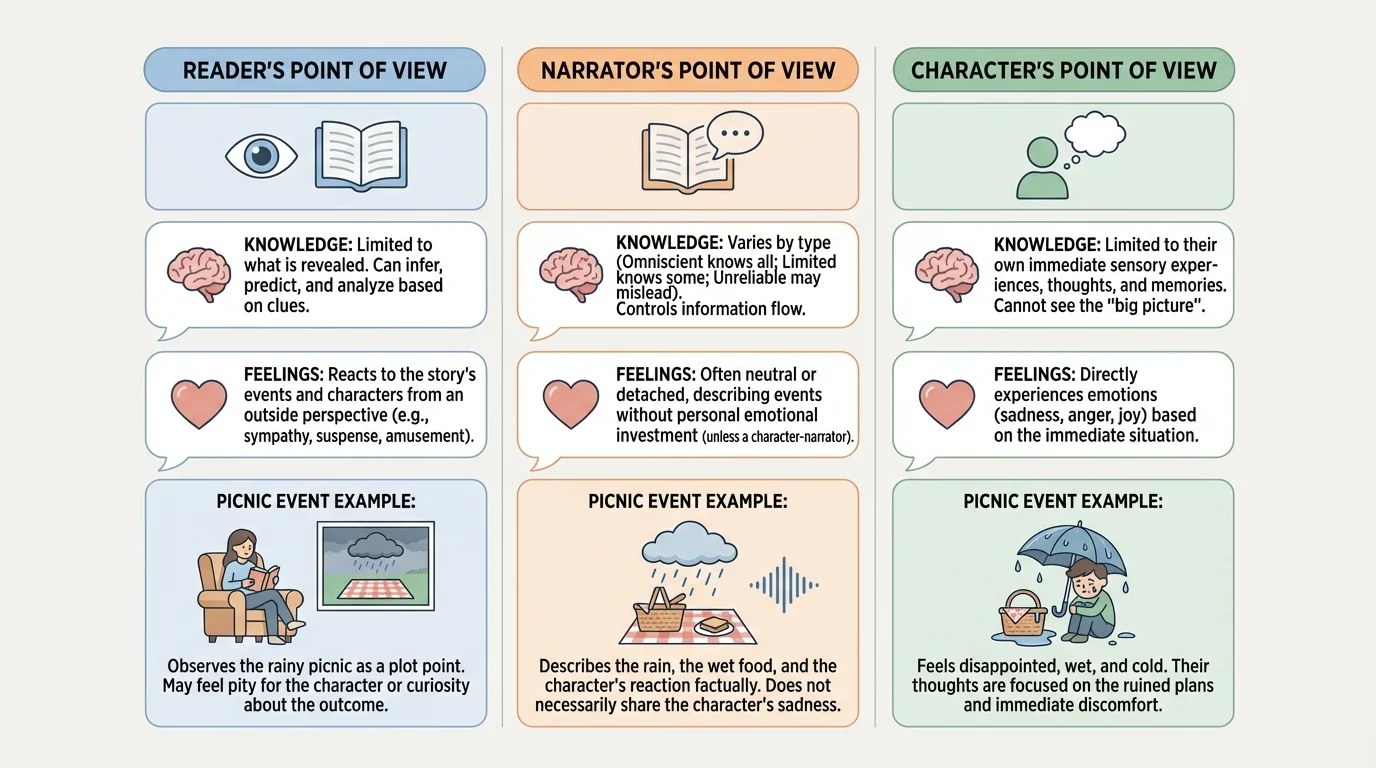
For example, suppose a story says, "Lena grinned when the rain began. At last, the picnic was over." The narrator tells us what happened, and we learn that Lena is glad about the rain. But you, as the reader, may feel disappointed because you would have wanted the picnic to continue. Your point of view is different from Lena's point of view.
Your own point of view comes from experience. Experience means things that have happened to you and things you have learned. If you have moved to a new town before, you might understand a character who feels nervous on the first day at a new school. If you have never moved, you can still think about how that might feel, but your point of view may be different.
Your point of view is important because it helps you connect with stories. It helps you ask questions such as: "Would I feel the same way?" "Do I agree?" "What would I do?" These questions help you become an active reader instead of a reader who only skims the words.
Readers can disagree with a character and still understand that character well. In fact, noticing a difference is often a sign of strong thinking.
Still, your job is not only to decide what you think. Your job is also to pay attention to what the story tells you about other points of view. That means listening carefully to the narrator and to the characters.
The narrator's point of view is the way the story's telling voice presents events. Sometimes the narrator sounds cheerful. Sometimes the narrator sounds serious. Sometimes the narrator gives facts without many feelings. Sometimes the narrator lets us know that a character is confused, excited, or worried.
A narrator may say things in a way that guides the reader. For example: "Poor Max dragged his heavy backpack up the hill." The word poor gives a clue that the narrator feels some sympathy for Max. But you might think, "Max should pack less stuff." Your opinion can be different from the narrator's.
In some stories, the narrator knows only what one character knows. In others, the narrator knows many characters' thoughts. Even then, the narrator's voice is still separate from your own. As we saw in [Figure 1], the reader stands outside the story and can agree or disagree with what the narrator suggests.
A character's point of view is shaped by what the character wants, fears, knows, and notices. A hungry child sees a bakery differently from a child who just finished a giant lunch. A new student sees a classroom differently from the teacher who has taught there all year.
Characters in the same story often disagree because they have different goals. One character may want to keep a stray kitten. Another may worry about who will feed it. Neither point of view has to match your own.
Here is a simple example. A story says, "Ben hugged the tree and begged everyone not to cut it down. Mr. Diaz checked the broken sidewalk and sighed." Ben's point of view is that the tree should stay. Mr. Diaz's point of view is that the tree roots are causing a problem. You, the reader, might think both sides make sense. That is your own point of view.
There is a simple way to sort viewpoints while reading. Ask yourself: Who is telling? Who is feeling? Who is speaking? What do I think? These questions help you keep the points of view separate.
[Figure 2] Look for clue words in the story. Words such as thought, felt, wished, wondered, said, and noticed often tell you whose point of view is being shown. If the story says, "Mila thought the cave looked magical," then the idea that the cave is magical belongs to Mila. You might think the cave sounds scary instead.
You can also pay attention to actions. If a character hides behind a chair, that action may show fear. If the narrator describes a room as gloomy, that description may help set a mood. If you think the room sounds cozy, then your point of view is different from the narrator's description.
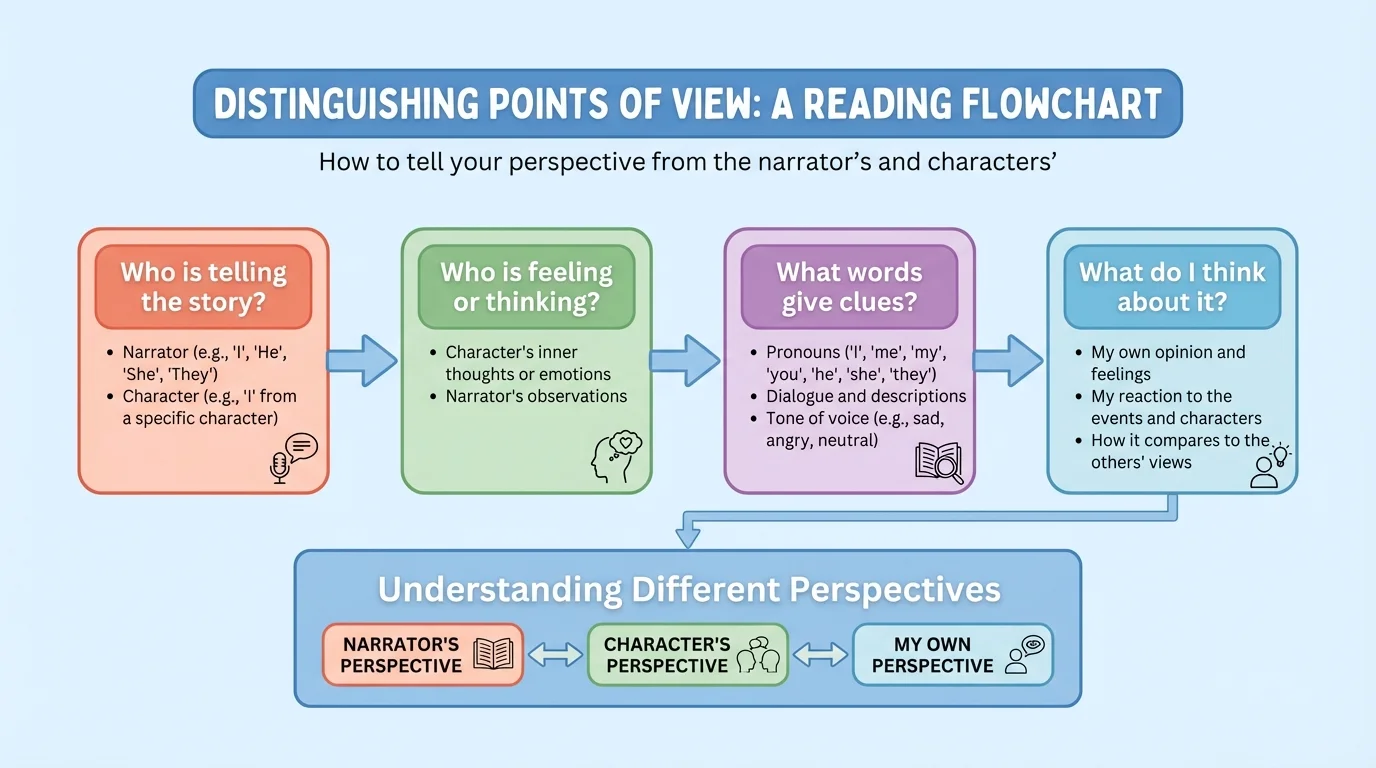
Another helpful strategy is to stop after an important event and name the viewpoints out loud or in your mind. You might say, "The narrator tells what happened. The character feels embarrassed. I think the mistake is funny." Keeping these ideas separate helps prevent confusion.
Clues that reveal point of view
Readers figure out point of view by noticing thoughts, feelings, dialogue, actions, and word choice. When a story says what someone thinks, that is a strong clue. When a character speaks, the dialogue gives clues about beliefs and feelings. When the narrator uses words like luckily, sadly, or bravely, the narrator's attitude may be showing.
It also helps to remember that not every sentence tells your point of view. Most sentences in a story tell the narrator's words or a character's words. Your point of view lives in your thinking as you read.
One event can be understood in several different ways, as [Figure 3] illustrates with a child on a diving board. The event stays the same, but the feelings and opinions can change depending on who is looking at it.
Example 1: The lost lunchbox
Story excerpt: "Ava searched under every desk for her lunchbox. The teacher watched quietly as the class whispered."
Step 1: Find the character's point of view.
Ava is searching everywhere, so she is probably worried or upset. Her point of view is that losing the lunchbox is a big problem.
Step 2: Notice the narrator's point of view.
The narrator tells the scene in a calm way and does not say the class is mean or kind. The narrator mostly reports what is happening.
Step 3: Add the reader's point of view.
You might feel sorry for Ava. Or you might think the class should help her instead of whispering. That is your own point of view.
This example shows that your feelings are not automatically the same as Ava's. You may feel sympathy, but Ava may feel panic. Those are related, but not identical.
Now think about another story event: "Jordan stepped onto the high diving board and froze. The pool sparkled below him, and children cheered for him to jump." In this scene, Jordan may feel scared. The narrator may simply describe the moment. You might think the jump looks fun, or you might feel nervous for Jordan. The difference matters and is easy to see.

Example 2: The muddy dog
Story excerpt: "When the dog burst through the door covered in mud, Tessa laughed, but her brother groaned and grabbed a towel."
Step 1: Compare the characters.
Tessa thinks the muddy dog is funny. Her brother thinks the muddy dog is a mess.
Step 2: Separate your own opinion.
You might agree with Tessa because muddy pets can look silly. Or you might agree with the brother because cleaning up is hard work.
Step 3: Notice how one event creates different points of view.
The same muddy dog leads to laughter for one character and frustration for another.
These examples help you see that point of view is not just about who is in the story. It is about how each person thinks or feels about what is happening.
Some stories show many points of view. You may read one chapter from one character's thoughts and another chapter from a different character's thoughts. Or the narrator may explain what several characters feel during the same event.
When this happens, keep asking: Who knows what? Who wants what? Who feels what? Those questions help you avoid mixing people together. A character may act rude because that character is embarrassed, while another character may think the behavior is just plain mean. You, the reader, may think both characters need to talk honestly.
This is another place where perspective matters. Perspective is a way of looking at something. If two people stand on opposite sides of a tree, each sees different things. In stories, people also "stand" in different emotional places. One may see a surprise party as exciting, while another sees it as overwhelming.
Earlier reading skills still help here. Readers use details, make inferences, and notice word choice. Those same skills help you figure out point of view.
Sometimes your own point of view changes while you read. At first, you might think a character is selfish. Later, you learn that the character was protecting a little sister. Now you may understand that character differently. Your point of view can grow as you learn more.
One common mix-up is thinking that the main character's point of view is always correct. Main characters can be wrong. They can misunderstand situations. They can make poor choices. Readers should listen carefully, but they do not have to agree.
Another common mix-up is thinking the narrator and the author are exactly the same. The narrator is the voice inside the story. The author is the real person who wrote the story. When we talk about the story itself, we focus on the narrator and the characters.
A third mix-up is forgetting to name your own point of view clearly. Instead of saying, "The story thinks the dog is funny," say, "Tessa thinks the dog is funny, but I think the mess is a problem." That sentence clearly separates the character's idea from your own idea.
| Question | What it helps you find |
|---|---|
| Who is telling the story? | The narrator's voice |
| Who is speaking right now? | A character's words |
| Who is thinking or feeling this? | A character's point of view |
| What do I think about it? | Your own point of view |
Table 1. Questions readers can ask to distinguish among the narrator, characters, and themselves.
If you get confused, return to the text and find evidence. Look for the exact words that show thoughts, feelings, speech, and description. Evidence helps you explain your answer instead of guessing.
When you distinguish your own point of view from the narrator's and the characters', you become a stronger reader. You understand not just the events of the story, but also the people inside it. You learn to notice feelings, motives, and misunderstandings.
This skill also helps you build empathy. Empathy means understanding how someone else may feel. You do not have to agree with every character, but you can still understand why that character feels a certain way. That makes reading deeper and more meaningful.
As you continue reading stories, keep your mind open. Notice when you agree, when you disagree, and when your ideas change. Strong readers are not quiet inside. They think carefully, compare viewpoints, and pay close attention to whose voice they are hearing.
