Have you ever heard someone explain something, nodded your head, and then realized you were not fully sure what they meant? That happens to everyone sometimes. Strong listeners do more than stay quiet. They listen closely, ask smart questions, and answer in a way that helps everyone understand better. In class discussions, partner talks, and small groups, these skills help people learn together.
When a person speaks, they share information. That information may include facts, directions, ideas, reasons, or examples. Good listeners pay attention so they can understand the speaker's message. Then they can ask questions if something is confusing, or answer questions by giving careful, complete responses. These are important speaking and listening skills.
Speaker means the person who is talking and sharing information. Question means something you ask to learn more. Elaboration means adding more information to make an answer clearer and stronger. Detail means a specific piece of information that helps explain an idea.
These skills matter in many places. You use them when a classmate explains a science idea, when a teacher gives directions, when your group reads a passage together, and even when a coach talks before a game. Asking and answering questions helps a group stay focused and learn from one another.
Questions are powerful because they help us understand. Sometimes a speaker gives the main idea, but we need more information. A good question can clear up confusion, help us notice an important detail, or invite the speaker to explain more. When students ask questions, they show they are paying attention.
Questions also help the whole group. If one student is wondering about something, another student may be wondering the same thing. By asking politely and clearly, a listener helps everyone. Good questions are part of cooperative learning because they move the conversation forward instead of stopping it.
Answers matter just as much. If someone asks you a question and you answer with only one word, your answer may be too small to help. A stronger answer gives the idea and then adds a reason, example, or fact. That is how speakers and listeners build understanding together.
In many classrooms, students learn more during discussion when they explain their thinking out loud. Talking and listening carefully can help the brain organize ideas.
When you ask or answer questions, remember your goal: understand the speaker's message and help others understand it too.
Good listening is more than hearing sounds. Main idea means the most important point the speaker wants listeners to understand, and [Figure 1] shows how a listener keeps track of the big idea while also noticing supporting details. A strong listener pays attention to both the big message and the smaller facts that explain it.
Good listeners often look at the speaker, sit or stand calmly, and avoid interrupting. They think about what is being said instead of planning what they want to say next. They may notice key words, repeated ideas, or examples. These clues help them decide what is most important.
Suppose a speaker says, "Our class garden needs sunlight, water, and healthy soil. We should check it every day because plants can dry out quickly." The main idea is that the class garden needs care. The details are that it needs sunlight, water, healthy soil, and daily checking.
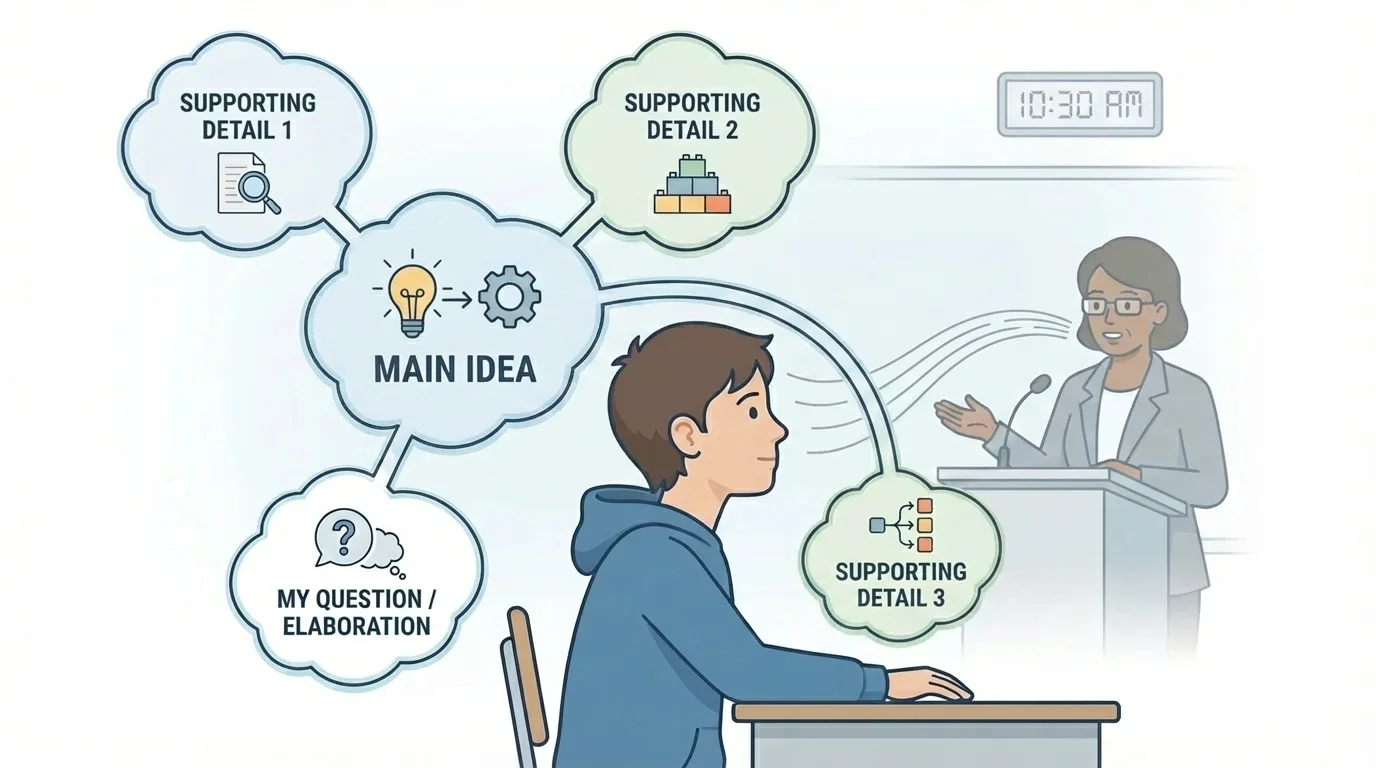
When listeners know the main idea and details, they can ask better questions. Instead of asking something random, they can ask about the topic the speaker is actually explaining. Later, when they answer questions, they can use those same details to make their answers stronger.
Sometimes good listening also means waiting. A speaker may answer your question if you let them finish talking. Careful listeners do not jump in too fast. They listen all the way through and then decide what to ask.
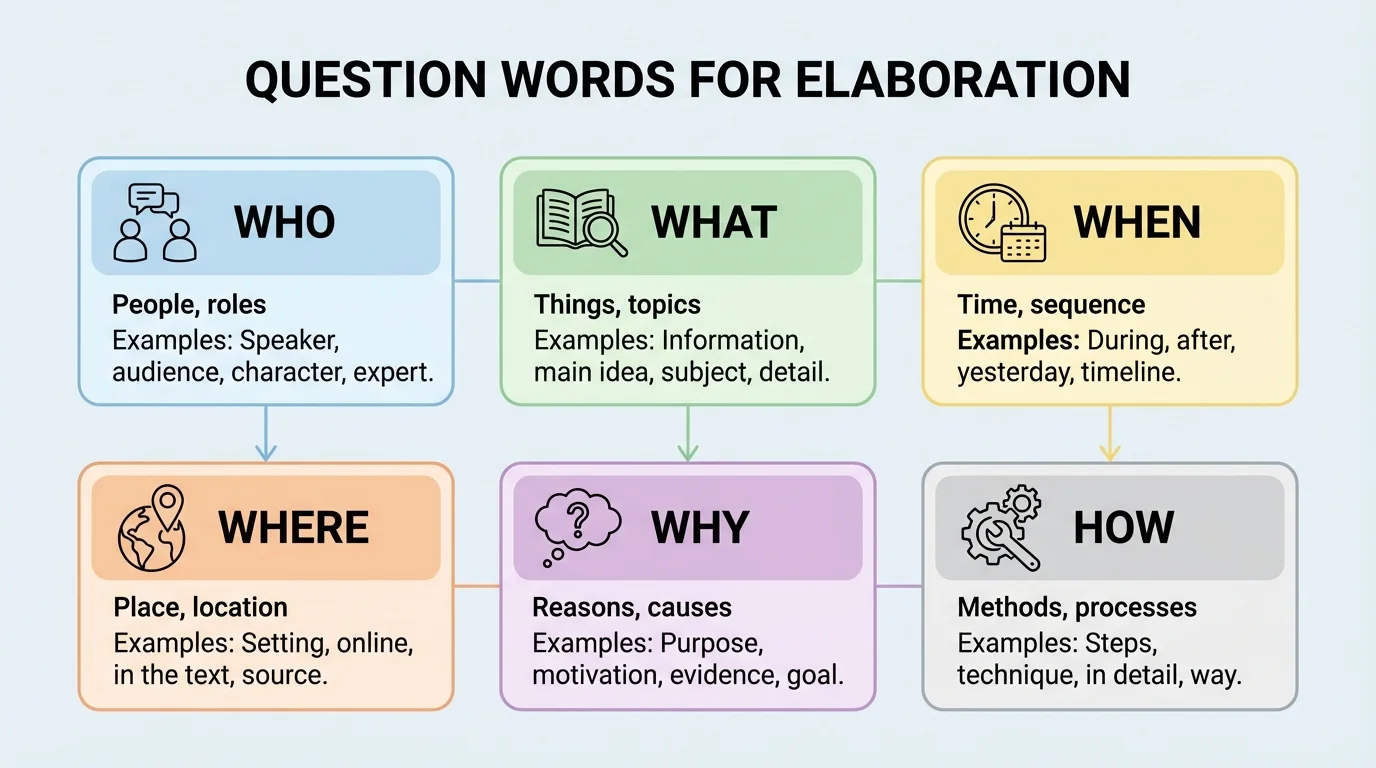
Different questions help us learn different kinds of information, as [Figure 2] illustrates. Some questions ask for facts. Some ask for reasons. Some ask a speaker to explain more clearly. When you know what kind of information you need, you can choose a better question.
Many questions begin with common question words. These words help listeners focus on a certain kind of answer.
| Question Word | What It Often Asks | Example |
|---|---|---|
| Who | a person or group | Who helped plant the garden? |
| What | a thing, idea, or action | What does the garden need most? |
| When | time | When should we water the plants? |
| Where | place | Where should the garden be placed? |
| Why | a reason | Why do the plants need daily care? |
| How | a method or explanation | How do we know if the soil is dry? |
Table 1. Common question words and the kinds of information they help listeners ask about.
Some questions are clarification questions. These are questions you ask when something is not clear. For example, "Can you explain what you mean by healthy soil?" or "Are you saying we should water every day or only when the soil is dry?" Clarification questions are helpful because they fix confusion.
Other questions are follow-up questions. These come after you have already heard one answer and want to learn more. For example, "What kinds of plants dry out fastest?" or "Why is sunlight important for growth?" Follow-up questions show careful listening because they connect to what the speaker already said.
Polite questions usually sound respectful. You might say, "Could you tell us more about that?" or "I heard you say the plants need sunlight. How much sunlight do they need?" These question forms keep the conversation kind and cooperative.
Remember that conversations have turns. One person speaks, another listens, and then someone responds. Asking a question at the right time is part of being a respectful group member.
As the lesson continues, the question words in [Figure 2] stay useful because they remind us that not all questions do the same job.
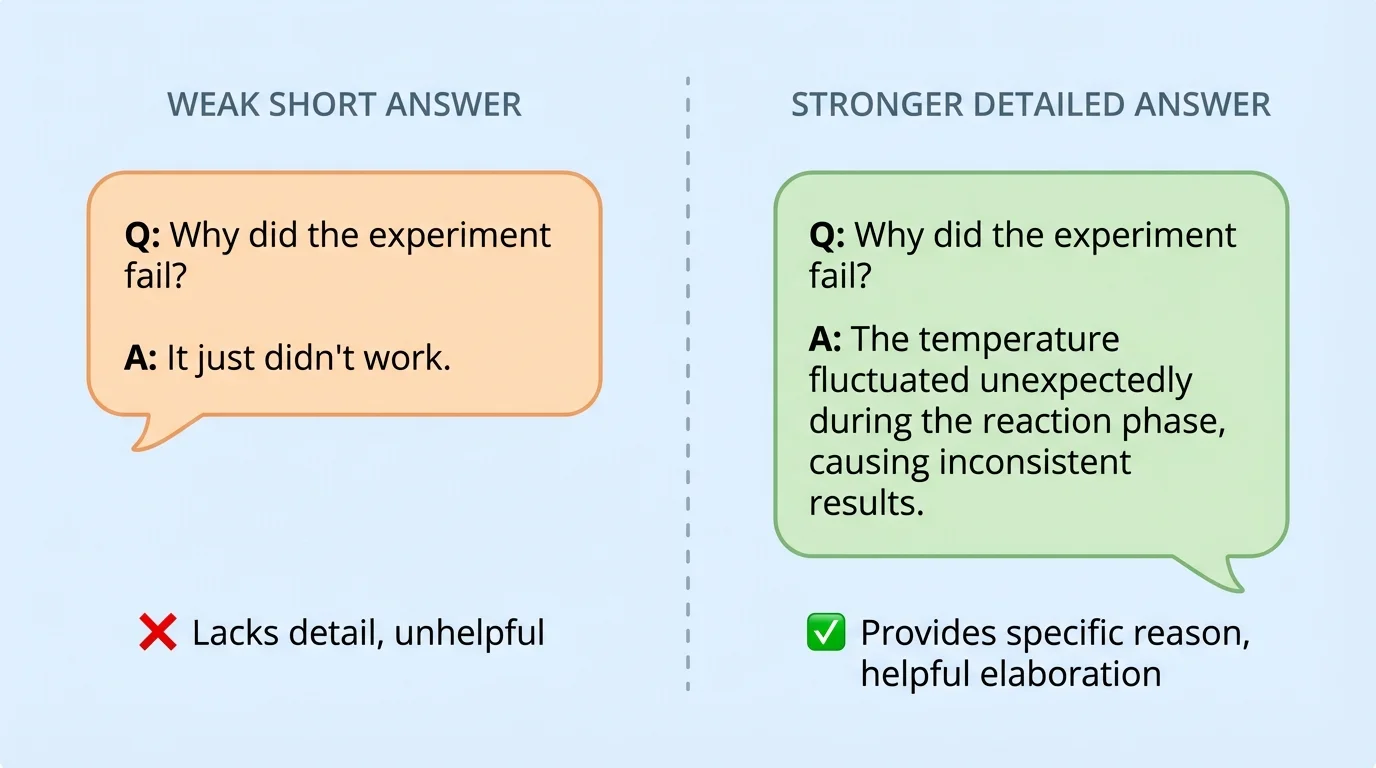
A short answer may be correct, but a detailed answer is often more helpful. Elaboration means adding more information so your listener understands your idea better, and [Figure 3] shows the difference between a weak answer and a strong one. When you elaborate, you might explain why, give an example, include facts, or connect your answer to what the speaker said.
Look at this question: "Why should the class check the garden every day?" A weak answer is, "Because it matters." That answer is not wrong, but it is not very helpful. A stronger answer is, "The class should check the garden every day because plants can dry out quickly, and daily checks help us see whether they need water or if something is wrong."
Example: Turning a short answer into a detailed answer
Question: "What did the speaker say the garden needs?"
Step 1: Start with the main answer.
"The speaker said the garden needs sunlight, water, and healthy soil."
Step 2: Add a supporting detail.
"The speaker also said the class should check the garden every day."
Step 3: Explain why that detail matters.
"That helps because plants can dry out quickly, so daily checks keep the garden healthy."
The detailed answer gives clear information and helps the listener understand more.
One helpful pattern is: answer the question, add a detail, and explain. Another helpful pattern is: answer the question, give an example, and connect it to the speaker's idea.
Suppose a speaker says, "Bats are helpful because they eat many insects." If someone asks, "Why are bats helpful?" you could answer, "Bats are helpful because they eat many insects, which can protect crops and gardens." That answer includes the reason and an extra detail.
You do not need to make your answer very long. The goal is not to say the most words. The goal is to say enough useful words. A good answer is clear, complete, and connected to the question.
When students answer with elaboration, they help the whole group. Just as the stronger speech bubble in [Figure 3] gives more useful information, a strong answer in a discussion helps everyone understand the topic more deeply.
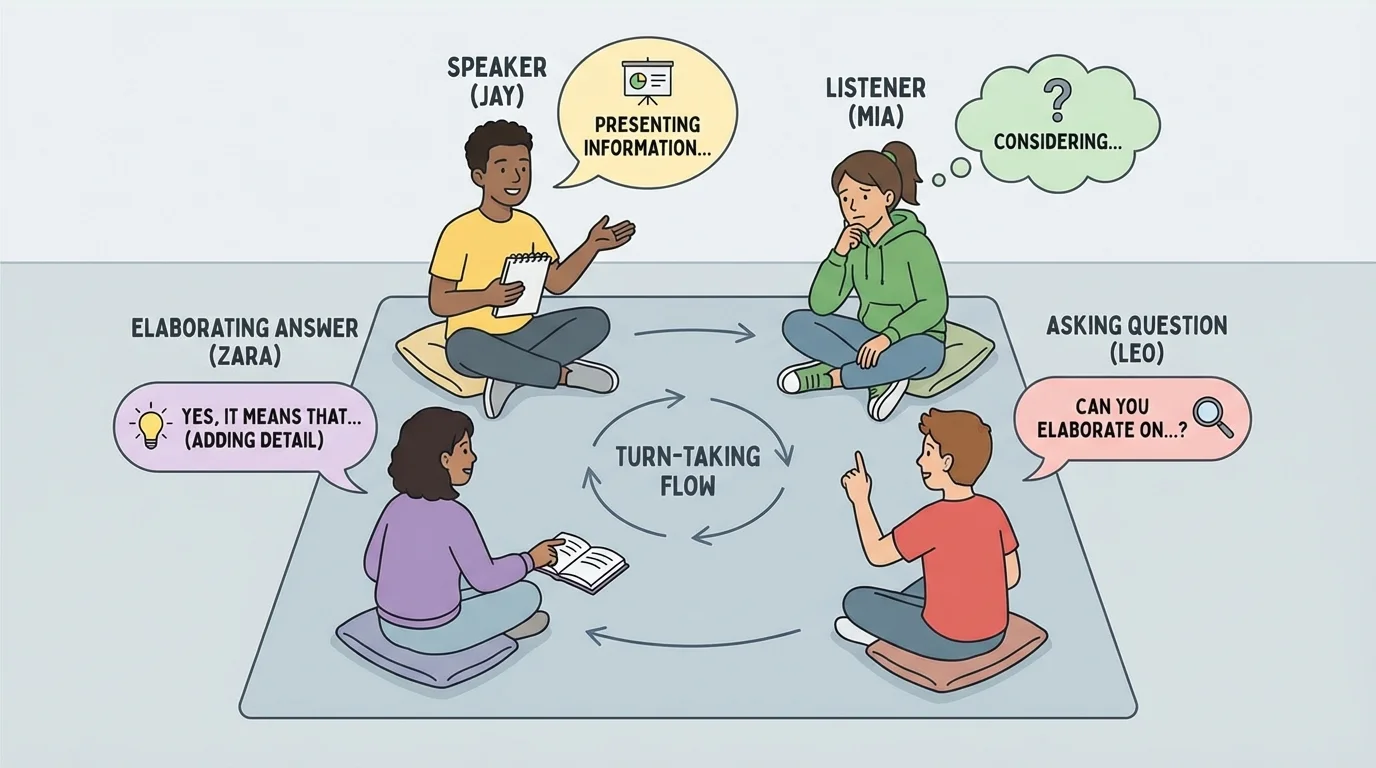
Group activities work best when everyone listens and speaks respectfully, as [Figure 4] shows in a discussion circle. To participate cooperatively means working with others in a way that is fair, thoughtful, and helpful. Students take turns, pay attention, and respond to ideas instead of trying to take over the whole conversation.
Respectful speakers do several things. They wait for a pause before speaking. They use kind words. They look at the person who is talking. They do not interrupt. They also stay on topic, which means they talk about the idea the group is discussing rather than changing to something unrelated.
Cooperative speakers can build on another person's idea. For example, one student might say, "The speaker said recycling saves materials." Another student can respond, "I want to add that recycling can also reduce trash in landfills." This kind of answer connects to the first idea and adds detail.
Sometimes students disagree, and that is okay. They can still be respectful. A student might say, "I heard something a little different," or "Can we look at that idea again?" These responses keep the group safe and productive.
Cooperative discussion means more than waiting for your turn. It means helping the group learn. Students do this by listening closely, asking useful questions, answering with details, and connecting their ideas to what others have said.
In many group tasks, every person has a chance to contribute. Some may ask questions. Some may explain ideas. Some may restate what the speaker said in simpler words. Each role matters. The turn-taking in [Figure 4] reminds us that good discussion is shared, not controlled by one person.
Speakers often give clues that help listeners understand what is important, and [Figure 5] highlights how signal words and important details stand out during listening. These clues may be words such as "most important," "for example," "because," "first," or "finally." They may also be changes in the speaker's voice or repeated ideas.
If a speaker says, "There are three reasons our town needs more trees. First, trees give shade. Second, they help clean the air. Third, they provide homes for birds," the listener can hear that there are three key details. The words "first," "second," and "third" organize the information.
Listeners can use these clues to ask better questions. A student might ask, "Which reason do you think is most important?" or "Can you give an example of how trees clean the air?" These questions fit the speaker's message because they are based on the clues that were heard.
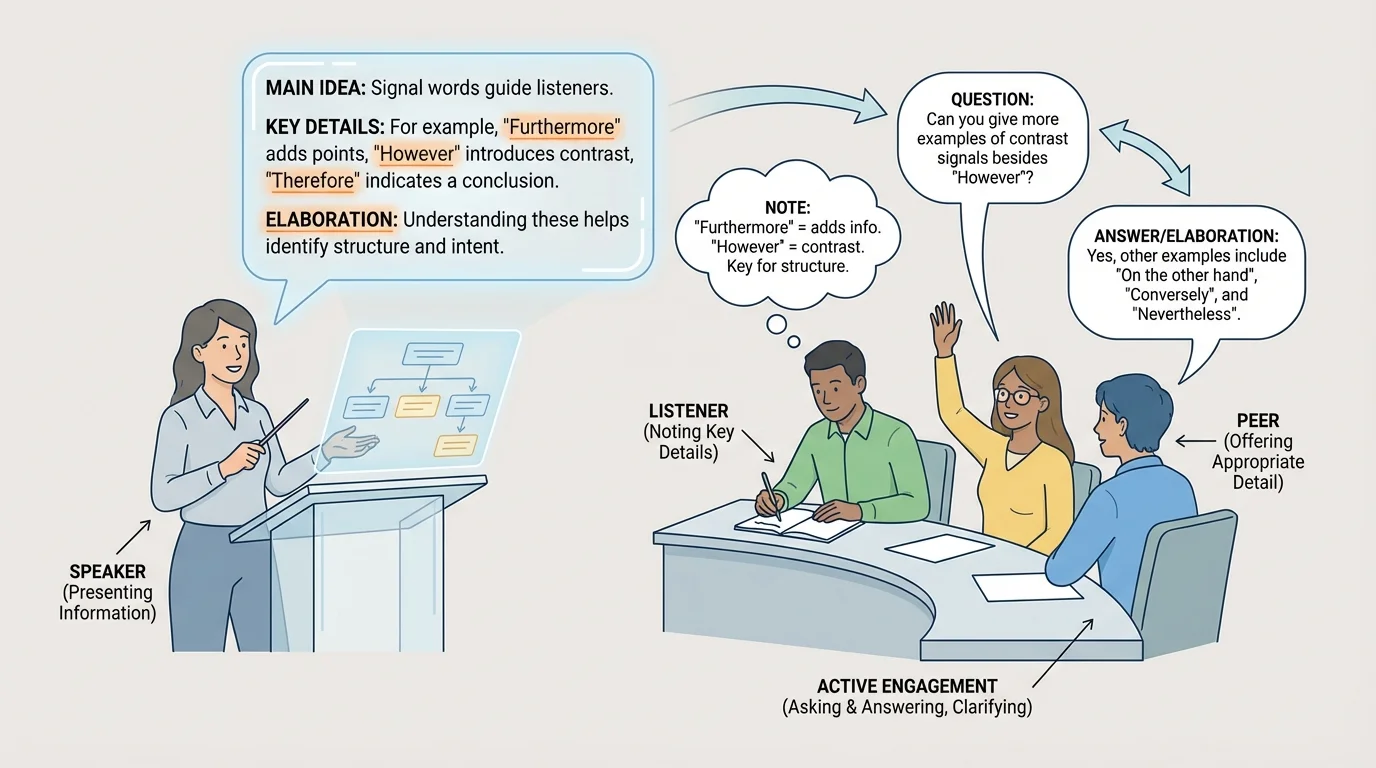
These clues also help students answer questions more clearly. If someone asks, "What reasons did the speaker give?" a strong answer would include the three reasons in order. A careful listener may even use signal words in the answer: "First, trees give shade. Second, they help clean the air. Third, they provide homes for birds."
Many strong readers are also strong listeners because both skills depend on noticing main ideas, details, and clue words that organize information.
Earlier, [Figure 1] showed main idea and details. Those same listening habits help students notice clue words when a speaker explains information.
These skills become easier to understand when we see them in real situations.
Situation 1: A student gives a short report about penguins and says, "Penguins live in groups, and their feathers help keep them warm." A listener asks, "How do the feathers help penguins stay warm?" That is a strong question because it asks for more explanation about the information the speaker already shared.
A strong answer would be, "Their feathers trap warmth close to their bodies, and they also have a layer of fat that helps protect them from the cold." This answer adds detail and stays focused on the question.
Example: Asking and answering in a book discussion
A speaker says, "The main character left home because she wanted to solve the mystery."
Step 1: Ask a question about the reason.
"Why was solving the mystery so important to her?"
Step 2: Answer using evidence from the speaker's information.
"It was important because she believed the mystery affected her family, and she wanted to protect them."
Step 3: Add elaboration.
"That shows she was brave and cared about others, not just herself."
The question and answer work together to deepen understanding.
Situation 2: In science, a speaker says, "Water can change form when it is heated or cooled." A weak question would be, "Do you like science?" That question is not about the speaker's information. A better question is, "What happens to water when it is heated?" A strong answer is, "When water is heated, it can turn into water vapor, which is a gas."
Situation 3: In social studies, a speaker says, "Communities need rules to keep people safe and treat people fairly." A listener might ask, "What is one rule that keeps people safe?" A detailed answer could be, "One rule is stopping at red lights because that helps prevent accidents and keeps drivers and walkers safer."
One common mistake is asking questions that do not match the speaker's topic. If the speaker is talking about animal habitats, a question about lunch choices does not belong in the discussion. To fix this, think: What did the speaker just say? Then ask about that idea.
Another mistake is giving answers that are too short. If someone asks, "Why do bees matter?" and you answer, "They just do," your listener learns almost nothing. A better answer is, "Bees matter because they help pollinate plants, and that helps many flowers, fruits, and vegetables grow."
Interrupting is another problem. When students interrupt, the speaker may lose their train of thought, and the group may miss important information. Waiting your turn is part of being respectful and cooperative.
Some students repeat what someone else said without adding anything. Repeating can sometimes be useful, especially when checking understanding, but discussion becomes stronger when you add something helpful. You might say, "I agree that plants need water, and I want to add that the speaker also said healthy soil is important."
"Listen to understand, not just to reply."
This idea helps students remember that careful listening comes before strong questions and strong answers.
Sentence starters can help students join a discussion politely and clearly. They are especially useful when students are learning to participate in a group.
| Purpose | Sentence Starter |
|---|---|
| Ask for more information | Can you explain more about ...? |
| Ask about a detail | What did you mean when you said ...? |
| Ask for a reason | Why do you think ...? |
| Answer clearly | I think ... because ... |
| Add a detail | Another detail is ... |
| Build on an idea | I want to add to that by saying ... |
| Show agreement respectfully | I agree because ... |
| Show disagreement respectfully | I heard it a little differently because ... |
Table 2. Sentence starters that help students ask and answer questions cooperatively in group discussions.
These sentence starters are tools. Students do not have to say them exactly the same way every time. The important part is that their words are clear, respectful, and connected to the speaker's information.
When you listen carefully, ask thoughtful questions, and answer with elaboration and detail, you become a stronger speaker and a stronger group member. Those skills help classrooms become places where people learn together.
