Have you ever answered a question with just one word, and then someone said, "Can you tell me more?" That happens because speaking is not only about saying words. It is about helping other people understand exactly what you mean. When you speak in complete sentences, your ideas sound clearer, stronger, and easier to follow.
Complete sentences are important in many parts of life. They help when you answer a teacher's question, explain rules in a game, tell a parent what happened at school, or give directions to a classmate. Sometimes a short answer is fine, but many tasks and situations call for more. When someone needs detail or clarification, a complete sentence helps you give the information they are asking for.
When people listen, they cannot reread your words the way they can reread a book. They hear your message once, so your speaking needs to be clear. A complete sentence gives a full idea. It tells enough so the listener can understand what happened, what you think, or what you need.
[Figure 1] Compare these answers to the question, "Why were you late?" One answer is, "Bus." Another answer is, "I was late because the bus arrived ten minutes after its usual time." The second answer is much clearer. It tells the reason in a way that makes sense right away. The listener does not have to guess.
Speaking in complete sentences can also make you sound more prepared and respectful. If a principal, teacher, coach, or family member asks you an important question, a complete answer shows that you are thinking carefully about your words.
Complete sentence means a group of words that expresses a full idea. In speaking, it usually names who or what the sentence is about and tells something about it.
Detail is extra information that helps explain an idea more clearly.
Clarification is an explanation that makes something easier to understand.
Not every speaking situation requires a long answer. If a friend says, "Ready?" you might simply say, "Yes." But when the task is to explain, report, describe, or answer a question fully, complete sentences are the best choice.
A sentence is complete when it shares a full thought. Usually, a complete sentence has a person, place, thing, or idea being talked about and tells what that person, place, thing, or idea does or is like.
For example, "The dog barked" is complete. It tells who, "The dog," and what happened, "barked." But "The dog in the yard" is not complete by itself. It names something, but it does not finish the thought.
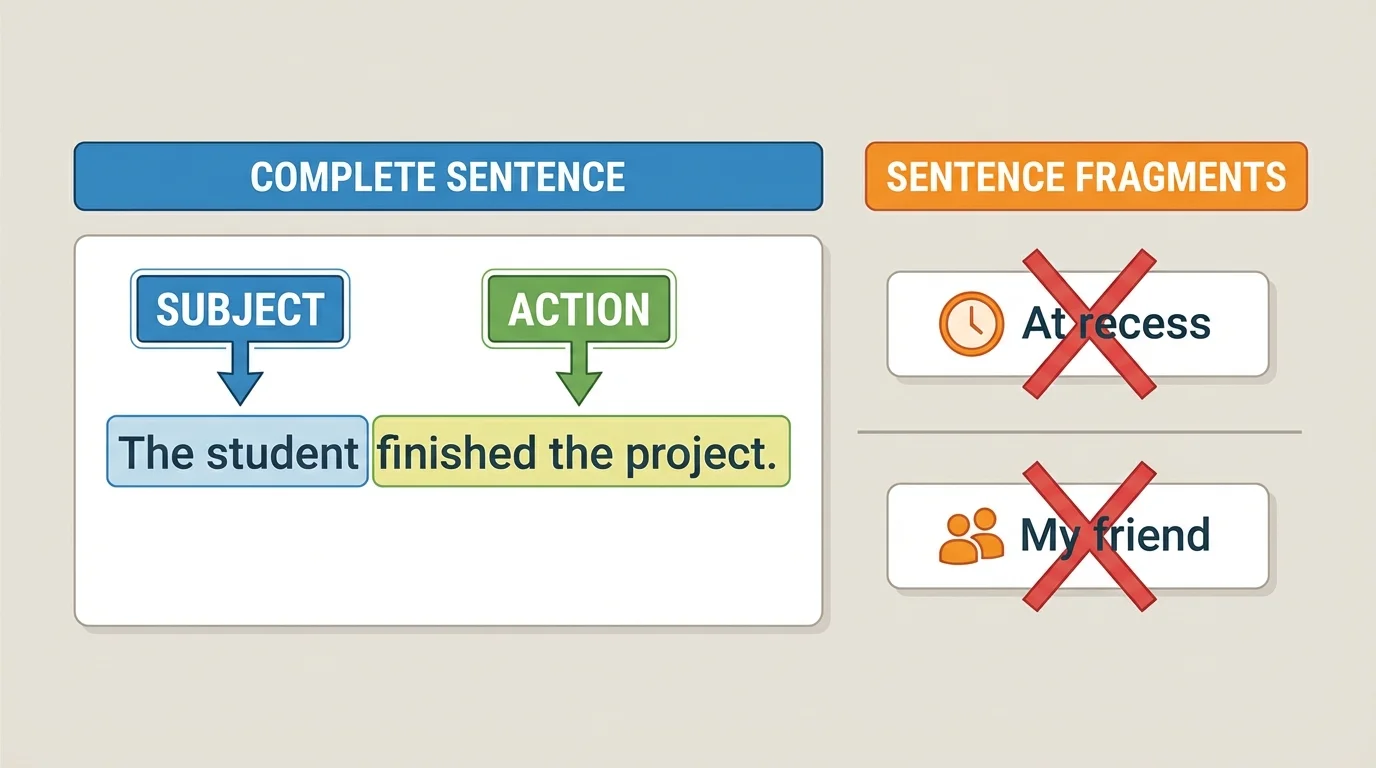
You do not need to use fancy words to speak in complete sentences. Simple, clear language works very well. "I finished my science project last night" is a complete sentence. "Last night" is not. "Finished my science project" is not. Those are only parts.
Sometimes students think a complete sentence must be very long. That is not true. A complete sentence can be short. "We won." "She smiled." "The bell rang." Each one gives a complete idea.
You may already know from writing that a sentence needs a complete thought. The same idea matters in speaking. Good speakers, like good writers, make sure their audience can understand the message without guessing.
When you speak, you may not stop and label the parts of a sentence in your head. Still, it helps to remember a quick check: Does my answer make sense all by itself? If the answer is yes, it is probably complete.
Some situations especially call for full answers. In class discussions, teachers often ask students to explain their thinking. If the teacher asks, "How did you solve the problem?" a one-word answer like "Math" does not help. A better response is, "I solved the problem by adding the tens first and then the ones."
You should also use complete sentences when telling about an event. If someone asks, "What happened at recess?" saying "Soccer" is too short. Saying "We played soccer near the blacktop, and my team scored two goals" gives useful detail.
Complete sentences are important in interviews, presentations, and group work. In these settings, other people are depending on your words to understand information. If your answer is too short, the listener may need to ask several more questions just to figure out what you mean.
Even in everyday life, complete sentences can solve problems. If you tell an adult, "My backpack," that may not be enough. If you say, "I think I left my backpack in the library after reading time," the adult can help more quickly. The same message can sound different in informal and formal situations.
[Figure 2] The way you speak can change depending on your audience. Informal language is relaxed speech often used with friends or family. Formal language is more careful and respectful, often used with teachers, principals, visitors, or during presentations.
If you are talking to a close friend, you might say, "I left my homework at home." If you are speaking to a teacher, you might say, "I left my homework at home, but I can bring it tomorrow morning." Both are complete sentences, but the second one fits a more formal school situation because it gives respectful information and a solution.
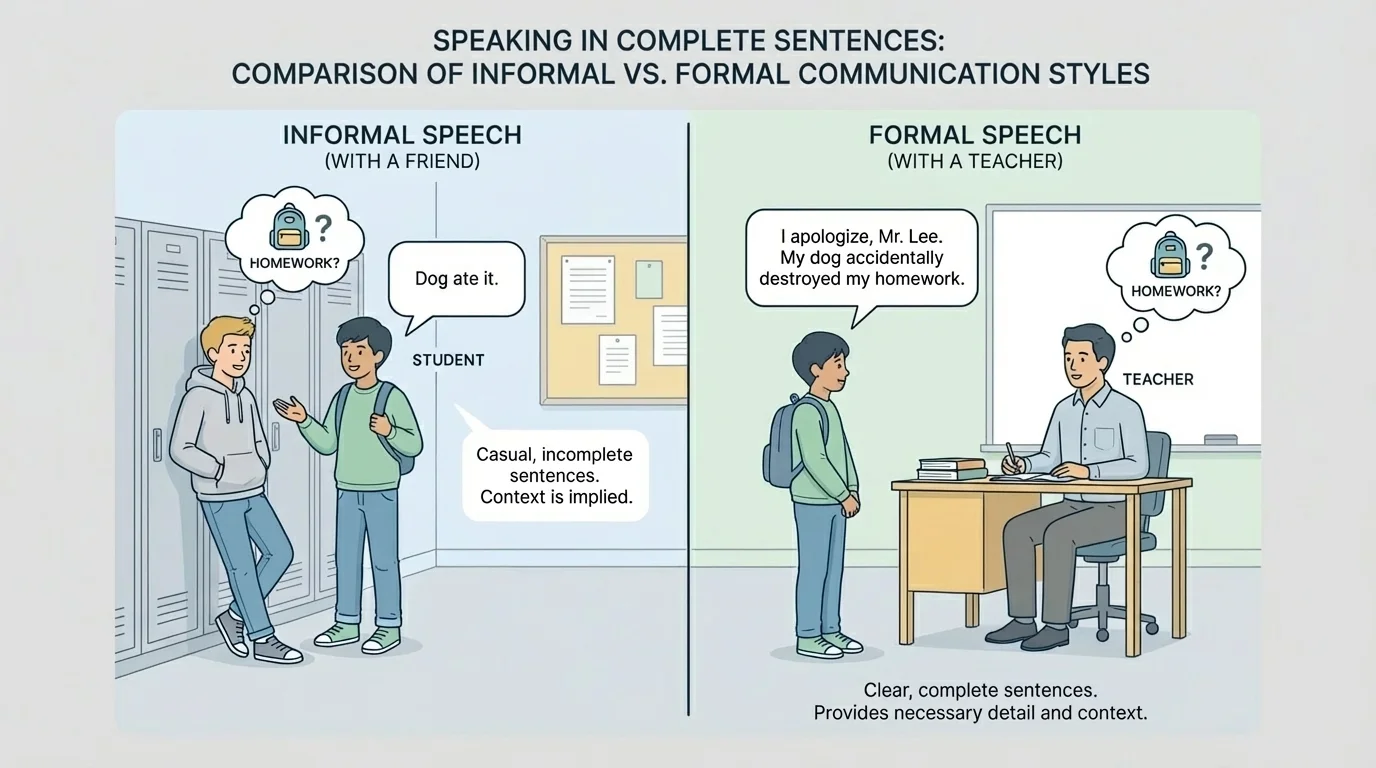
Formal speaking does not mean using big or confusing words. It means speaking clearly, politely, and fully. For example, instead of saying, "Yeah, I did it," you might say, "Yes, I completed the assignment."
Informal speaking can still include complete sentences. With a friend, you might say, "I am coming over after lunch." That is casual but clear. The important point is that your language should fit the task and situation.
| Situation | Type of Language | Example Response |
|---|---|---|
| Talking with a friend | Informal | I liked your drawing a lot. |
| Answering a teacher | Formal | I liked the story because the ending was surprising. |
| Speaking in a presentation | Formal | Our group discovered that plants need sunlight to grow well. |
| Playing at recess | Informal | We are starting a new game by the swings. |
Table 1. Examples of how language can match different speaking situations.
Later, when you think about speaking clearly in school, remember [Figure 2]. The message may stay similar, but the style changes depending on who is listening.
Sometimes a listener understands your main idea but still needs more information. This is when details and clarification matter.
[Figure 3] If someone asks, "What book did you choose?" the answer "The dog book" may be too unclear. A better answer is, "I chose a book about service dogs because I wanted to learn how they help people." That answer tells what the book is about and why it was chosen.
If a teacher says, "Please clarify your answer," the teacher is asking you to make your idea easier to understand. You might add an example, explain your reason, or tell the steps in order. Clarification does not mean repeating the same short answer louder. It means saying more that helps the listener understand.
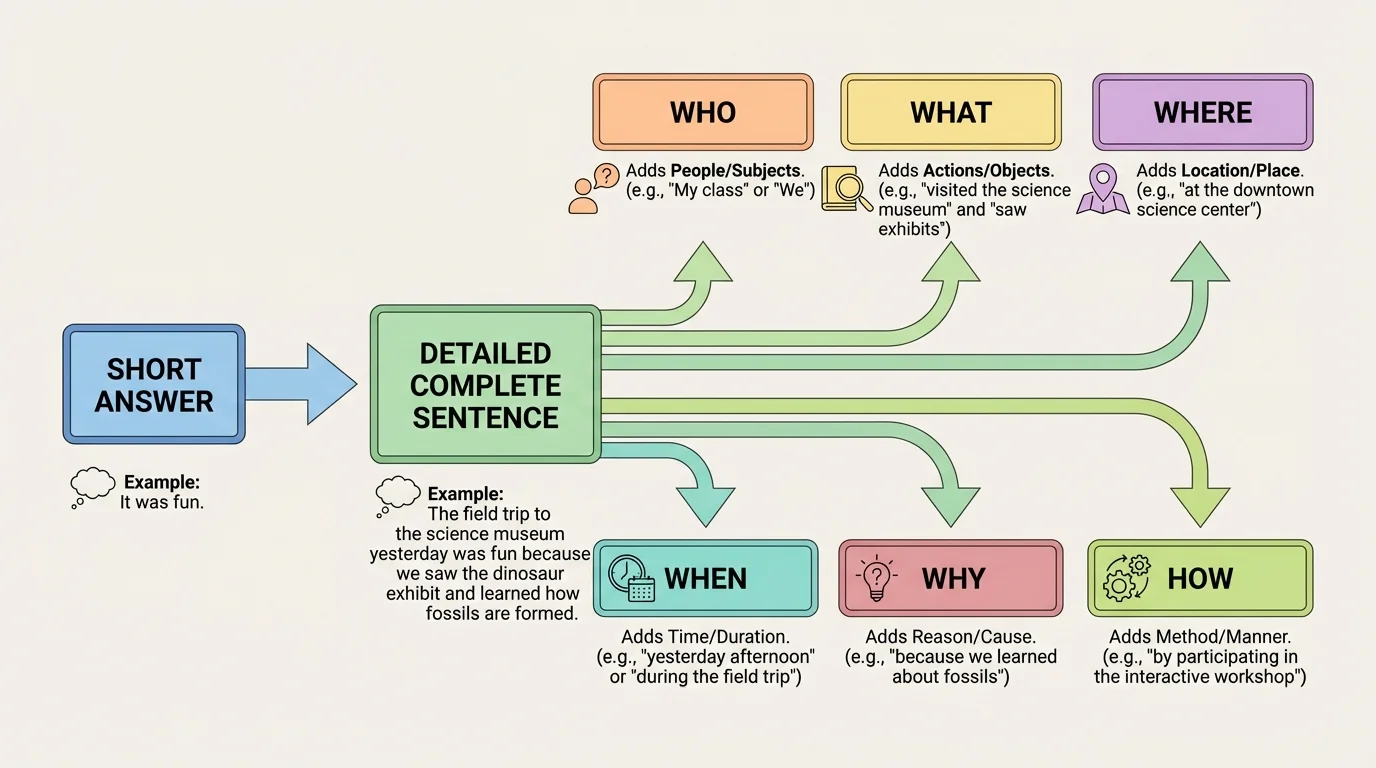
Here is a simple pattern you can use: begin with a complete answer, then add one or two helpful details. For example, if the question is "Where did you find the information?" you can say, "I found the information in a book about weather and on the school's website."
How to build a stronger spoken answer
Start by answering the question directly. Next, add a detail that explains your answer. If needed, add a second detail, such as a reason, an example, or a time and place. This helps your listener understand the whole idea, not just one small piece.
Notice how short answers can grow into clear ones. "Park" becomes "We went to the park after school." That can become "We went to the park after school to practice kicking the soccer ball." Each new detail helps the listener picture the situation more clearly.
Making answers clearer
A speaker is asked, "Why did your group choose that animal for the report?"
Step 1: Start with a direct answer.
"We chose dolphins."
Step 2: Turn it into a complete sentence.
"We chose dolphins for our report."
Step 3: Add a reason for detail.
"We chose dolphins for our report because they are intelligent and communicate with sounds."
The final answer gives both the main idea and helpful detail.
When you need to explain your thinking, details show that you understand your own idea. They also help others learn from what you say.
Good speaking begins with good listening. If you do not listen carefully, your answer may not match the question. For example, if someone asks, "When did the experiment begin?" and you answer, "In the science room," your answer may be a complete sentence if you say, "It was in the science room," but it still does not answer the right question. The listener asked when, not where.
Audience means the people who are listening. To speak well, you need to think about what your audience needs to know. Are they asking for a reason? A description? A step? A time? A place? Listening helps you choose the right kind of complete sentence.
One helpful habit is to pause for a moment before speaking. That short pause gives your brain time to organize the answer. Then you can answer the actual question instead of just saying the first word that comes to mind.
Many strong speakers sound confident not because they answer instantly, but because they take a moment to think before they speak. A short pause can make an answer clearer and calmer.
When you listen carefully and respond clearly, conversations go more smoothly. Fewer misunderstandings happen, and you are more likely to be understood the first time.
One common mistake is using a fragment instead of a full answer. A fragment is a group of words that does not express a complete thought. In speaking, fragments often sound choppy or confusing.
Here are some examples of weak answers and stronger ones:
Weak: "Because tired." Stronger: "I went to bed early because I felt tired after practice."
Weak: "At my grandma's." Stronger: "I spent the weekend at my grandma's house."
Weak: "The red one." Stronger: "I chose the red folder because it was labeled with my reading group."
Another mistake is giving too little detail. A complete sentence is helpful, but sometimes you need more than one sentence. If a teacher asks you to explain how your group solved a problem, one short sentence may not be enough. You may need two or three clear sentences in order.
Students also sometimes wander away from the topic. Good speakers stay focused on what was asked. The detail should help the listener, not distract from the answer.
When you are adding detail, think back to the pattern in [Figure 3]. Start with the answer, then choose the best question words to expand it in a useful way.
Clear speaking is not only about the words you choose. It is also about how you say them. Speaking loudly enough, facing the listener, and using a calm voice all help your message come across clearly.
Respect matters too. If you disagree with someone, you can still use complete, polite sentences. Instead of saying, "No, wrong," you might say, "I understand your idea, but I think the character felt sad because of what happened at the end." That kind of response is both clear and respectful.
Confidence grows with practice and careful thinking. You do not need to sound perfect. You simply need to share your ideas in a way that makes sense. A complete sentence gives your thoughts a strong shape.
"Say what you mean clearly, so others can understand your thinking."
As you speak in class, at home, and with friends, choose the sentence length that fits the task. A quick reply may work sometimes, but when someone asks for explanation, detail, or clarification, complete sentences help you communicate successfully.
