A writer can change a whole sentence by changing just one word. Think about the difference between "The rain fell" and "The rain pounded." Both sentences tell about rain, but one sounds gentle and the other sounds loud and strong. That is the power of careful word choice. When writers choose words and phrases for effect, they help readers see, hear, and feel what is happening.
Writing is more than putting words on a page. Writing is also about making readers think, feel, or picture something. A writer who picks just the right word can make a story more exciting, a description clearer, or an opinion more convincing.
If you say, "The girl went to the door," your reader understands what happened. But if you say, "The girl tiptoed to the door," your reader learns more. Now the reader may wonder: Why is she being quiet? Is she hiding? Is she nervous? One stronger word can add meaning.
Good writers do not always choose the longest word or the fanciest word. They choose the word that fits best. The best word is the one that says exactly what the writer means.
Effect is the feeling, picture, or idea that words create in a reader's mind. Word choice means selecting words carefully so writing sounds clear, strong, and interesting.
When you write, you are making choices all the time. You choose whether a character whispers or talks, whether the wind blows or howls, whether a room looks neat or spotless. These choices shape the writing.
Choosing words and phrases for effect means picking language on purpose. A writer does not choose words by accident. A writer asks questions such as: What do I want my reader to picture? What feeling do I want to create? What is the best way to say this?
Sometimes the effect is to make writing vivid. Sometimes the effect is to make writing funny. Sometimes the effect is to make information easy to understand. Different kinds of writing can have different effects, but all strong writing uses words thoughtfully.
A phrase is a small group of words that works together. A phrase can add power too. Compare these: "The leaves moved" and "The leaves danced in the wind." The second example uses a phrase to create a stronger picture.
Words are tools. Just as an artist chooses colors, a writer chooses words. Bright, exact, and vivid words can help readers make a mental movie. Soft or plain words may give less detail. The writer's job is to choose the tool that matches the job.
Sometimes one sentence needs a strong action word. Another sentence may need a phrase that helps set a scene. The effect comes from how all the choices work together.
Some words are useful but general. They are not wrong, but they may not give enough detail. Stronger words are often more exact, and as [Figure 1] shows, exact words help readers picture the action more clearly. For example, the word "went" tells that someone moved, but it does not tell how the person moved.
Look at these pairs:
"The boy went across the room."
"The boy raced across the room."
"The cat made a sound."
"The cat yowled."
"The baby looked at the cake."
"The baby stared at the cake."
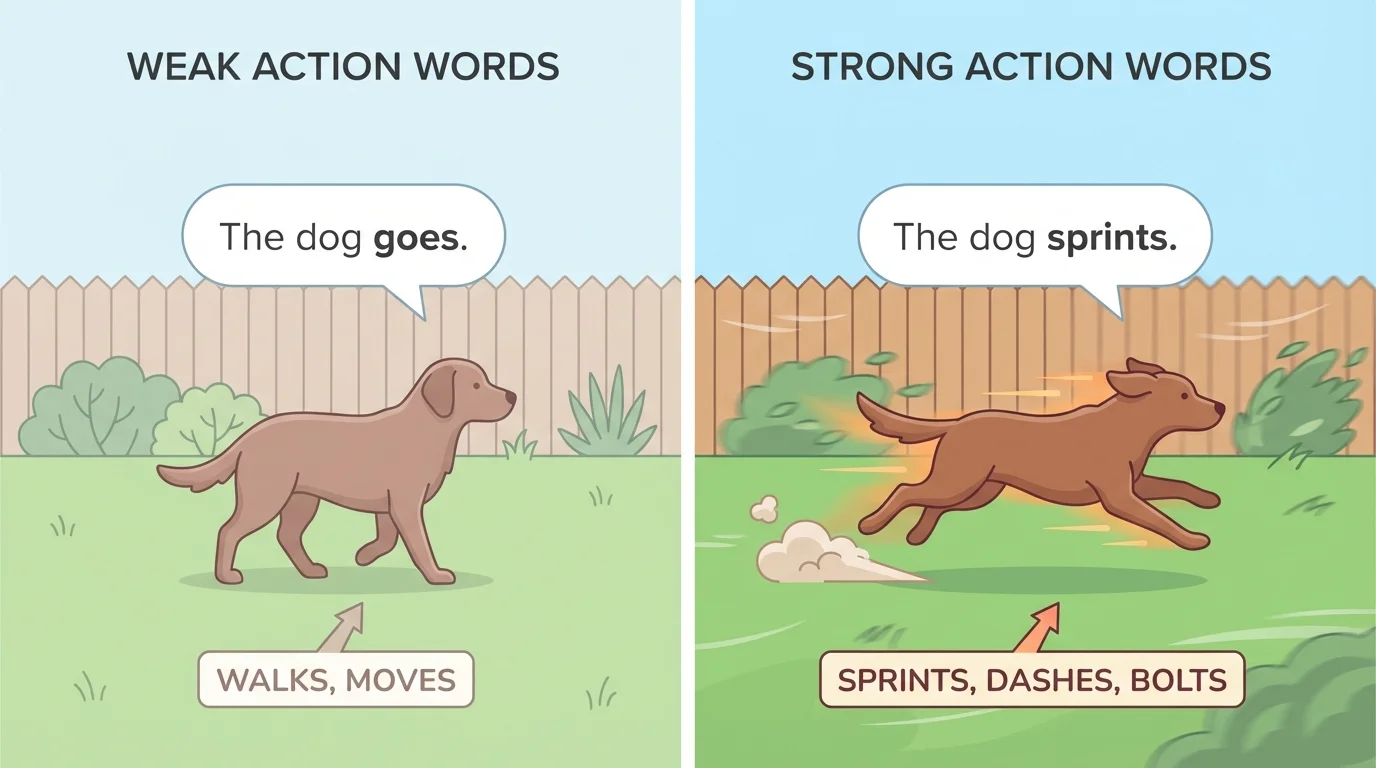
Words such as raced, yowled, and stared are stronger because they are more specific. They help the reader understand the action better.
Weak words are not always bad. Sometimes simple words are the best choice. But when a sentence feels dull or unclear, it may need a stronger word. Writers often revise by looking for words like "went," "said," "nice," "good," or "bad" and asking whether there is a better choice.
For example, instead of "said," a writer might choose "shouted," "murmured," "answered," or "cried." Each word gives more information. Later, when you revise, the same idea from [Figure 1] still helps: a more exact word can create a stronger scene.
Writers often use describing words and action words to improve their writing. Adjectives describe nouns. Adverbs describe verbs, adjectives, or other adverbs. Verbs show action or state of being. Strong verbs are especially important because they carry a lot of meaning.
Compare these sentences:
"We had a good day at the beach."
"We had a sunny, breezy day at the beach."
The second sentence helps the reader picture the weather.
Now compare these:
"The waves came to shore."
"The waves crashed onto the shore."
The second sentence uses a stronger verb. The reader can almost hear the water.
Improving a sentence with better word choice
Plain sentence: "The big dog went quickly to the gate."
Step 1: Look for words that are general.
The words "big," "went," and "quickly" tell something, but they do not create the clearest picture.
Step 2: Replace one or more words with more exact choices.
"Big" can become "giant" or "shaggy." "Went quickly" can become "charged" or "bounded."
Step 3: Read the new sentence aloud.
"The shaggy dog bounded to the gate."
The new sentence is shorter, but it is stronger because the words are more exact.
Strong writing does not mean stuffing in many describing words. Too many can make a sentence crowded. "The huge, fluffy, brown, muddy, sleepy, noisy dog" may be too much if all those details are not important. Pick the details that matter most.
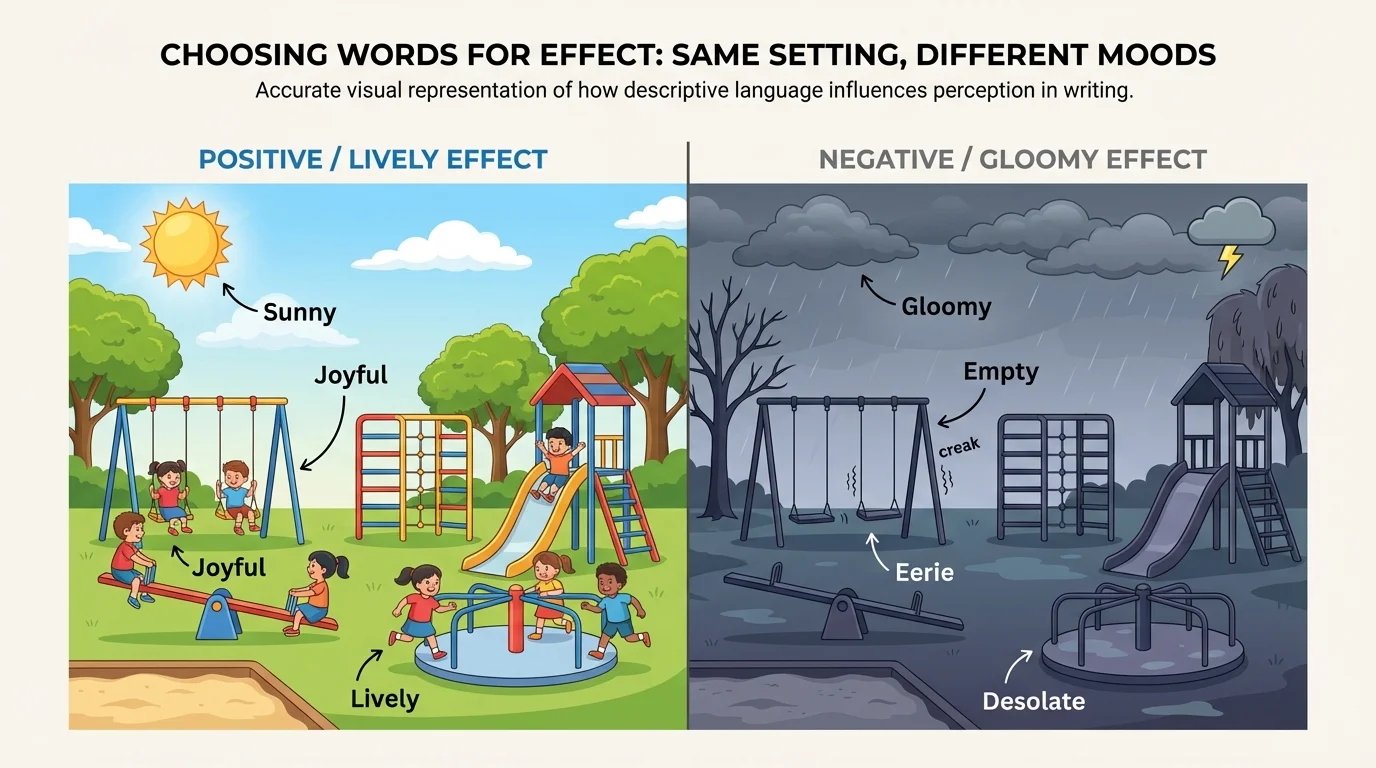
Mood is the feeling a piece of writing gives the reader. Words create mood, and [Figure 2] illustrates how the same place can feel cheerful or spooky depending on the writer's choices. A park can sound joyful, peaceful, lonely, or scary, depending on the words used.
Read these two descriptions of the same place:
"The playground was full of bright swings, laughing children, and warm sunshine."
"The playground stood silent under gray clouds, and the swings creaked in the wind."
Both sentences describe a playground, but the mood is very different. Words like "bright," "laughing," and "warm" create a happy feeling. Words like "silent," "gray," and "creaked" create an eerie feeling.
Tone is the writer's attitude toward the subject. Tone might sound cheerful, serious, playful, or angry. If you are writing about a fun field day, playful words may fit. If you are writing an informational piece about staying safe in a storm, clear and serious words fit better.
Writers choose mood and tone carefully. A silly word in a serious report may sound strange. A scary word in a cheerful story may not fit. The words must match the purpose of the writing.
Many authors make readers feel nervous without ever saying "This is scary." They choose words such as "shadow," "creak," "flicker," and "whisper" to build that feeling.
Later in your own writing, think back to the contrast in [Figure 2]. The setting stays the same, but the word choice changes the feeling completely.
Writers choose words differently depending on what they are writing. A story, an opinion paragraph, and an informational report all need strong word choices, but they use them in different ways.
In narrative writing, writers often choose words that help readers picture characters, settings, and actions. They may use strong verbs and descriptive phrases. Example: "The lantern flickered as Maya crept down the hallway."
In opinion writing, writers choose words that make their ideas clear and convincing. Example: "School gardens are valuable because they teach responsibility and help students learn about plants." Words such as "valuable" help strengthen the opinion, and the reason that follows supports it.
In informational writing, writers choose clear, exact words so readers can understand facts. Example: "A penguin's feathers help keep it warm in icy water." The writer does not need fancy words. The best effect here is clarity.
| Kind of Writing | Helpful Word Choices | Example Effect |
|---|---|---|
| Story | Strong verbs, sensory details, vivid phrases | Creates pictures and feelings |
| Opinion | Clear reasons, convincing words | Persuades the reader |
| Information | Exact, simple, correct words | Explains clearly |
Table 1. Different kinds of writing use word choice in different ways to create the right effect.
The kind of writing helps the writer decide what kind of effect is most important.
Writers can also create effect by repeating a word or phrase on purpose. Repetition can make an idea stand out. For example: "We looked under the bed, behind the chair, inside the closet. Still no puppy. Still no puppy." The repeated phrase adds feeling and emphasis.
Sometimes writers choose words for the way they sound. Alliteration happens when words close together begin with the same sound, such as "busy buzzing bees." This can make a phrase catchy and fun to read.
Short phrases can create effect too. In an exciting part of a story, a writer may use short sentences or short phrases: "The door opened. Silence. One step. Then another." These brief parts can build suspense.
Sound can support meaning. Soft-sounding words may help create a peaceful mood. Sharp or sudden sounds can make action feel faster or more dramatic. Writers often listen to their sentences as well as read them.
Writers should use repetition and sound effects carefully. If every sentence repeats words or uses alliteration, the writing may feel forced. A few strong choices usually work better than too many.
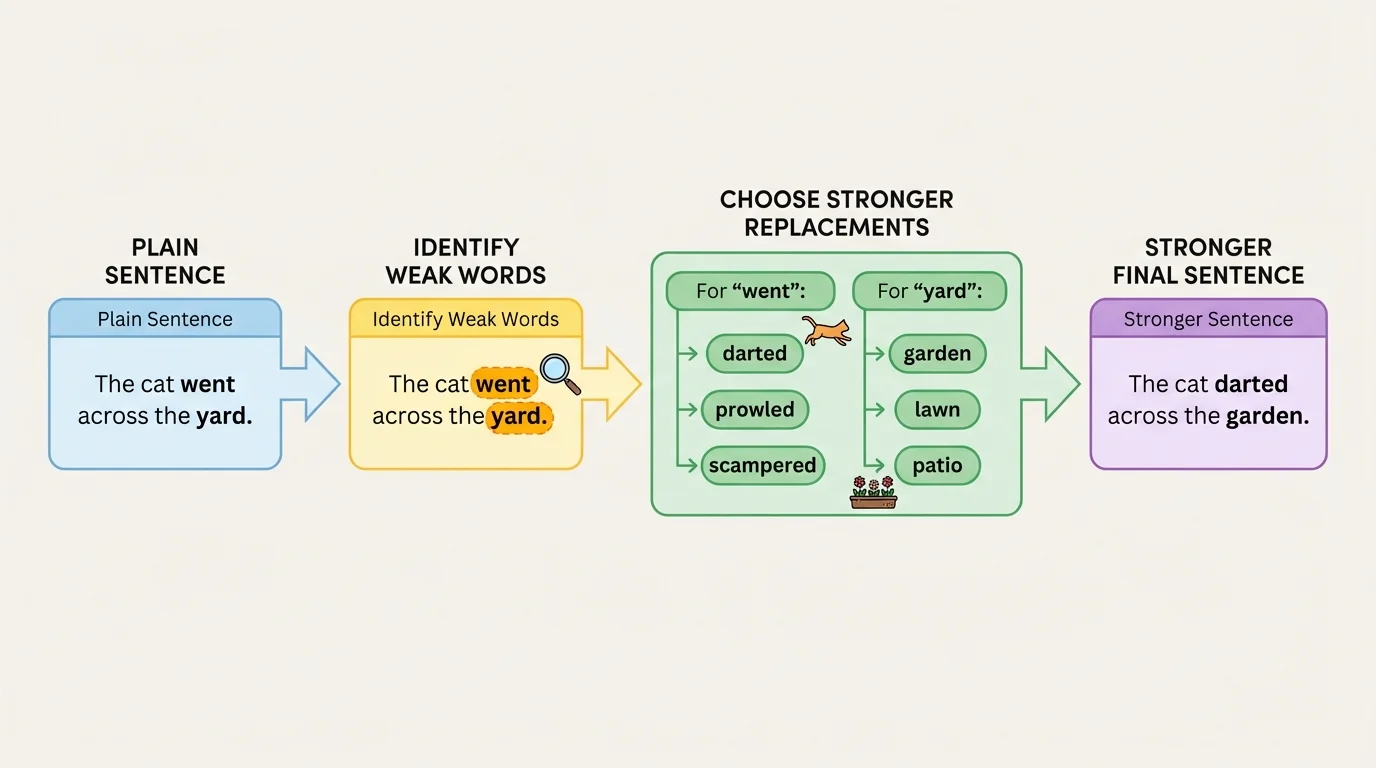
Strong word choice often happens during revision, not just during the first draft. Writers reread, notice weak words, and replace them with better ones, as [Figure 3] shows in a step-by-step way. This is part of a recursive writing process, which means writers may plan, draft, revise, and edit more than once.
When revising for effect, ask questions like these: Does this word create a clear picture? Is there a stronger verb I can use? Do these words match the mood I want? Is this phrase interesting and clear?
Here is a plain draft sentence: "The storm was bad, and the trees moved." A writer can revise it to: "The fierce storm bent the trees." The second sentence is stronger because "fierce" and "bent" give a clearer image.
Revision does not always mean adding more. Sometimes the best revision is to cut extra words. "The very, very huge giant wave" may be less effective than "the towering wave." Careful writers replace weak words, remove unnecessary words, and read again.
Revision example
Draft sentence: "My brother said the roller coaster was good."
Step 1: Find weak words.
The words "said" and "good" are not very exact.
Step 2: Think about the feeling.
Was the roller coaster exciting, scary, or amazing?
Step 3: Replace weak words.
"My brother shouted that the roller coaster was thrilling."
The revised sentence gives more energy and feeling.
As you keep revising, the process in [Figure 3] remains useful: read, notice, replace, and read again.
Even strong words need to fit correct writing rules. Good word choice works together with grammar, capitalization, punctuation, and spelling.
Grammar helps sentences make sense. If you choose a strong verb, it still has to match the subject and tense. For example, "The dogs dash to the fence" and "The dog dashes to the fence" are both correct, but they use different forms of the verb.
Capitalization matters too. Names, days of the week, months, and the first word in a sentence should be capitalized. "maria tiptoed into the library" should be "Maria tiptoed into the library."
Punctuation helps show meaning and effect. Compare "Let's eat, Grandma!" with "Let's eat Grandma!" The comma changes everything. Punctuation can also help with mood. Short sentences with periods can feel fast and tense. Questions can create curiosity.
Spelling matters because a misspelled word can confuse the reader. If a writer means "crept" but writes "creeped" instead, the sentence may sound less natural, and the effect may weaken. Careful editing helps powerful words do their job.
You already know that complete sentences need correct capitalization, end punctuation, and words spelled as accurately as possible. Strong word choice becomes even more effective when these rules are in place.
Writers often revise for effect first and then edit for correctness. Both steps matter.
One common mistake is choosing words that are too fancy. If a word is hard to understand and does not fit the rest of the piece, it may distract the reader. Clear writing is usually stronger than confusing writing.
Another mistake is repeating the same ordinary word too many times. Read this: "The fun game was fun because the fun team had fun." The repeated word "fun" gets boring. A better version might use words like "exciting," "energetic," or "enjoyable."
A third mistake is using words that do not match the writing. In a serious report about animal habitats, a silly phrase may feel out of place. In a playful story, a stiff and formal word may sound awkward.
Writers should also avoid adding details that do not help. If every sentence is packed with strong words, none of them stand out. Good word choice is about balance.
Careful word choice helps writing come alive. A precise verb can make action clearer. A vivid adjective can sharpen an image. A thoughtful phrase can build mood. A repeated line can add emphasis. All of these choices help the writer create an effect on the reader.
Think about these changes:
"The bird was in the tree."
"The tiny bird perched in the oak tree."
"The room was messy."
"Books, socks, and papers were scattered across the room."
"The fire was bright."
"The fire crackled and flashed in the dark."
Each stronger sentence gives the reader more to see or feel. The words are chosen on purpose.
When you write, your words are not just information. They are also tools for painting pictures, building feelings, and guiding your reader. The more carefully you choose them, the stronger your writing becomes.
