Have you ever been reading a story and suddenly met a word you did not know? Strong readers do not always stop right away for a dictionary. First, they become word detectives. They look at the rest of the sentence for hints. Very often, the sentence itself helps unlock the meaning. That skill makes reading smoother, faster, and more powerful.
When you use the words around an unknown word to help figure it out, you are using context clues. In this lesson, the special kind of clue we study is the clue inside one sentence. Sometimes a sentence explains the word. Sometimes it gives an example. Sometimes it shows the opposite idea. Sometimes it helps you feel what the word means by showing an action or reaction.
Good readers do not guess wildly. They look carefully, think about what would make sense, and then test their idea. If the meaning fits the whole sentence, they keep reading. If it does not fit, they try again.
Sentence-level context means the words and ideas in the same sentence that help explain an unknown word or phrase. A word or phrase can be a single word, such as fragile, or a group of words, such as in a flash.
Sometimes the clue is easy to spot. In the sentence, "Kai was exhausted, so he fell asleep the minute he got into bed," the words fell asleep help show that exhausted means very tired. The sentence gives enough information to make a smart guess.
A sentence is like a small neighborhood. Every word lives next to other words, and those neighboring words can help explain one another. If you only stare at the unknown word by itself, it may seem confusing. But when you read the whole sentence, the meaning often becomes clearer.
Look at this sentence: "The glass vase is fragile, so carry it carefully with two hands." The phrase carry it carefully tells you the vase can break easily. You can figure out that fragile means easy to break.
Now look at another one: "Mina gave a generous gift and shared her snacks with everyone too." The words shared and with everyone show that generous means willing to give and share.
Sentence-level context is especially helpful when you are reading stories, directions, science books, or articles and do not want to stop every few seconds. It keeps your reading moving while still helping you learn new vocabulary.
Sentences can give different kinds of clues, as [Figure 1] shows, and each kind helps readers in a slightly different way. The clue may tell the meaning directly, hint at a similar word, show an opposite, list examples, or describe actions and feelings that match the unknown word.
One kind is a definition clue. This happens when the sentence tells what the word means. For example: "A nocturnal animal is active at night and sleeps during the day." The sentence explains the word clearly. You can tell that nocturnal means active at night.
Another kind is a synonym clue. A synonym is a word with a similar meaning. In the sentence, "The path was tiny, narrow, and hard to find," the word narrow helps explain that tiny path means not wide. Sometimes the unknown word comes first, and sometimes the known word comes first.
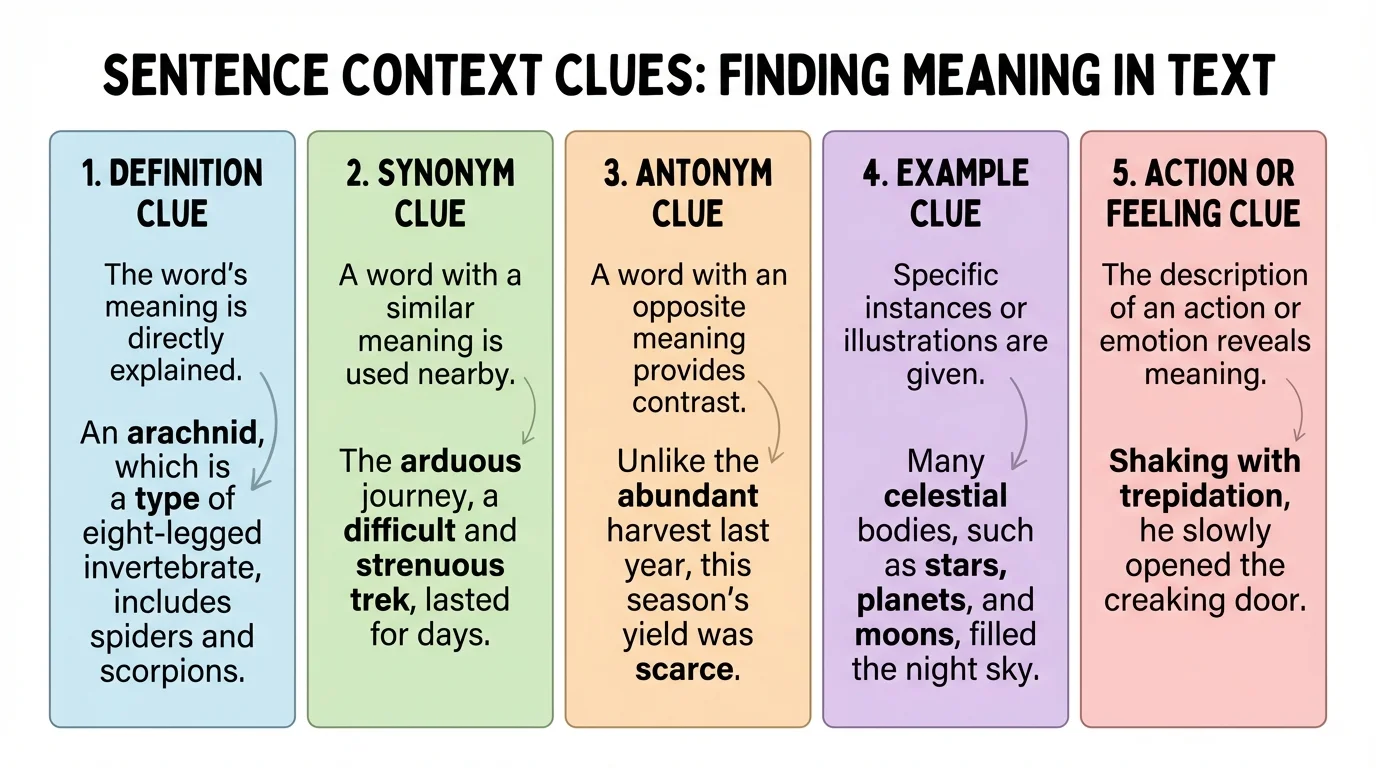
A third kind is an antonym clue. An antonym is an opposite. In the sentence, "Unlike his noisy brother, Ben was silent during the movie," the word unlike and the idea of noisy help you understand that silent means quiet.
A fourth kind is an example clue. The sentence gives examples that help explain the word. Read this sentence: "The market sold produce such as carrots, tomatoes, and lettuce." The examples tell you that produce means fruits and vegetables.
A fifth kind is an action or feeling clue. For example: "Jada hesitated at the diving board, stepping back and biting her lip." Even if you do not know the word hesitated, the actions show that she paused because she was unsure.
When you compare these clue types, as in [Figure 1], you can see that readers should stay flexible. One sentence might explain a word directly, while another gives only a hint through behavior or examples.
Why context clues work
Authors want readers to understand the message. Because of that, writers often place helpful hints near hard words. They may explain the word, restate it in a simpler way, or show its meaning through details in the sentence.
Not every sentence gives a perfect clue, but many give enough for a good reader to make a strong guess. The goal is not always to find a dictionary definition. The goal is to understand what the word means in that sentence.
When you meet an unfamiliar word, slow down for a moment. First, read the whole sentence from beginning to end. Then reread it and pay attention to the words around the unknown word. Ask yourself, "What is happening here?" and "What meaning would make sense?"
Suppose you read: "The puppy was mischievous, chewing a shoe and dragging a sock across the room." The actions tell you a lot. The puppy is not calm or careful. The sentence suggests that mischievous means playful in a troublesome way.
After you make a guess, test it by putting your idea back into the sentence. If you think mischievous means causing a little trouble, the sentence makes sense: "The puppy was causing a little trouble, chewing a shoe and dragging a sock across the room." That fits.
If your guess does not fit, try another one. Good readers change their thinking when needed. That is not a mistake. That is smart reading.
Using sentence context step by step
Sentence: "The ground was soggy after the long rain, and our boots sank into the mud."
Step 1: Read the full sentence.
The sentence talks about long rain, boots, and mud.
Step 2: Notice the clues.
After the long rain and boots sank into the mud are strong hints.
Step 3: Make a meaning guess.
Soggy probably means very wet and soft.
Step 4: Test the guess in the sentence.
"The ground was very wet and soft after the long rain..." makes sense.
The sentence-level context helps you figure out the meaning without needing outside help right away.
This kind of thinking becomes easier with practice. The more you pay attention to sentence clues, the faster you will notice them.
Some words have more than one meaning, and the sentence tells you which one is correct, as [Figure 2] makes clear. This is why reading only the word is not enough. You must read the whole sentence.
Look at the word bat. In "Leah swung the bat and hit the ball to left field," hit the ball tells you that bat means sports equipment. In "A bat flew out of the cave at dusk," the words flew and cave tell you that bat means the animal.
The same thing happens with the word bark. In "The bark on the tree felt rough," the sentence points to the outside covering of a tree. In "The dog began to bark at the mail truck," the sentence points to a sound a dog makes.
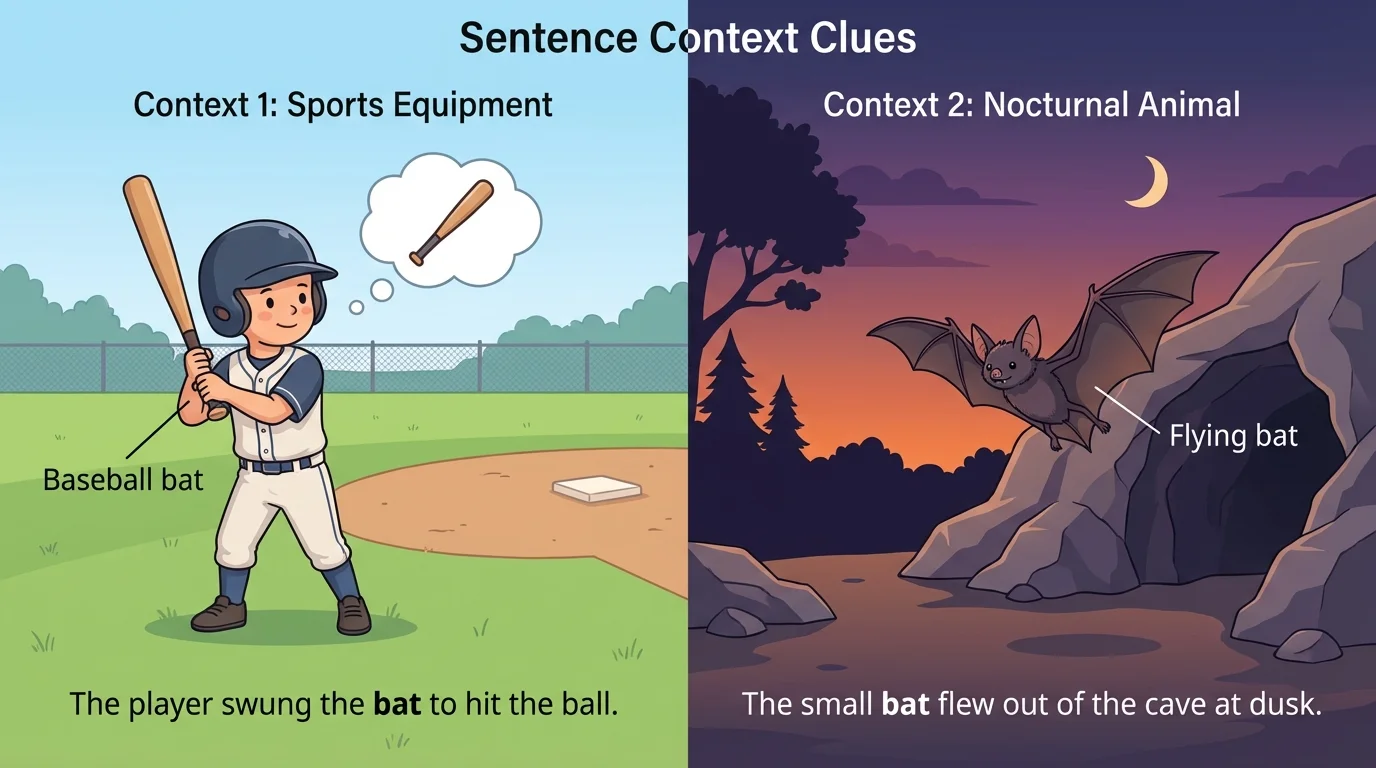
Words like these are called multiple-meaning words. The reader uses the sentence to decide which meaning belongs. That is one reason context is so important.
Later, if you meet another multiple-meaning word, remember the two-scene idea from [Figure 2]. The same letters may stay the same, but the sentence changes the meaning.
Many common English words have more than one meaning. That can seem tricky at first, but it also means one sentence can teach you a lot when you pay close attention.
Here is another example: "Please watch the soup so it does not boil over," and "I got a new watch for my birthday." The first uses watch as a verb meaning look after. The second uses watch as a noun meaning a timepiece. The sentence tells you which one is meant.
Some words in a sentence act like little signs for readers, and [Figure 3] highlights several of the most useful ones. When you notice these signal words, you can often tell what kind of context clue the sentence is giving.
Words like or, is, and commas sometimes introduce a definition. In "A dromedary, or one-humped camel, lives in hot dry places," the phrase after the comma and the word or explain the meaning.
Words like but, however, unlike, and instead often point to an opposite idea. In "The trail looked dangerous, but the guide said it was safe," the word but signals a contrast.
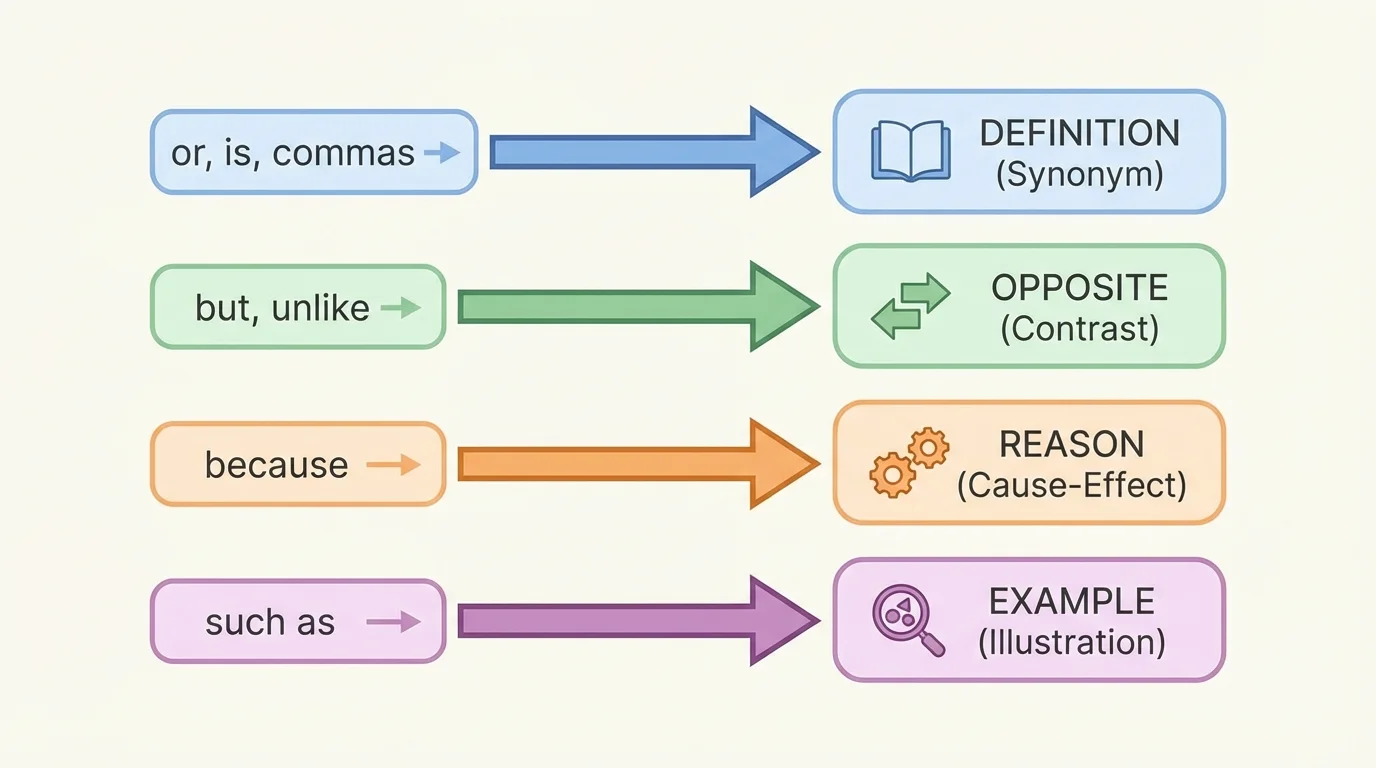
Words like such as, for example, and including often introduce examples. In "We saw marine animals such as dolphins, seals, and sea turtles," the examples help explain the group.
Words like because can also help. In "Nora felt relieved because her lost backpack had been found," the reason in the sentence helps you understand that relieved means glad that a worry is over.
When you read new sentences later, think back to the signal words in [Figure 3]. They do not always guarantee one clue type, but they often point you in the right direction.
| Signal word or pattern | What it may tell you | Example |
|---|---|---|
| or | Definition or restatement | "arboreal, or tree-living" |
| but | Opposite or contrast | "small but strong" |
| unlike | Opposite or difference | "Unlike the loud crowd, Ava was calm." |
| such as | Examples | "tools such as a hammer and saw" |
| because | Reason that hints at meaning | "smiled because she succeeded" |
| commas | Extra explaining words | "The cub, a young bear, slept." |
Table 1. Common signal words and patterns that often introduce sentence-level context clues.
This reading skill is useful in every subject, not just in stories. In science, a sentence might say, "Cactus plants survive in arid places where very little rain falls." The words very little rain help you know that arid means dry.
In social studies, you might read, "Settlers built a shelter, a safe place to live, before winter arrived." The words after the comma explain the word directly.
In a story, you may see, "The knight was brave, stepping in front of the dragon to protect the village." The action in the sentence helps show the meaning.
In directions, you might read, "Stir the sauce gently so it will not splash." Even if a reader is unsure about gently, the idea that the sauce should not splash gives a clue that it means softly or carefully.
You already know that reading is about making meaning, not just saying words aloud. Using context clues is one way readers make meaning while they read.
The more kinds of books you read, the more chances you get to use sentence-level context. Each subject gives practice in a slightly different way.
Sometimes one sentence gives only a small clue. If that happens, do not give up. Read the next sentence and the one before it if possible. A second sentence may add the missing information.
For example, "The cave was dim." That tells you a little, but not much. If the next sentence says, "We could barely see the walls without a flashlight," now you have enough to know that dim means not bright.
You can also use what you know about parts of words. A prefix, suffix, or base word may help. If you see careless, you might know care and the ending -less, which means without. Then the sentence can help confirm your idea.
If context and word parts still do not help enough, then it is a good time to ask, look in a glossary, or use a dictionary. Strong readers use context first, but they also know when they need another tool.
When one sentence is not enough
First sentence: "The kitten hid in a crevice."
Second sentence: "It squeezed into the narrow crack between two rocks."
Step 1: Notice that the first sentence alone may not fully explain crevice.
Step 2: Read the next sentence for more context.
Step 3: Use the words narrow crack between two rocks to infer the meaning.
Now you can understand that a crevice is a narrow opening or crack.
Flexible readers use more than one strategy when needed. That is a sign of strength, not weakness.
Using sentence-level context becomes easier when you build good habits. Read all the way through the sentence. Reread when needed. Look for clue words. Notice actions, feelings, examples, and contrasts. Then make a smart guess and test it.
It also helps to keep your mind on the meaning of the whole passage. If a guessed meaning fits one sentence but does not fit the paragraph, check again. The best meaning should make sense in the sentence and in the text around it.
Every time you solve an unknown word using context, your vocabulary grows. That means future reading gets easier. One new word can lead to many more.
Readers are not just sounding out words. They are thinking, noticing patterns, and solving meaning. Sentence-level context is one of the most useful tools for doing that work well.
"The words around a hard word are often the keys that unlock it."
When you read carefully, the sentence often speaks twice: once to tell the story or teach the fact, and once more to help you understand a new word inside it.
