Have you ever finished a page and suddenly realized, "I read the words, but I do not know what I just read"? That happens to many readers. Strong reading is not only about saying words correctly. It is also about knowing why you are reading and making sure the words turn into ideas in your mind. When readers read on-level text with purpose and understanding, they unlock stories, directions, facts, and new knowledge.
Reading is like using a set of tools together. You need to decode words, read smoothly, understand what words mean, and keep checking that the text makes sense. When these skills work together, reading feels less like guessing and more like discovering.
A reader's purpose is the reason for reading. You might read to enjoy a story, learn about frogs, follow game directions, or find one important fact. When you know your purpose, your brain knows what to pay attention to. If you are reading a story, you may focus on characters and problems. If you are reading directions, you need to notice steps in the correct order.
Reading with purpose helps you stay alert. Instead of racing through words, you ask yourself questions such as: "What am I trying to learn?" "What is important here?" and "Does this make sense?" Purpose guides understanding.
Purpose is the reason you are reading. Understanding, or comprehension, means making meaning from the text. On-level text means text that is right for your grade and reading development—not too easy and not too hard.
Suppose you read a recipe for fruit salad. Your purpose is not to admire fancy words. Your purpose is to learn what ingredients to use and what order to follow. But if you read a folktale, your purpose may be to enjoy the plot and understand the lesson the story teaches. Good readers change their focus depending on the task.
Fluency means reading with accuracy, at a smooth pace, and with expression, as [Figure 1] shows. A fluent reader does not stop at every word or read in a choppy, robotic way. Fluent reading sounds more like natural speaking, and that helps the reader hold on to meaning.
There are three big parts of fluency. Accuracy means reading the words correctly. Rate means reading at a pace that is not too slow and not too fast. Expression means using your voice to show punctuation, feeling, and meaning. A question should sound like a question. An exciting line in a story should sound exciting.
When fluency is strong, your brain has more space to think about meaning. If a reader uses too much energy just trying to say the words, there is less energy left for understanding. That is why fluency supports comprehension.
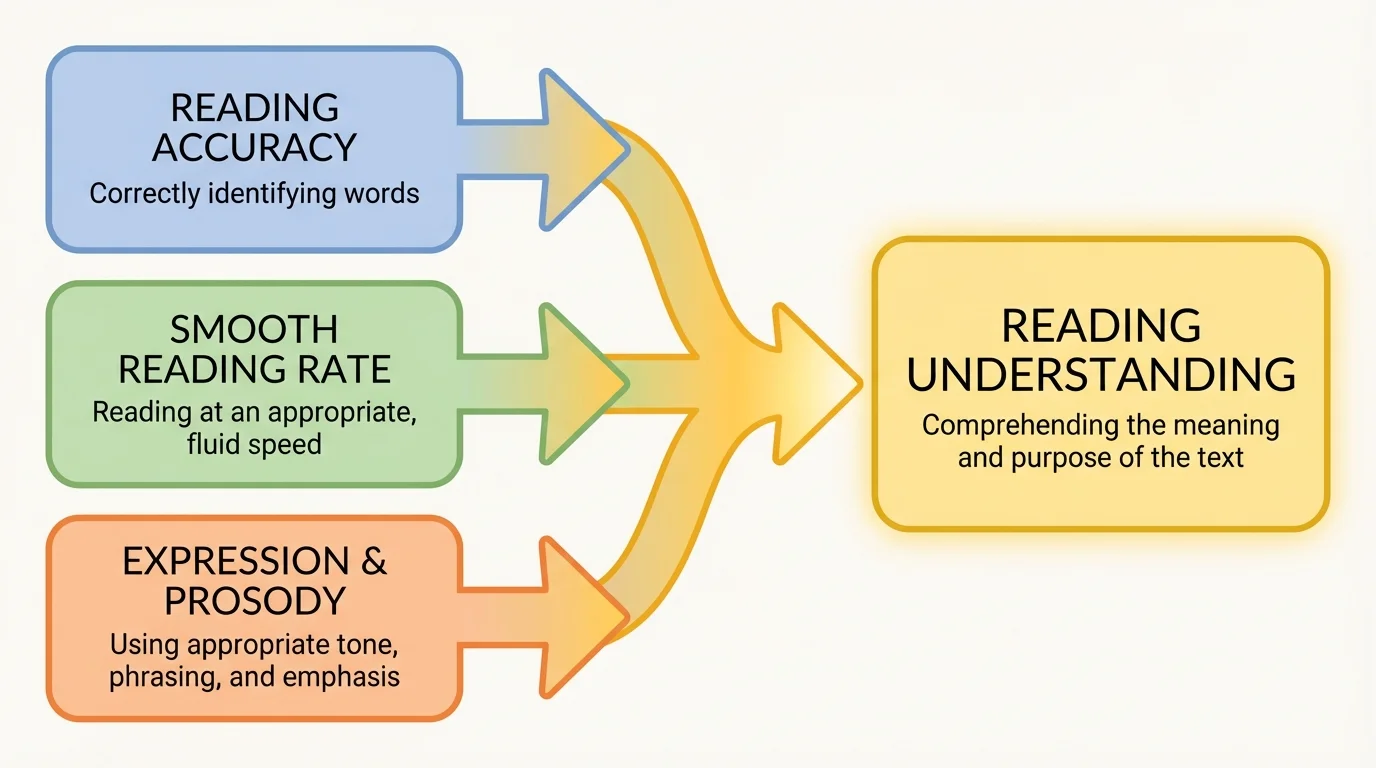
Listen to the difference between these two ways of reading a sentence. One reader says, "The... dog... ran... to... the... pond." Another reader says, "The dog ran to the pond!" The second reader sounds smoother and understands the sentence as a whole. That is fluency in action.
Fluent reading does not mean rushing. Reading too fast can cause mistakes and confusion. As we saw with the parts of fluency in [Figure 1], good readers balance smoothness, correctness, and meaning.
Your brain works hard to connect letters, sounds, words, and meaning in just seconds while you read. The more smoothly those parts work together, the easier it is to understand what you read.
Punctuation also helps fluency. Periods tell you to stop. Commas tell you to pause. Exclamation points show strong feeling. Quotation marks can signal that a character is speaking. Readers who notice punctuation often understand the tone of a passage better.
Sometimes a reader meets a word that is unfamiliar. That is when decode skills matter. Decoding means using letter patterns, sounds, and parts of words to figure out how to read a word. Strong decoders do not panic when they see a long word. They break it into manageable parts.
[Figure 2] One useful tool is looking for syllables. A syllable is a beat or chunk in a word. For example, sunset has two syllables: sun and set. The word basket can be broken into bas and ket. Breaking words into syllables can make them easier to read.
Another useful tool is noticing spelling patterns. Readers in third grade often use vowel teams, silent letters, and common endings. In the word train, the letters ai work together to make one vowel sound. In night, the letters igh form a common pattern. In baked, the ending ed changes the form of the word.
Readers can also look for known smaller words inside bigger words. If you know play, you can use that knowledge to help read playing or replay. If you know care, you may more easily read careful and careless. This is one reason word study helps reading.
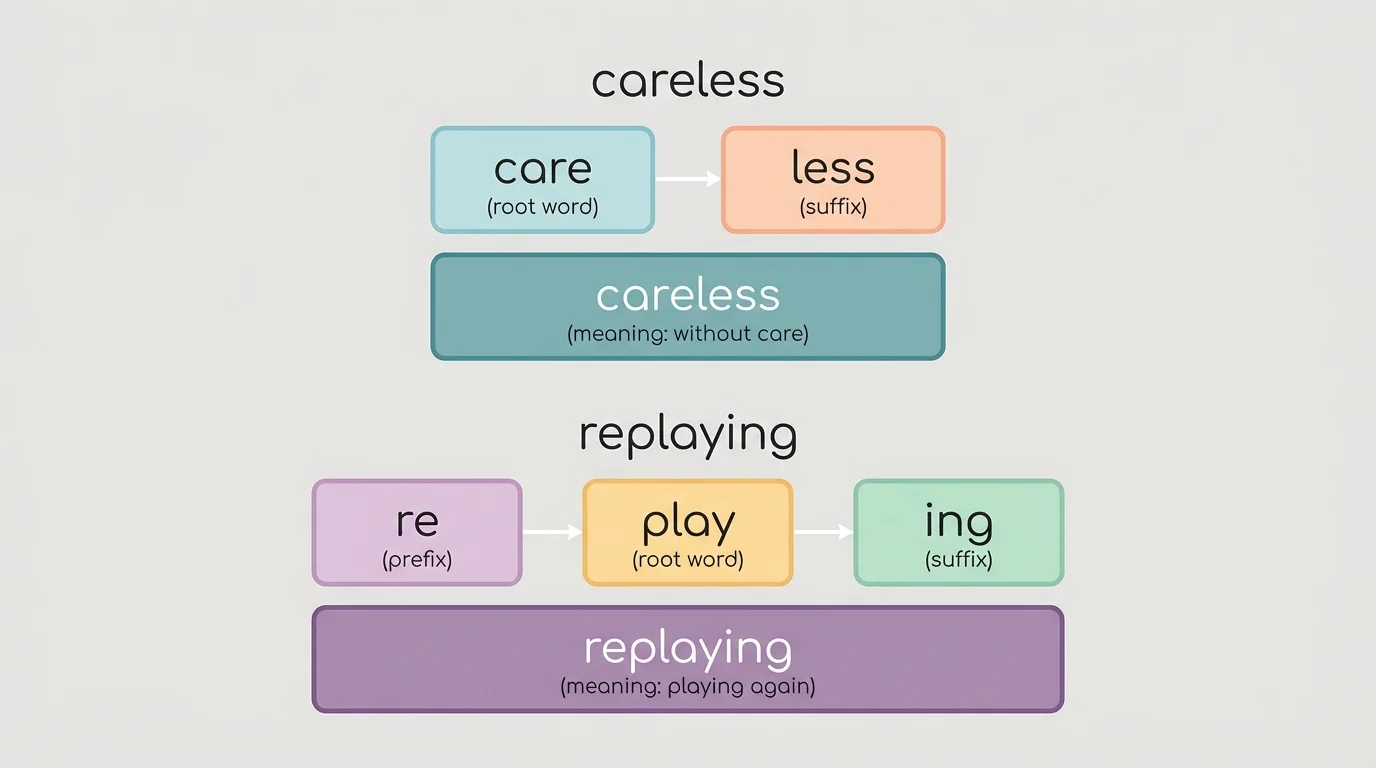
Prefixes and suffixes are important clues. A prefix is a word part added at the beginning of a word. A suffix is added at the end. In unhappy, the prefix un- helps show "not." In hopeful, the suffix -ful helps show "full of." These parts can help with both pronunciation and meaning.
The main part of a word is often the base word. In jumping, the base word is jump. In unsafe, the base word is safe. Knowing the base word can help readers read the whole word correctly. It also helps them understand what the word means.
Using word parts to decode
Look at the word disagree.
Step 1: Find a part you know.
The word contains the base word agree.
Step 2: Notice the prefix.
The prefix dis- is at the beginning.
Step 3: Put the parts together.
dis + agree becomes disagree.
By using known parts, the word becomes easier to read and understand.
When a word still does not make sense, reread the sentence and try the word again. Sometimes the words around it help you decide whether your decoding makes sense.
Later, when you meet other long words, you can use the same chunking strategy we used in [Figure 2]. Readers grow stronger when they reuse strategies across many words.
Reading is not just sounding out words. It is also understanding them. Some words tell their meaning through parts. This study of word parts and meanings is called morphology. For example, if a reader knows that re- can mean "again," then replay may mean "play again." If a reader knows that -er can mean "a person who," then teacher means a person who teaches.
Readers also use context. Context clues are hints in the sentence or nearby sentences that help explain an unknown word. In the sentence "Maya was exhausted after the long hike, so she sat down to rest," the words sat down to rest help show that exhausted means very tired.
Word relationships matter too. Synonyms are words with similar meanings, like small and tiny. Antonyms are words with opposite meanings, like begin and end. Knowing relationships between words grows vocabulary and helps readers notice exactly what an author means.
| Word Tool | How It Helps | Example |
|---|---|---|
| Prefix | Changes meaning at the beginning | redo means do again |
| Suffix | Changes meaning at the end | kindness means the state of being kind |
| Base word | Gives the main meaning | help in helpful |
| Context clue | Uses nearby words to help | shivered helps explain cold |
| Synonym/Antonym | Connects words by meaning | glad/happy, hot/cold |
Table 1. Tools readers use to understand unfamiliar words and build vocabulary.
Some words have more than one meaning. The word bark can mean the sound a dog makes, or the outer covering of a tree. Readers use the sentence to choose the correct meaning. In "The rough bark felt scratchy," the tree meaning fits. In "We heard the bark across the yard," the dog meaning fits.
Words connect to other words
Readers build vocabulary best when they connect new words to words they already know. If you know joy, then joyful and enjoy become easier to understand. Word families help reading because one known word can unlock many related words.
Good readers stay flexible. They may begin by sounding out a word, then use its parts, then use context to confirm the meaning. Reading is strongest when decoding and meaning work together.
Strong readers pay attention to whether the text makes sense. This is called monitoring comprehension. If something sounds wrong, looks wrong, or does not make sense, the reader stops and fixes it. That may mean rereading, slowing down, reading ahead for clues, or checking a tricky word again.
Suppose a sentence says, "The cub scampered after its mother into the den." A reader might not know the word scampered. But the reader can notice that the cub is moving after its mother. That helps suggest that scampered means moved quickly or ran in a lively way.
You already know that good readers ask questions while reading. Questions such as "Who is speaking?" "What just happened?" and "Why did that happen?" help keep your mind active and connected to the text.
Sometimes readers understand every word but still miss the main idea. That is why monitoring includes thinking about the bigger picture. In a nonfiction paragraph about penguins, the important idea may be how penguins survive in cold places, not just one interesting detail about their feathers.
One helpful habit is to pause after a paragraph and say the main idea in your own words. Another is to predict what may come next. If your prediction does not fit later details, you adjust your thinking. That is active reading.
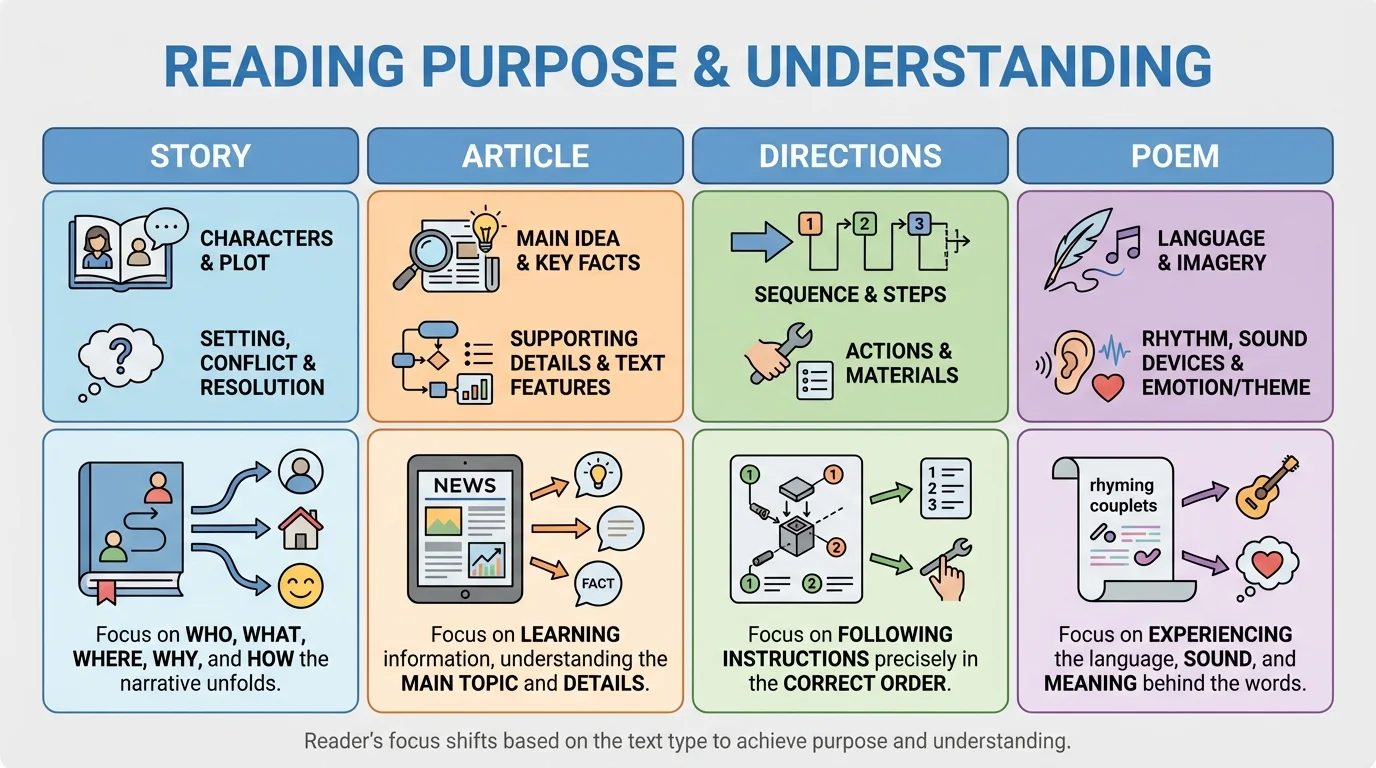
[Figure 3] Readers do not read every text in the same way. They change their focus depending on the type of text. A story, a science article, a set of directions, and a poem each ask the reader to notice different things.
In a story, readers often track characters, setting, problem, and solution. They may notice how characters feel and why they act a certain way. In informational text, readers often focus on facts, main ideas, details, headings, captions, and topic words. In directions, readers look carefully at sequence words such as first, next, and finally. In poetry, readers may pay attention to rhythm, repeated sounds, and strong imagery.
Purpose changes how carefully you read certain parts. If you are reading a game manual to learn the rules, every step matters. If you are reading a fun mystery, you may pay special attention to clues and surprises. If you are reading a short article about weather, you may search for the main idea and important details.
Text features can also guide understanding. Headings tell the topic of a section. Captions explain pictures. Bold words may signal important vocabulary. Diagrams and labels can add information not stated in the paragraph. Good readers use all these clues.
Later, when you choose how to read a text, think back to the comparison. Matching your reading moves to the text type helps you understand more deeply.
Reading on-level text with purpose and understanding happens when several skills work together. You decode unfamiliar words using spelling patterns and parts of words. You read with enough fluency to keep ideas connected. You use word meanings, context clues, and relationships between words. You monitor your understanding and fix problems when meaning slips away.
Think about reading a page about dolphins. You may decode the word playful by seeing the base word play and the suffix -ful. You may read smoothly enough to notice that the paragraph explains dolphin behavior. You may use context to understand pod as a group of dolphins. Then you stop and realize the main idea is that dolphins are social animals. That is purposeful reading.
Purposeful reading in action
A student reads a short article about how plants make food.
Step 1: Set the purpose.
The student decides to read to learn how plants make food.
Step 2: Decode and understand key words.
The student breaks apart sunlight and uses context for energy.
Step 3: Monitor understanding.
After each paragraph, the student checks: "What did I just learn?"
Step 4: Identify the important idea.
The student understands that plants use sunlight, water, and air to make food.
The student does more than read words. The student reads for meaning.
Every time you read, you can ask yourself three important questions: "Why am I reading this?" "What strategies can help me?" and "Does this make sense?" Those questions help turn reading into understanding.
Becoming a stronger reader does not mean never getting stuck. It means knowing what to do when you get stuck. Purpose, fluency, decoding, vocabulary, and comprehension are partners. The more they work together, the more confident and capable you become.
