Have you ever been in a conversation where one person knows the topic well and another person has no idea what everyone is talking about? The conversation feels very different for each person. When you come to a discussion prepared, you are ready to join in, share ideas, ask good questions, and understand what others say. Being prepared is like bringing the right tools to a job. If the job is talking and thinking together, your tools are your reading, your notes, your memory, and your questions.
A discussion is not just talking. It is a way of learning with other people. When students discuss a story, a science article, or a class topic, they are expected to listen carefully, think deeply, and respond clearly. Preparation helps all of that happen.
If you read the required material before the discussion, you already know the topic. You remember characters, events, facts, examples, or important details. Then, instead of guessing, you can speak with confidence. You can say what you noticed and explain why it matters.
Preparation also helps you be a better listener. If your class is discussing a text you already studied, other people's ideas make more sense to you. You can compare your thinking with theirs. You might agree, disagree politely, or add a new detail. This is how discussions grow.
Prepared means ready ahead of time. In a classroom discussion, being prepared means you have read or studied the required material and thought about what you want to say.
Discussion is a conversation in which people share ideas, listen to one another, and think together about a topic.
When everyone comes prepared, the whole group benefits. The conversation becomes stronger because students are using real information, not random guesses. People can learn from one another because everyone brings something useful.
Being prepared does not mean memorizing every word. It means understanding the important parts well enough to talk about them. You may prepare by reading a story, studying class notes, looking at a chart, listening to instructions, or reviewing facts the class already learned.
Preparation can include several actions. You might read slowly and carefully. You might notice the main idea. You might think about what surprised you. You might mark a part that seems important. You might remember something else you learned that connects to the topic.
For example, suppose your class reads a story about a child who learns to be brave. If you are prepared, you may remember what problem the character faced, how the character felt at the beginning, what changed, and what lesson the story teaches. Then you can speak clearly during the discussion.
Suppose the class studies animal habitats. If you are prepared, you may remember facts about where animals live, what they need to survive, and how weather affects them. You may also remember something from a nature show or a trip to the zoo that connects to the topic. That extra knowledge can help you explore ideas in a richer way.
A strong preparation routine helps students know what to do before a discussion, as shown in [Figure 1]. Good preparation is not rushed. It gives your brain time to gather ideas.
First, read or study the required material carefully. If it is a story, pay attention to the characters, setting, problem, and ending. If it is an article, notice the main idea and important facts. If it is a teacher explanation, think about the most important points.
Second, stop and think after you read. Ask yourself: What is this mostly about? What is important here? What do I understand well? What is confusing? What do I want to ask?
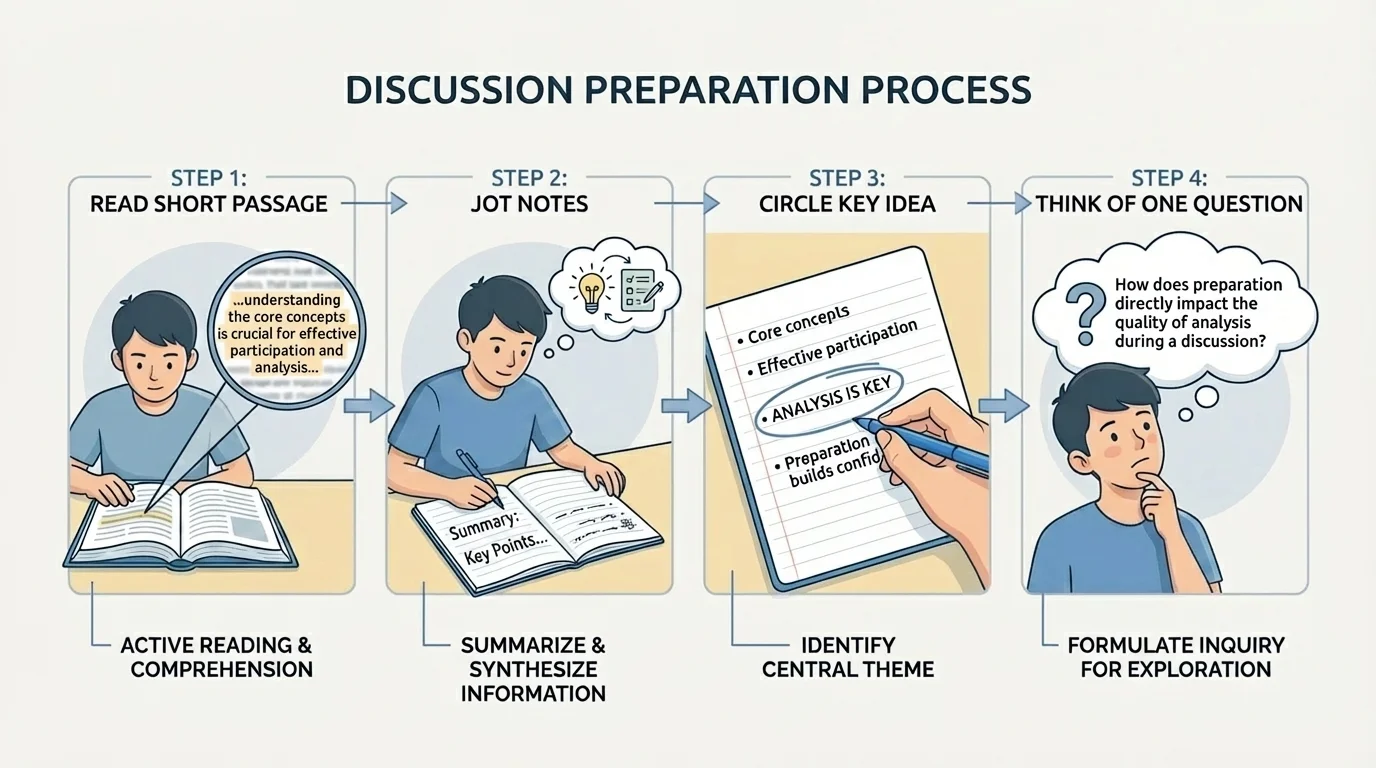
Third, make a few notes in your mind or on paper. You do not need a long list. Even a few short words can help. You might write "main idea," "important fact," "question," or "favorite part." These notes help you remember during the discussion.
Fourth, be ready with evidence. Evidence means the facts, details, or parts of the text that support your idea. If you say, "I think the main character changed," you should also be able to explain what happened in the story that shows the change.
A simple way to prepare is to think in three parts: what I learned, what I noticed, and what I wonder. What I learned helps you remember the topic. What I noticed helps you focus on details. What I wonder helps you ask questions that keep the discussion going.
Finally, bring your attention and a ready attitude. Preparation is not only about papers and books. It is also about being mentally ready to listen, speak, and stay on the topic.
Prepared speakers do more than talk a lot. They use the text and their own knowledge together, as shown in [Figure 2]. This helps everyone explore ideas in a thoughtful way.
Explicitly drawing on your preparation means clearly showing that your idea comes from what you read or studied. You might say, "In the story, the boy first felt afraid of the dark, but later he walked outside by himself." That tells listeners your idea comes from the text.
You can also connect the topic to other information you know. This does not mean changing the subject. It means adding something that fits. For example, during a discussion about plant growth, you might say, "Our science book says plants need sunlight, and I noticed my window plant grew toward the light." That is a useful connection.
Helpful sentence starters can make this easier. You can say, "I learned that...," "The text says...," "One detail that supports this is...," "This reminds me of...," "I agree because...," or "I want to add... ." These sentence starters help you speak clearly and stay connected to the topic.
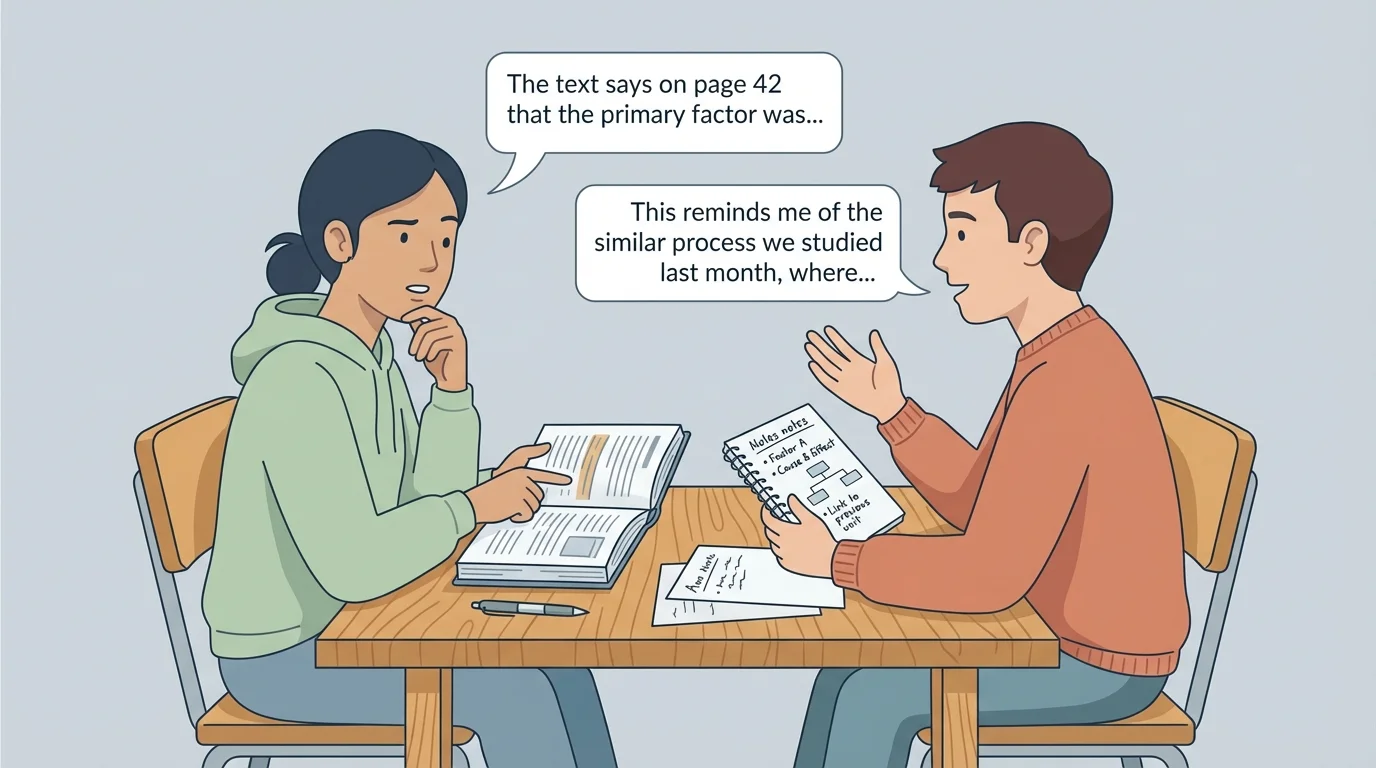
When you use information from reading and from your own experience, your ideas become stronger. For example, if the class discusses recycling, you might share a fact from the article and then connect it to what your family sorts at home. The discussion becomes more meaningful because you are using both study and experience.
This also helps you answer questions. If someone says, "Why do you think that?" you can go back to your preparation. You can point to a fact, an event, or a detail. In this way, preparation gives you support during the discussion, much like the notes and speech examples in [Figure 2].
A good discussion is not a row of separate speeches. It is a shared conversation. That means students listen closely and respond to what others say.
Collaborative discussion means people work together by sharing ideas, listening carefully, and helping the conversation grow. In a collaborative discussion, you do not just wait for your turn. You pay attention so that your response fits what the other person said.
You can build on another person's idea in many ways. You can add a detail: "I want to add that the character also apologized at the end." You can agree with a reason: "I agree because the article says the storm lasted three days." You can ask a question: "What part of the story made you think that?" You can make a connection: "That matches what we learned in science."
Example: Building on an idea
Topic: Why did the main character change?
Step 1: One student shares an idea.
"I think Mia changed because she finally told the truth."
Step 2: A second student uses preparation to add evidence.
"I agree. Earlier in the story, she kept hiding the problem, but at the end she spoke honestly to her grandmother."
Step 3: A third student extends the idea.
"I want to add that telling the truth also made her less worried, so the change was not only in her actions but also in her feelings."
This kind of response shows listening, evidence, and clear speaking.
Sometimes you may disagree. That is okay when you do it respectfully. You can say, "I see it differently because...," or "I understand your point, but I think... ." Respectful disagreement still uses preparation. It still needs evidence and clear thinking.
If you interrupt, ignore others, or repeat the same idea again and again, the discussion becomes weaker. Preparation helps prevent this because you have enough material to respond thoughtfully instead of blurting out random comments.
Discussion looks a little different in each setting, as shown in [Figure 3], but preparation matters in all of them. Whether you talk with one partner or the whole class, you still need to know the topic and think before speaking.
In a one-on-one discussion, you and one partner take turns more often. You need to listen closely because every idea matters. If your partner mentions an important detail from the reading, you should be ready to respond to it.
In a small group, more voices are included. This means you may need to wait longer for your turn, but you still stay active by listening, nodding, keeping your mind on the topic, and preparing to connect your idea to someone else's.
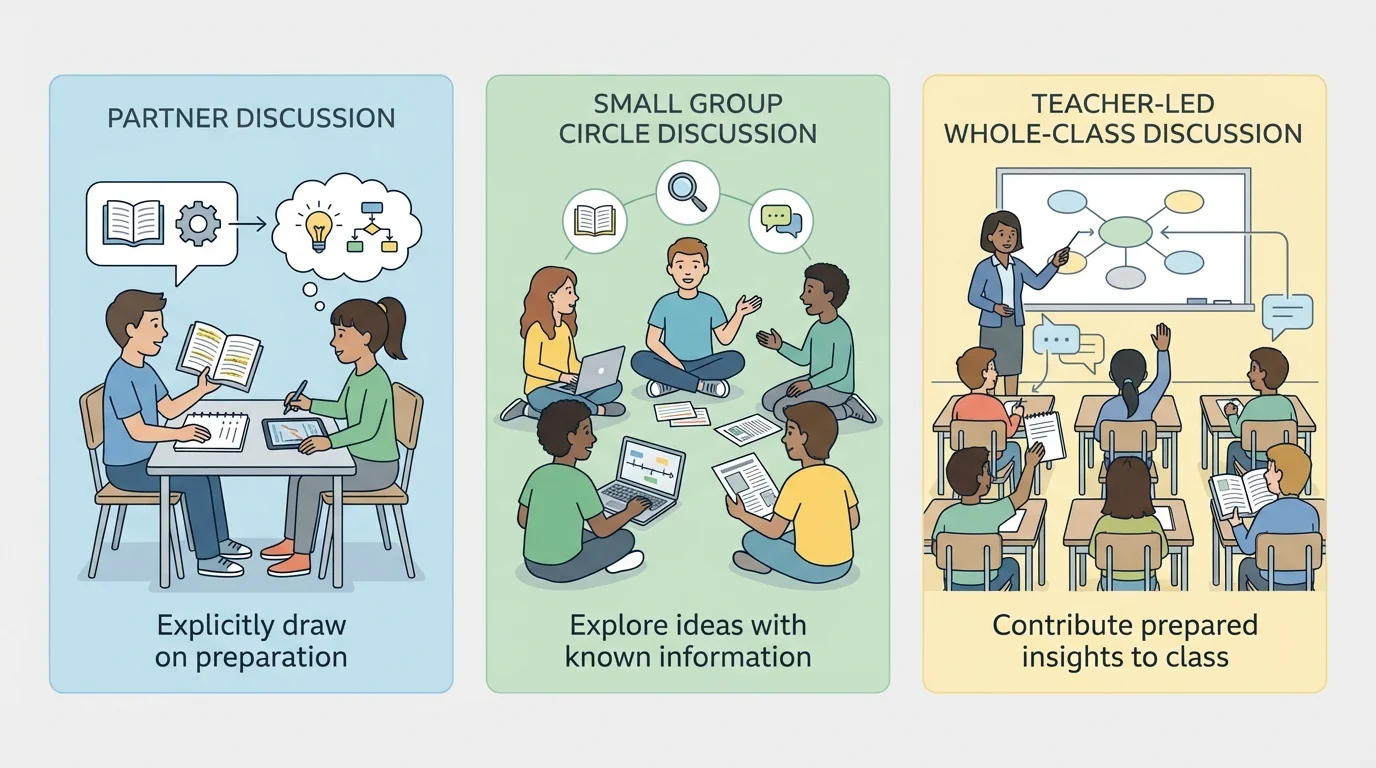
In a teacher-led discussion, the teacher may ask questions and guide the conversation. Students still need to be prepared. You may be called on to answer, explain, or respond to another student. Because the whole class is listening, clear speaking becomes especially important.
| Discussion Setting | What Students Do | How Preparation Helps |
|---|---|---|
| One-on-one | Take turns with a partner | Helps you respond directly and ask good questions |
| Small group | Share with several classmates | Helps you remember ideas while waiting and connect to others |
| Teacher-led | Answer questions and respond in a whole-class discussion | Helps you speak clearly and support your ideas |
Table 1. This table compares how preparation supports students in different kinds of discussions.
The three settings in [Figure 3] all require the same basic habits: know the material, listen carefully, stay on topic, and speak clearly. The setting changes, but the preparation habits stay important.
Sometimes students come to a discussion unready. They may not remember the reading. They may give answers that are too short, too general, or off-topic. The good news is that these problems can be fixed with simple habits.
One common problem is saying, "I don't know," right away. If you prepared, you can usually begin with at least one detail, one question, or one connection. Another problem is making a claim without support. For example, saying "The article was interesting" is too weak by itself. A stronger response is "The article was interesting because I learned that desert animals rest during the hottest part of the day."
Another problem is forgetting what someone else said. Careful listening helps with this. You can focus on one key idea from the speaker and then respond to that. If needed, you can say, "So you are saying that...," and then explain your response.
Even adults prepare for discussions. Reporters read information before interviews, scientists study data before meetings, and coaches review plans before talking with their teams.
Some students worry that they need the perfect answer. They do not. A good discussion is about exploring ideas together. Preparation gives you a starting point. Then listening and thinking help you keep going.
Let's look at how preparation works with real classroom topics. In reading, your class might discuss a folktale. A prepared student can explain the lesson of the tale and point to events that teach that lesson. The student might also compare the folktale to another story with a similar message.
In science, the class might read about weather. A prepared student can mention facts from the text, such as how clouds form or how rain helps plants. The student might also connect this to something noticed outside, like dark clouds before a storm. This connection adds meaning without leaving the topic.
In social studies, the class might discuss communities. A prepared student can use facts from the lesson about rules, leaders, and helpers in a community. Then the student can connect the lesson to the student council, firefighters, or the local library.
Example: A prepared response in class
Topic: How do communities help people live together?
Step 1: State an idea from the lesson.
"Communities help people by making rules and providing services."
Step 2: Add evidence from what was studied.
"Our class text explained that rules keep people safe and that services like trash pickup and firefighters help the neighborhood."
Step 3: Add other related knowledge.
"I also know our town library helps the community because people can borrow books and attend events there."
This response is strong because it uses both studied material and other information that fits the topic.
Prepared discussion is useful far beyond school. When teammates plan a game, they do better if they know the plays. When musicians rehearse, they do better if they practiced first. When families make plans, the conversation goes better when everyone knows the choices. Preparation helps people think together in many parts of life.
By practicing these habits, students become stronger speakers and listeners. They learn how to enter a conversation with ideas, support those ideas, and help the group learn more. That is an important skill in every subject.
