Have you ever tried to convince someone that your favorite recess game is the best, or that one book deserves five stars? You were already using opinion writing. Good opinion writing is not just saying what you like. It is telling the reader what the topic is, what you think about it, and why you think that. When writers do those things well, their ideas are easier to understand and more compelling.
Opinion writing helps you share your thinking in a clear, organized way. A reader should not have to guess what you are writing about or what you believe. Right from the start, your writing should tell the reader the topic or text, your opinion about it, and the reasons that support your opinion. That clear structure is what makes an opinion piece strong.
An opinion piece is a kind of writing in which an author shares what they think about a topic or a text and gives reasons to support that thinking. A topic can be something like school uniforms, pets, or homework. A text can be a story, article, or book that you have read.
Opinion is what a person thinks or believes. A reason is why that person thinks it. A topic is the subject the writing is about. A text is something that is read, such as a story, poem, or article.
Not every statement is an opinion. Some statements are facts. A fact can be proved true. An opinion tells what someone thinks, feels, or believes. For example, "Our school has a library" is a fact if it is true. "The library is the best room in the school" is an opinion because different people may think different things.
When you write an opinion piece, you do more than give an opinion. You support it with reasons. Without reasons, your writing sounds unfinished. With reasons, your reader can understand your thinking.
The first job of an opinion writer is to clearly introduce the topic. This means the reader should quickly know what the writing is about. If you are writing about school lunch, say that. If you are writing about the book Charlotte's Web, name the book.
Introducing the topic is like opening a door for your reader. You are showing them where your writing will go. A clear beginning might say, "School lunch should include more fresh fruit," or "Charlotte's Web is a wonderful book for third graders." In each sentence, the reader knows the subject right away.
If you do not introduce the topic clearly, the reader may feel confused. Suppose a piece begins with, "It is the best one because it is exciting." The reader will wonder, What is the writer talking about? A better opening would be, "The book The Wild Robot is one of the best class read-aloud books because it is exciting." Now the topic is clear.
Examples of clear topic introductions
Step 1: Name the topic.
"Recess should be longer for students."
Step 2: Name the text.
"The story Officer Buckle and Gloria is funny and worth reading."
Step 3: Avoid unclear openings.
Unclear: "It is really great." Clear: "Our class garden is a great project for students."
Sometimes writers introduce a topic with a little background. For example, "Many students look forward to recess every day. Recess should be longer because it helps kids move, play, and learn better." The first sentence sets up the subject, and the second sentence states the opinion.
After introducing the topic, the writer should give a clear opinion. This is the sentence that tells what the writer believes. A strong opinion sentence is direct. It does not hide the writer's thinking.
Examples of clear opinion statements include "Dogs make better pets than cats," "Our class should have a read-aloud every day," and "The article about dolphins was interesting and useful." Each one tells exactly what the writer thinks.
Weak opinion statements can sound unsure. For example, "I sort of think recess might maybe be important" does not sound strong. A stronger sentence would be "Recess is an important part of the school day." Opinion writing should sound confident when the writer has chosen a point of view.
Readers need two things near the beginning: the subject and the writer's opinion. If one is missing, the writing becomes harder to follow.
Sometimes a writer can introduce the topic and state the opinion in the same sentence. For example, "School uniforms are a good idea for students." That sentence names the topic and gives the opinion at once. Other times a writer uses two sentences. Both ways can work if the reader understands the writer's point of view.
Strong opinion writing has an organizational structure, as [Figure 1] shows. That means the writing has parts in an order that makes sense. For students, a simple structure works very well: beginning, middle, and ending.
In the beginning, introduce the topic and state your opinion. In the middle, list your reasons. In the ending, remind the reader of your opinion and finish your thoughts clearly. This kind of structure helps the reader move through the writing step by step.
The middle is where your reasons do the hard work. Each reason should connect to your opinion. If your opinion is "Reading every night is important," your reasons might be "it builds vocabulary," "it helps you become a stronger reader," and "it can be relaxing and fun."
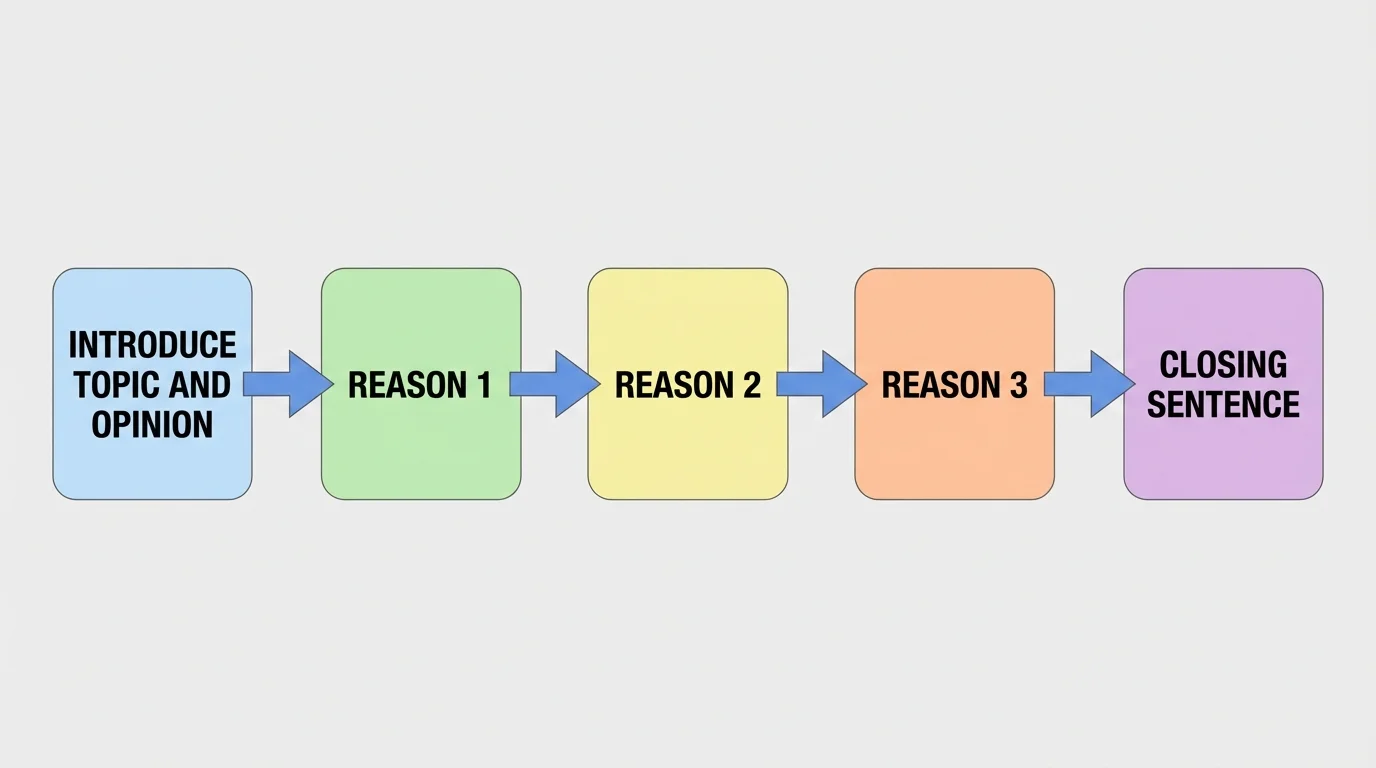
A list of reasons does not need to be fancy. It needs to be clear. One reason can come in each sentence or each paragraph. The important part is that the reader can tell where one reason ends and the next one begins.
Writers often use linking words to connect reasons. Words such as first, next, also, and finally help organize ideas. These words act like signposts. They guide the reader through the writing.
Later, when you reread your writing, you can use the pattern in [Figure 1] to check your work. Ask yourself: Did I begin with the topic and opinion? Did I give reasons in the middle? Did I end clearly?
A reason explains why your opinion makes sense. Strong reasons match the opinion and help the reader agree with you. Weak reasons are off-topic, unclear, or repeated again and again.
Look at this opinion: "Students should help care for the school garden." A strong reason would be "It teaches responsibility." Another strong reason would be "Students learn about plants by doing real work." A weak reason would be "Gardens are green." That sentence may be true, but it does not strongly support the opinion.
Good reasons are often followed by small details. Details make the reason easier to understand. For example, "Students learn about plants by doing real work, such as watering, weeding, and watching seeds grow." The detail helps the reader picture the reason.
Strong reasons stay connected to the opinion. If your opinion is about books, your reasons should be about books. If your opinion is about lunch, your reasons should be about lunch. A reason that does not match the opinion confuses the reader.
It also helps when reasons are different from each other. If your opinion is "Art should be taught every week," you would not want all three reasons to say the same thing in slightly different words. Instead, one reason might be about creativity, one about problem-solving, and one about enjoyment.
Sometimes young writers write one strong reason and then stop. One reason is a start, but listing more than one reason makes the piece stronger. That is why organizing your reasons matters so much.
Opinion writing can focus on two common kinds of subjects, as [Figure 2] explains. One kind is writing about a topic from everyday life. The other kind is writing about a text you have read. Both kinds need a clear opinion and good reasons.
When you write about a topic, you are sharing what you think about something such as pets, playground rules, or school events. For example: "Students should have more time to read independently." Then you give reasons such as "reading helps students grow as readers" and "students can explore books they enjoy."
When you write about a text, you tell your opinion about a story, article, or book. For example: "Because of Winn-Dixie is a touching book." Then your reasons come from the text, such as "the characters feel real" and "the story shows friendship and kindness."
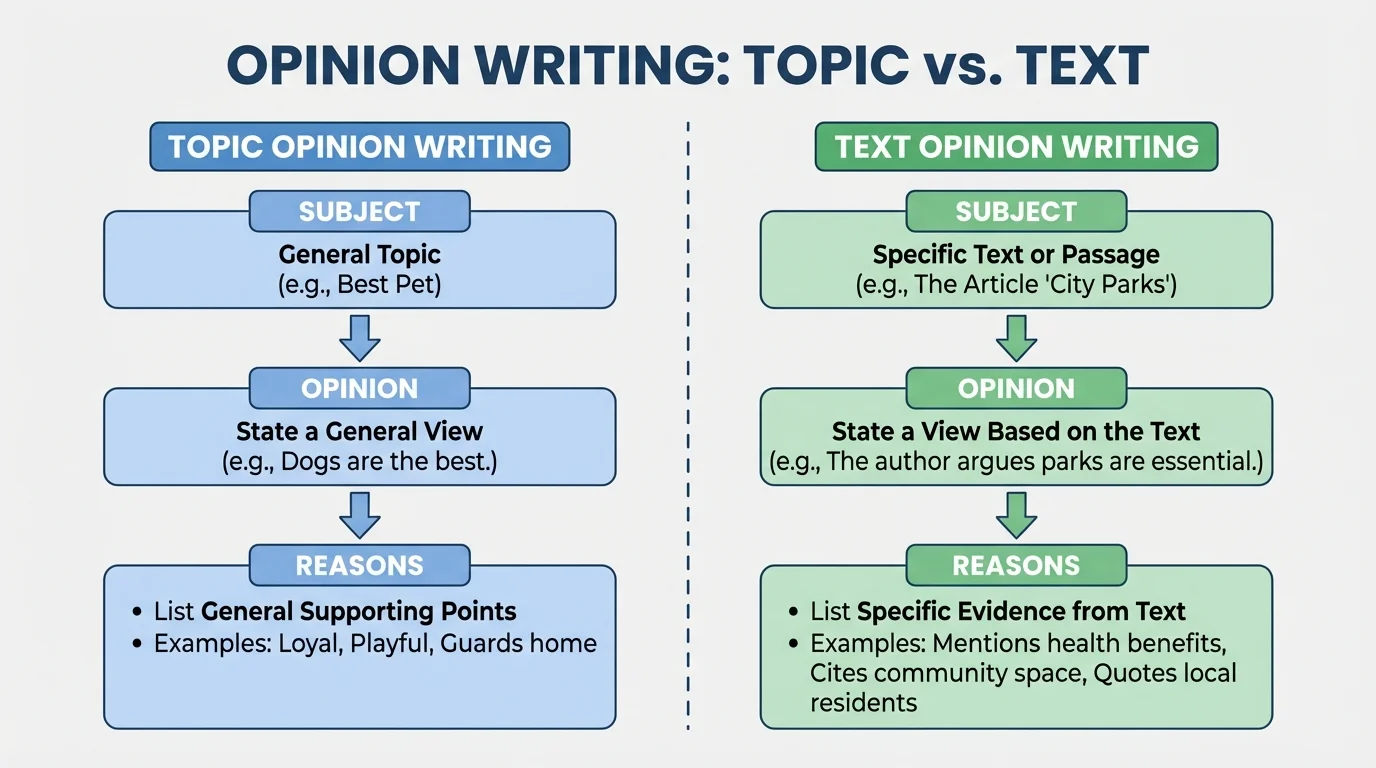
Writing about a text often means using details from what you have read. If you say a book is exciting, explain what makes it exciting. Maybe there is a surprising event, an interesting problem, or a character who changes. The reader should see that your opinion comes from the text itself.
Writing about a topic also needs support, but the support may come from your experiences, what you know, or what you have learned. In both cases, the reasons should be clear and connected to the opinion.
The comparison in [Figure 2] helps show that the structure stays almost the same. You still introduce the subject, state your opinion, and organize reasons. What changes is whether the subject is a general topic or a text you have read.
[Figure 3] When all the parts work together, the writing becomes easy to follow, and the piece includes a topic, an opinion, reasons, and a closing. A good opinion piece does not feel like random thoughts. It feels planned.
Here is a model about a topic: "Our school should have a recycling club. I think it would help students take better care of the environment. First, students would learn how recycling works. Next, the club could help reduce trash at school. Also, students could work together on a helpful project. For these reasons, a recycling club would be a great idea." This piece introduces the topic, states an opinion, gives reasons, and ends clearly.
Here is a model about a text: "Stone Fox is a memorable book. I think it is worth reading because it has a powerful story. First, the main character faces a serious problem. Next, the race in the story keeps the reader interested. Also, the book makes readers feel strong emotions. That is why Stone Fox is a book many students remember." This piece uses the same structure, but it focuses on a text.
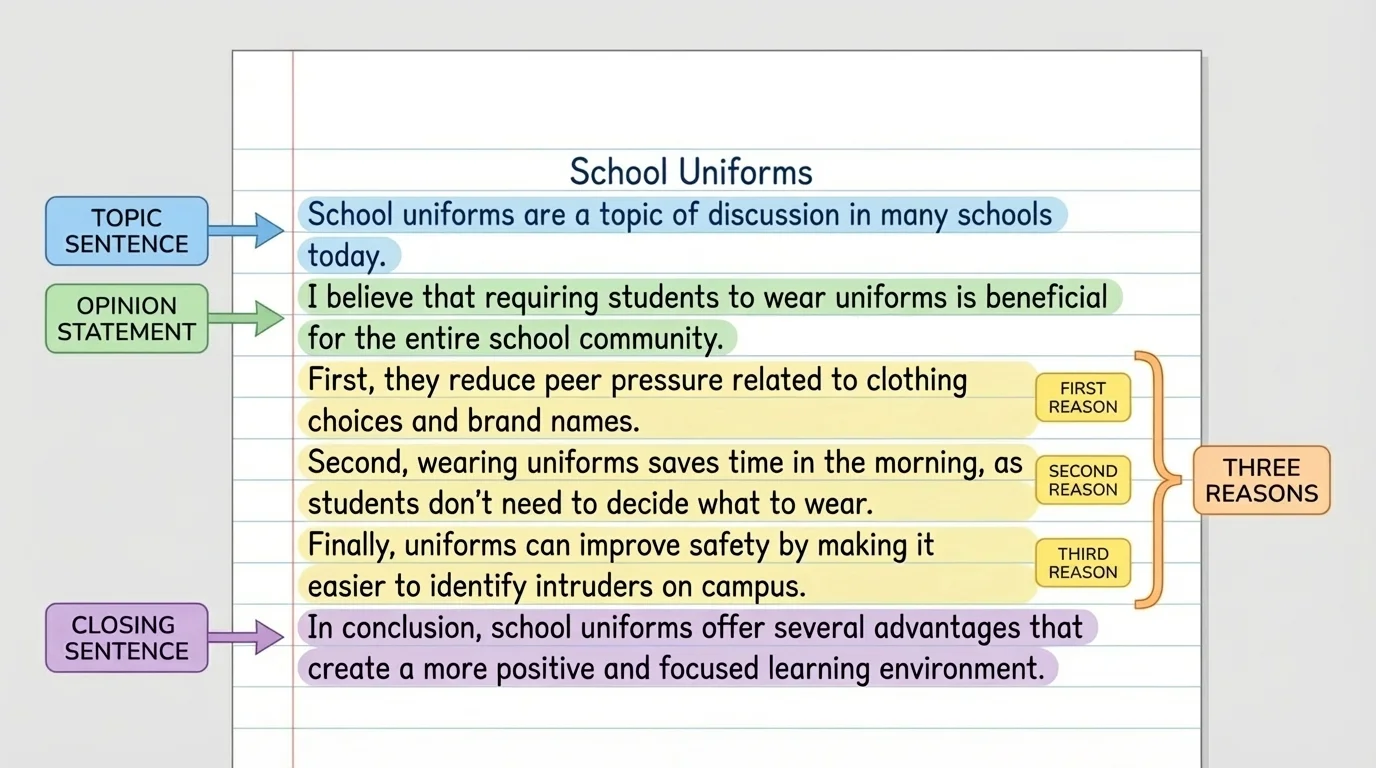
Notice that the examples do not wander away from the main idea. Each reason supports the opinion. Each sentence has a job to do. That kind of organization helps the reader understand and trust the writer's thinking.
How to build an opinion piece
Step 1: Introduce the subject.
Name the topic or text so the reader knows what the writing is about.
Step 2: State the opinion.
Tell exactly what you think in a clear sentence.
Step 3: Add reasons.
List reasons that support the opinion and keep them connected to the subject.
Step 4: End clearly.
Finish by reminding the reader of your opinion or leaving them with a strong final thought.
If you compare your own writing to the model, you can often spot missing parts quickly. Maybe the opinion is clear, but the topic is not named. Maybe the reasons are listed, but the ending is missing. A visible structure makes revision easier.
One common mistake is forgetting to name the topic or text at the beginning. When that happens, readers feel lost. The fix is simple: add a sentence that clearly tells what the writing is about.
Another mistake is giving an opinion without reasons. A sentence like "Soccer is the best sport" tells an opinion, but it needs support. Reasons such as "it builds teamwork," "it keeps players active," and "it is exciting to watch and play" make the opinion stronger.
Some writers repeat the same reason in different words. For example, "It is fun," "It is enjoyable," and "It is a good time" are almost the same reason. A better set of reasons would be different from one another.
A final mistake is ending too suddenly. An opinion piece should not simply stop. A closing sentence helps the writing feel complete. It can restate the opinion or give a final thought, such as "For all of these reasons, our class should visit the museum."
Professional writers and reviewers use opinion writing too. Book reviews, movie reviews, and even letters to a principal often follow the same pattern: introduce the subject, share an opinion, and support it with reasons.
Good writers reread their work to check if every part is present. They ask: Is the topic clear? Is my opinion clear? Do my reasons make sense? Does my ending finish the piece well?
Writers often use special words to make their organization easy to follow. These words do not create the ideas, but they help show how the ideas fit together.
Here are some useful starters and linking words:
| Purpose | Helpful words or sentence starters |
|---|---|
| Introduce the topic | "I want to share my thoughts about...", "The book ... is...", "Our school should..." |
| State an opinion | "I think...", "I believe...", "In my opinion..." |
| Give reasons | "First...", "Next...", "Also...", "Another reason is..." |
| Close the piece | "For these reasons...", "That is why...", "This shows that..." |
Table 1. Helpful words and sentence starters for organizing an opinion piece.
These words are useful because they help the reader follow your thinking. Still, strong writing is not just about using sentence starters. The opinion must be clear, and the reasons must make sense.
"Say what you think, and tell why you think it."
That simple rule captures the heart of opinion writing. First, let the reader know the subject. Next, tell your opinion clearly. Then, support it with organized reasons. When you do that, your writing becomes stronger, clearer, and more convincing.
