Have you ever tried to explain a game, a pet, or your favorite place, but your ideas came out in a jumbled order? Readers can feel that jumble too. Good informative writing helps readers learn by putting ideas where they belong. When a writer introduces a subject clearly and keeps related information together, the writing becomes easier to follow, easier to remember, and more enjoyable to read.
Informative writing teaches. It explains a topic using facts, definitions, and details. A strong piece of informative writing does not toss ideas everywhere. Instead, it begins by introducing the topic, then it groups information in a clear, logical way, and finally it ends with a statement that matches the topic.
When information is grouped, the reader does not have to guess how ideas connect. One part of the writing might explain what something is. Another part might tell what it looks like. A third part might explain how it works. Each group has a job.
Think about a backpack. If pencils, books, lunch, and shoes were all dumped in one pocket, finding anything would be hard. Writing works the same way. Organized writing puts each kind of information in its own place. That helps the reader learn one part at a time.
Topic is the subject of a piece of writing. Related information means facts and details that belong together because they tell about the same part of the topic. Concluding statement is an ending sentence or ending part that wraps up the writing in a way that connects to the topic.
Writers often group information by parts, types, steps, or important ideas. For example, if the topic is weather, one group might be types of weather, another might be tools used to measure weather, and another might explain how weather affects people.
The first job of informative writing is to tell the reader what the writing is about. This is called introducing the topic. A reader should not have to wait too long to figure out the subject.
One simple way to introduce a topic is with a strong opening sentence. For example: "Sea turtles are amazing ocean animals." That sentence clearly names the topic. A writer can also use a short opening paragraph. For example: "Sea turtles live in warm and cool oceans around the world. These reptiles are known for their shells, long migrations, and difficult journey from egg to adult." This opening tells the topic and gives the reader a preview of what may come next.
A good introduction is clear and focused. It should match the rest of the writing. If a piece is about how bees help plants, the introduction should not start with a long story about picnics unless that story truly leads to the topic. Readers should be guided quickly toward the main subject.
A paragraph usually has a main idea and supporting details. Informative writing uses that same skill in a bigger way: the whole piece has a main topic, and each section or paragraph supports it with details that belong together.
A weak introduction is often too broad or confusing. For example, "Animals are everywhere" is true, but it does not tell enough. "Red pandas are small forest animals that spend much of their time in trees" is better because it points the reader to one clear topic.
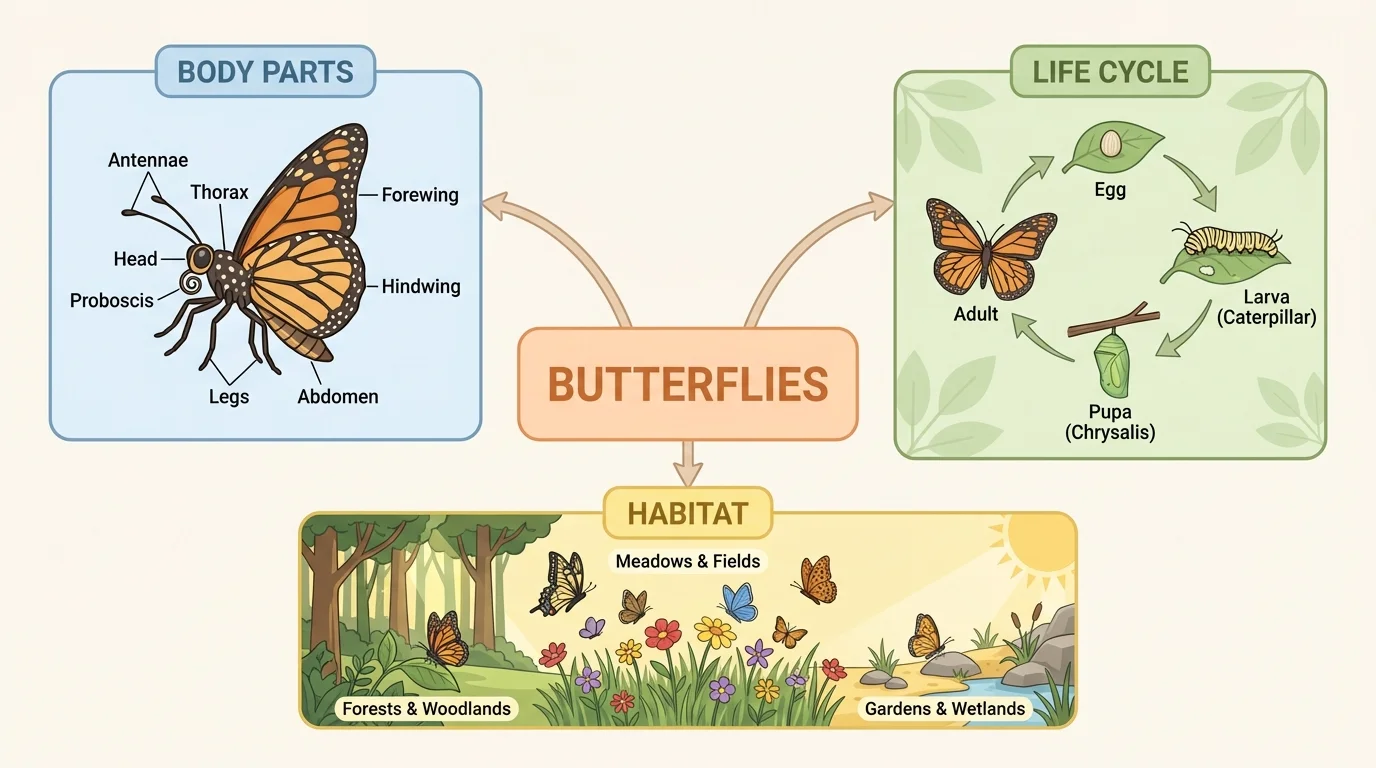
After the topic is introduced, the writer needs to organize the information. This is where categories help. A category is a group of details that belong together. When writers sort facts into categories, readers can learn the topic more easily, as [Figure 1] illustrates with one main topic divided into clear parts.
Suppose the topic is butterflies. A writer might make one group about body parts, one group about the life cycle, and one group about where butterflies live. That way, the reader learns each part separately instead of jumping from wings to eggs to flowers and back to wings again.
Grouping information also helps the writer decide what belongs and what does not. If the paragraph is about a butterfly's life cycle, a detail about the color of a garden bench does not belong. Good writers choose details that connect to the group they are explaining.
Here is one way information can be grouped:
| Topic | Possible Group | Details That Fit |
|---|---|---|
| Dogs | Body | fur, tail, paws, ears |
| Dogs | Behavior | barking, playing, guarding |
| Dogs | Care | food, water, walks, vet visits |
| Volcanoes | Parts | magma, vent, lava |
| Volcanoes | How they erupt | pressure builds, lava rises, eruption happens |
| Volcanoes | Effects | ash, new land, danger to people |
Table 1. Examples of topics organized into related groups of information.
Notice that each group has details that match. This kind of organization makes writing stronger. Later, when the writer drafts paragraphs, each group can become its own paragraph or section.
Writers can also use signal words to keep each group clear. Words such as another, also, next, and one kind help readers move through the information. These words do not do all the work, but they help connect ideas smoothly.
Sometimes words alone are enough, and sometimes readers understand more quickly when the writing includes illustrations or other text features. An illustration can show what something looks like, where its parts are, or how steps happen in order, as [Figure 2] shows with labeled parts placed right beside an informational explanation.
Helpful text features include headings, labels, captions, bullet lists, and diagrams. These features should support the writing, not distract from it. A heading can tell what a section is about. A label can name a part in a picture. A caption can explain what the reader should notice.
If the topic is a plant, an illustration of the roots, stem, leaves, and flower can help the reader connect the words to the parts. If the topic is how a chick hatches, pictures showing the order can help readers understand the sequence. But if an image does not teach anything important, it is not necessary.
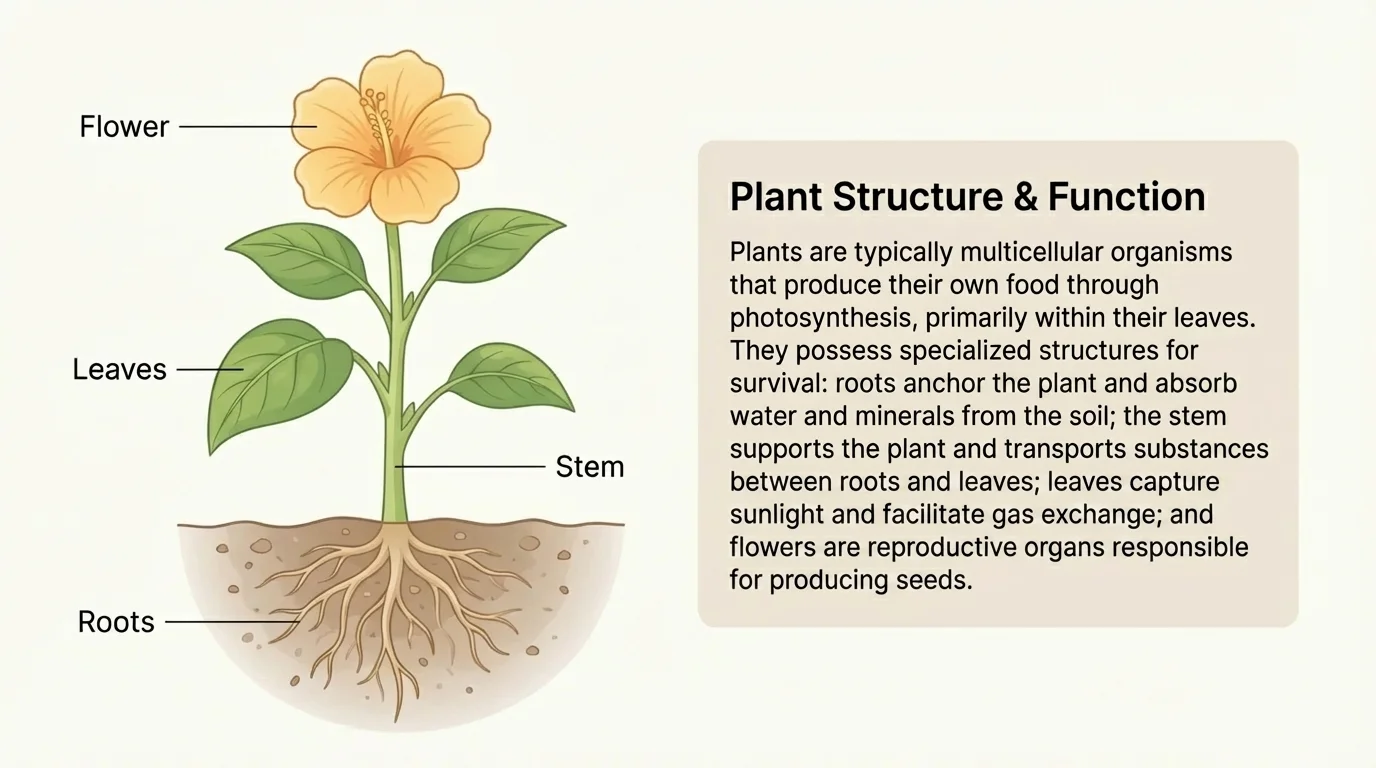
A useful illustration does not replace writing. It works with the writing. The words explain the facts, and the picture makes those facts easier to understand. For example, when a paragraph explains that roots grow underground and take in water, the plant picture gives the reader a visual idea of where the roots are. That same support makes labels especially useful for science and how-to topics.
Many textbooks use pictures for a very practical reason: the brain often understands a shape or arrangement faster when it can both read about it and see it at the same time.
Headings are also important because they show the groups of information. A section heading such as Habitat tells the reader, "The next details are all about where this animal lives." That simple clue helps the reader stay organized while reading.
Grouping information is important, but the groups also need a sensible order. Writers choose an order that fits the topic. They may go from general to specific, from first to last, from part to part, or from one category to another.
For example, a piece about a school garden might begin with what the garden is, then explain what grows there, then describe how students care for it. A piece about a frog might begin with what frogs are, then describe body features, then explain habitat, and then tell about the life cycle. There is more than one good order, but the order should make sense.
Matching the structure to the topic means choosing an order that helps readers learn naturally. If the topic is a process, step-by-step order works well. If the topic has different parts, grouping by categories works well. If the topic compares two things, placing matching details side by side can help.
As readers, we notice order right away. If a writer keeps switching between ideas, reading feels confusing. If a writer stays with one group until it is complete, reading feels smooth. Clear order helps the reader trust the writer.
We can still remember the grouped butterfly example from [Figure 1]. If the writer chooses body parts first, then life cycle, then habitat, the reader knows exactly where each set of details belongs.
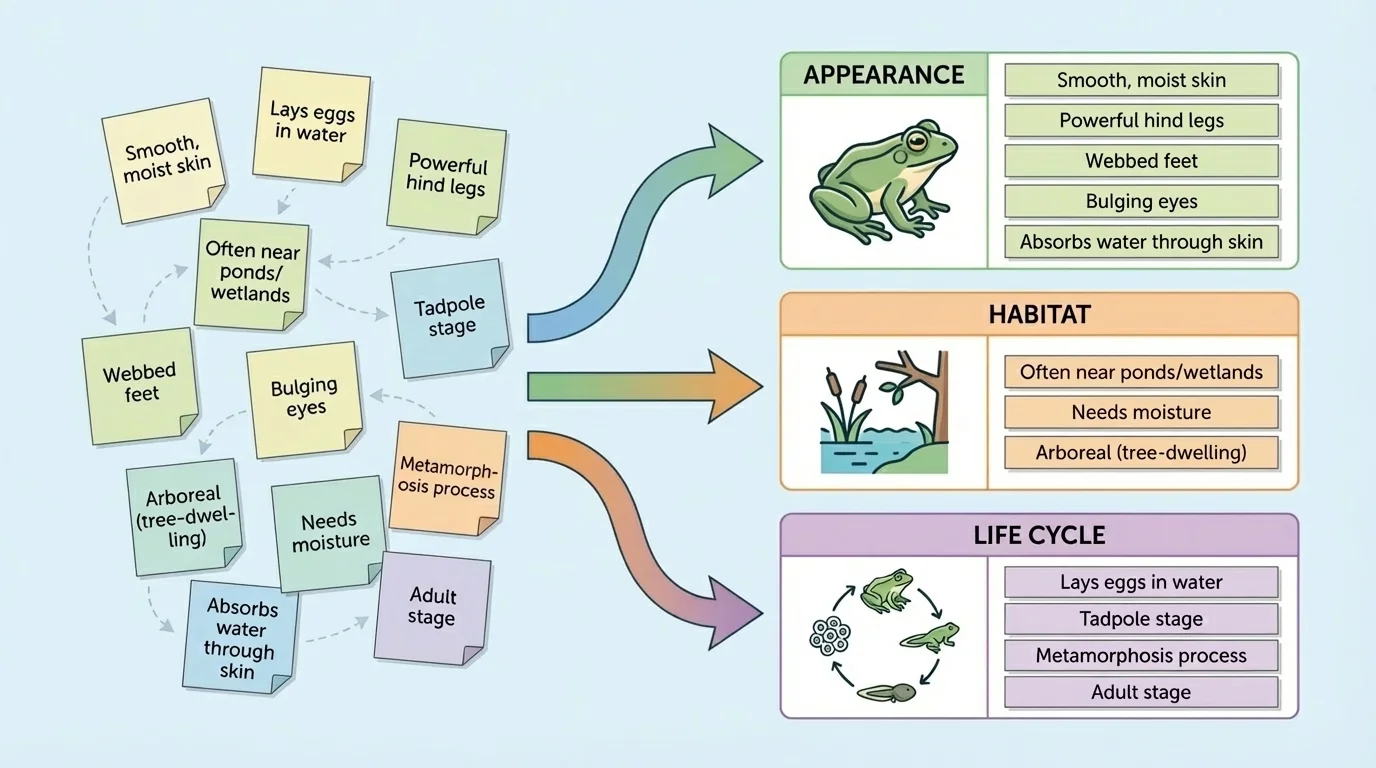
Writers do not always think in neat groups at first. They often begin with mixed notes. The important job is to sort those notes before writing full paragraphs. That sorting process turns a pile of facts into organized writing, as [Figure 3] explains by showing notes moved into clear groups.
Here are mixed notes about frogs: "frogs begin as eggs," "they can live near ponds," "many frogs have long back legs," "tadpoles hatch from eggs," "adult frogs can jump far," "frogs need water to reproduce." These notes are useful, but they are not organized yet.
A writer can sort them into groups. One group could be body and movement: long back legs, jump far. Another group could be life cycle: begin as eggs, tadpoles hatch. A third group could be habitat and needs: live near ponds, need water to reproduce.
Organizing a short informative piece about frogs
Step 1: Name the topic clearly.
Opening sentence: "Frogs are animals that live both in water and on land during different parts of their lives."
Step 2: Group the notes.
Group 1: body and movement. Group 2: life cycle. Group 3: habitat and needs.
Step 3: Turn each group into connected sentences.
Paragraph about body and movement: "Many frogs have strong back legs. These legs help them leap far."
Step 4: Add an ending that fits.
Concluding statement: "Because of their interesting life cycle and special bodies, frogs are fascinating animals to study."
When writers sort first, drafting becomes easier. Instead of wondering what to say next, they already know the next group. That is why planning is such a helpful writing habit.
The frog note sorter in [Figure 3] also reminds us that notes do not need to be perfect at the beginning. They only need to be moved into groups that make sense before the final writing begins.
An informative piece should end with a statement that connects to the topic. The ending does not need to be long. It should leave the reader with a final thought that matches what has been explained.
A related ending might restate the importance of the topic, name what makes it interesting, or bring the groups of information together. For example, after writing about how bees pollinate flowers, a concluding statement could be: "Because bees help many plants grow, they are an important part of nature." That ending fits the topic and the details.
A weak ending feels unrelated. If the piece is about volcanoes, ending with "Summer is my favorite season" does not fit. A strong conclusion stays connected to the subject the whole time.
"Good writing is like giving your reader a clear path to follow."
The ending should sound finished. It tells the reader, "We have learned about this topic, and now the explanation is complete." It does not need to repeat every detail. It simply needs to connect back to the main idea.
One common problem is organization that jumps around. A writer may start with one idea, switch to another, and then return to the first. To fix this, the writer can underline details that belong together and move them into one section.
Another common problem is a missing or weak topic sentence. If the reader cannot tell what a paragraph is about, the paragraph may feel unclear. Adding a topic sentence helps the reader understand the group right away.
Some writers also include details that are interesting but not related. For example, in a report about penguins, a sentence about a favorite video game does not belong. Good writers ask, "Does this detail teach something important about my topic or group?" If the answer is no, the detail can be removed.
Sometimes illustrations are added but not used well. A picture should connect to the words. The labeled plant image in [Figure 2] works because the labels match the explanation in the text. Decorative images do not support comprehension in the same way.
Writers can check their work by asking a few important questions. Did I introduce the topic clearly? Did I place related details together? Did I choose an order that makes sense? Did I use headings or illustrations when they help? Did I write an ending that matches the topic?
These questions matter because informative writing is meant to teach. If the ideas are clear and grouped well, the reader can learn without getting lost. That is the goal of explanatory writing: not just to write many facts, but to present them in a way that truly makes sense.
As you grow as a writer, your topics may become bigger and more detailed, but this skill stays important. Whether you explain animals, weather, sports, space, or community helpers, clear introductions, grouped information, and helpful illustrations make your writing stronger.
