Have you ever said something out loud that sounded perfectly fine, but when you tried to write it down, it suddenly seemed wrong? That happens because speaking and writing are not exactly the same. Both use English, but each one has its own rules and habits. Good communicators learn to notice these differences so they can speak clearly and write clearly too.
When you talk, your listener can hear your voice, your pauses, and your expression. When you write, the reader cannot hear any of those things. That means writing has to do more work on the page. Writers use punctuation, spelling, and complete sentences to help readers understand the message. Speakers use tone, gestures, and pauses to help listeners understand.
People speak and write for different reasons. We usually speak when we want to share ideas right away. We write when we want our words to stay on a page or screen so others can read them later. Because the situations are different, the conventions are different too.
Spoken English happens in real time. A person can stop, start again, change words, or explain more if the listener looks confused. Written English is read later, often when the writer is not there. That is why written language usually needs to be more complete and organized.
Think about talking to a friend on the playground. You might say, "Wait, no, not that one—the blue one over there!" Your friend can see where you are pointing, hear your voice, and ask a question. But if you write directions, you cannot just point. You need to describe things carefully so the reader understands without seeing you.
Spoken English is language people say out loud and hear with their ears. Written English is language people put into words on paper or a screen for others to read. Standard English is a commonly accepted form of English used in school, books, reports, and many public situations.
Knowing these differences helps you in school because you are expected to do both. You may answer a question out loud during class, and later you may write the answer in a paragraph. The idea may be the same, but the way you say it and the way you write it may need to change.
Standard English is not "better" because it belongs to one group of people. It is important because many people agree to use it in school and formal communication. It helps readers and listeners from different places understand one another more easily.
Standard English often follows expected grammar rules. It uses words in ways that many people recognize. It also follows usual spelling, punctuation, and sentence patterns in writing. When students learn standard English, they are learning one useful way to communicate clearly in many settings.
This does not mean people cannot speak in relaxed, playful, or family ways. Many people use different styles of language in different places. A student might speak casually with a sibling but use more careful standard English when giving a class presentation or writing a report.
Many strong speakers and writers change their language depending on where they are and who is listening. That skill is a sign of language awareness, not confusion.
Using standard English helps in school because teachers and classmates need to understand your ideas. It also helps when reading books, writing directions, making reports, and speaking to a group.
When people speak, they often use shorter sentences and sometimes leave out words. The meaning is still clear because listeners hear the speaker's voice and can ask questions. Spoken language often includes repeated words, quick changes, and unfinished thoughts.
For example, a speaker might say, "I was, um, going to tell you, but then I forgot." The little pause word "um" is common in speech. It helps the speaker think. In polished writing, that word is usually not needed.
Spoken English also uses tone. Tone is how a voice sounds. The same words can mean different things depending on tone. If someone says, "That was smart," the meaning may be kind or sarcastic. In speech, the voice gives clues.
Another convention of spoken English is that listeners can respond right away. They can nod, smile, interrupt politely, or ask for more information. This immediate feedback changes how people speak. A speaker may say, "You know what I mean?" or "Let me explain that better."
Spoken English may also include contractions such as "I'm," "don't," and "we're." These are part of standard English when used correctly. In many spoken situations, contractions sound natural. Some kinds of writing also use them, especially stories and friendly letters, but some formal writing may use fewer contractions.
Why speech can be less complete
When people talk, they share meaning with more than words. They use facial expressions, gestures, eye contact, and pauses. Because of that, spoken English can still make sense even when the sentences are not perfectly complete. Writing does not have those extra clues, so it usually needs stronger sentence structure.
In class discussions, students often begin a thought, stop, and then say it another way. That is normal in speaking. It shows that speech can be flexible. Writing usually gets revised before it is finished, so readers expect it to be smoother.
Written English needs to be clear without the writer standing beside the reader. That is why written language follows more visible rules. Writers use punctuation, capitalization, spelling, and complete sentences to show exactly what they mean.
A sentence in writing usually begins with a capital letter and ends with a period, question mark, or exclamation point. These marks help the reader know where ideas begin and end. Without punctuation, writing can become confusing very quickly.
Capitalization also matters. Writers capitalize the first word in a sentence, the word I, names of people, places, days, months, and other proper nouns. These conventions help readers recognize important words right away.
Spelling is another important part of written English. In speech, a listener may still understand a word even if it is pronounced a little differently. In writing, incorrect spelling can make a word hard to recognize or can even change the meaning.
Written English is often more organized than spoken English. Writers group ideas into sentences and paragraphs. They choose words carefully, reread their work, and revise unclear parts. This is one reason writing is often part of a process: plan, draft, revise, and edit.
For example, someone might say out loud, "Me and him went there yesterday." In careful standard written English, that would usually be revised to "He and I went there yesterday." Writing often asks for more attention to grammar because the reader cannot ask the writer what was meant.
You already know that sentences express complete thoughts. In writing, complete thoughts become especially important because the reader depends on the words alone, not on your voice or gestures.
Writers also think about the audience. A note to a friend may sound relaxed, but a report for school should sound more formal and complete. The conventions of writing help match the message to the purpose.
The same idea can sound different depending on whether it is spoken or written, as [Figure 1] shows with a side-by-side comparison. When we compare both forms, we can notice what changes and why those changes help the listener or reader.
Suppose a student says, "Yeah, I kinda liked it because it was, like, funny." A written version for a book response might be: "I liked the story because it was funny." The written sentence removes extra filler words, uses clearer wording, and sounds more polished.
Here is another example. Spoken: "Can you hand me that thing over there?" Written directions: "Please hand me the blue folder on the table." The spoken version can work when both people are in the same room. The written version needs to be exact.
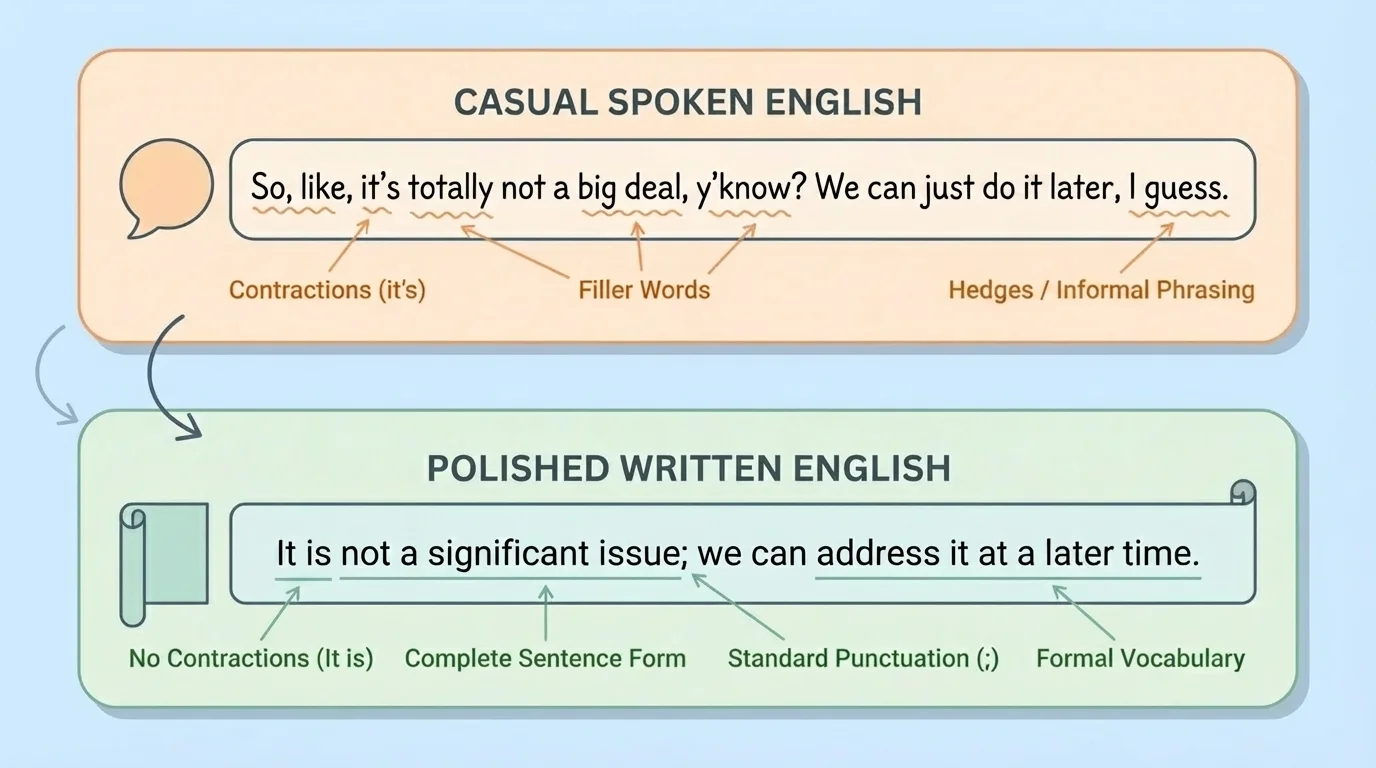
Writers often take ideas that begin in casual speech and revise them into standard written English. That is part of the recursive writing process. A writer may say an idea aloud first, draft it, reread it, and then improve grammar, word choice, and punctuation.
Comparing one message in two forms
A student wants to tell the class about a science project.
Step 1: Spoken version
"We made this cool volcano, and then it, like, erupted really fast."
Step 2: Revised written version
"Our group made a model volcano, and it erupted very quickly."
Step 3: Notice the changes
The written version removes filler words, uses a more exact word, and forms a complete sentence with clear punctuation.
Later, when students edit their own writing, they can remember that comparison. A sentence that sounds fine in conversation may need changes before it is ready for a reader.
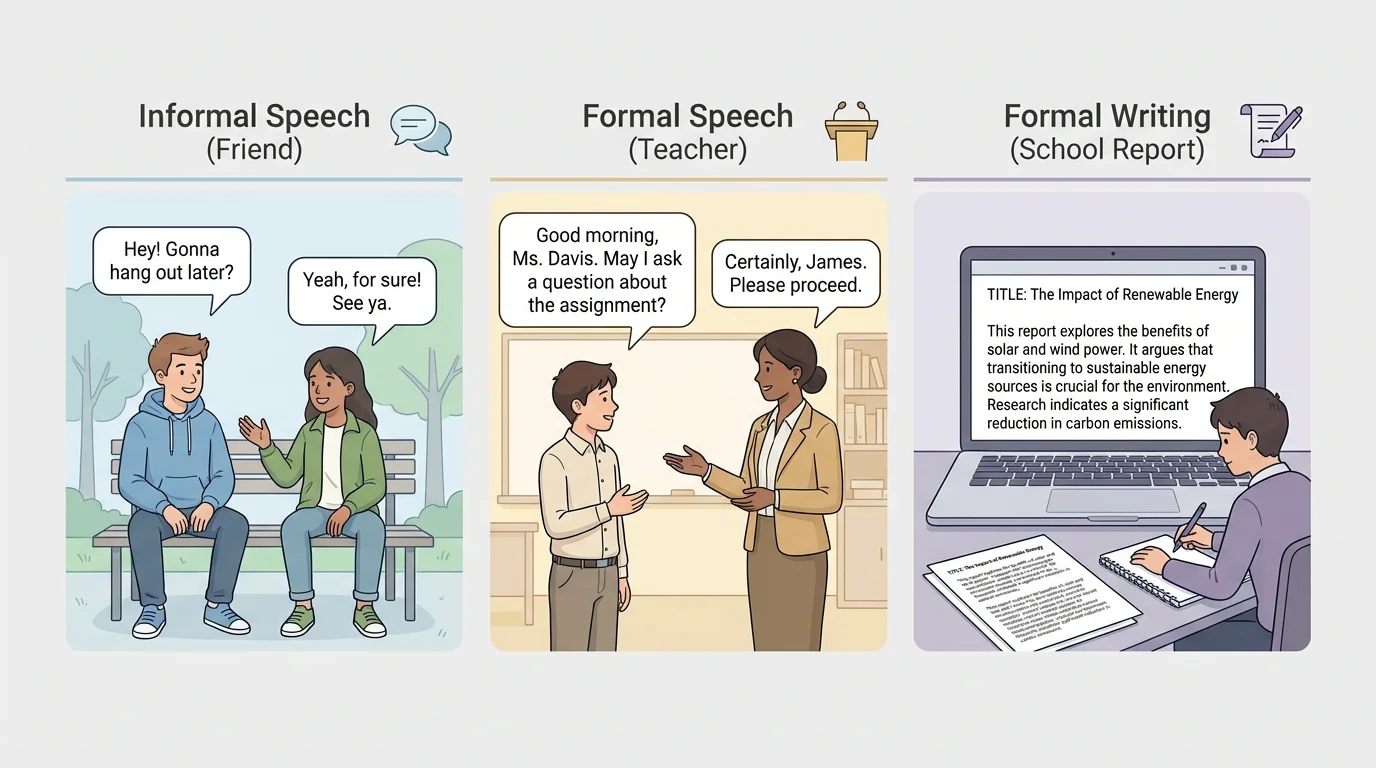
The situation helps decide which kind of language to use, and [Figure 2] illustrates how the same student may speak differently to a friend, a teacher, or a reading audience. This is the difference between formal language and informal language.
Informal language is relaxed. People often use it with friends and family. It may include slang, shorter expressions, or playful words. For example: "That game was awesome!"
Formal language is more careful and often more complete. People use it in school assignments, speeches, reports, and respectful conversations. For example: "The game was exciting and enjoyable." Both sentences make sense, but they fit different situations.
Formal language does not mean boring language. It means language that fits a serious or public purpose. Students often use formal language when writing essays, explaining learning, or speaking to a class.
Informal language is not wrong in every situation. It can help people feel comfortable and friendly. The important skill is choosing the right language for the moment. A strong communicator can shift styles when needed.
If a student writes, "My experiment was super cool and stuff," that might sound too informal for a science report. A more formal version would be, "My experiment was interesting and taught me new information." The meaning becomes clearer and more appropriate for school writing.
Audience and purpose guide language choices
Audience means the person or group who will hear or read your message. Purpose means the reason for communicating. If your audience is your class and your purpose is to teach, your language should be clearer and more formal than if you are chatting with a friend at recess.
Even in speaking, some situations call for more formal standard English. During a presentation, students usually speak in complete thoughts, pronounce words clearly, and avoid too many fillers. The classroom setting in [Figure 2] makes that difference easy to notice.
Different tasks need different language choices. A conversation, a story, a report, and a thank-you note do not all sound the same. Good communicators think first: Who is this for? Why am I saying or writing this? Then they choose the conventions that fit.
In a class discussion, it is normal to pause, restart, or answer quickly. In a final paragraph, readers expect complete sentences and correct punctuation. In a story, dialogue may sound like real speech, but the rest of the writing still needs correct spelling and punctuation so readers can follow it.
Here are some examples of matching conventions to the job:
| Situation | What often works in speech | What often works in writing |
|---|---|---|
| Talking to a friend | Relaxed words, quick responses | Short friendly note, simple sentences |
| Giving a presentation | Clear voice, complete thoughts, fewer fillers | Organized note cards with key points |
| Writing a report | Oral rehearsal may help first | Correct spelling, punctuation, formal language |
| Telling a story | Expression and voice add excitement | Descriptive words, dialogue punctuation, paragraphs |
Table 1. Examples of how spoken and written conventions can change depending on the situation.
Notice that speaking and writing are connected. Sometimes students speak ideas before writing them. Sometimes they read writing aloud to see whether it sounds clear. These two forms support each other, but they are not identical.
Choosing conventions for a school task
A student needs to share what was learned during a field trip.
Step 1: Speaking to a partner
"We saw baby plants, and they were really tiny, but cool."
Step 2: Writing in a science notebook
"We observed young plants. They were very small and had new green leaves."
Step 3: Why the writing changed
The notebook entry uses more exact words, complete sentences, and a school-appropriate style.
Writers and speakers both make choices. Those choices become stronger when students pay attention to conventions instead of using the same style for every situation.
Language learning works best when students notice patterns across all four areas: listening, speaking, reading, and writing. When you listen carefully, you can hear how people organize spoken ideas. When you read carefully, you can see how writers organize written ideas.
Reading helps students notice standard written English. Books, articles, and classroom texts show sentence structure, punctuation, paragraphing, and spelling. Listening to thoughtful speakers helps students notice tone, pacing, and the way spoken language flows.
Speaking can help writing too. Some students say a sentence aloud before writing it. If it sounds confusing, they can revise it. Then, after writing, they can read it aloud and hear whether it sounds smooth. This is part of using language knowledge in a recursive process.
Revise means to change writing to improve it. Edit means to fix smaller errors in grammar, punctuation, capitalization, and spelling. Students often revise first and edit after that.
For example, a first draft might say, "The dog was nice and it did tricks and we liked it a lot." After revising, the sentence might become, "The dog was friendly and performed several tricks." After editing, the writer checks capitals, punctuation, and spelling.
"The right words, in the right form, help other people understand your thinking."
As students grow as readers, writers, speakers, and listeners, they become more aware of language choices. They learn that not every spoken sentence should be copied exactly into writing, and not every written sentence should sound stiff when spoken aloud. The goal is clear communication.
Recognizing differences between spoken and written standard English helps students do better in school and in everyday life. It supports strong writing, thoughtful speaking, careful listening, and better reading. It also helps students understand that language is flexible, useful, and powerful.
