A tiny word part can change a word in a big way. If you know the word care, then you are already close to understanding careless. If you know heat, then preheat is not a mystery for long. Good readers do this all the time: they look at a word, notice familiar parts, and build the meaning step by step.
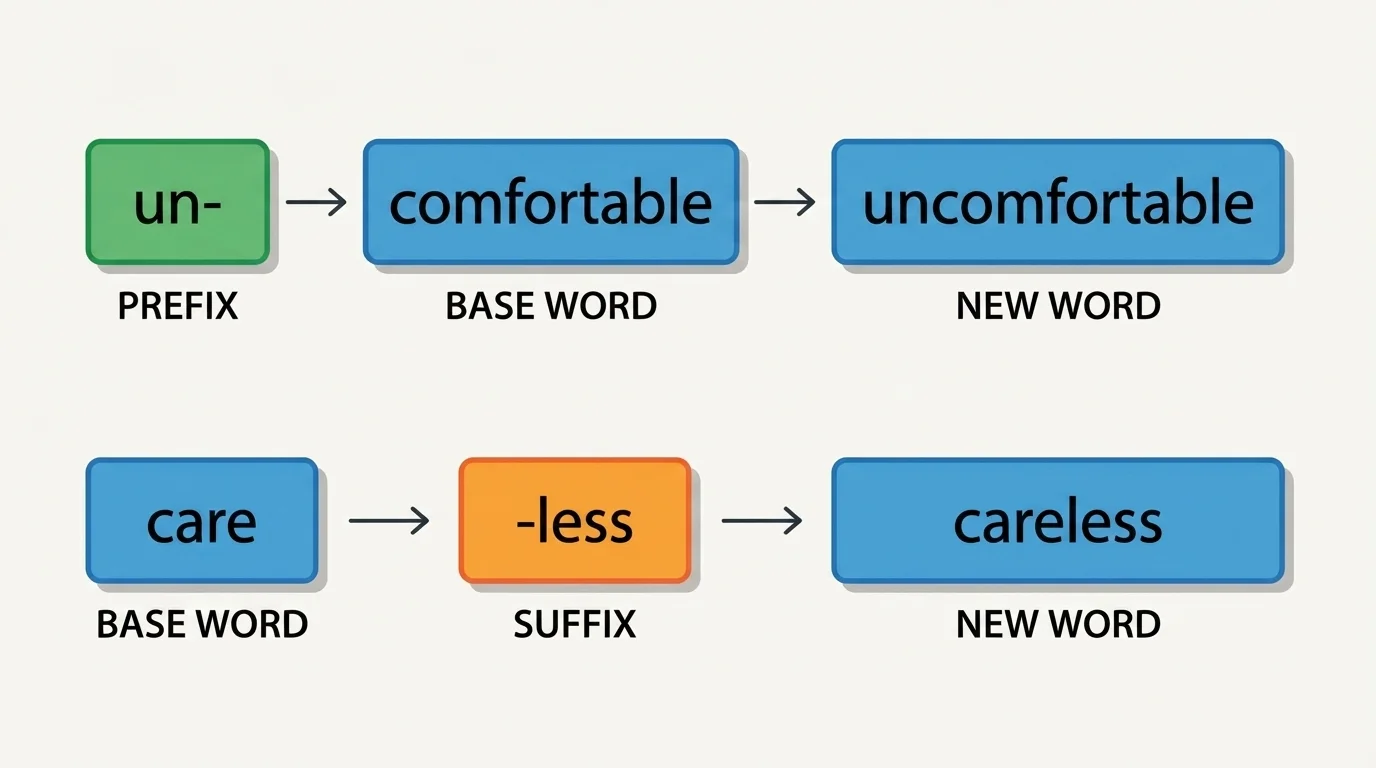
A base word is the word part that carries the main meaning. An affix is a word part added to a base word. As [Figure 1] shows, some affixes are added to the beginning of a word and some are added to the end. When an affix is added, the new word often gets a new meaning.
There are two common kinds of affixes. A prefix is added to the beginning of a base word. A suffix is added to the end of a base word. For example, in preheat, the prefix pre- comes before heat. In careless, the suffix -less comes after care.
Base word means the main word without extra parts added.
Prefix means a word part added to the beginning of a word.
Suffix means a word part added to the end of a word.
Affix means a prefix or suffix added to a base word.
When readers know the base word and know the affix, they can often determine the meaning of the new word. This is an important reading skill because books often contain words you have never seen before. Instead of stopping right away, you can use the parts of the word as clues.
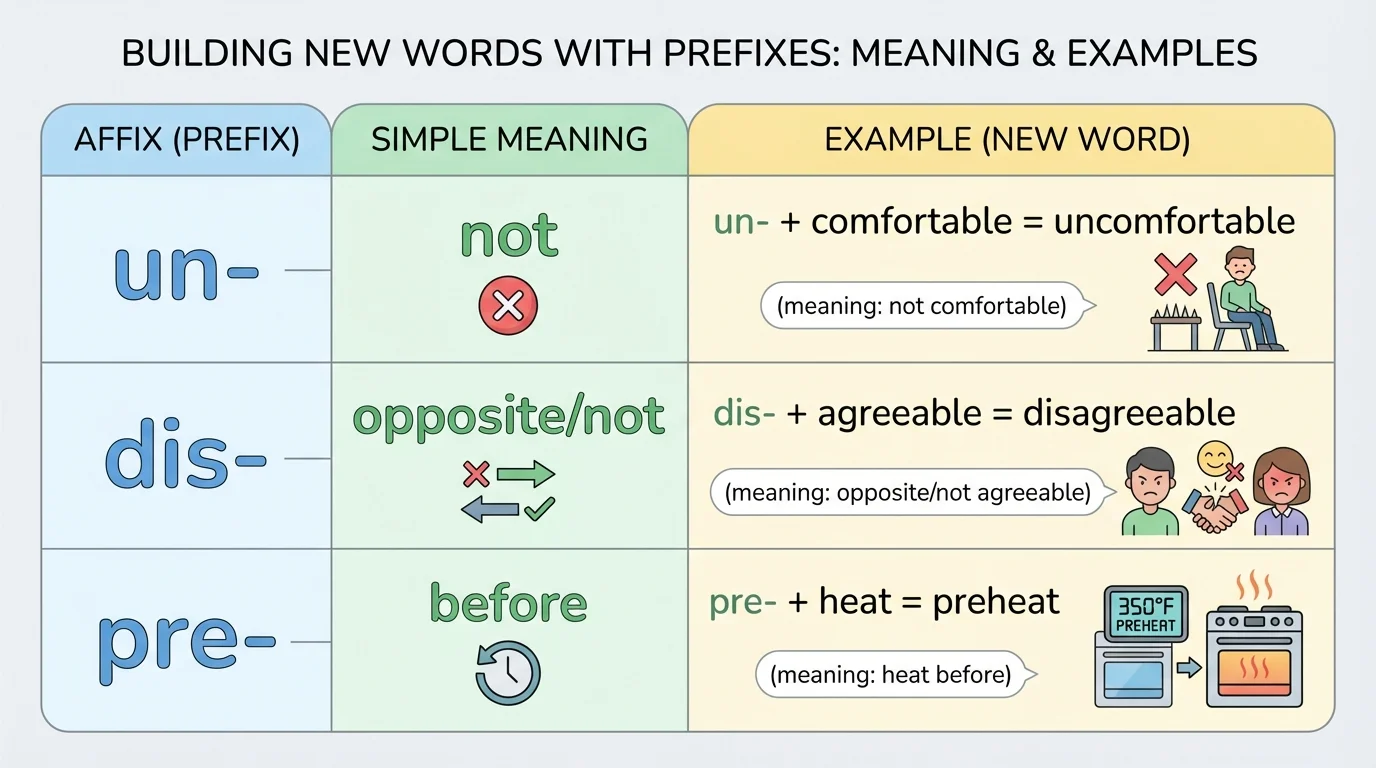
A prefix changes the meaning of the base word. Some common prefixes for this lesson are un-, dis-, and pre-. The comparison in [Figure 2] helps show that each prefix adds its own meaning to the base word.
The prefix un- often means not. If comfortable means feeling good and at ease, then uncomfortable means not comfortable. If kind means nice, then unkind means not kind.
The prefix dis- can mean not or the opposite of. If agreeable means pleasant or easy to like, then disagreeable means not pleasant or not easy to like. If you agree, you have the same opinion. If you disagree, you do not have the same opinion.
The prefix pre- means before. If heat means to make something warm or hot, then preheat means to heat before. When a recipe says to preheat the oven, it means to heat the oven before you put the food in.
Prefixes are powerful because they can quickly change a word. If you know the base word, the prefix gives you a strong clue. Later, when you meet a word like unsafe or preview, you can use the same idea. Unsafe means not safe, and preview means to view before.
Many long words are really built from smaller parts you already know. That means your vocabulary can grow quickly when you learn common prefixes and suffixes.
A suffix is added to the end of a base word. Suffixes can change meaning in different ways. In this lesson, one very important suffix is -less.
The suffix -less means without. If care means attention or kindness, then careless means without care. A careless person may not pay enough attention. A careless mistake is a mistake made because someone was not careful.
Here are more examples. Help becomes helpless, which means without help. Fear becomes fearless, which means without fear. Home becomes homeless, which means without a home. In each case, the suffix adds the idea of without.
Sometimes a suffix does more than add one simple meaning, but for many grade-level words, recognizing a common suffix gives you a very useful clue. When you see a known base word at the start of a longer word, stop and ask, "What does the ending add?"
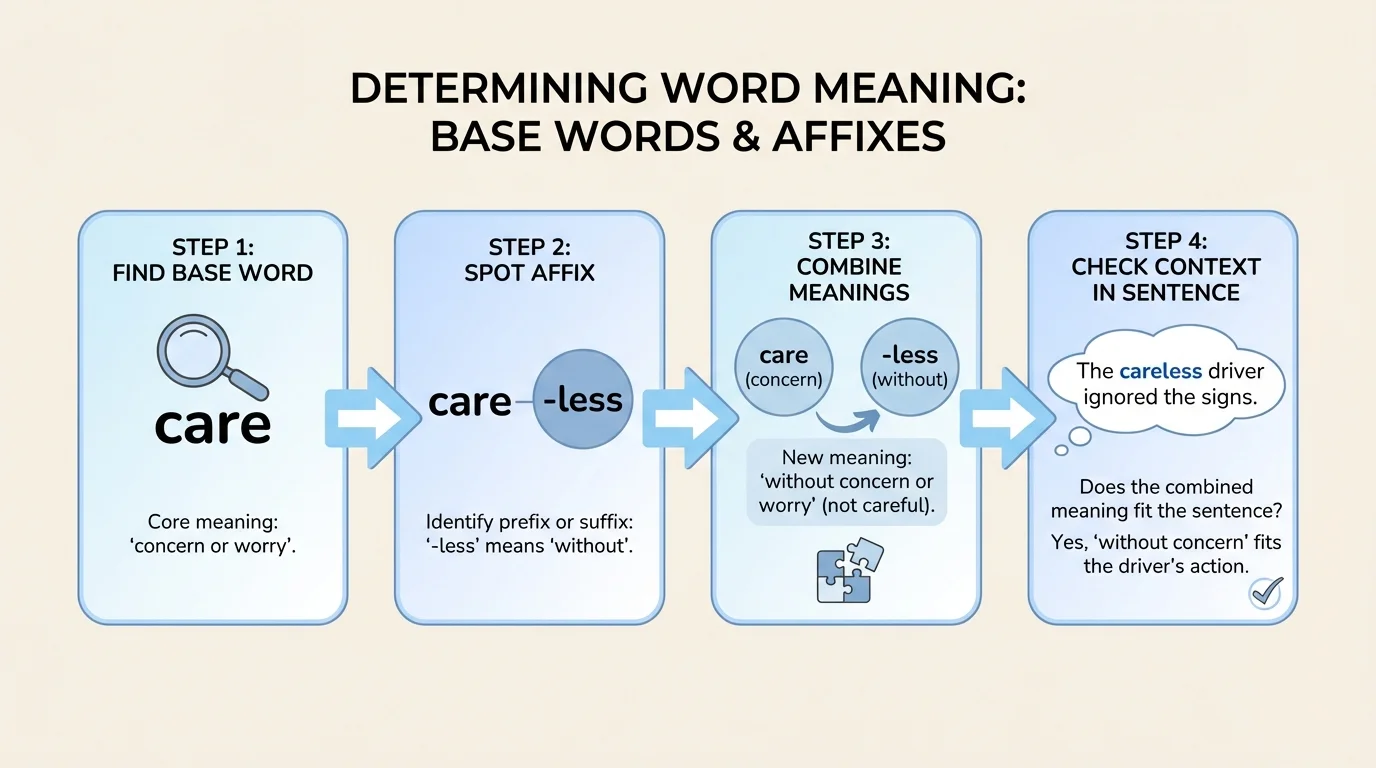
Readers can follow a simple strategy when they meet a longer word. The process in [Figure 3] breaks it into clear steps so you can slow down and think carefully instead of guessing.
Step 1: Find the base word.
Step 2: Look for the affix.
Step 3: Think about what the affix means.
Step 4: Put the parts together and check the sentence.
How meaning is built
When you combine the meaning of the base word with the meaning of the affix, you can often build the meaning of the whole word. Then you use the sentence, or context, to make sure your idea makes sense.
For example, suppose you read: "Mina felt uncomfortable in the wet socks." First, find the base word comfortable. Next, notice the prefix un-, which means not. Put the meanings together: uncomfortable means not comfortable. Then check the sentence. Wet socks really can make someone feel not comfortable, so the meaning fits.
This same strategy works in many subjects. In reading, it helps you understand stories and articles. In science, social studies, and health, it helps with new vocabulary. When you know how word parts work, hard words become easier to unlock.
Now let's examine the sample words more carefully. The word pairs in [Figure 4] make it easier to compare the base word with the new word and notice exactly how the meaning changes.
Agreeable means pleasant, nice, or easy to get along with. Add the prefix dis-, and you get disagreeable, which means not pleasant or not nice to be around. The base meaning changes because the prefix adds the idea of not or opposite.
Comfortable means feeling good, relaxed, or at ease. Add the prefix un-, and you get uncomfortable, which means not feeling good or at ease. The new word does not mean something completely unrelated. It keeps the idea of comfort, but the prefix changes it to the opposite.
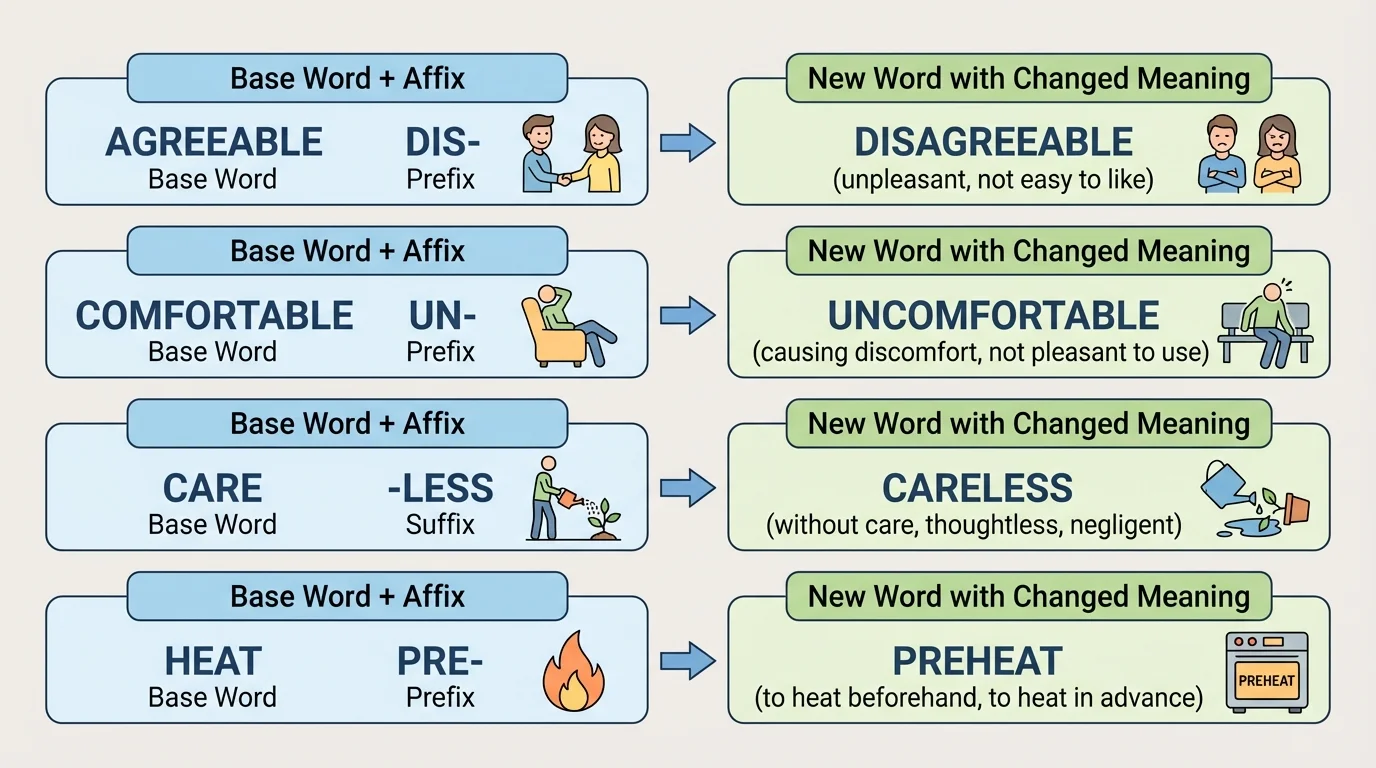
Care means attention, concern, or kindness. Add the suffix -less, and you get careless, which means without care. A careless action may happen when someone does not pay attention.
Heat means to make warm or hot. Add the prefix pre-, and you get preheat, which means to heat beforehand. This word is common in cooking directions. If a recipe says, "Preheat the oven," it is telling you to heat the oven before baking begins.
Word detective examples
Step 1: Look at unsafe.
The base word is safe. The prefix un- means not.
Step 2: Put the meanings together.
Unsafe means not safe.
Step 3: Check the sentence.
In "Climbing the broken fence is unsafe," the meaning not safe makes sense.
Here are more examples you can reason through in the same way. Dislike means not like. Prewash means wash before. Hopeless means without hope. As we saw earlier in [Figure 2], knowing the meaning of the prefix or suffix gives you a strong clue before you even finish the sentence.
Sometimes the base word or the whole new word can have more than one meaning. That is why readers should also look at the sentence around the word. The sentence gives context clues.
Take the word care. It can mean attention, as in "Use care with the glass." It can also mean looking after someone, as in "The nurse gave care to the patient." In both cases, careless still connects to the idea of being without enough care, but the exact shade of meaning depends on the sentence.
The word agreeable can mean pleasant, or it can describe a person who agrees easily. So disagreeable may mean unpleasant, or in some cases it may connect to not agreeing. Readers use both word parts and context together.
You already know one important reading habit: good readers do not rely on only one clue. They use word parts, sentence clues, and what makes sense together.
This is why the strategy in [Figure 3] ends with checking the sentence. The first guess you make from the affix might need a small change after you read the whole line. That is normal and smart reading.
Affixes matter because they help you grow your vocabulary. If you learn one base word and one affix, you can understand many more words. For example, if you know happy, then unhappy becomes easier. If you know tie, then untie becomes easier. If you know view, then preview becomes easier.
Affixes also help in everyday life. You may see them in school directions, library books, recipes, games, and signs. A recipe may say preheat. A classroom rule may warn about unsafe behavior. A story may describe a careless character. A nonfiction book may mention a disagreeable smell or uncomfortable weather.
Writers use affixes to be exact. Instead of writing many extra words, they can use one well-built word. Compare not comfortable and uncomfortable. Compare without fear and fearless. The affix helps make writing clear and strong.
As you keep reading, watch for familiar base words hiding inside longer words. When you notice them, you can unlock meaning more quickly. The word may be new, but its parts may already be old friends.
| Base Word | Affix | New Word | Meaning of New Word |
|---|---|---|---|
| agreeable | dis- | disagreeable | not pleasant; opposite of agreeable |
| comfortable | un- | uncomfortable | not comfortable |
| care | -less | careless | without care |
| heat | pre- | preheat | to heat beforehand |
| safe | un- | unsafe | not safe |
| hope | -less | hopeless | without hope |
Table 1. Examples of base words, affixes, new words, and how the meanings change.
