Have you ever heard two people describe the same classmate in different ways? One person might say, "She is nice," while another says, "She is helpful," or "She is friendly." Those words are close in meaning, but they are not exactly the same. Good readers and writers notice how words connect to real life. They understand that the best word helps paint the clearest picture in someone's mind.
Words are not just marks on a page. They connect to people we know, places we go, and things we do every day. When you read a story or listen to someone speak, you use your own life experiences to understand the words. If a sentence says a child was helpful, you might think of someone who picks up dropped papers, explains homework, or holds the door open for others.
This is called making a real-life connection. A real-life connection happens when you link a word or idea to something true in everyday life. These connections help you understand new words better and remember them longer.
Real-life connection means linking a word, phrase, or idea to something that happens in everyday life.
Context clue means a word or detail near an unfamiliar word that helps explain its meaning.
Figurative language means words or phrases that do not mean exactly what they say, but create a special picture or idea.
For example, if you hear the word patient, you may think of someone waiting calmly in a long lunch line without complaining. If you hear the word honest, you may think of someone telling the truth even after making a mistake. Understanding words becomes easier when you match them to actions you can see and situations you know.
Sometimes a word is easier to understand when you ask, "What does this look like in real life?" If a story says, "Marco was generous," you can think about what a generous person might do. Maybe Marco shares his crayons with someone who forgot theirs. Maybe he gives part of his snack to a friend. The word becomes clearer because it is tied to actions.
Readers often do this without even noticing. When they read the word brave, they may picture someone speaking in front of the class even when feeling nervous. When they read curious, they may picture someone asking many questions about how a plant grows or how a robot works. Real-life connections help turn words into meaningful ideas instead of just sounds.
These connections are useful because many words describe more than one kind of action. A friendly person may smile, invite others to play, or greet a new student. A helpful person may carry books, explain directions, or clean up without being asked. The word and the action work together.
When we describe people, we often use traits. Traits are words that tell what a person is like. As shown in [Figure 1], a trait can describe how someone acts, speaks, or treats others. Traits are often understood through actions, not just through labels. A child who welcomes a new student may be called friendly. A child who helps tie a shoe may be called helpful.
Using the right trait word matters. If you say someone is kind, that means the person cares about others. If you say someone is polite, that means the person uses good manners, like saying "please" and "thank you." If you say someone is responsible, that means the person takes care of jobs and follows through.
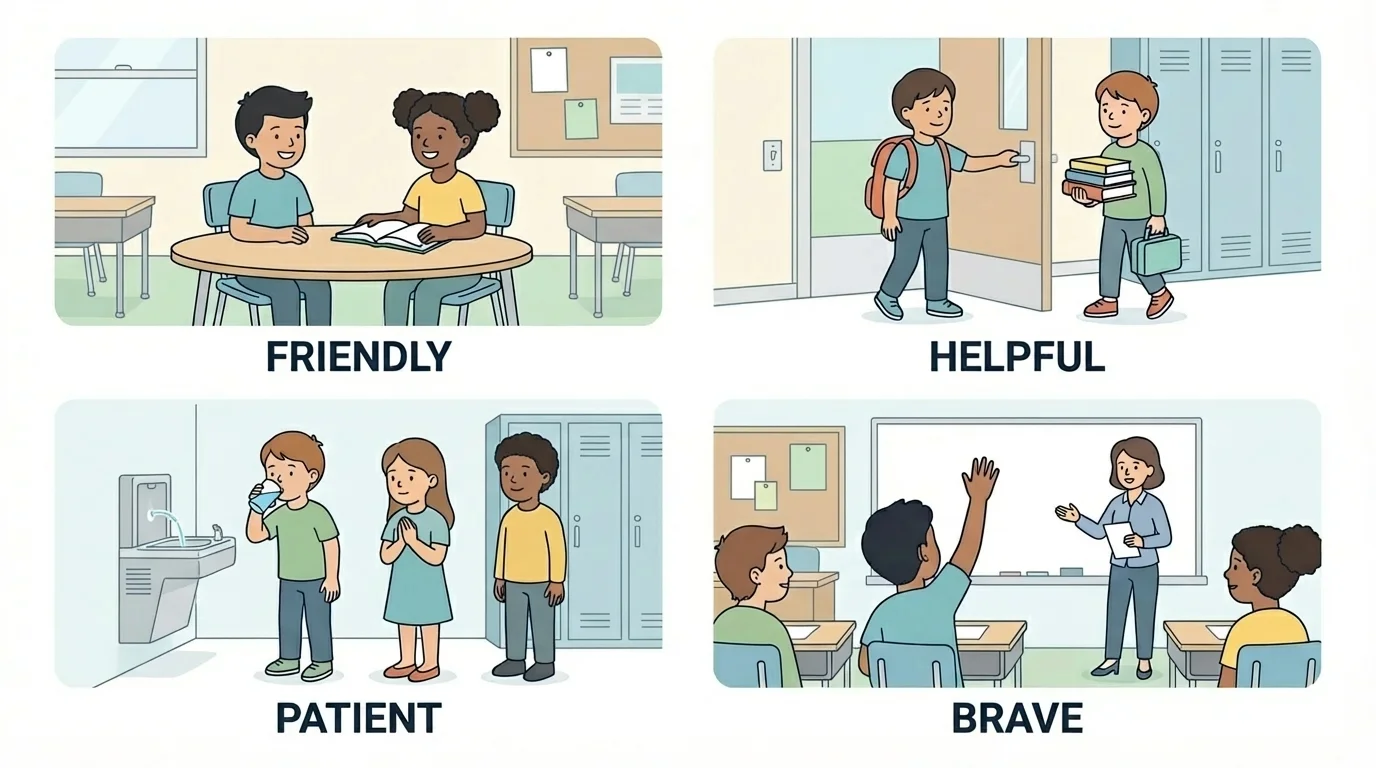
Notice that one action can sometimes fit more than one word, but some words fit better than others. A student who shares a pencil may be helpful and kind. But if that student also notices someone feels left out and invites them into a game, friendly may be the strongest word. Careful word choice helps us say exactly what we mean.
Here are some common words used to describe people in real life:
| Word | What It Means | Real-Life Example |
|---|---|---|
| friendly | acts in a warm, welcoming way | smiles and talks kindly to a new classmate |
| helpful | gives support or assistance | picks up books someone dropped |
| brave | acts even when something feels scary | tries a new activity in front of others |
| patient | waits calmly | stands quietly while others take turns |
| honest | tells the truth | admits breaking a crayon by accident |
| responsible | takes care of duties | finishes chores and returns homework |
Table 1. Common words used to describe people, with meanings and everyday examples.
Later, when you read about characters in stories, these same ideas help you understand them. If a character shares, comforts, and includes others, you can connect those actions back to words like kind, friendly, or generous. Actions reveal meaning.
Real-life example: choosing the best word
A student notices that her classmate is carrying too many books and offers to help.
Step 1: Think about the action.
The student is giving assistance.
Step 2: Match the action to a trait word.
The strongest match is helpful.
Step 3: Consider similar words.
The student might also be kind, but helpful is more exact because the action is helping directly.
This shows how real-life actions help us pick the best word.
Some words are close in meaning, but each one has its own nuance, or small difference in meaning. Words like friendly, kind, helpful, and polite are related, but they are not interchangeable in every situation.
As [Figure 2] shows, think about these pairs. Friendly means warm and welcoming. Helpful means giving assistance. A person can be friendly by smiling and saying hello. A person can be helpful by carrying a box or explaining directions. Sometimes a person is both, but the words point to different parts of behavior.
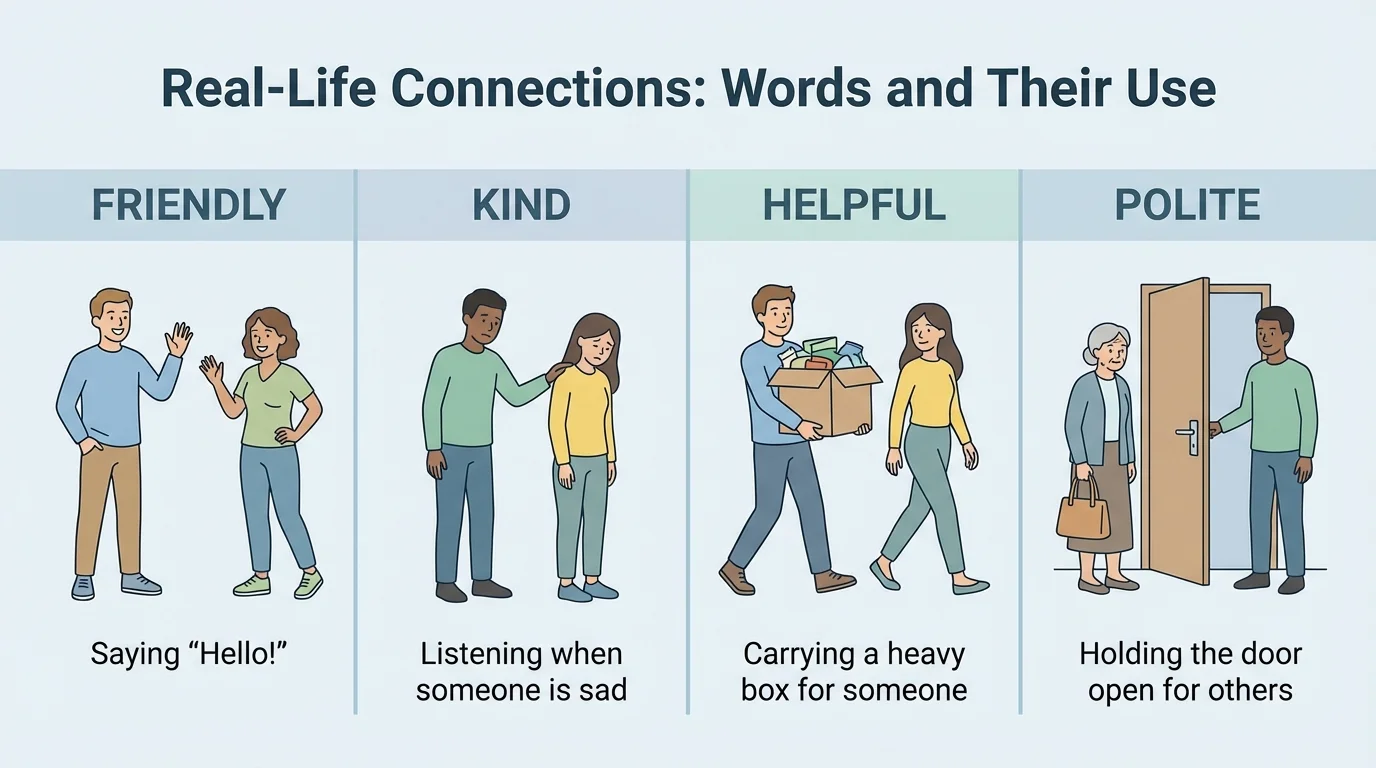
Another pair is brave and reckless. Both may describe someone doing something risky, but brave usually means facing fear for a good reason, while reckless means not being careful. That difference matters. Calling a firefighter brave is very different from calling someone reckless for running into danger without thinking.
Another useful pair is quiet and shy. Quiet means not making much noise. Shy means feeling nervous around people. A person can be quiet because they are thinking. A person can be shy because speaking to others feels hard. Similar words can point to different ideas, and readers need to pay attention to those small differences.
When writers choose one word instead of another, they are being precise. If a book says a character is determined, that tells more than just saying the character "kept going." Determined means the character does not give up easily. Strong vocabulary creates stronger meaning.
Sometimes you do not know a word right away. That is when context clues can help. Context clues are words, phrases, or details around the unfamiliar word. They help readers infer meaning.
Look at this sentence: "Janelle was considerate. She noticed her friend was tired, so she spoke softly and carried part of his project." Even if you did not know the word considerate, the details tell you that Janelle was thinking about someone else's needs. That helps you figure out the meaning.
Here is another example: "The coach praised Leo for being determined. Even after missing the goal twice, he practiced again and again." The clue is in the actions. Leo keeps trying. That tells us that determined means not giving up.
Context clues are especially useful with words that have more than one meaning. The word bright can mean giving off a lot of light, or it can mean smart. In the sentence "The bright flashlight helped us see the path," bright means full of light. In the sentence "Mina is a bright student who solves hard puzzles," bright means smart. The surrounding words help readers decide.
How context and real life work together
Readers understand words best when they use both context clues and their own experiences. The sentence gives hints, and real life gives meaning. If you know what a patient person acts like in real life, then a sentence about waiting calmly becomes easier to understand.
As your vocabulary grows, you will use context clues more quickly. You may not stop and think about every word, but your brain keeps making connections between the text and the world around you.
Words are connected in different ways. Some words are synonyms, which are words with similar meanings. Some are antonyms, which are words with opposite meanings. Understanding these relationships helps you choose the right word.
For example, helpful and supportive are similar. Helpful and unhelpful are opposites. Friendly and welcoming are similar. Friendly and mean are opposites. Knowing these connections helps you read carefully and write clearly.
Words can also belong to categories. For instance, cheerful, grumpy, and excited are words about feelings or moods. Honest, responsible, and brave are words about character traits. When readers group words this way, they build stronger understanding.
You can also connect words to actions. A generous person shares. A curious person asks questions. A careful person checks work and watches where they step. Matching a word to likely actions helps the meaning stay clear in your mind.
Many strong readers do not memorize word meanings by themselves. They connect words to people, events, and actions they already know, and that makes vocabulary easier to remember.
These relationships matter in stories too. A writer may never say, "The character was helpful." Instead, the character may gather supplies, assist a friend, and stay after class to clean up. Readers infer the character trait from the actions.
As [Figure 3] shows, not every phrase means exactly what the words say. Figurative language uses words in a creative or nonliteral way. People use figurative language in books, songs, and everyday conversation.
For example, if someone says, "My backpack weighs a ton," the backpack does not really weigh a ton. The speaker means it feels very heavy. If someone says, "She has a heart of gold," that does not mean her heart is made of metal. It means she is very kind.
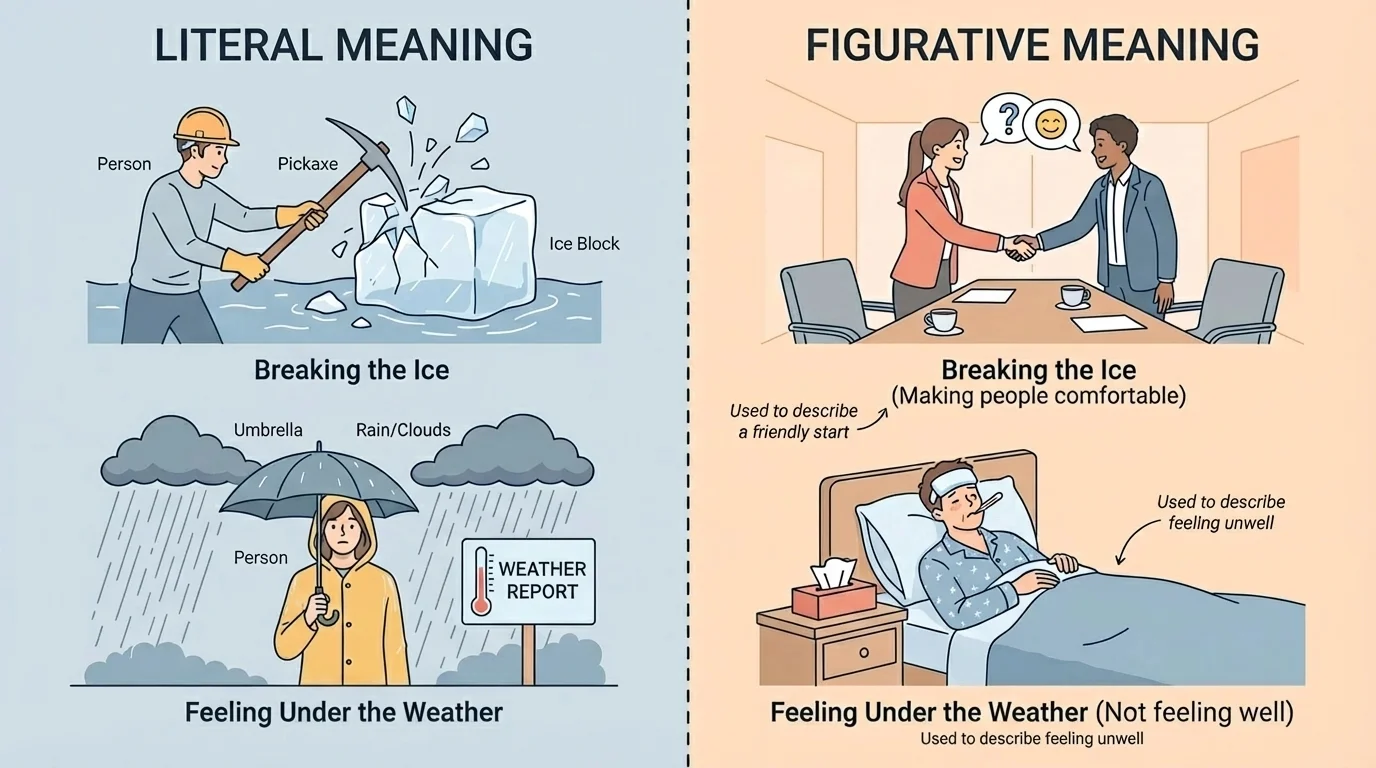
Idioms are a type of figurative language. An idiom is a phrase whose meaning is different from the exact meanings of the words. If someone gets "cold feet," that usually means they feel nervous, not that their feet are freezing. If someone says a class is "a piece of cake," that means it is easy.
Real-life connections help with figurative language too. If you know what it feels like to be nervous before speaking, you can better understand why "cold feet" means worry. If you know bees are busy moving from flower to flower, then "busy as a bee" makes sense as a way to describe a very active person.
Writers use figurative language to make descriptions stronger and more memorable. Later, when you hear someone say a room is "buzzing," you know they probably mean it is full of energy and talk, not filled with insects. The more examples you hear, the easier these meanings become. That difference between literal and nonliteral meaning becomes clearer with practice.
Real-life example: literal or figurative?
Sentence: "After waiting for the contest results, Maya had butterflies in her stomach."
Step 1: Ask whether the words make literal sense.
Real butterflies are not actually flying in Maya's stomach.
Step 2: Use real-life knowledge.
People often feel jumpy or fluttery when they are nervous.
Step 3: Find the meaning.
The phrase means Maya feels nervous or excited.
Real-life feelings help readers understand figurative language.
When you speak or write, exact words help others understand you better. Instead of saying, "He is nice," you can think about what kind of nice. Is he friendly? Helpful? Generous? Polite? More exact words give more information.
Suppose you are writing about a classmate. If you write, "Amira is friendly," that tells one thing. If you write, "Amira is friendly because she welcomes new students and invites them to join games," that gives evidence from real life. The description becomes stronger because the word matches clear actions.
The same idea works outside of school. A coach may call a player determined because the player keeps practicing. A parent may call a child responsible because the child feeds a pet every day. A neighbor may call someone helpful because that person carries groceries upstairs. Vocabulary becomes most powerful when it fits real situations.
Careful word choice also helps avoid confusion. If a person is quiet, do not automatically call that person shy. If someone laughs a lot, do not automatically call that person silly. Good readers and writers look for evidence before choosing words.
You build vocabulary every time you read, listen, talk, and notice the world around you. If you hear a new word, ask what it looks like in real life. What would a person do if they were generous? What might a classroom feel like if it were peaceful? What actions would show someone is thoughtful?
Another good way to grow your word bank is to compare words. Ask yourself how helpful is different from kind, or how brave is different from reckless. These small differences make your vocabulary more powerful.
You can also listen for figurative language in conversations, books, or songs. When you hear an unusual phrase, ask whether it is literal or figurative. Then connect it to a real feeling, action, or experience. That helps the meaning stick.
Strong vocabulary is not about using the hardest word. It is about using the right word. When you understand how words connect to life, you become a better reader, listener, speaker, and writer.
"The right word can paint the clearest picture."
Each new word becomes more useful when you can connect it to a person, an action, a feeling, or a situation you know. That is how vocabulary grows from something you memorize into something you truly understand.
