Have you ever said, "Chocolate milk is the best drink," or "Our class should have more reading time"? Lots of people can share an opinion, but the writers who sound most convincing do something extra: they tell why. When you give good reasons, your opinion becomes stronger, clearer, and more believable.
An opinion is what someone thinks, feels, or believes. People can have different opinions because opinions are not proven the same way facts are. One student may think dogs are better pets, while another student may think cats are better pets. Both are opinions.
Opinion means a belief or judgment a person has about something.
Fact means something that can be checked and shown to be true.
Reason means why someone believes an opinion.
A fact is different from an opinion. A fact can be checked. For example, "A week has 7 days" is a fact. "Saturday is the best day of the week" is an opinion. When you write an opinion piece, you are sharing your thinking. But your reader needs more than just your opinion sentence. Your reader needs support.
That support comes from reasons. If you simply write, "Summer is the best season," your reader knows what you think, but not why you think it. If you add reasons, such as "the weather is warm," "there is no school," and "families can spend more time outside," your writing becomes much stronger.
A reason tells why an opinion makes sense. It is the part of your writing that answers the question, "Why do you think that?" An opinion becomes stronger when it has support behind it, as [Figure 1] shows with one opinion connected to several matching reasons.
Look at this opinion: "School uniforms are a good idea." That is only the writer's belief. Now add reasons: "Uniforms can make getting dressed easier," "they can help students feel like part of a team," and "they can keep clothing from becoming a big distraction." These reasons help the reader understand the writer's thinking.
Reasons should connect directly to the opinion. If the opinion is about school uniforms, the reasons should be about uniforms, school, or students. A sentence like "My brother likes pizza" does not support that opinion because it is off topic.

Writers often use more than one reason. One reason can help, but two or three reasons usually make the writing stronger. Each reason adds another piece of support, almost like adding extra legs under a table so it stands more firmly.
People are more likely to agree with writing when the writer gives clear reasons instead of only saying what they like or dislike.
That is why opinion writing is not only about having ideas. It is also about explaining them in a way that makes sense to someone else.
Not all reasons are equally powerful. Some reasons are strong reasons, and some are weak. A strong reason matches the opinion, makes sense, and helps the reader understand why the writer believes the opinion.
Suppose the opinion is "Recess should be longer." As [Figure 2] shows, here are some stronger reasons: "Students need time to move their bodies," "playing helps children return to class ready to learn," and "extra recess gives students more time to practice sharing and teamwork." These reasons all connect clearly to recess.
Now look at weaker reasons: "Recess is awesome," "I just want more time outside," or "Long recess sounds fun." These sentences do show a feeling, but they do not explain much. They are not very convincing because they do not give enough information.
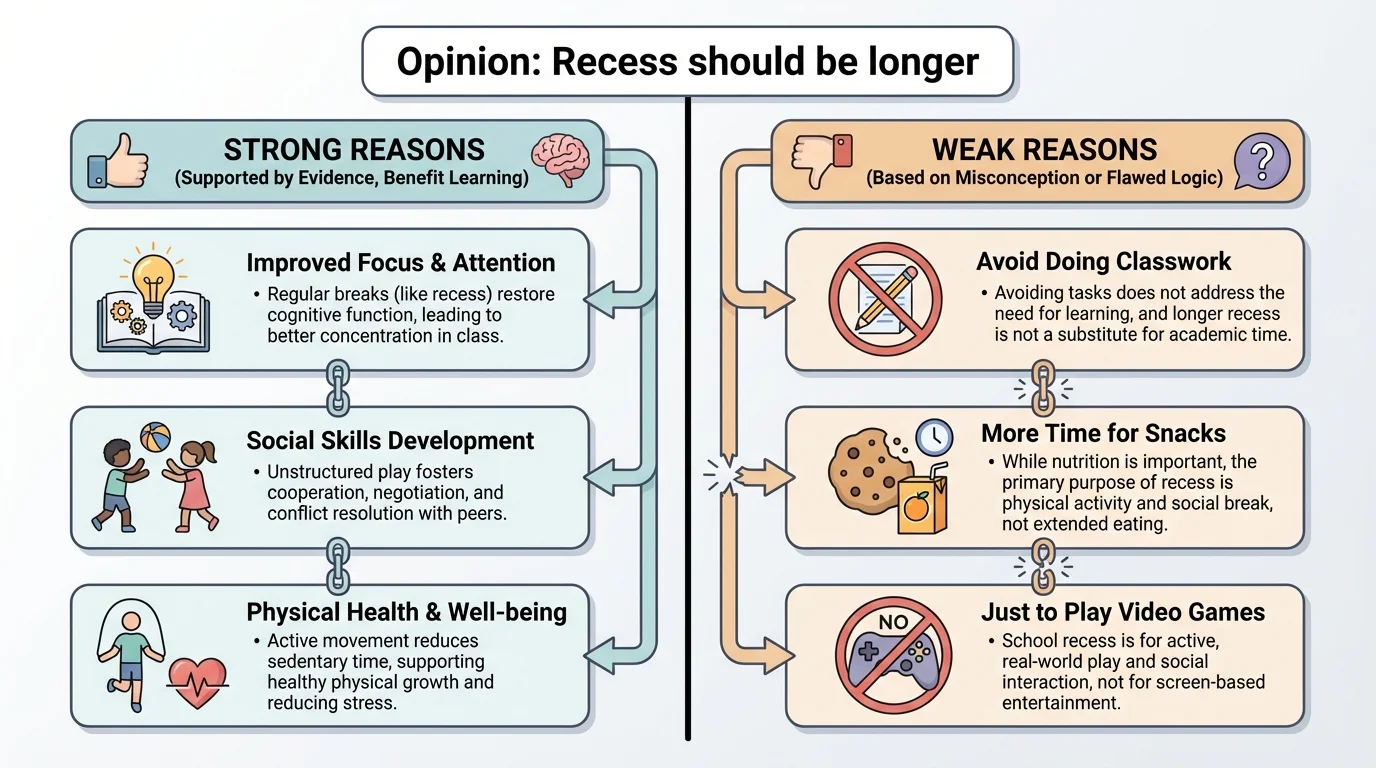
Strong reasons are usually more specific. Instead of saying, "Reading is good," a writer could say, "Reading helps students learn new words," or "Reading lets children learn about places and people they have never seen." Specific reasons help the reader picture the idea.
Strong reasons also avoid repeating the same idea again and again. If a writer says, "Art is fun," "Art is enjoyable," and "Art is exciting," the writer is mostly repeating one thought. It is better to give different reasons, such as "Art helps students be creative," "Art can help people express feelings," and "Art teaches careful observation."
One of the most important jobs in opinion writing is making sure each reason fits. This is called support. Support means your reasons hold up your opinion instead of wandering away from it.
Read this opinion: "The library is the best place in school." Matching reasons might include "it is quiet for reading," "students can find many kinds of books," and "the library is a place to learn new information." These reasons all belong with the opinion.
Now think about a mismatched reason: "The cafeteria has tasty food." That may be true, but it does not support the opinion about the library. Good writers check every reason and ask, "Does this really help my opinion?"
The same idea appears when writing about books. If your opinion is "The main character in a story is brave," your reasons should come from the story. You might write, "She rescued her friend," or "She told the truth even when she was scared." Those details match the opinion. Saying, "The book cover is blue," does not help prove bravery.
As we saw earlier in [Figure 1], the clearest opinion writing keeps each reason connected to the main idea. When the reasons branch away from the opinion, the writing feels confusing.
Matching matters
A reason is useful only if it connects to the opinion. Writers should choose reasons that answer the exact opinion they stated, not just any idea that pops into mind.
When you stay focused, your reader can follow your thinking step by step.
Sometimes a reason is good, but it can be even better with extra explanation. Writers often add an detail or an example after a reason. A detail gives more information. An example shows the idea in action.
Look at this opinion sentence: "Pets belong in many homes." One reason could be "Pets can be good companions." That is a good start. A writer can make it stronger by adding details: "A dog or cat can help a person feel less lonely," or "Many children enjoy talking to and caring for a pet every day."
Here is another example. Opinion: "Our school should plant a garden." Reason: "A garden helps students learn." Detail: "Students can observe how plants grow, care for living things, and study science outdoors." The detail helps the reader understand the reason more clearly.
Example of adding details
Opinion: "Students should read every day."
Step 1: State a reason.
"Reading helps students become better readers."
Step 2: Add a detail or example.
"When students read often, they practice decoding words and understanding what they read."
Step 3: Explain why it matters.
"That practice can help them in every school subject."
The writing becomes stronger because the reason is explained.
Examples and details do not replace reasons. They work with reasons. First, the writer gives a reason. Then the writer adds details to make it clearer and more convincing.
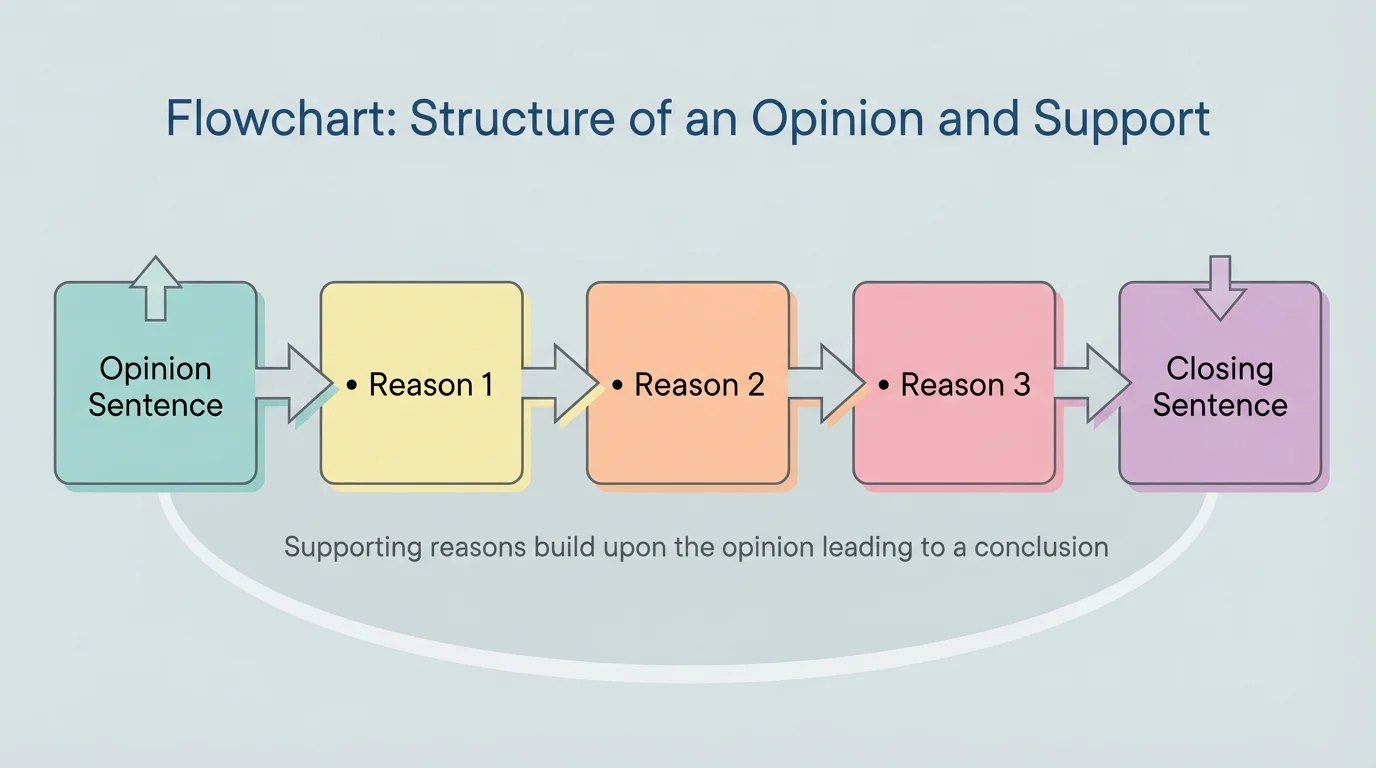
Good ideas are easier to understand when they are in a clear order. A simple opinion paragraph often follows a pattern: first the opinion sentence, then the reasons, and then a closing sentence.
As [Figure 3] shows, one common pattern is this: start with your opinion, give two or three reasons, add details when needed, and finish with a sentence that reminds the reader of your opinion. This helps the writing stay focused and easy to follow.
Here is a model paragraph:
"I think field trips are an important part of school. First, field trips help students learn in real places. For example, a visit to a museum lets students see history up close. Second, field trips can make learning more exciting. Students often remember lessons better when they experience them. For these reasons, field trips are a valuable part of education."
This paragraph works because the opinion comes first, the reasons come next, and the ending wraps up the idea. The writer does not jump from one topic to another.
Later, when you read your own writing, you can compare it to the structure in [Figure 3] and check whether your ideas are in a helpful order.
Writers use certain words and phrases to make their thinking clear. These are sometimes called linking words because they connect ideas. They help readers understand which sentence states the opinion and which sentences give reasons or examples.
Opinion words and phrases include: "I think," "I believe," "In my opinion," and "I feel." Reason words include: "because," "since," and "one reason is." To add more support, writers can use "also," "another reason," and "for example."
Here is a useful list in a table.
| Job in Writing | Helpful Words and Phrases |
|---|---|
| State an opinion | I think, I believe, In my opinion |
| Give a reason | because, one reason is, since |
| Add another reason | also, another reason, in addition |
| Give an example | for example, for instance |
| Close the writing | for these reasons, that is why, in conclusion |
Table 1. Words and phrases that help connect opinions, reasons, and examples.
These words are helpful, but they do not do the whole job by themselves. A sentence with "because" still needs a real reason after it. For example, "Books are great because they are" is not complete enough. "Books are great because they teach new ideas and build imagination" gives true support.
Strong opinion writing usually gets better through revision. To revise means to look again at your writing and improve it. Writers often ask questions such as: "Did I clearly state my opinion?" "Do my reasons match?" "Did I explain enough?"
Suppose a student writes, "Our class should have plants because plants are nice." That is a beginning, but revision can make it stronger. The writer might change it to: "Our class should have plants because they make the room feel calm and they help students learn to care for living things." Now the reason is clearer and fuller.
Another revision might add missing support. If a writer has only one short reason, the writing may feel unfinished. Adding another reason can help: "Plants also make the classroom more colorful and welcoming."
Good writing does not always appear perfectly the first time. Writers improve their work by rereading, checking their ideas, and making changes.
Revision also helps remove reasons that are weak or off topic. If a reason does not fit, it is better to replace it with one that truly supports the opinion.
You can give reasons for many kinds of opinions. Some opinions are about school, such as "Homework should be shorter" or "Music class is important." Some are about books, such as "This character made a good choice." Others are about home or community, such as "The park needs more trash cans."
When writing about a text, your reasons often come from what happened in the story or article. If you think a character is kind, you should mention kind actions from the text. If you think an article teaches an important lesson, your reasons should come from the ideas in the article.
When writing about everyday topics, your reasons can come from observation and experience. If you think bicycles are a good way to travel short distances, your reasons might include "they do not need gasoline," "they give exercise," and "they can be faster than walking."
The same rule stays true in every topic: say the opinion clearly, give matching reasons, and explain those reasons with enough detail. Just like the strong examples compared in [Figure 2], the best writing moves beyond simple feelings and gives thoughtful support.
When readers can understand your reasons, they are more likely to understand your point of view. That is what makes opinion writing powerful. It is not only saying what you think. It is showing why your thinking makes sense.
