Have you ever heard someone tell a story that sounded flat, like this: "I went outside. It rained. I went back in." The events are there, but the story does not feel alive. Strong narratives do more than list what happened. They help readers hear the voices, see the movements, and understand what the characters are thinking and feeling. That is how a writer turns simple events into a real experience.
In a narrative, a character is the person, animal, or being in the story. Readers want to know not only what happens to the character, but also how the character reacts. If a boy drops his ice cream, readers may wonder: Does he laugh? Does he cry? Does he stomp away? Does he say something? Those details matter because they help the reader understand the moment.
Good writers often include four kinds of details: what the character says, what the character does, what the character thinks, and what the character feels. When these details work together, the story becomes more vivid. Instead of telling the reader, "Mia was nervous," a writer can show nervousness through shaky hands, worried thoughts, and whispered words.
Dialogue is the exact words a character says. Description tells about actions, thoughts, feelings, or the setting. Narrative is a story with characters, events, and a clear sequence. Response is the way a character reacts to a situation or event.
Writers do not need to use every kind of detail in every sentence. The goal is to choose details that help the reader understand the experience. Sometimes one line of dialogue is enough. Sometimes one action, like a character covering their face, says a lot.
Dialogue lets the reader hear the characters speak. It makes the scene sound real, as [Figure 1] shows in a moment when two students talk about a missing lunchbox. Dialogue can reveal a problem, show feelings, or help move the story forward. If a girl says, "My backpack is gone!" the reader knows right away that something important has happened.
Writers put quotation marks around the exact words a character says. They may also add a speaker tag to show who is talking. A speaker tag is a short phrase such as "said Maya" or "asked Ben."
Here is a simple example: "Where did my hat go?" asked Luis.
This sentence includes both the spoken words and the speaker tag. The dialogue tells what Luis says, and the tag tells who says it.
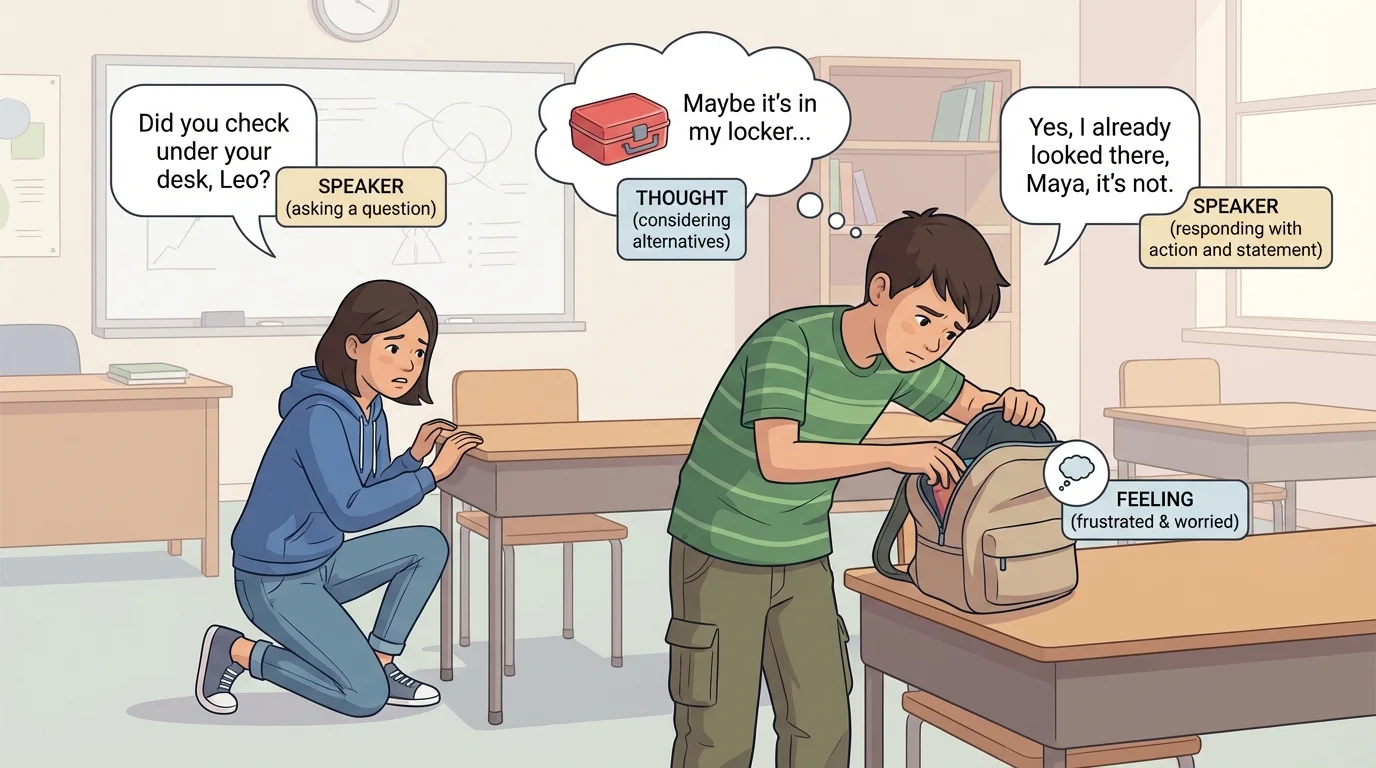
Dialogue should have a job in the story. It should not be added just to fill space. Strong dialogue can show surprise, fear, excitement, or kindness. Compare these two examples.
Plain example: Sam was upset.
Stronger example: "That was my turn!" Sam shouted.
The second example helps the reader hear Sam's emotion. The words and the verb shouted make his feeling clearer.
Dialogue can also show relationships between characters. If one character says, "Are you okay?" it can show care. If another says, "Hurry up!" it can show impatience. Later in a story, the same kind of speaking pattern can remind readers about that character, just like the classroom scene in [Figure 1] helps show how spoken words reveal the problem right away.
Actions are what characters do. Action descriptions help readers picture the scene and understand how a character responds. Body language can show feelings even when a writer does not name the feeling directly. A child who taps a foot, bites a lip, or grips a paper tightly may be worried or excited.
As [Figure 2] illustrates, actions can be big or small. Running across a field is a big action. Twisting a shoelace around a finger is a small action. Both kinds of actions can tell the reader something important.
Look at this example: Ella stood by the stage and rubbed her sweaty hands on her shirt.
That sentence does not say, "Ella was nervous," but readers can figure it out from the action. This is called showing instead of just telling.
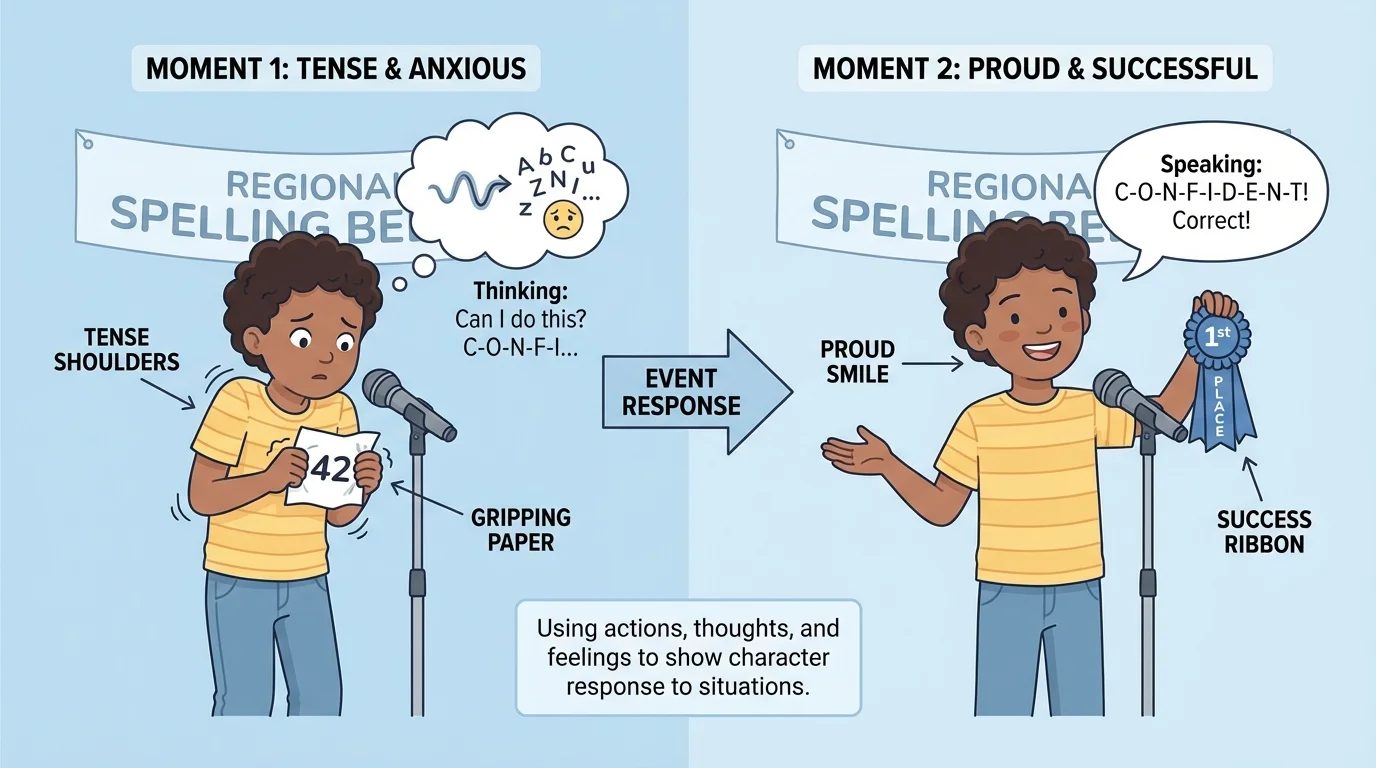
Actions can also move the plot from one event to the next. If a dog darts through an open gate and a girl chases after it, the story suddenly has motion. Actions keep a narrative from feeling stuck.
Sometimes actions show a character's personality. A brave character may step forward. A shy character may hide behind a friend. A thoughtful character may stop to help someone before continuing. These choices matter because they reveal who the character is.
Writers can also use action to show change. At first, a child might clutch a note and stare at the floor. Later, that same child might stand tall and read clearly. The actions show growth. The change shown in [Figure 2] works this way too, because the body language shifts from tense to proud.
Thoughts are what a character thinks privately. Feelings are emotions, such as happiness, anger, fear, or pride. When writers include thoughts and feelings, readers can understand the inside of the story, not just the outside.
For example, read this sentence: Nina stared at the dark hallway. What if someone is in there? she wondered.
The thought helps the reader understand why Nina pauses. Without the thought, the reader sees only the action. With the thought, the reader understands the reason behind it.
Showing the inside and outside of a character
Strong narratives often show both the outside and the inside of a character. The outside includes actions and dialogue. The inside includes thoughts and feelings. When a writer includes both, the reader understands not only what the character does, but why the character does it.
Feelings can be named directly, but they can also be shown with description. Here are two ways to write about the same emotion.
Telling: Jada felt excited.
Showing: Jada bounced on her toes and grinned as the bus pulled up.
Both are correct, but the second sentence gives the reader a stronger picture. Sometimes writers use a mix of both showing and telling. For example: Jada felt excited. She waved both hands over her head and nearly dropped her backpack. This works because the feeling is named, and then the action adds detail.
Thoughts and feelings are especially useful when the character faces a challenge. If a child forgets a line in a play, readers want to know what rushes through the character's mind. Is the child embarrassed? Determined? Ready to try again? Those inner details help the event feel real.
A narrative should have a clear order. Most stories have a beginning, a middle, and an end. The beginning introduces the characters and situation. The middle shows the problem, action, or important events. The end brings the story to a close.
As [Figure 3] shows, dialogue, actions, thoughts, and feelings belong in all parts of the story, not just one part. In the beginning, dialogue may introduce the situation. In the middle, actions and thoughts may show the problem getting harder. In the end, feelings may show relief, pride, or disappointment.
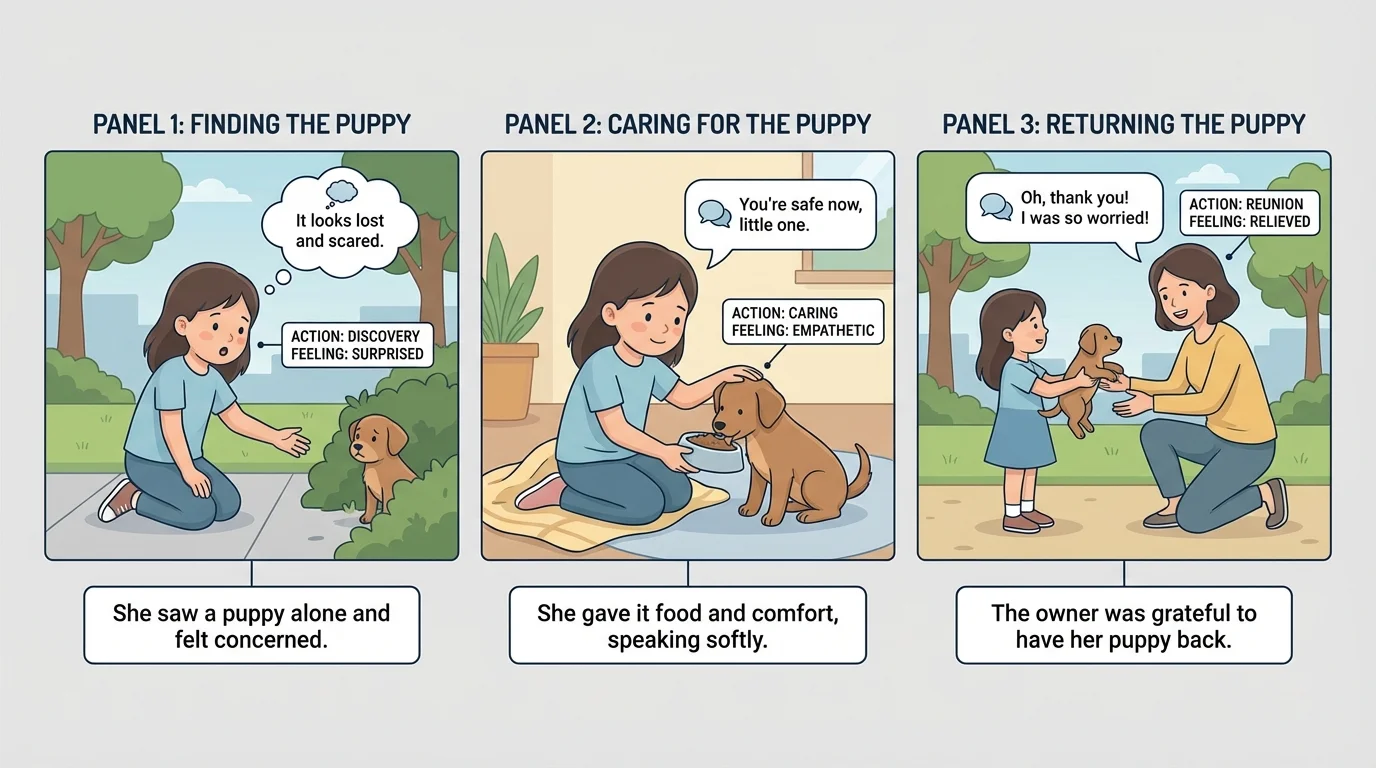
Here is a simple sequence:
Beginning: Tori heard a soft bark behind the bushes.
Middle: She pushed the branches apart and found a small puppy with a red collar. "Oh no, are you lost?" she whispered. Her heart thumped as she looked around for the owner.
End: After reading the phone number on the tag, Tori called the puppy's family. When the owner arrived, Tori smiled as the puppy bounced into the man's arms.
This sequence is clear because each event leads to the next. The dialogue, action, and feeling details make the events stronger. The puppy story in [Figure 3] also makes it easier to notice how a beginning, middle, and end fit together.
Words such as first, next, then, after that, and finally can help show order. These words are called transition words. They guide readers through the story.
One important job of a narrative is showing how a character responds to what happens. Two characters can face the same situation and react in very different ways. That difference can make a story interesting.
Suppose a thunderstorm starts during a picnic. One character might laugh and dance in the rain. Another character might grab the basket and run for shelter. The event is the same, but the responses are different. Dialogue, actions, thoughts, and feelings help show those differences clearly.
| Situation | Possible Response 1 | Possible Response 2 |
|---|---|---|
| A surprise test | "I studied!" Lena said with a grin. | Owen swallowed hard and stared at his desk. |
| A loose dog in the park | Mila knelt and held out her hand. | Jon stepped behind his father and stayed quiet. |
| Winning a race | Aria threw her arms in the air. | Noah smiled softly and took a deep breath. |
Table 1. Different characters can respond to the same kind of event in different ways.
When writers show response, they help readers understand the character more deeply. A brave response, a worried response, or a kind response can all reveal something important.
Actors on a stage often use body movement and facial expressions to help the audience understand a character, even before the character speaks. Writers do the same thing with action descriptions on the page.
Response can also change during the story. A character may begin afraid and end confident. That kind of change makes the story satisfying because readers can see the experience mattered.
Strong narrative writing uses a balance of details. If a story has only dialogue, readers may feel like they are hearing voices in an empty space. If a story has only actions, readers may not understand what the characters are thinking. If a story has only feelings, the story may seem slow. Good writers mix these parts together.
Here is a weak version of a scene: Max went to the diving board. He was scared. He jumped.
Here is a stronger version: Max climbed the ladder one step at a time. The pool looked huge below him. "I can do this," he whispered, even though his knees trembled. He squeezed his eyes shut, leaped, and then burst up from the water laughing.
The second version uses action, dialogue, thought, and feeling. It helps the reader experience the moment with Max.
It is also important to choose exact words. Instead of always using words like said and went, writers can sometimes use words such as whispered, murmured, raced, or stumbled. These words give more information. Still, writers should keep the writing easy to understand. Clear writing is better than fancy writing that confuses the reader.
Readers already know that every story needs characters and events. What makes narrative writing stronger is the way a writer expands those events with details that help the reader picture, hear, and feel the experience.
Another strong choice is adding closure. Closure means the story feels finished. The ending should not stop suddenly unless that is done on purpose. Readers want to know what happened after the important event. Did the character solve the problem? Learn something? Feel different at the end?
The following examples show how writers can build a full scene.
Example 1: Lost homework
Step 1: A plain version
Riley lost her homework. She was upset.
Step 2: Add dialogue
Riley searched her desk. "Where is my math paper?" she cried.
Step 3: Add action, thought, and feeling
Riley yanked open her backpack and shook the folders. "Where is my math paper?" she cried. Her cheeks grew hot. What if Mrs. Cruz thinks I did not finish it? she thought.
The final version gives the reader much more information about the experience.
Notice how the strongest version does not just tell us Riley is upset. It shows the feeling through words, movement, and thought.
Example 2: First soccer goal
Step 1: Set up the event
Evan ran down the field while the crowd cheered.
Step 2: Add response
He kicked the ball hard and watched it roll past the goalie.
Step 3: Add dialogue and feeling
"I did it!" Evan shouted. He threw both fists into the air, and his stomach fluttered with happy surprise.
This example shows a clear event and the character's excited response.
Now the reader understands not only what happened, but also how important the moment feels to Evan.
Example 3: A sudden blackout
Step 1: Beginning
The lights snapped off during dinner, and the room fell dark.
Step 2: Middle
"Mom?" Ava whispered. She reached across the table until her fingers found her brother's sleeve. Her heart pounded, but she kept telling herself it was only a power outage.
Step 3: End with closure
A minute later, Dad lit a candle, and warm light filled the kitchen. Ava let out a long breath and laughed. "Okay," she said, "now it feels like an adventure."
This scene has a beginning, middle, and end. It also shows how Ava's response changes from fear to calm.
When writers revise, they often ask themselves helpful questions: Can my reader hear the character? Can my reader picture the action? Can my reader understand the thought or feeling? Does the story move in order? Does the ending feel complete? Those questions lead to stronger narratives.
Even short stories can use these tools well. A narrative does not have to be long to feel powerful. A few carefully chosen details can turn a small event, like losing a mitten or meeting a new classmate, into a story that readers remember.
