Have you ever read a word that looked a little familiar, even if you did not know exactly what it meant? That is not an accident. Many words are built like families. They share a word part that carries an important meaning. When you learn to spot that shared part, you can become a word detective and unlock the meaning of new words while you read.
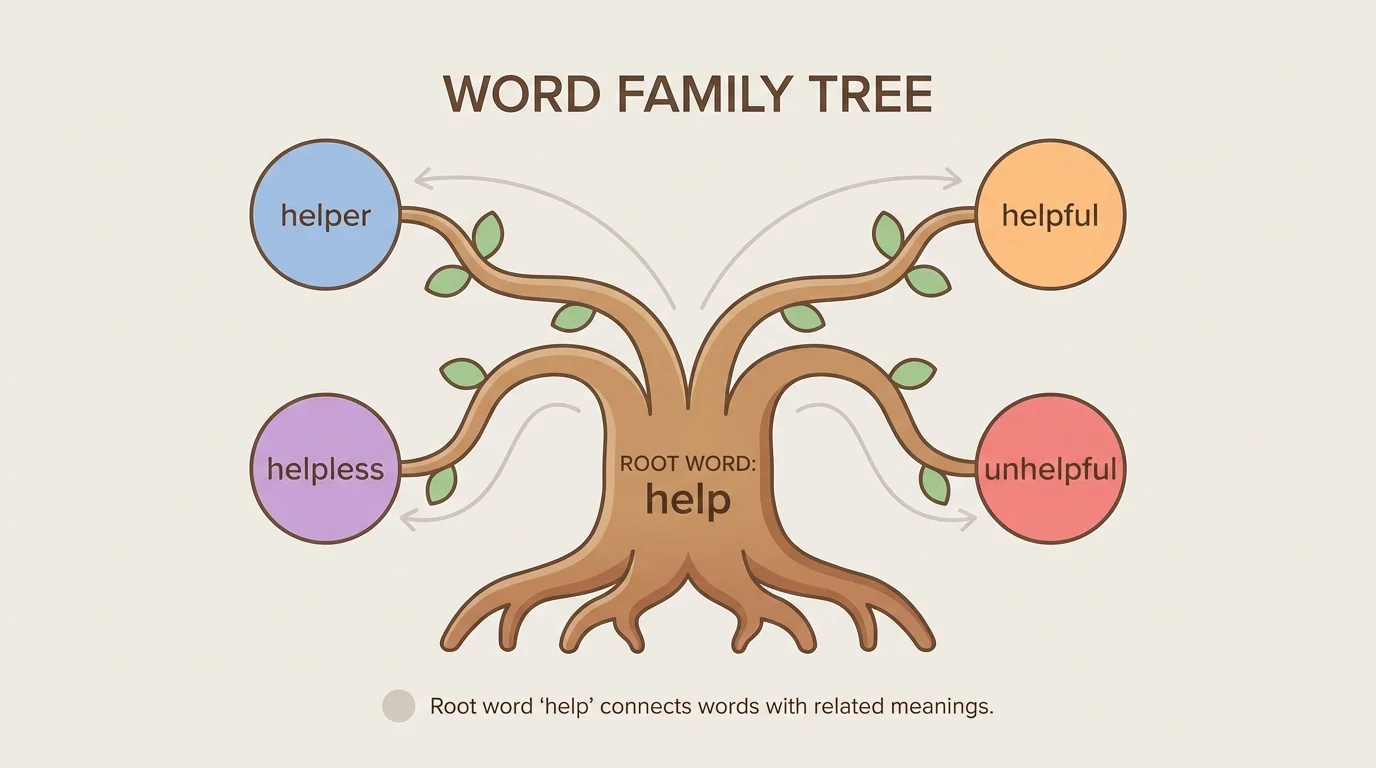
Many English words belong to a word family. A word family is a group of words that share a root or base and have related meanings. One word can help you understand another word, as [Figure 1] shows with words built from the same root. If you know the word help, you already have a clue to the words helper, helpful, and unhelpful.
These words are not identical, but they are connected. They all carry the idea of giving help or having something to do with help. When readers notice these connections, they can understand more words without stopping every time to ask someone or look in a dictionary.
Think about the word friend. If you know a friend is a person you like and trust, then the words friendly and friendship already make more sense. A friendly person acts like a friend. Friendship is the relationship between friends. The same root gives you a strong clue.
Root word is the main part of a word that carries its basic meaning. Prefix is a word part added to the beginning of a word. Suffix is a word part added to the end of a word.
When you know one word in a family, you can often use it to understand others. This does not mean you will know every word perfectly right away. It means you can make a smart guess and then check whether the rest of the sentence fits that guess.
A root word is the part of a word that holds its core meaning. It is like the trunk of a tree. Other word parts can grow from it, but the root still carries the main idea. In the words play, player, and playful, the root is play.
If you know what play means, you can get clues about the other words. A player is someone who plays. Playful describes someone or something full of play or fun. The meanings are related because the root stays the same.
Sometimes the root is a whole word you already know. Sometimes it is a word part inside a longer word. Either way, the root gives you a starting point. Good readers look for that starting point before they give up on an unfamiliar word.
You already know that sentences give clues about meaning. Root words are another clue. Strong readers use both kinds of clues together.
For example, if you read, "Mia was fearless as she climbed the tall rock," the word fearless may be new. But if you know fear, then the suffix -less suggests "without." A fearless person is without fear, or not afraid.
When you come to an unknown word, do not panic. You can follow a simple thinking process. First, look for a part you recognize. Next, think about the meaning of that known part. Then, notice any extra parts at the beginning or end. Finally, read the whole sentence again to see whether your idea makes sense.
A smart reading strategy is to break a longer word into meaningful parts. Ask yourself: "Do I know the root? Do I know a prefix or suffix? What is happening in the sentence?" Those clues work together.
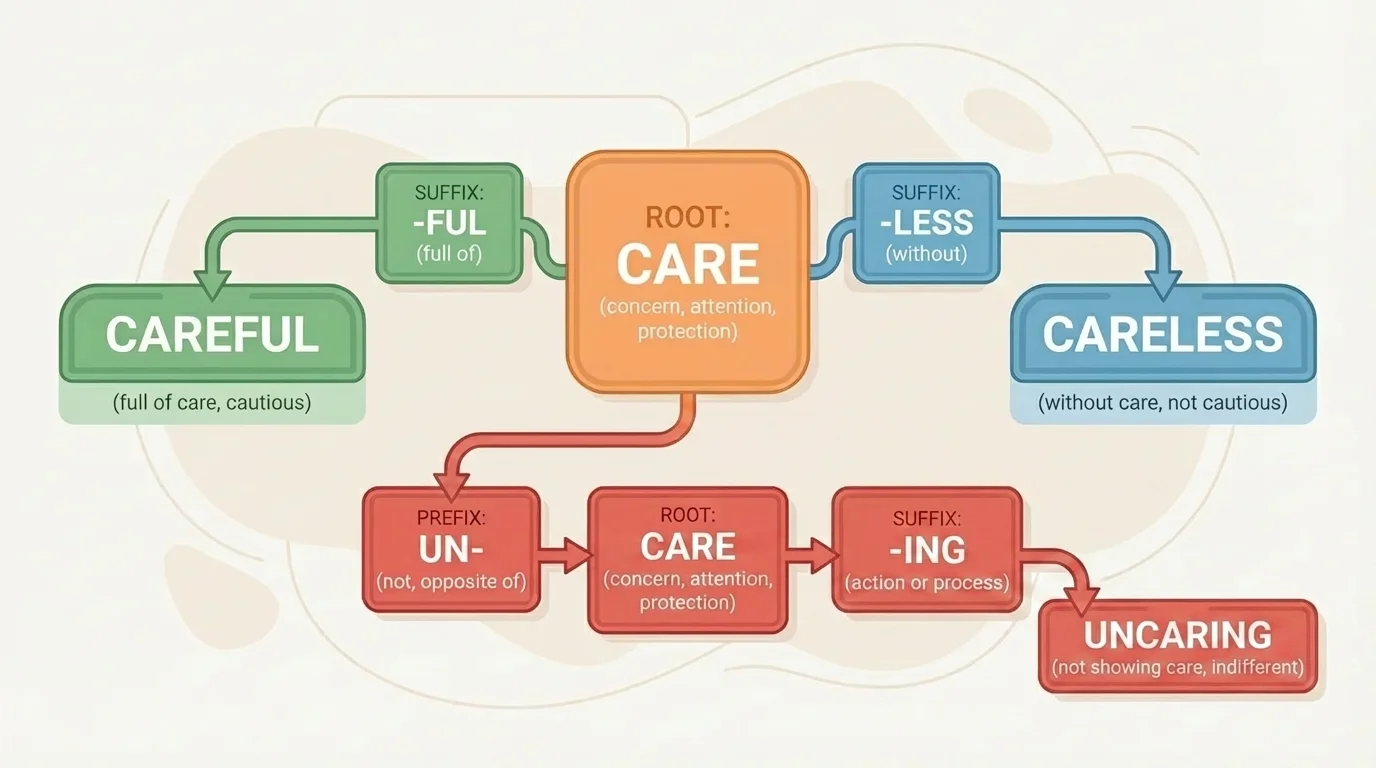
Suppose you know the word care, but you see the word careful. The root care gives the idea of paying attention or concern. The ending -ful often means "full of." So careful means full of care, or paying close attention.
Now suppose you see careless. You still know the root care, but the ending -less often means "without." That gives you the clue that careless means without enough care. This is why noticing the root and the other parts is so useful.
Words often grow by adding parts around the root, and [Figure 2] makes that pattern easy to see. A prefix can come before the root, and a suffix can come after it. These parts change the meaning, but the root still gives the main clue.
Look at these examples with the root care. In careful, the suffix changes the word into one that describes how someone acts. In careless, a different suffix changes the meaning in almost the opposite way. In uncaring, the prefix un- adds the idea of "not."
Knowing common prefixes and suffixes can help you use root words even better. Here are some helpful ones for grade-level reading.
| Word Part | Where It Goes | Usual Clue | Example |
|---|---|---|---|
| un- | Beginning | not | unhappy |
| re- | Beginning | again | replay |
| -er | End | person or thing that does something | teacher |
| -ful | End | full of | hopeful |
| -less | End | without | hopeless |
| -y | End | having a quality | windy |
Table 1. Common prefixes and suffixes that help readers use root words as clues.
These word parts do not work like magic every single time, but they are powerful clues. When you pair them with a root you know, your guess about the word becomes much stronger.
Now let us look at several root families. These examples show how one familiar word can unlock many others.
If you know act, you know it means to do something. Then your knowledge of morphology, the study of word parts and meaning, can help you see why action means something done and active describes someone who does things with energy. The root gives the idea of doing.
If you know help, then helper is someone who helps, and helpful describes something or someone that gives help. If you know joy, then joyful means full of joy. If you know dust, then dusty means covered with or full of dust.
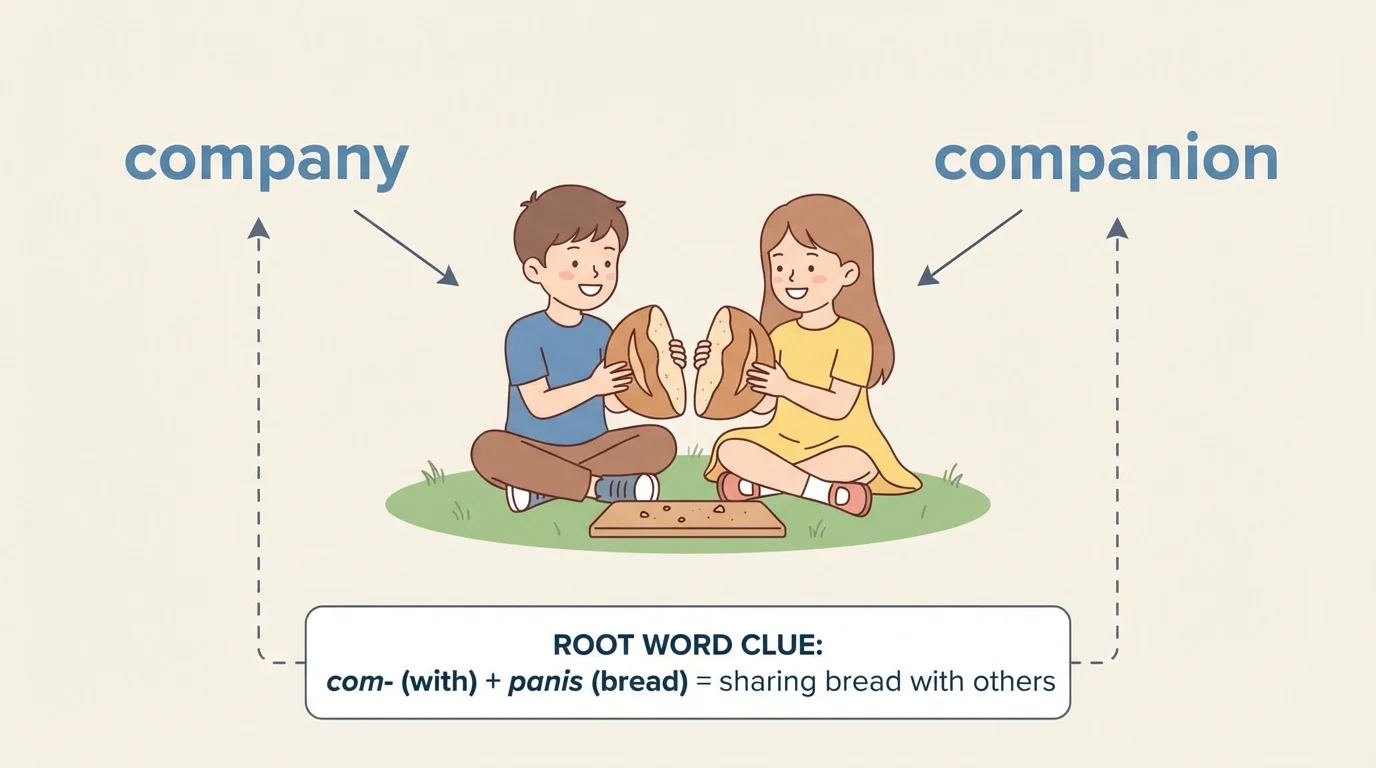
[Figure 3] One especially interesting pair is company and companion. The words are not used in exactly the same way, but they share an old root idea about being together. That shared meaning helps readers connect the words. Company can mean people being together or a business group. Companion means a person who goes with another person or spends time with them.
So if you know that company has to do with being with others, then companion becomes less mysterious. A companion is someone who is with you. The exact meanings are different, but the shared root idea still points you in the right direction.
Another root family comes from cycle, which means a circle or something that goes around. If you read the word bicycle, the root helps you know it has something to do with wheels, and the prefix bi- means two. If you read recycle, the prefix re- means again, so the word suggests using something again in a cycle.
Using a known root to unlock new words
Read each word and see how the known root gives a clue.
Step 1: Start with teach.
If you know teach, then teacher means a person who teaches.
Step 2: Start with read.
If you know read, then reader means a person who reads.
Step 3: Start with hope.
If you know hope, then hopeful means full of hope, while hopeless means without hope.
In each case, the root word gives the main meaning, and the added part changes it.
As you build your vocabulary, more and more words connect in your mind. That is one reason reading becomes easier over time. You are not learning every word separately. You are learning systems and patterns.
A root word clue is powerful, but readers should also use context. Context means the words and sentences around an unfamiliar word. Sometimes the root gives only part of the meaning, and the sentence helps you finish the job.
Read this sentence: "The kitten was playful and chased the string across the floor." If playful is new, the root play helps. The rest of the sentence tells even more. The kitten is chasing string, so playful must describe lively, fun behavior.
Now read this sentence: "The desert air was dusty, and sand covered our shoes." The root dust tells you part of the meaning. The rest of the sentence confirms it. Dusty means having a lot of dust.
Many very long words become less scary when you find a small part you already know. Skilled readers often spot familiar roots inside words almost automatically.
Using context protects you from making a wrong guess. For example, if you know company, you might think it always means a business. But in the sentence "I enjoyed my grandfather's company," the context shows that it means being with another person. The sentence matters.
Words with the same root often have related meanings, but they are not always exactly the same. This is important. A root is a clue, not always the whole answer.
Take the root sign. A sign can be a notice with words on it. But signal is not exactly the same thing. It is related because both involve giving information. The shared root points to communication, but each word has its own special use.
The same is true for company and companion. As we saw earlier in [Figure 3], the words connect through the idea of being together. Still, one word can name a group or a business, while the other names a person who goes with someone. Readers use the root to get close to the meaning, then use context to be more exact.
Root words give clues, not perfect answers. The job of a root is to point you toward meaning. Then the rest of the word and the sentence help you decide the exact meaning.
This is why flexible thinking matters. If your first guess does not fit the sentence, try again. Look again at the root. Look again at the added word parts. Look again at the whole sentence.
When readers use roots to figure out words, they become more independent. They do not have to stop every few seconds. They can keep reading and keep thinking. This helps in stories, science books, social studies texts, and even directions for games or projects.
Suppose you are reading about a careless mistake in a story, an active volcano in a science book, or a replay in sports news. If you know the roots care, act, and play, you already have strong clues. The more roots you know, the larger your vocabulary grows.
This skill also helps with spelling and writing. When you understand how words are built, you can choose stronger words and spell them more carefully. You begin to notice patterns. For example, words in the same family often keep the same root spelling, even when new parts are added.
"Big words are often built from smaller words you already know."
That idea can give you confidence. You do not need to know every word the first time you see it. You need strategies. Spot the root. Notice the other parts. Check the sentence. Then figure out the best meaning you can.
Over time, this strategy becomes faster. A word that once seemed hard begins to feel familiar because your brain notices the root right away. As you continue reading, your word knowledge keeps growing like branches on a tree, just as the word family in [Figure 1] shows.
