Have you ever told a friend, "I know it will rain," and then changed your mind and said, "I think it will rain"? Those two sentences are close, but they do not mean exactly the same thing. One sounds very sure. The other sounds less sure. Readers and writers need to notice these small differences because one word can change the whole meaning of a sentence.
Authors choose words carefully. When a character's state of mind is shown through words like knew, believed, or wondered, we learn what that character is thinking and how sure that character feels. These words help us understand people in stories, articles, and even everyday conversations.
If someone says, "Mia knew the answer," we understand that Mia was certain. If someone says, "Mia suspected the answer," we understand that she had an idea but was not fully sure. Good readers pay attention to these shades of meaning. Good writers use them on purpose.
Shades of meaning are small differences between related words. Two words may be close in meaning, but one may be stronger, weaker, happier, sadder, or more certain than the other.
Certainty means how sure someone is about something. Some words show strong certainty, while others show doubt or guessing.
These differences matter in fiction and nonfiction. In a mystery story, the detective may suspect a person first, then later know the truth. In a science article, a writer may say people believed something long ago, but now scientists know more because they have evidence.
A state of mind is the way a person is thinking or feeling at a moment. Some words describe feelings, such as worried or excited. Other words describe thinking, such as knew, believed, suspected, heard, and wondered. These thinking words tell us what is happening inside a person's mind.
When we read, we cannot look directly into a character's brain. We learn about thoughts through actions, dialogue, and word choice. If a story says, "Lena wondered whether the puppy was hungry," we know Lena is asking herself a question. If it says, "Lena knew the puppy was hungry," then the story tells us she is certain.
You already know that synonyms are words with similar meanings. This lesson goes one step further: synonyms are often not exact matches. Their small differences are important.
That is why readers should not treat all thinking words as the same. A careful reader notices whether a person knows, thinks, guesses, hears, or wonders. Those choices give clues about understanding, evidence, and confidence.
Many thinking words fit on a certainty scale. Some words tell us a person is very sure. Other words tell us a person is only a little sure or not sure at all. Learning this scale helps us compare shades of meaning.
One simple way to think about the scale is to move from strongest certainty to weakest certainty. The exact order can change a little depending on context, but a helpful order is: knew, believed, suspected, heard, and wondered.
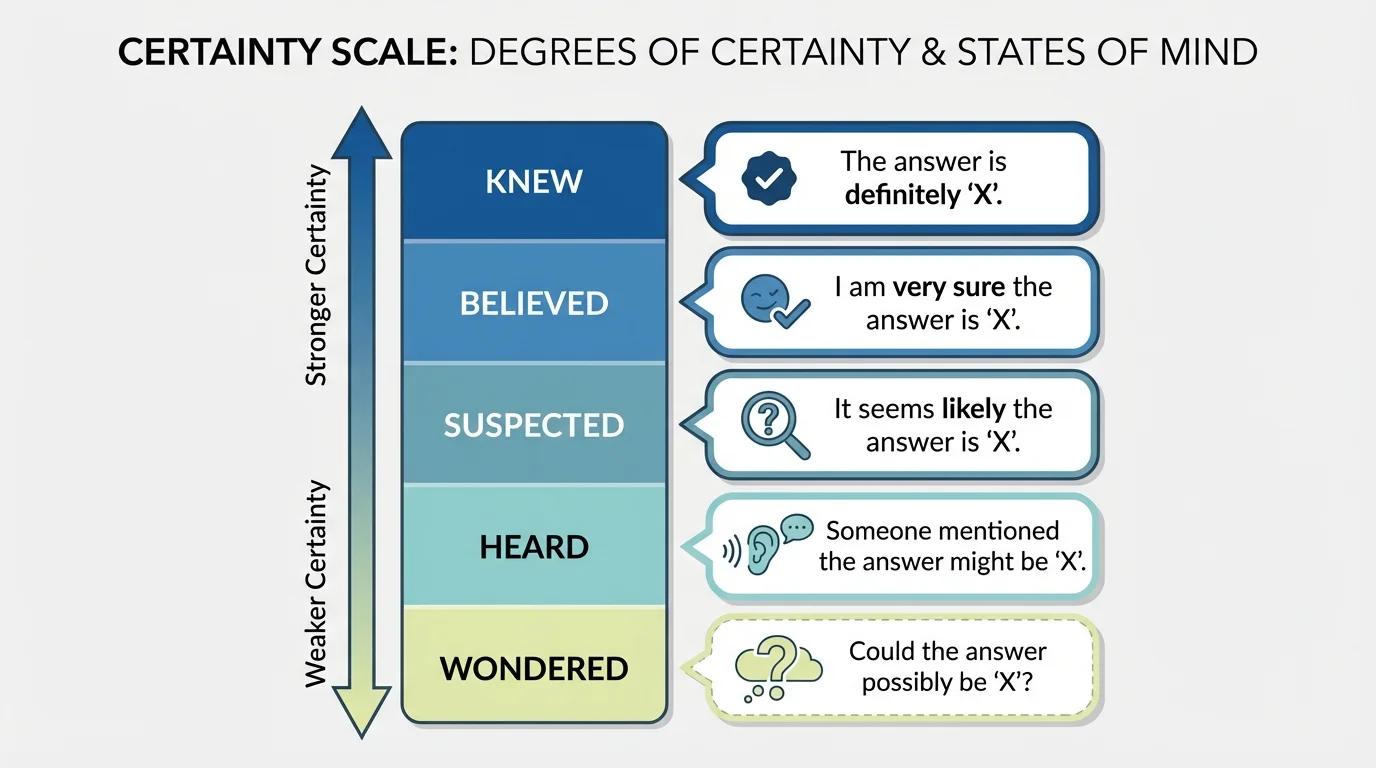
Knew usually shows the strongest certainty. A person is sure. Believed shows that a person thinks something is true, but may not have complete proof. Suspected shows a guess based on clues. Heard means a person got information from another source, but what was heard may or may not be true. Wondered shows a question in the mind, not certainty.
Think of these sentences: "Owen knew the bus was late." "Owen believed the bus was late." "Owen suspected the bus was late." "Owen heard the bus was late." "Owen wondered whether the bus was late." Each sentence gives a different picture of Owen's thinking.
[Figure 2] One event can be described very differently depending on the exact word chosen. Let's look closely at the words knew, believed, suspected, heard, and wondered.
Knew means being sure because of facts, experience, or direct proof. Example: "Tariq knew his shoes were by the door because he had put them there." This word feels strong and firm.
Believed means thinking something is true. A person may have reasons, but not complete proof. Example: "Tariq believed his shoes were by the door because they were usually there." This word is less certain than knew.
Suspected means thinking something might be true because of clues. Example: "Tariq suspected his little brother had moved the shoes because one sock was in the hallway." This word often appears in mysteries because detectives use clues.
Heard means learning something from another person or source. Example: "Tariq heard that the dog had carried one shoe outside." When you hear something, you have information, but it may not be confirmed yet.
Wondered means asking yourself a question or being curious. Example: "Tariq wondered where his shoes had gone." This word shows curiosity instead of certainty.
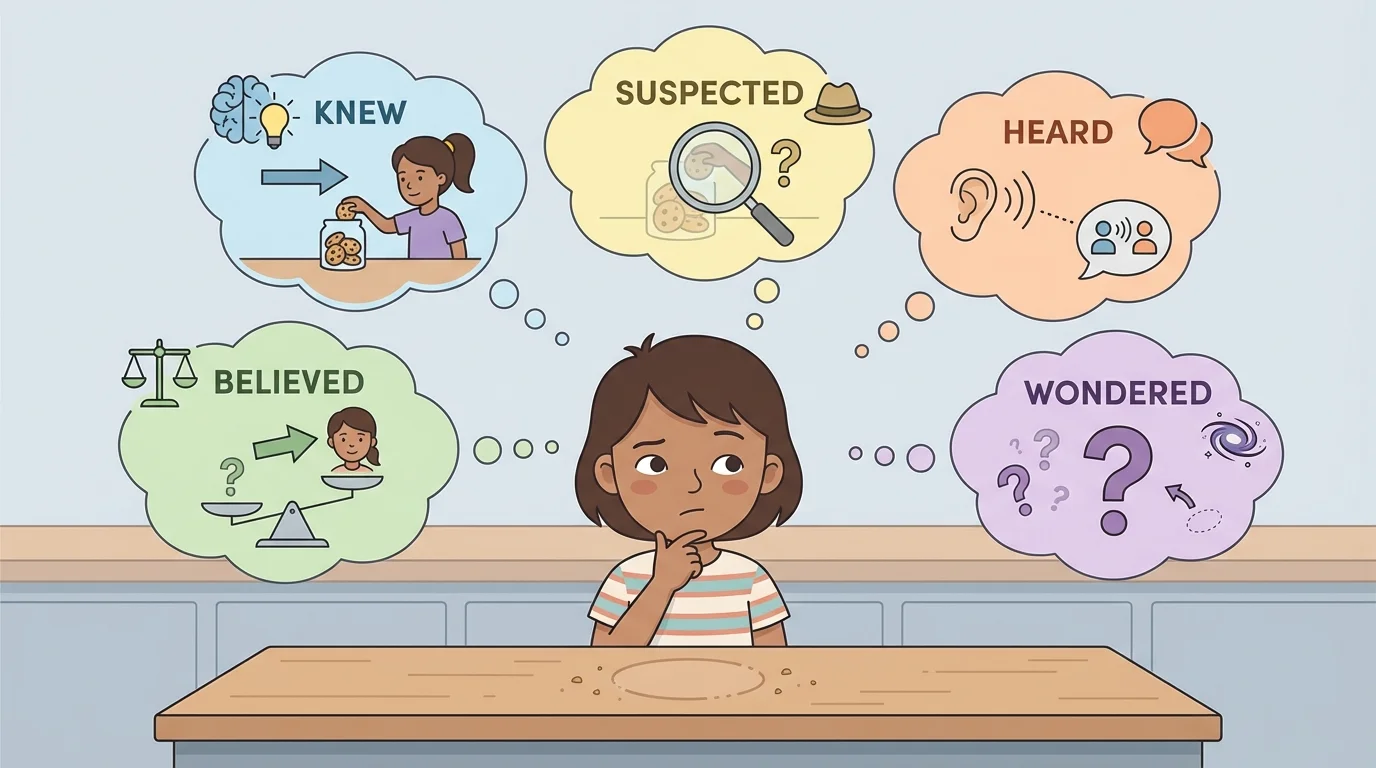
Comparing one situation with different words
Read how the meaning changes in each sentence about the same dog.
Step 1: Strong certainty
"Nora knew the dog was tired because it fell asleep on the rug." This sentence gives clear proof.
Step 2: Moderate certainty
"Nora believed the dog was tired because it yawned all morning." This sounds likely, but not completely certain.
Step 3: Clue-based guess
"Nora suspected the dog was tired because it walked slowly." This sounds like a guess based on clues.
Step 4: Information from others
"Nora heard the dog was tired from her brother." This tells where the information came from.
Step 5: Questioning
"Nora wondered whether the dog was tired." This shows she is thinking about it but does not know.
The event stays similar, but the writer's word choice changes the meaning.
Notice that these words do more than tell what someone thinks. They also tell how the person got the idea. Knew often connects to proof. Believed often connects to trust or opinion. Suspected often connects to clues. Heard connects to information from outside. Wondered connects to curiosity.
[Figure 3] Readers use context clues to decide which thinking word fits best. Context clues are the words and details around a sentence that help us understand meaning.
Read this example: "There were muddy paw prints on the floor, and the trash can was tipped over. Jalen suspected the raccoon had visited the porch." The clues are the paw prints and the tipped trash can. Jalen does not know for sure, but he has reasons to think it happened.
Now read this example: "Jalen watched the raccoon climb onto the porch. He knew the raccoon had visited." Here, Jalen saw it himself. The context gives direct proof, so knew fits better than suspected.
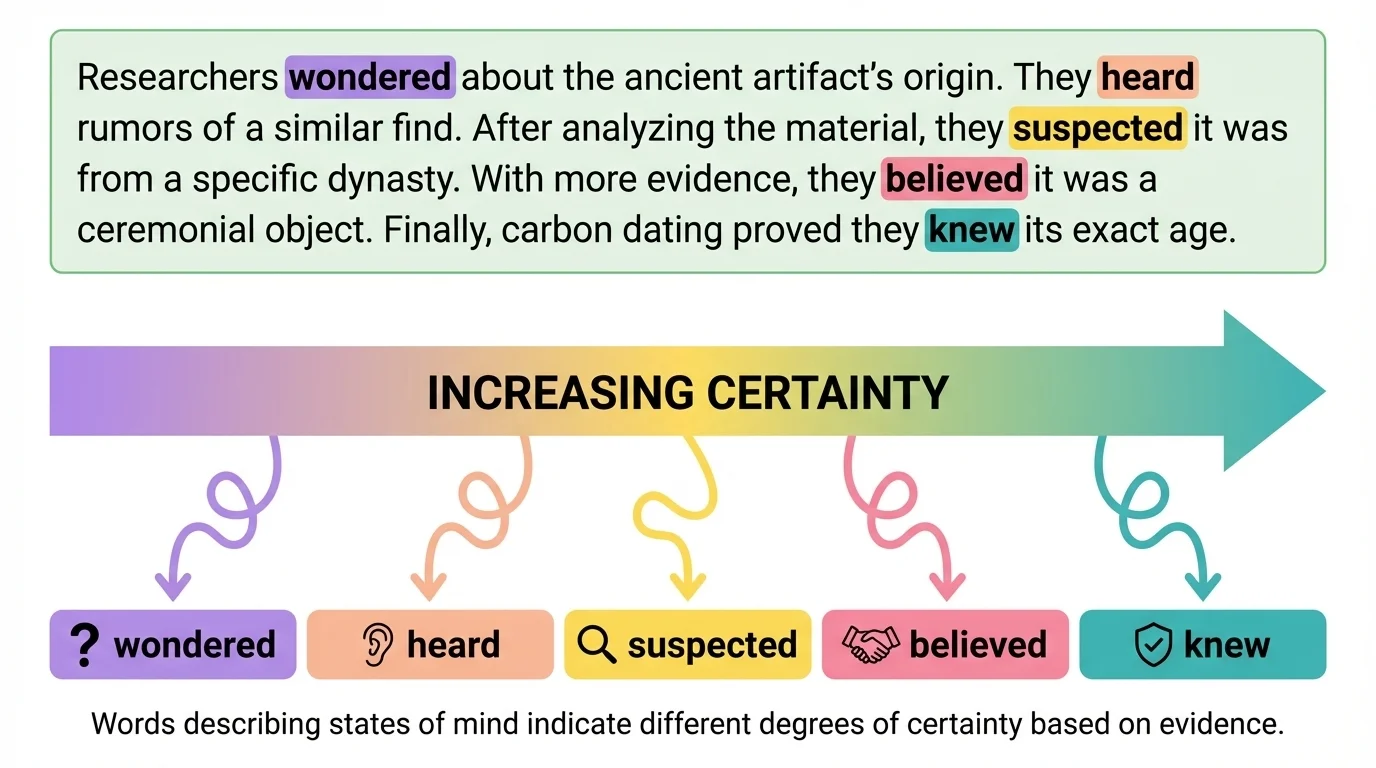
Context can also tell us if a word is weak or strong. In the sentence "Ava heard that school might close early," heard suggests the information came from someone else. Ava may not be sure it is true. But in "Ava knew school closed early because the principal announced it over the speaker," the context makes the certainty much stronger.
As shown earlier in [Figure 1], these words sit at different places on a certainty scale. Context helps show where on that scale a sentence belongs.
English has many related words for thinking. Some are close to the target words, but each has its own shade of meaning. For example, guessed often means making a choice with very little information. Supposed can mean thought or assumed. Realized means suddenly understood. Doubted means thought something might not be true.
| Word | What it usually means | How certain it sounds |
|---|---|---|
| knew | was sure because of proof or experience | very strong |
| believed | thought it was true | strong, but not complete |
| suspected | guessed from clues | medium |
| heard | got information from another source | depends on source |
| wondered | asked a question in the mind | not certain |
| guessed | chose without much information | weak |
| realized | finally understood | strong |
| doubted | thought something might be false | shows uncertainty |
Table 1. Comparison of related words that describe thinking and certainty.
These words are useful because they let writers be exact. Instead of using the plain word thought again and again, a writer can choose the word that matches the moment more clearly.
Mystery writers often choose words like suspected, doubted, and realized to control how much readers know. A single word can make a story feel more puzzling or more clear.
Small changes in word choice can also change how a character feels to the reader. A character who always wonders may seem curious. A character who often suspects others may seem cautious or suspicious. A character who knows things may seem confident.
Authors do not choose these words by accident. They choose them to shape meaning. If a story says, "Ella believed her friend would come," that tells us Ella has trust and hope. If the story says, "Ella knew her friend would come," that sounds firmer and more certain.
In informational writing, these differences matter too. An article might say, "Long ago, people believed the earth was flat." That sentence tells us what people thought in the past. It would mean something else to say they knew it, because knew suggests certainty based on proof.
When you read closely, pay attention to the author's choice. Ask, "Why this word and not another?" That question helps you understand characters, facts, and ideas more deeply.
One common mix-up is between heard and knew. If you hear something, you received information. That does not always mean the information is true. For example, "Mila heard that the carnival was canceled" is weaker than "Mila knew that the carnival was canceled."
Another mix-up is between believed and suspected. Believed often sounds more settled. Suspected often sounds more like a clue-based guess. A detective may suspect a thief before believing the thief is guilty.
A third mix-up is between wondered and asked. These are related, but not identical. If someone wondered, the question was in that person's mind. If someone asked, the person spoke or wrote the question.
How to tell words apart
Ask three questions: How sure is the person? Where did the idea come from? Is the person stating, guessing, hearing, or questioning? These questions help you choose the best word and understand an author's exact meaning.
When you compare words carefully, you become a stronger reader. You can notice whether a sentence shows proof, trust, rumor, clues, or curiosity.
Shades of meaning help in reading because they reveal what a character truly thinks. They also help in writing because they let you be precise. Instead of writing "Sam thought the storm was coming," you can choose a clearer word: "Sam knew," "Sam believed," "Sam suspected," "Sam heard," or "Sam wondered."
As we saw in [Figure 2], the same situation can be described in several ways, but each way tells the reader something different. That is why exact word choice matters so much.
Precise vocabulary also makes your writing sound stronger. It helps the reader understand the difference between proof and guesswork. It helps the reader understand whether a character is confident, unsure, curious, or doubtful.
When you notice these shades of meaning, you are doing more than learning vocabulary. You are learning to listen closely to language. That skill helps you in stories, articles, conversations, and all kinds of writing.
