Have you ever read a sentence, said a word out loud, and then suddenly thought, "Wait, that does not sound right"? That moment is not a sign of bad reading. It is actually something strong readers do all the time. Good readers pay attention to the words on the page, the meaning of the sentence, and the way the whole passage fits together. When something feels wrong, they stop and fix it.
Reading is more than saying words aloud. Reading means understanding ideas. Sometimes a reader comes to a hard word and makes a guess. That guess might be correct, or it might need to be changed. A skilled reader listens to the sentence in their mind and asks, "Does this word make sense here?"
When readers self-correct, they notice a mistake and repair it. They do not just keep going if the sentence sounds strange or confusing. They check their reading because understanding matters most.
For example, a student reads, "The boy carried the bag of groceries into the house." But the word on the page is actually "box." If the reader sees the picture of a cardboard box and notices that "bag" does not match the letters, the reader can stop and fix it. That is careful reading.
Context is the words, sentences, and ideas around a word that help a reader figure out what the word probably is and what it means.
Confirm means to check that your reading is correct.
Reread means to read a word, sentence, or passage again to understand it better or fix a mistake.
Strong readers do not depend on only one clue. They use letter clues, sound clues, and meaning clues together. That is why checking yourself is such an important reading habit.
When a word is tricky, the other words around it can help. The sentence itself gives clues, as [Figure 1] shows, because nearby words often point to the kind of word that belongs in that spot. These clues are called context clues.
Look at this sentence: "Mia wore boots and a raincoat because the weather was wet and stormy." If you were unsure about the word "raincoat," the rest of the sentence helps. The words "boots," "wet," and "stormy" tell you that this is something worn in rainy weather.
Context can help in different ways. Sometimes it tells what is happening. Sometimes it tells how a character feels. Sometimes it gives a definition or example right in the sentence. Sometimes it simply helps you notice that the word you said does not fit.
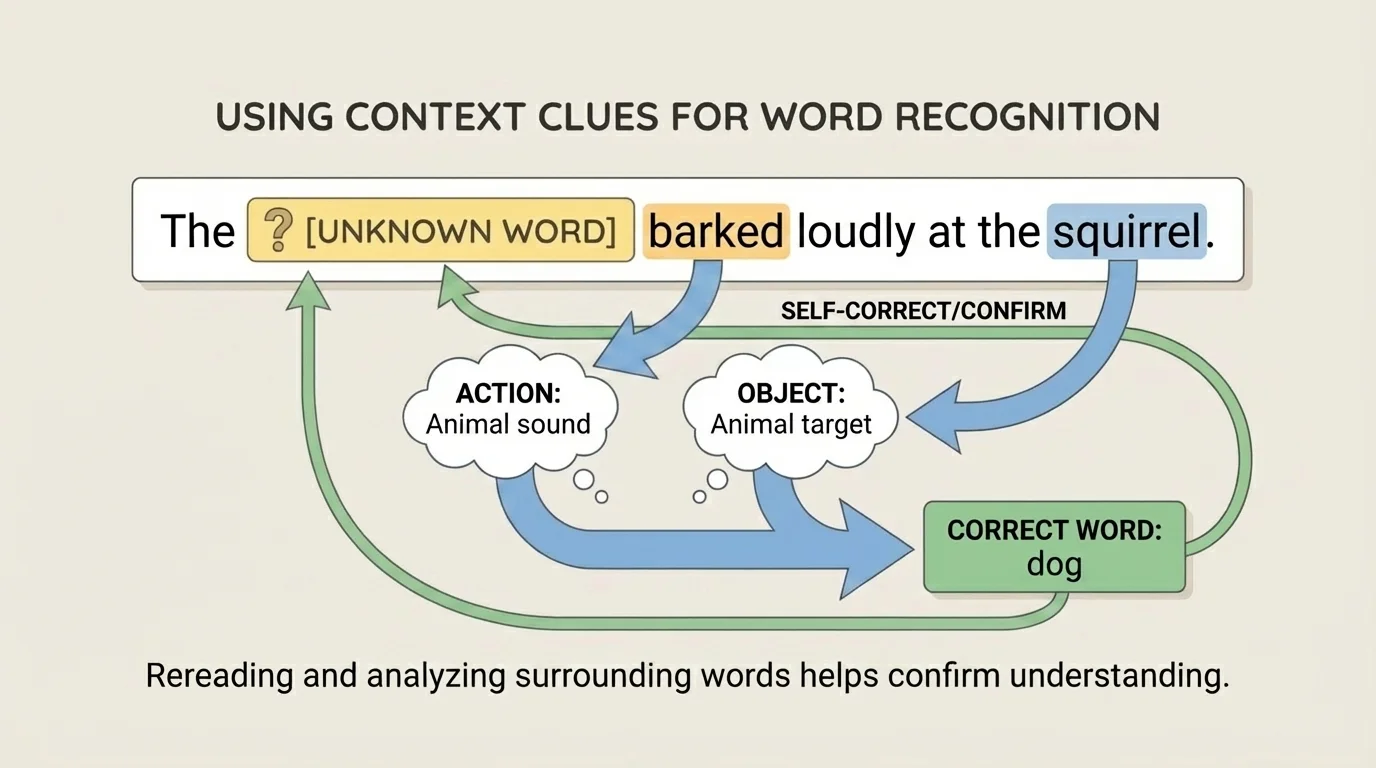
Here is another example: "The puppy was so tired that it curled up on the rug and slept for hours." If a reader says "jumped" instead of "curled," the sentence no longer makes sense. The idea of sleeping on the rug helps the reader know that "curled" fits better.
Context is useful, but readers must also look closely at the letters in the word. A word must make sense and match the print on the page. If a reader changes too much, the guess may sound good but still be wrong.
Skilled readers often correct mistakes so quickly that other people do not even notice. Their brains are checking print and meaning at the same time.
That is why context is a helper, not a replacement. It works best when readers use it with careful attention to the word itself.
When readers come to a new or difficult word, they can check three important things. Does it look right? Does it sound right? Does it make sense? These three questions help confirm whether a word is correct.
Looks right means the letters and spelling pattern match the word the reader said. If the printed word is "shouted," a reader should notice that it begins with "sh," not "ch."
Sounds right means the sentence sounds like normal language. For example, "She is running to the bus" sounds right, but "She is runned to the bus" does not sound right.
Makes sense means the word fits the meaning of the sentence and passage. In "The farmer fed the chickens," the word "fed" makes sense. The word "folded" would not make sense there, even though it begins with the same first letter.
Readers often use all three checks very quickly. Suppose a student reads, "The squirrel hid a nut under the leaves," but says "hill" instead of "hid." The word "hill" begins with the same letter, but it does not sound right in the sentence and it does not make sense. So the reader should go back and fix it.
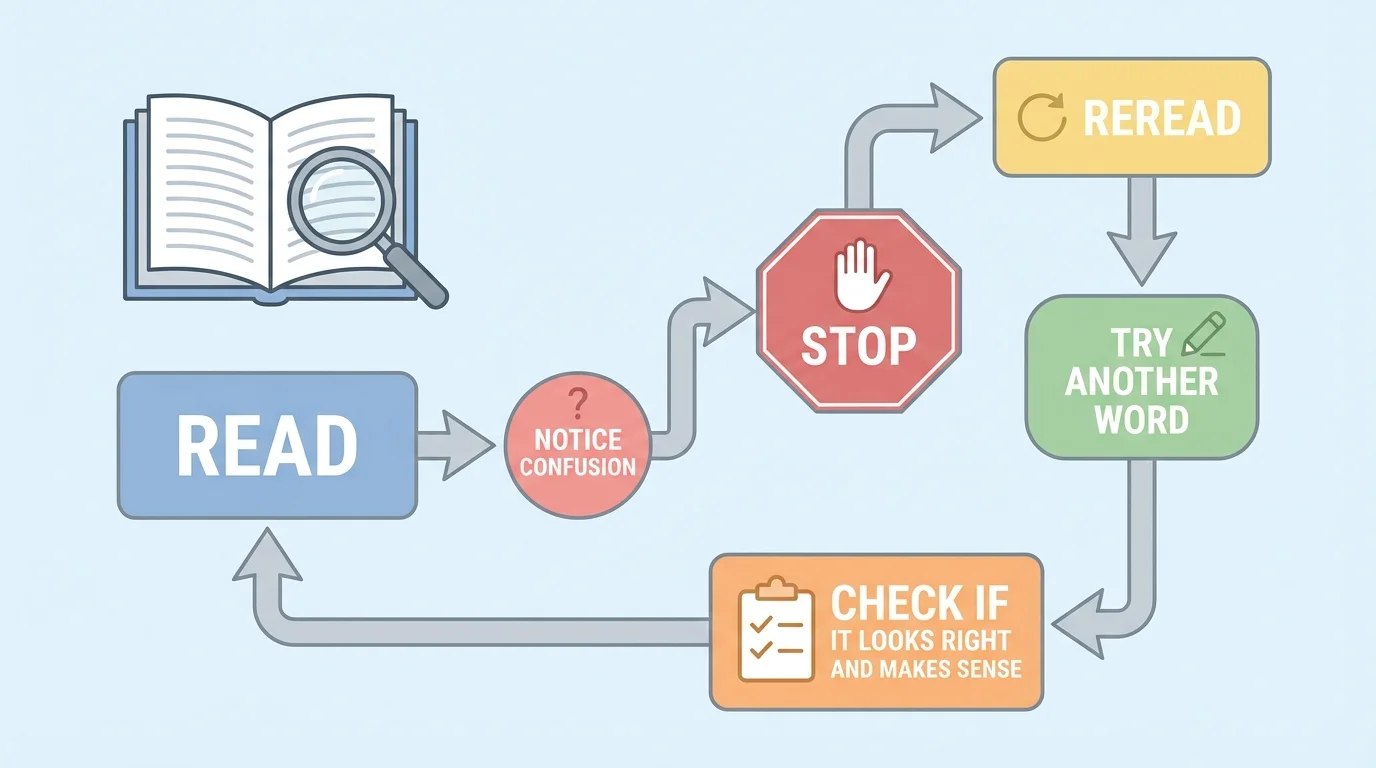
Sometimes a reader notices a problem right away. Other times, the confusion comes a little later. The repair process, shown in [Figure 2], helps readers stop, think, and try again when the reading does not fit the text.
A reader may notice that the sentence sounds odd. A reader may notice that the meaning suddenly becomes confusing. A reader may also notice that a word does not match the letters on the page. Any of these signs means it is time to slow down.
One important strategy is to stop at the problem word and look at it again. Another is to go back and reread the whole sentence from the beginning. Rereading is powerful because it lets the reader hear the sentence again and use fresh clues.
For example, a reader says, "The fox crept quietly through the forest," but reads "kept" instead of "crept." The sentence may still sound close, but looking again at the beginning letters and rereading the sentence helps the reader notice that "crept" fits the action better.
Another example is, "Grandpa planted tulip bulbs in the garden." If the reader says "built" for "bulbs," the sentence becomes confusing. Rereading helps the reader notice that something people plant in a garden is "bulbs," not "built."
Good readers do not feel upset when they need to reread. They know that rereading is part of reading well. Athletes watch plays again. Musicians practice parts again. Readers also go back and try again.
Self-correcting is a sign of strength. It shows that a reader is paying attention to meaning, spelling, and language. A reader who notices and fixes a mistake is doing deeper thinking than a reader who rushes past confusion.
Later, when reading longer stories or articles, this same habit becomes even more important. One wrong word can make an entire paragraph harder to understand, so correcting early helps comprehension stay strong.
Readers do not use context alone. They also use spelling patterns and word parts, as [Figure 3] illustrates, to figure out unfamiliar words more accurately. This is part of decoding, which means using what you know about letters and sounds to read words.
Spelling patterns can help readers recognize words quickly. If a student knows the pattern in "light," that can help with "night," "bright," and "fright." If a sentence says, "The moon was bright in the dark sky," the pattern and the context both support the word "bright."
Readers also use prefixes and suffixes. A prefix is added to the beginning of a word, and a suffix is added to the end. In the word "unhappy," the prefix "un-" means "not." In "careless," the suffix "-less" means "without."
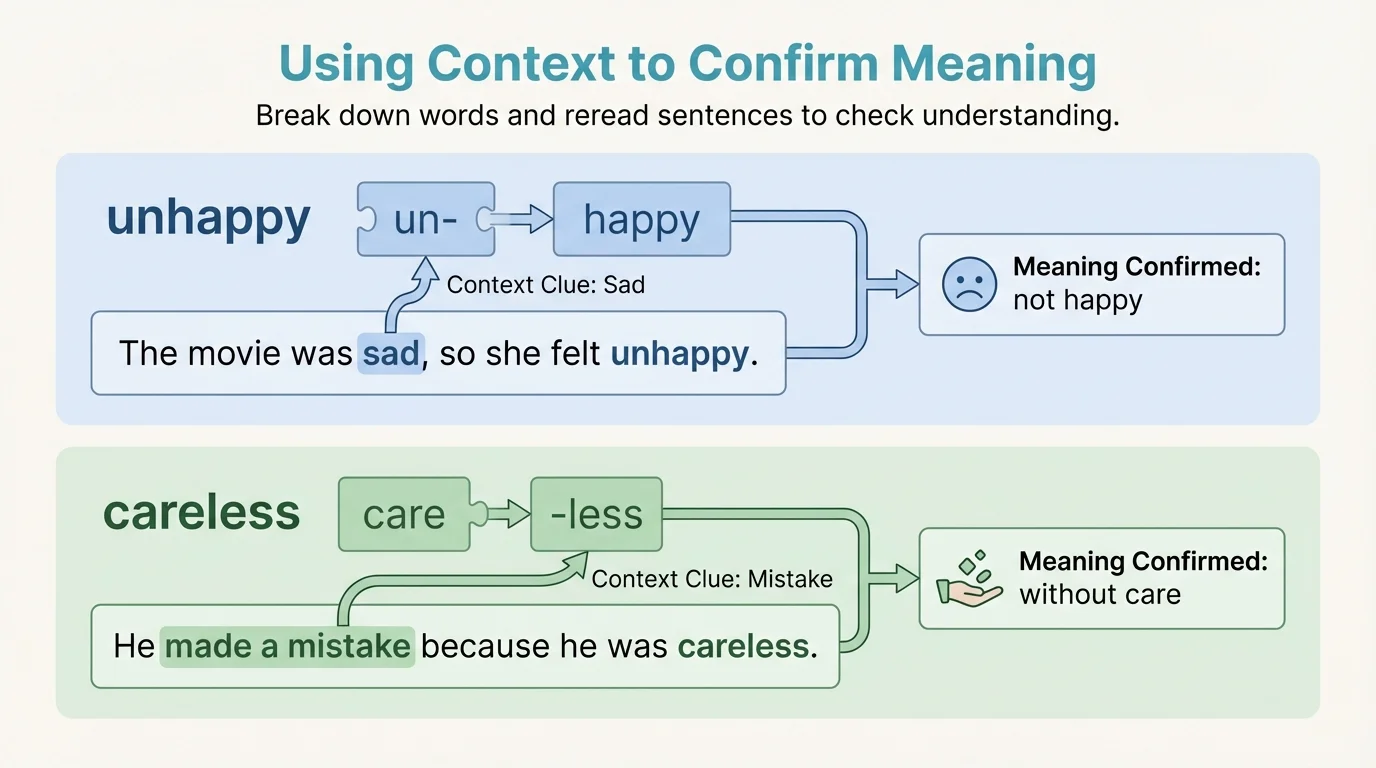
If a reader meets the sentence, "Lena felt unhappy when her kite tore," the word parts and the sad event in the sentence work together. The reader can figure out that "unhappy" means "not happy."
Word endings also help with grammar and meaning. For example, "jump," "jumped," and "jumping" all have related meanings, but the endings tell when or how the action happens. In "The rabbit hopped away," the ending "-ed" helps show that the action already happened. Checking the whole sentence helps readers choose the correct verb form. Checking the whole sentence helps readers choose the right form.
As we saw in [Figure 3], combining word parts with sentence clues is much stronger than using just one clue. Skilled readers gather evidence from the print and from the meaning around it.
You already know many common spelling patterns, such as short vowels, long vowels, blends, and digraphs. Those patterns still matter when you read longer words. The more patterns you recognize, the faster you can focus on meaning.
That is one reason vocabulary grows during reading. When readers notice parts like "re-," "un-," "-ful," or "-less," they can unlock the meanings of many new words.
Fluency means reading accurately, smoothly, and with expression. Fluency is not just reading fast. A fast reader who makes many mistakes may miss the meaning. A fluent reader reads in a way that supports understanding.
Accurate word recognition helps fluency. When readers can figure out words and self-correct quickly, they can keep the meaning of the story or article in mind. If too many words are wrong, comprehension breaks apart.
Think about listening to a song with missing notes. It would be hard to follow. Reading works in a similar way. If many words are guessed incorrectly, the sentence becomes bumpy and confusing. When the words are read accurately, the meaning flows.
Expression also helps. If a sentence is a question, the voice usually rises at the end. If a character is excited, the reading sounds lively. Paying attention to punctuation and meaning makes reading sound natural, and natural-sounding reading often helps readers notice mistakes sooner.
Now let us look at some longer examples of confirming and fixing words while reading.
Example 1: Fixing a word that does not make sense
Sentence: "The rabbit nibbled a carrot in the garden." A reader says, "The rabbit needed a carrot in the garden."
Step 1: Check whether it makes sense.
"Needed a carrot" could make some sense, but it is not the best match for what rabbits do in a garden.
Step 2: Check the letters.
The printed word begins with "nib-," not "nee-."
Step 3: Reread the sentence.
When the sentence is read again, "nibbled" fits both the letters and the meaning because rabbits eat carrots.
The corrected reading is nibbled.
This kind of correction shows the reader is using meaning and print together. That is exactly what skilled readers do.
Example 2: Fixing a word that sounds wrong
Sentence: "She ran quickly across the playground." A reader says, "She run quickly across the playground."
Step 1: Listen to the sentence.
"She run quickly" does not sound like correct spoken language.
Step 2: Look again at the word.
The printed word is "ran."
Step 3: Read the full sentence again.
"She ran quickly across the playground" sounds right and makes sense.
The corrected reading is ran.
Sometimes sounding right is the clue that helps first. Other times meaning helps first. Strong readers are ready to use both.
Example 3: Using context and word parts together
Sentence: "The careless painter spilled blue paint on the floor."
Step 1: Notice the word part.
The suffix "-less" means "without."
Step 2: Think about the base word.
"Care" is about being careful.
Step 3: Use context.
If the painter spilled paint, the sentence suggests the painter was not careful.
The word careless means not careful.
As with the sentence clues we saw earlier in [Figure 1], surrounding words often help readers choose between possible words and understand what a word means.
Rereading is especially helpful when a sentence suddenly becomes confusing, when a character's action seems strange, when new information does not fit with earlier information, or when a word looks familiar but does not quite work.
Suppose a passage says, "The desert was dry, hot, and almost empty of water." If a reader says "dense" instead of "desert," the next words do not match. Rereading helps the reader notice that "dry" and "hot" fit "desert," not "dense."
Rereading can also help with longer sentences. Sometimes a reader says all the words correctly but still feels unsure of the meaning. Reading the sentence again more slowly can make the meaning clear.
This is also true in nonfiction. In a science book, for example, one key word can change the whole idea. If a reader misunderstands the word, the explanation may stop making sense. Going back and checking the text helps the reader stay accurate.
"Good readers do not just read the words. They think about whether the words make sense."
That habit matters in every subject. Whether reading a story, directions for a game, or facts about animals, readers need the words to connect into meaning.
Readers become stronger by practicing several habits together. They pay attention to letters and spelling patterns. They listen to whether the sentence sounds right. They think about whether the meaning fits. They reread when needed. They correct mistakes instead of ignoring them.
Over time, these habits become more automatic. A reader begins to notice problems quickly and fix them smoothly. That helps the reader stay focused on ideas, characters, facts, and details instead of getting stuck.
When you read carefully, you are doing detective work. You gather clues from the word, the sentence, and the whole passage. Then you test your idea. If it does not fit, you try again. That is how reading grows stronger.
And when reading becomes more accurate and fluent, understanding grows too. The goal is not just to say words aloud. The goal is to make meaning from text.
