Have you ever been in a group where one person says something interesting, then another person suddenly talks about lunch, and then someone else forgets the question? A discussion can feel like a train going off the tracks. Good discussion skills help keep the train moving in the right direction. When you ask helpful questions, stay on topic, and connect your ideas to what others say, everyone understands more.
Talking and listening are not just things we do all day. They are also important learning tools. In school, you talk about stories, science experiments, class rules, and problem-solving. A strong discussion is not just about saying your own idea. It is also about listening carefully, thinking about what you heard, and responding in a way that helps the group.
When students work together well, they learn more than they could alone. One person may notice an important detail. Another may ask a smart question. A third may explain an idea more clearly. Group talk becomes powerful when each person helps the discussion grow.
A discussion is a shared conversation. People take turns speaking and listening. In a classroom discussion, students talk about a topic, text, question, or task. The goal is not to talk the most. The goal is to help everyone think and learn.
Sometimes you may understand right away. Other times, you may feel confused. That is normal. Good learners do not pretend to understand when they do not. They ask questions. They listen again. They make connections. These habits help you become a better speaker and a better listener.
Discussion is a shared conversation about one topic. Topic is the main subject being talked about. Remark is something a person says in the discussion. To check understanding means to ask or say something that helps make the meaning clearer.
When you discuss a story, for example, you might talk about a character's actions. When you discuss science, you might talk about what happened in an experiment. In both cases, your words should connect to the main idea being studied.
To check understanding means you make sure you really know what another person means. You may do this when a classmate explains an answer, when a teacher gives directions, or when a partner shares an opinion.
You can check understanding by asking questions such as, "Can you explain that again?" "What do you mean by that?" or "Are you saying that the character was nervous?" These questions are helpful because they do not stop the discussion. They improve it.
Checking understanding is different from guessing. If you guess, you may miss the point. If you ask a question, you show that you care about understanding correctly. That is a strong learning habit.
Checking understanding helps everyone. When one student asks a clear question, other students often realize they were wondering the same thing. A single question can help the whole group understand better. It can also help the speaker explain their idea more clearly.
For example, if a student says, "The animal adapted," you might not know what they mean. You could ask, "What change helped the animal survive?" That question invites the speaker to explain instead of giving only a short answer.
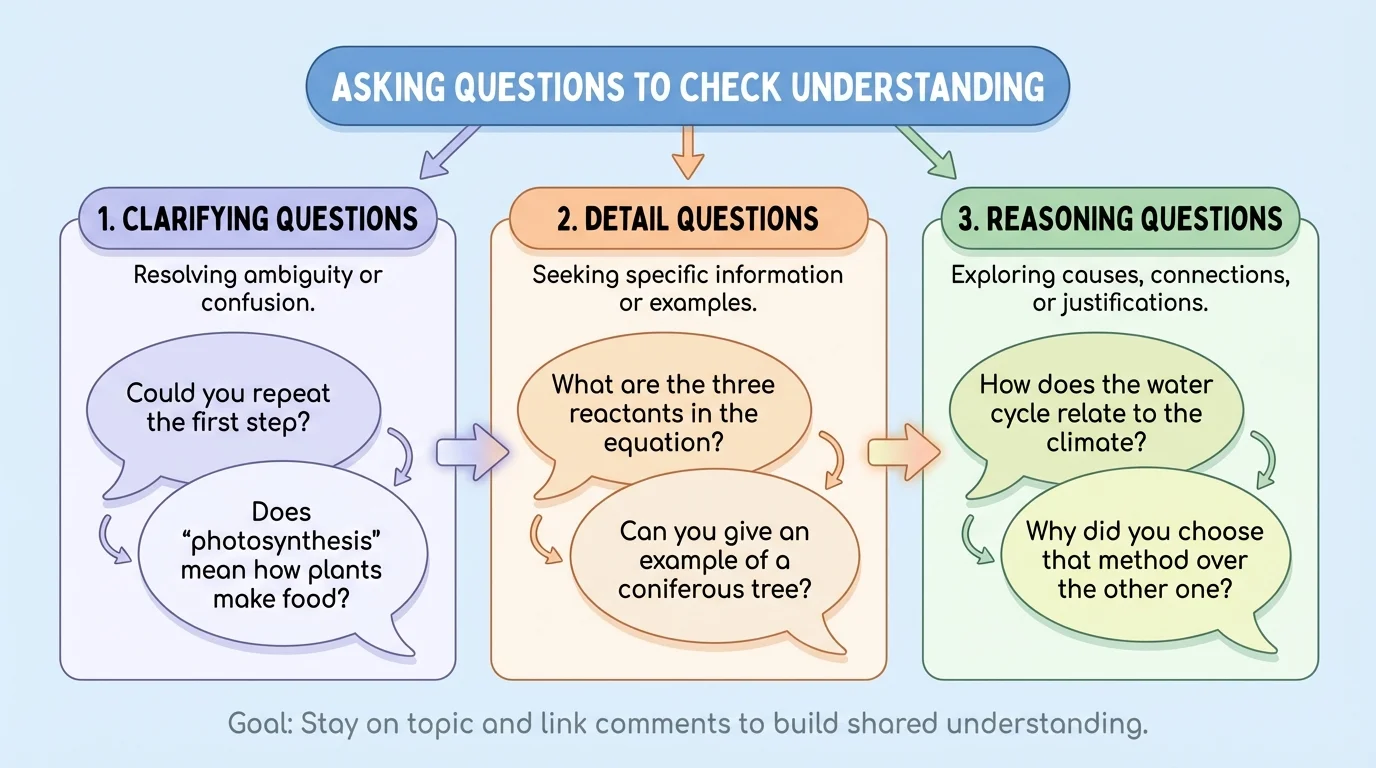
Not all questions do the same job. Some questions help you understand a word or idea. Some help you learn more details. Some help the group think more deeply. The question groups in [Figure 1] help show how different questions can support a discussion in different ways.
One kind of question is a clarifying question. A clarifying question helps make meaning clearer. You might ask, "What does that word mean?" or "Can you say that in a different way?"
Another kind is a detail question. A detail question asks for more information. You might say, "Which part of the story shows that?" or "What happened before that?" A third kind is a reasoning question. This asks why someone thinks something. You might ask, "Why do you think the plant wilted?" or "What makes you say that?"
Helpful questions are polite and connected to the discussion. They sound respectful. They are not meant to trick or embarrass someone. They are meant to learn.
You can also check understanding by repeating part of what someone said and asking if you understood. For example: "So, are you saying the main character changed at the end?" This shows careful listening. It also gives the speaker a chance to say yes or to explain more.
Many strong readers are also strong question-askers. Asking the right question while listening can help your brain remember ideas better.
Later in a discussion, the question types from [Figure 1] can still help you decide what to ask next. If something is confusing, ask a clarifying question. If something is interesting, ask for more detail. If you want deeper thinking, ask for a reason.
Staying on topic means your words match the subject the group is discussing. If the class is talking about weather, your comment should be about weather, not about your favorite snack. The comparison in [Figure 2] shows how on-topic comments connect like links in a chain.
One way to stay on topic is to listen for the main idea. Ask yourself, "What are we talking about right now?" Then think, "Does my comment fit that idea?" If the answer is yes, your comment is probably on topic.
Another way is to use words from the discussion. If your class is talking about penguins, you might say, "I learned that penguins huddle to stay warm," or "I have a question about how penguins care for eggs." These comments clearly connect to the subject.
Off-topic comments can confuse the group. They can also waste time. Sometimes students go off topic because a new thought pops into their minds. That happens to everyone. A good discussion partner notices it and saves that thought for later if it does not fit the current subject.
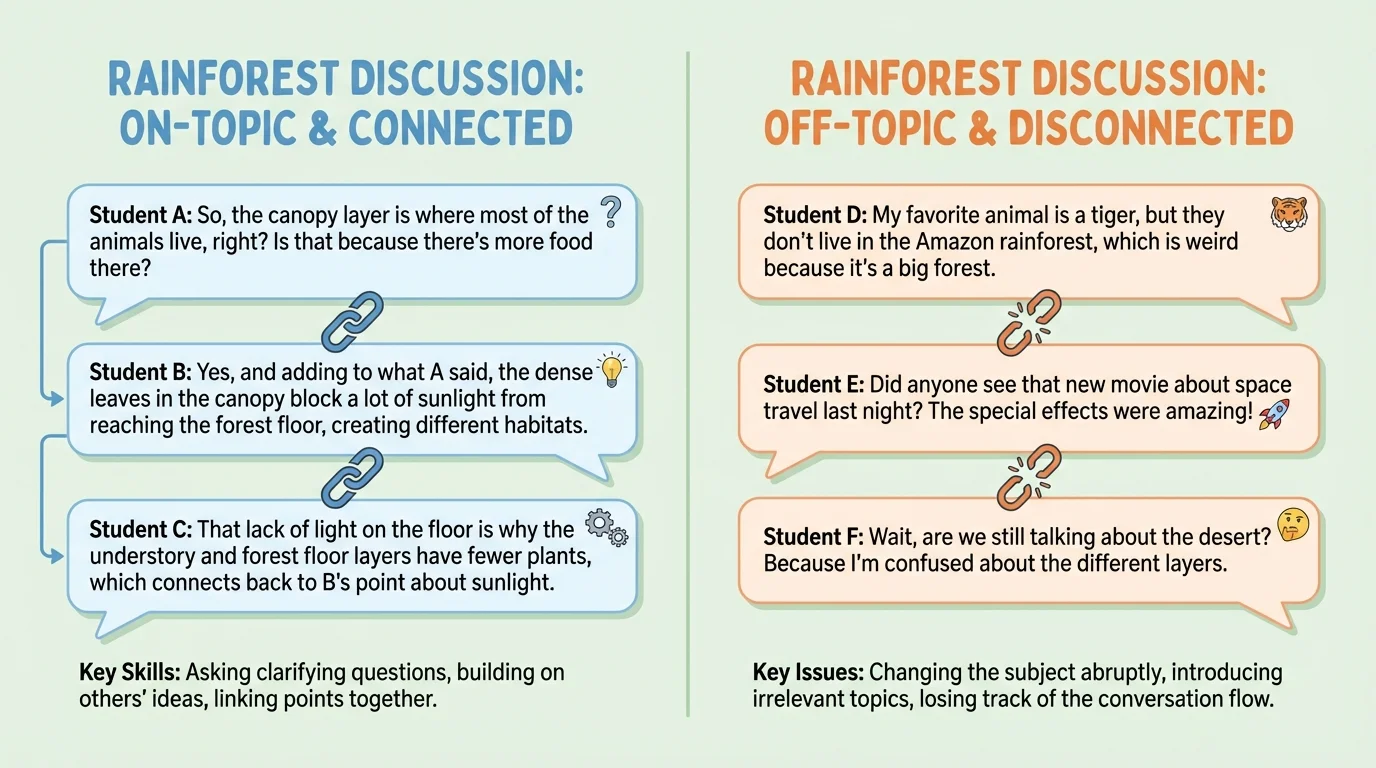
Suppose the class is discussing a book about a lost dog. An on-topic comment might be, "I think the dog followed the smell of food." An off-topic comment might be, "My cousin has a red bike." The second sentence may be true, but it does not belong in that discussion.
As you continue speaking, use the idea from [Figure 2] to check your own words. Before you share, quickly ask yourself whether your sentence adds to the same subject or pulls the group away from it.
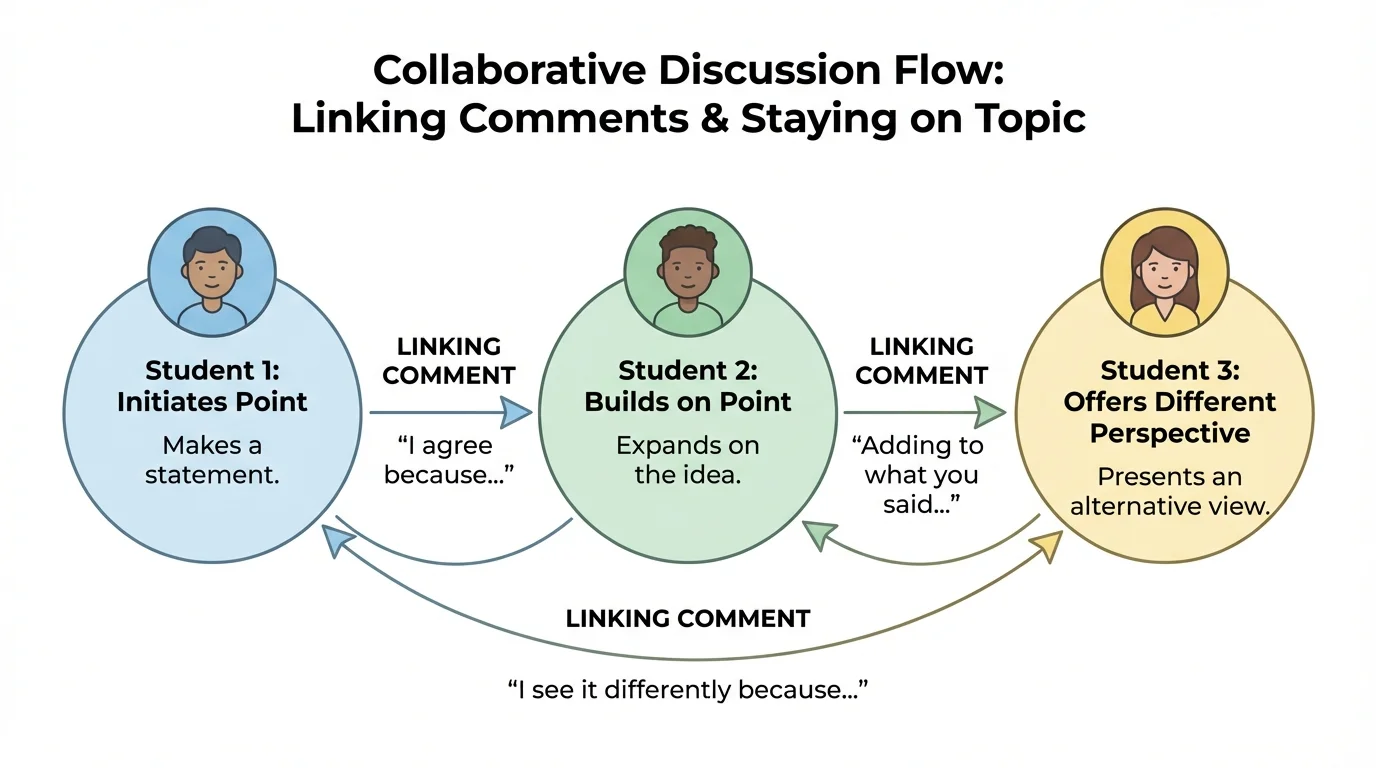
[Figure 3] A strong discussion is not a group of separate speeches. It is a connected conversation. When you build on what another person says, you help the group think together.
To link your idea to someone else's remark, first listen carefully. Then begin with words that show the connection. You might say, "I agree with Maya because...," "I want to add to what Leo said...," or "I have a different idea from Ana..." These sentence starters help listeners hear the link.
You can agree, add on, ask a question, or politely disagree. The important thing is that your comment connects to what came before it. If someone says, "The rabbit hid because it was scared," you might respond, "I agree because the story says its ears were flat." That response is linked to the first remark and gives evidence too. Figure 3 shows how one remark can lead to another in a meaningful way.
Here are some useful sentence starters for linking ideas:
| Purpose | Sentence starter |
|---|---|
| Agree | I agree with ___ because ... |
| Add on | I want to add that ... |
| Ask for more | Can you explain more about ...? |
| Give a different idea | I see it differently because ... |
| Connect two ideas | That reminds me of what ___ said about ... |
Table 1. Sentence starters students can use to connect their comments to others' remarks.
Using these starters does not make your speaking sound boring. It makes your thinking easier to follow. Listeners can tell exactly how your idea fits into the discussion.
Example: Building on a classmate's idea
Topic: Why did the boy in the story stop running?
Step 1: Listen to the first remark.
A classmate says, "I think he stopped because he was tired."
Step 2: Choose how to connect.
You decide to add on.
Step 3: Use a sentence starter.
You say, "I want to add to what Jamal said. I think he was tired, and I also think he was worried about getting lost."
This response stays connected to the first idea and helps the discussion grow.
Later, when a discussion becomes more complex, [Figure 3] still helps remind you that each speaker can connect their thought to the one before it instead of starting a brand-new topic.
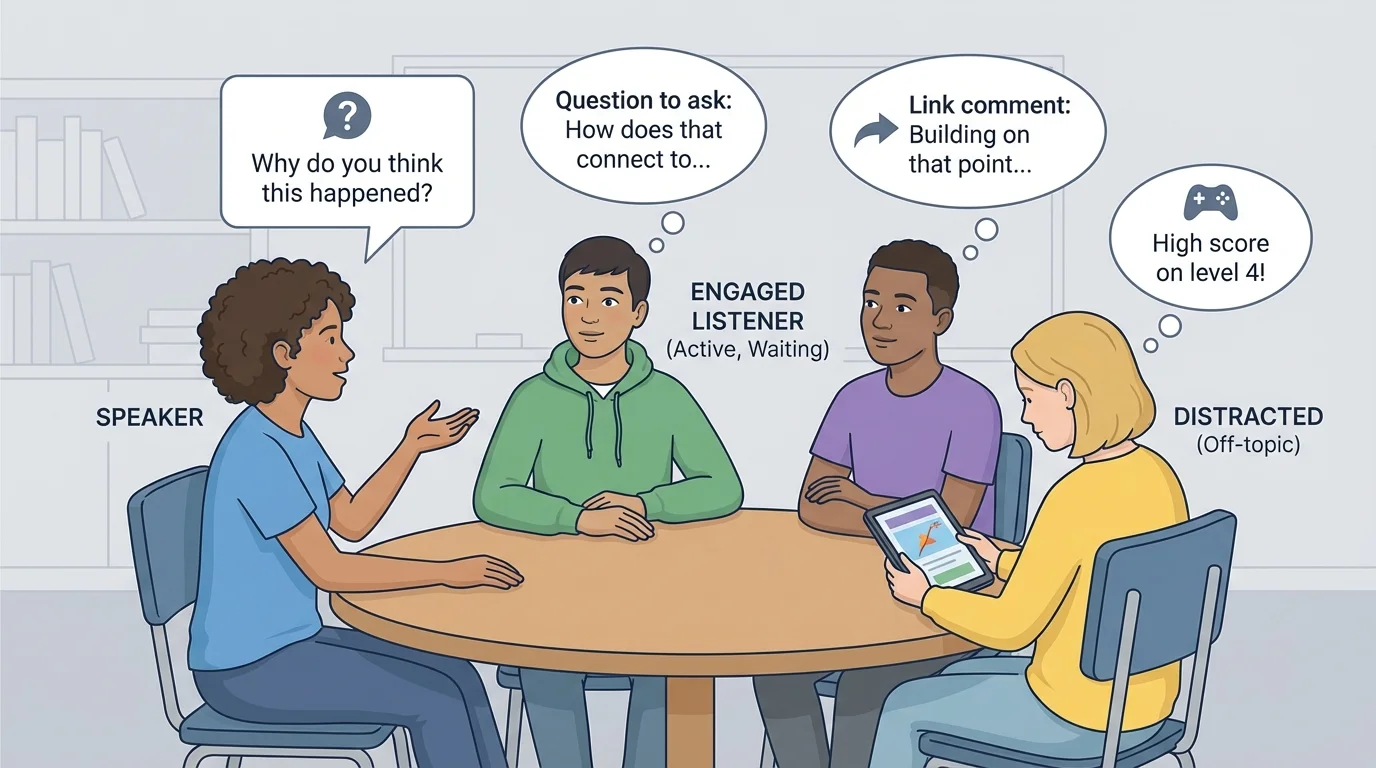
Good discussions depend on active listening. Active listening means you listen with your whole attention. You face the speaker, keep your body calm, and think about the meaning of the words. The group scene in [Figure 4] shows several signs of this kind of listening.
Listening is not just being quiet. A person can be quiet and still not listen. Active listening means your mind is engaged. You are ready to ask a question, respond to an idea, or explain what you heard.
Some signs of active listening are looking at the speaker, nodding when you understand, waiting for your turn, and not interrupting. You may also take a moment to think before answering. That shows care, not slowness.
If you are thinking about your own answer while someone else is still talking, you may miss an important detail. That is why listening comes first. Then speaking comes next.
The behaviors in [Figure 4] help discussions feel respectful and safe. When students know they will be heard, they are more willing to share their ideas.
Remember that taking turns is part of cooperation. In partner talk, small groups, and whole-class conversations, each person needs a chance to speak and a chance to listen.
Listening also helps you stay on topic. If you miss what someone said, your answer may not match the discussion. Careful listening makes better speaking possible.
Speaking clearly means using a voice others can hear, saying your idea in complete thoughts, and choosing words that fit the discussion. You do not need the longest answer. A short, clear answer is often stronger than a long, confusing one.
Respectful speaking means treating others kindly, even when you disagree. You can disagree without being rude. Instead of saying, "That's wrong," you can say, "I see it differently because..." or "I understood that part differently."
Respect also means not interrupting. If someone is speaking, wait. If two people begin at once, one person can pause and let the other go first. This small action helps the whole group work better.
"Listen carefully, speak kindly, and connect your ideas."
Teacher-led discussions, partner talks, and group work may feel a little different, but the same habits matter in all of them. Ask helpful questions. Stay on topic. Build on others' ideas. Speak so people can follow your thinking.
These skills matter in many school situations. During a read-aloud, you may ask, "What clue shows the character is nervous?" In science, you may say, "I want to add to Mia's idea. The ice melted faster in the sun." In social studies, you may ask, "Can you explain why the people moved there?"
During group projects, discussion skills help students share jobs and solve problems. If one student says, "Let's make a poster," another might respond, "I agree, and I think we should add labels." That builds the plan together. If someone gets confused, a teammate might ask, "Can you say which part I should draw?" That checks understanding.
Example: Staying on topic in science
Topic: What plants need to grow.
Step 1: A classmate says, "Plants need sunlight."
Step 2: You connect your idea.
"I want to add that plants also need water."
Step 3: You ask a question to learn more.
"Do all plants need the same amount of sunlight?"
Each part of the discussion stays on the same topic and helps the group learn more.
At recess, on a team, or while planning a class game, these same habits still help. People work together better when they listen, connect ideas, and keep the conversation focused.
Sometimes discussions do not go smoothly. A student may repeat the same idea many times. Another may jump to a new topic. Someone else may stay silent because they are unsure what to say. These problems can be fixed with discussion habits.
If you do not understand, ask a question. If you are drifting off topic, listen again and reconnect. If you want to join in, use a sentence starter. If you disagree, use respectful words. If the group is confused, someone can restate the main idea.
| Problem | Smart fix |
|---|---|
| I do not understand. | Ask a clarifying question. |
| My idea may be off topic. | Check the subject before speaking. |
| I want to respond to someone. | Use a sentence starter to link your idea. |
| I disagree. | Speak respectfully and give a reason. |
| I have nothing to say yet. | Listen for a detail you can ask about or add to. |
No one is perfect in discussions. Everyone forgets, gets distracted, or feels unsure sometimes. What matters is learning the habits that help you return to the conversation in a useful way.
A strong discussion partner is curious, respectful, and focused. This person listens closely, asks helpful questions, stays with the topic, and connects ideas to what others say. These are skills you can build every day.
When you walk into a class discussion, think of yourself as part of a team. Your job is not only to share your own thinking. Your job is also to help the group understand, learn, and move the conversation forward.
If you remember just a few habits, start here: listen first, think next, then speak clearly. Ask when you are unsure. Stay with the topic. Connect your remark to someone else's remark. These habits turn simple talk into real learning.
