Have you ever heard someone tell a story that jumped all over the place? Maybe they said the ending before the middle or forgot to explain what happened first. It can feel like trying to follow footsteps that zigzag in every direction. Good writers help readers follow every step. One powerful way to do that is by using temporal words and phrases that tell when events happen and what order they happen in.
A narrative is a story. It can be real or imagined. In a good narrative, events do not feel scattered. They connect in a clear way, so the reader knows what happened at the beginning, what happened after that, and how the story ends.
When writers put events in order, readers can picture the action more easily. They can understand how one event leads to the next. If a character loses a library book, then searches for it, and then finds it under the couch, the order matters. If those parts are mixed up, the story becomes confusing.
Temporal words and phrases are words and groups of words that show time and order. They tell readers when something happens and what comes before, during, or after another event.
These words and phrases are like signals on a road. They guide the reader through the story. Instead of wondering, "What happened now?" the reader can move smoothly from one event to the next.
Some temporal words are only one word long. Words like first, next, then, and finally are common examples. Some temporal phrases are made of several words, such as after a while, the next morning, or at the end of the day.
Writers use these signals to show sequence. Sequence means the order in which things happen. In a story, sequence helps the reader understand the path of the events.
Temporal words can show simple order, such as one event after another. They can also show exact time, such as whether something happened early in the morning, later that night, or a week afterward.
Stories usually have a beginning, a middle, and an ending. Temporal words help connect those parts so the story feels complete instead of choppy.
Without time signals, a narrative may sound like a pile of details. With time signals, it sounds like a real story unfolding step by step.
[Figure 1] Writers often choose temporal words based on where an event belongs in the story. These words act like signposts in a simple sequence where each event has a clear place.
For the beginning of a story or process, writers often use words like first, to begin, at first, and in the beginning. These words tell the reader that the action is starting.
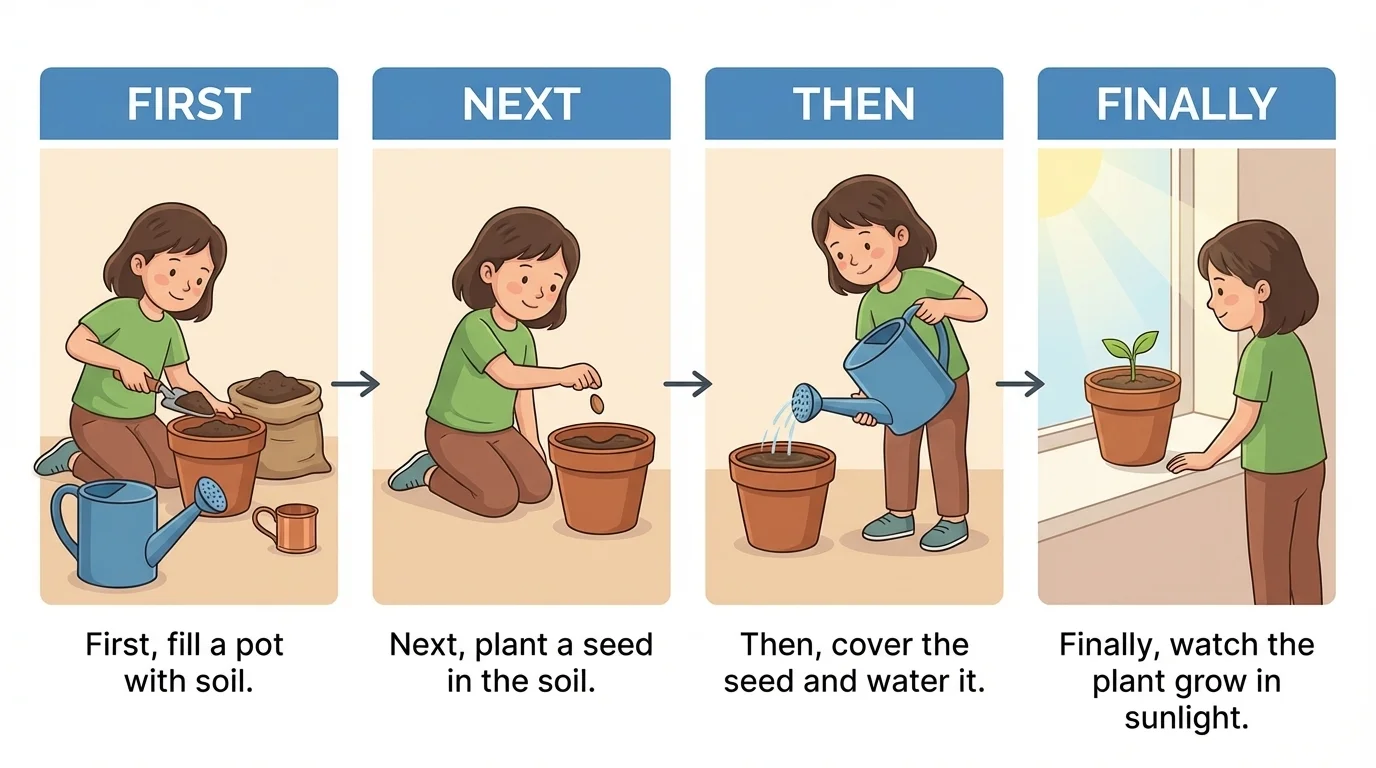
For the middle of a story, writers may use next, then, after that, soon, and later. These words move the story forward.
For the end, writers often use finally, at last, in the end, and eventually. These tell the reader that the story or action is reaching its finish.
Here is one short example: "First, Maya found a tiny seed in the garden shed. Next, she dug a hole and placed the seed inside. Then, she watered the soil carefully. Finally, she waited for the sprout to appear." The events are easy to follow because each action is connected with a temporal word.
| Part of Sequence | Common Temporal Words and Phrases |
|---|---|
| Beginning | first, at first, to begin, in the beginning |
| Middle | next, then, after that, soon, later, meanwhile |
| Ending | finally, at last, in the end, eventually |
Table 1. Common temporal words and phrases grouped by where they often appear in a sequence.
Not every story uses the same words. A writer chooses the ones that best fit the events. Still, the job stays the same: help the reader know what happens when.
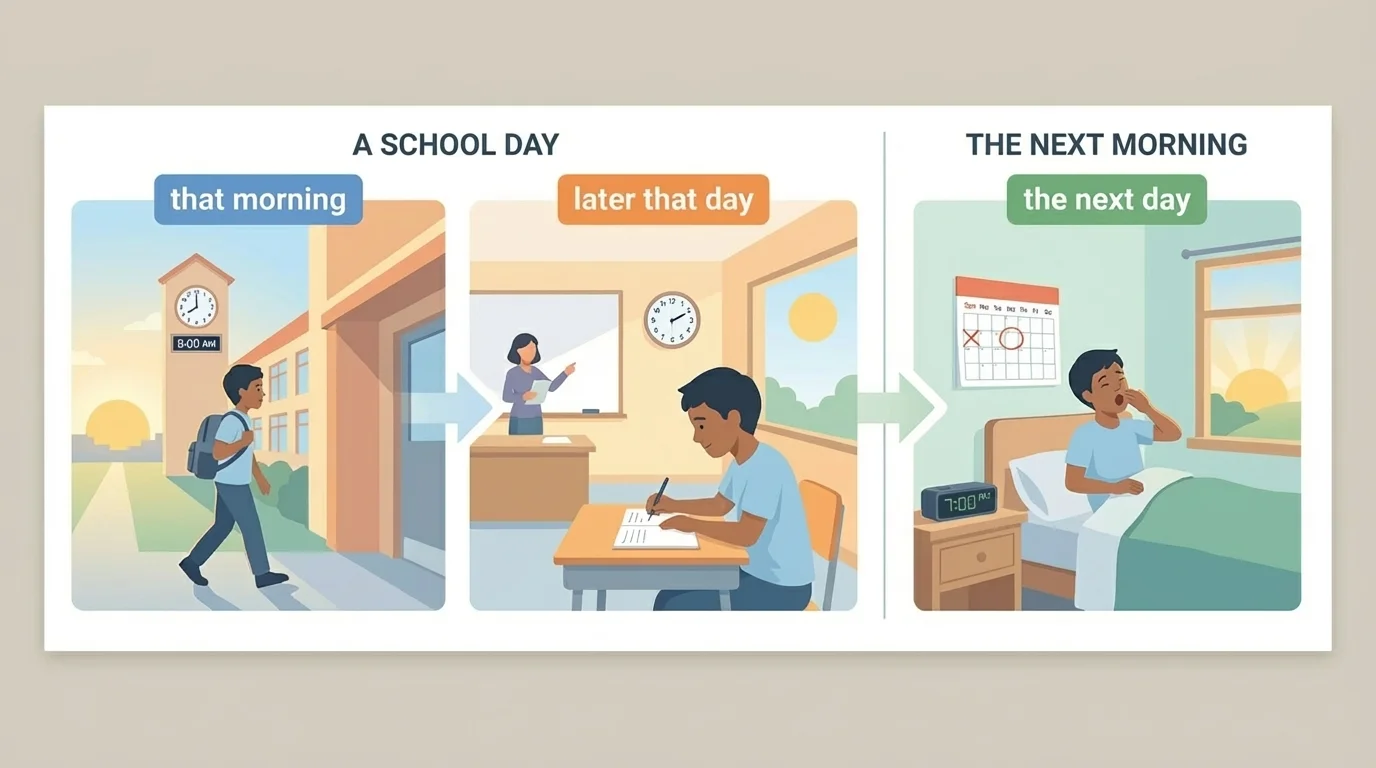
[Figure 2] Sometimes a writer needs more than simple order. A story may move from morning to afternoon, or from one day to the next. Temporal phrases can show both small and large jumps in time, including events that happen on the same day and events that happen the following day.
Words and phrases such as that morning, later that afternoon, after dinner, before bedtime, and the next day help readers understand exactly when the action happens.
Look at this example: "That morning, Luis packed his soccer bag. After school, he hurried to practice. Later that evening, he showed his muddy cleats to his dad. The next day, he scored a goal in the game." These phrases make the timeline of the story very clear.
Some temporal phrases show that two things are happening around the same time. For example, meanwhile can tell readers that the action shifts to another place or person during the same time period. "Nina searched the attic for the costume. Meanwhile, her brother checked the hallway closet."
Other phrases show what happens before or after something else. "Before the rain started, the class finished recess." "After the rain stopped, the students returned outside." These words help explain the relationship between events, not just the order.
Movies and television shows also use time signals. A scene might start with words like three hours later or the next morning so the audience can follow the story more easily.
As with the seed story in [Figure 1], readers understand events best when each time jump is easy to track.
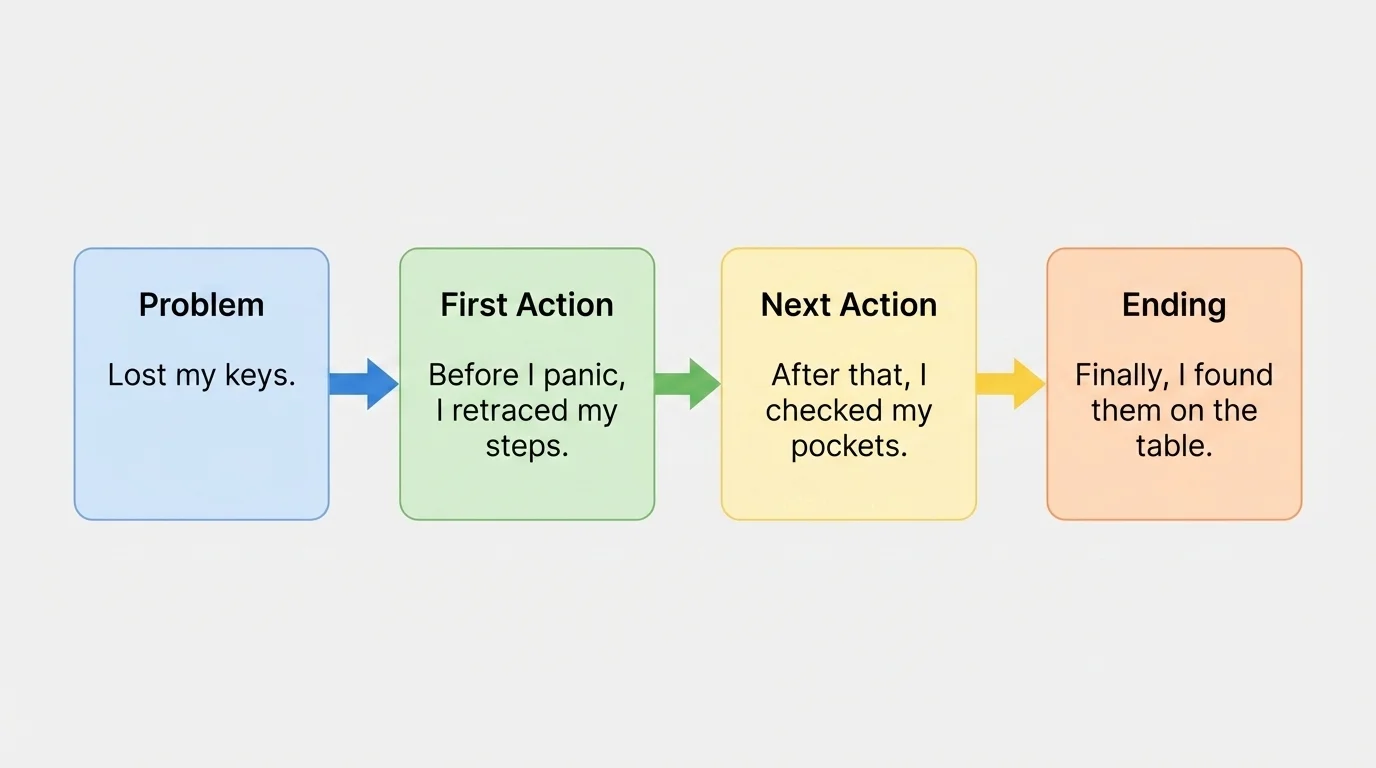
[Figure 3] A strong story is a chain of connected events, and writers think about what happens first, what problem or action comes next, and what happens at the end.
When planning a narrative, it helps to think in order. A character may begin with a goal, face a problem, try to solve it, and then reach an ending. Temporal words connect those parts so the story flows naturally.
Suppose a student writes about losing a pet turtle. A clear sequence might be: "At first, Jaden noticed the turtle tank was empty. Then, he looked under the table. After that, he checked behind the curtains. Finally, he found the turtle hiding in a shoe." Because the sequence is clear, the story feels complete.
If the writer scrambled the order, the reader might not understand the story. For example, saying "Finally, he found the turtle" before explaining that the turtle was missing would not make sense.
Event order means the order in which story actions happen. Good event order helps each part of the narrative connect to the next part.
How sequence supports meaning
Temporal words do more than connect sentences. They help readers understand cause and effect. If one event happens before another, it may explain why the next event happens. For example, if a girl forgets her umbrella before she leaves home, then she gets soaked in the rain, the order helps the reader understand the reason.
That is why clear sequence is not just neat writing. It helps the story make sense.
Temporal words can appear at the beginning of a sentence, in the middle of a sentence, or even connect whole paragraphs. Writers choose the place that sounds smooth and clear.
At the beginning of a sentence: "Next, the class mixed the paint colors." This is a very clear signal. Readers immediately know a new step or event is happening.
In the middle of a sentence: "The class, after that, mixed the paint colors and painted the mural." This can work, though writers must make sure the sentence still sounds natural.
Across a paragraph, temporal phrases can connect larger parts of a story. One paragraph might begin, "Later that afternoon, the storm clouds disappeared." Another might begin, "The next morning, the yard sparkled with puddles." Those phrases guide the reader through larger jumps in time.
Example: improving a plain paragraph
Plain version: "Sara opened her backpack. She took out her homework. She saw her lunch had spilled. She cleaned the folder."
Step 1: Add a word to show the first action.
"First, Sara opened her backpack."
Step 2: Add words to connect the middle actions.
"Next, she took out her homework. Then, she saw her lunch had spilled."
Step 3: Show the final action.
"Finally, she cleaned the folder."
The revised version is easier to follow because the order is clear.
Writers do not need a temporal word in every single sentence. The goal is not to stuff the paragraph with transitions. The goal is to guide the reader clearly.
Not all temporal words mean exactly the same thing. A thoughtful writer picks the word or phrase that best matches the event.
First usually starts a sequence. Next and then move to another event. Meanwhile shifts to something happening at the same time. Eventually suggests that something happens after a longer wait. At last often carries a feeling of relief or excitement.
Compare these two sentences: "Then, the bus arrived." "At last, the bus arrived." Both show order, but the second one also gives a feeling that the characters were waiting a long time.
Writers can also use words such as suddenly to show a quick change in time or action. "The picnic was quiet. Suddenly, a gust of wind sent napkins flying." This choice adds energy to the narrative.
| Word or Phrase | What It Often Shows | Example |
|---|---|---|
| first | the beginning | First, Eli tied his skates. |
| next | the following event | Next, he stepped onto the ice. |
| meanwhile | something happening at the same time | Meanwhile, his sister waited by the bench. |
| eventually | something happening after some time | Eventually, Eli skated across the whole rink. |
| at last | an ending after waiting | At last, the rink lights turned on. |
Table 2. Examples of temporal words and the kinds of time relationships they often show.
As the day-to-night changes in [Figure 2] make clear, precise phrases help readers understand whether events are minutes apart or a whole day apart.
[Figure 4] Readers get lost when event order is unclear. Even good ideas can become hard to follow if the time words are missing or used in a confusing way.
One common mistake is leaving out important transitions. If a writer jumps from one event to another with no signal, the reader may wonder how the story moved there.
Another mistake is using the same word over and over. A paragraph that begins every sentence with then can sound dull. Writers should vary their words: first, next, after that, later, finally.
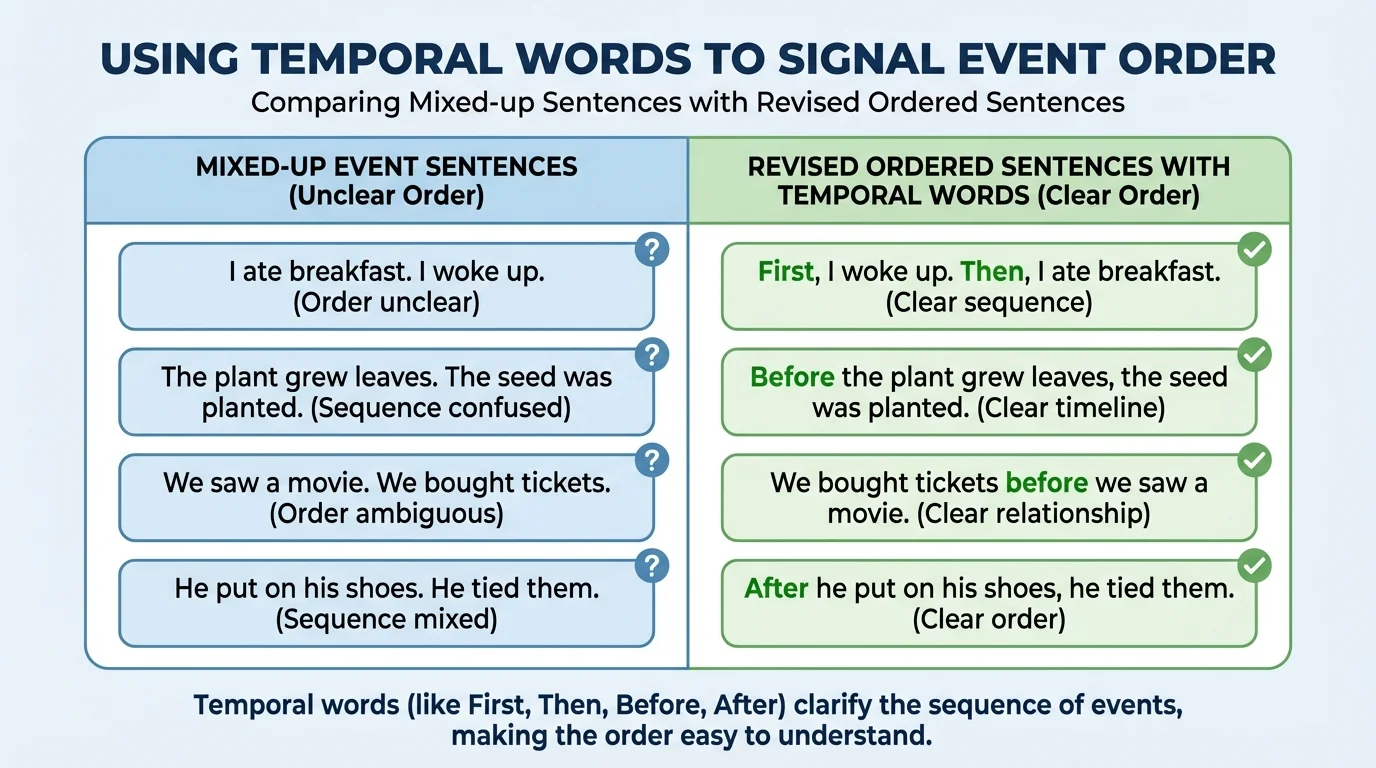
A third mistake is choosing a temporal word that does not fit. For example, finally should usually come near the end. If a writer says "Finally, we got on the bus" and then keeps telling six more major events, the word does not match the story structure.
Here is a confusing version: "Lena won the race. First, she stretched. Finally, she tied her shoes. Then, she ran." The order does not make sense. A clearer version is: "First, Lena tied her shoes. Next, she stretched. Then, she ran. Finally, she won the race."
When writers reread their work, they should ask, "Can my reader tell exactly what happened first, next, and last?" If the answer is no, they can revise the transitions.
A narrative should not stop suddenly. It should have closure, which means the ending feels finished. Temporal words can help lead the reader into that ending.
Words like finally, in the end, and at last help prepare the reader for closure. They show that the events are reaching a result.
For example: "In the end, Ava returned the lost kitten to its owner." This sentence closes the action. The main problem has been solved. The reader feels that the story has landed in the right place.
Closure can also include a final feeling, thought, or lesson. "Finally, Ben climbed off the stage with a huge smile. He knew he would never forget his first piano recital." The temporal word helps signal the ending, and the final thought gives the story a sense of completion.
We can still see this need for a logical finish in [Figure 3], where the flow of events leads naturally to an ending rather than stopping in the middle of the action.
"A story is easier to follow when each event leads clearly to the next."
When a narrative has strong event order and a clear ending, readers stay oriented from the beginning all the way to the last sentence.
Temporal words and phrases are small, but they do a big job. They help readers follow the story, understand changes in time, and connect one event to another.
Writers use them in personal narratives, fictional stories, and even writing that explains steps in a process. A child describing a science experiment might write, "First, we poured the water into the cup. Next, we added the food coloring. Then, we stirred it. Finally, we recorded what we saw." The same skill works in many kinds of writing.
Strong writers think carefully about order. They choose temporal words that fit the story, create smooth transitions, and guide the reader toward closure. When they do that, their narratives feel organized, clear, and satisfying to read.
