Have you ever read a sentence that seemed confusing because of just one word? That happens to every reader. One small word can change the meaning of a whole page. Strong readers know a secret: when a word is unclear, they do not just guess. They use tools such as a glossary or a dictionary to find the precise meaning, which means the exact meaning that fits.
When you understand important words, reading becomes smoother and more interesting. You can follow directions, understand stories, learn science ideas, and explain your thinking better. Knowing how to use glossaries and dictionaries is like having a flashlight when you are reading in a dark place. The tools help you see clearly.
Sometimes a word is completely new. Sometimes you have seen the word before, but it means something different in a new sentence. For example, the word table can mean a piece of furniture, but in a science or math book it can also mean information arranged in rows and columns. If you choose the wrong meaning, the whole passage may stop making sense.
Readers need to determine or clarify meaning. Determine means to figure it out. Clarify means to make it clear. You can begin with context clues from the sentence, but when you need a sure answer, a glossary or dictionary gives you more help.
Glossary is a small word list, usually found at the back of a book, that explains important words used in that book.
Dictionary is a book or digital tool that lists many words in alphabetical order and gives their meanings.
Context clues are hints from the words and sentences around an unknown word.
These tools do more than tell you a meaning. They can also show how to say a word, what kind of word it is, and how the word is used in a sentence. That extra information helps you become a more accurate reader and writer.
[Figure 1] A glossary is often found in nonfiction books, such as science, health, and social studies books. It lists special topic words that are important to that book. If you are reading about weather, you might find words such as forecast, temperature, and precipitation in the glossary.
A glossary is helpful because it focuses on the key words for that book. Instead of searching through thousands of words, you can look at a shorter list of words chosen for that topic. The definitions are often written in simpler language for students.
Glossaries are usually in alphabetical order. That means the words are arranged from A to Z. If you want to find the word habitat, you would look in the H section. If you want migration, you would look in the M section.
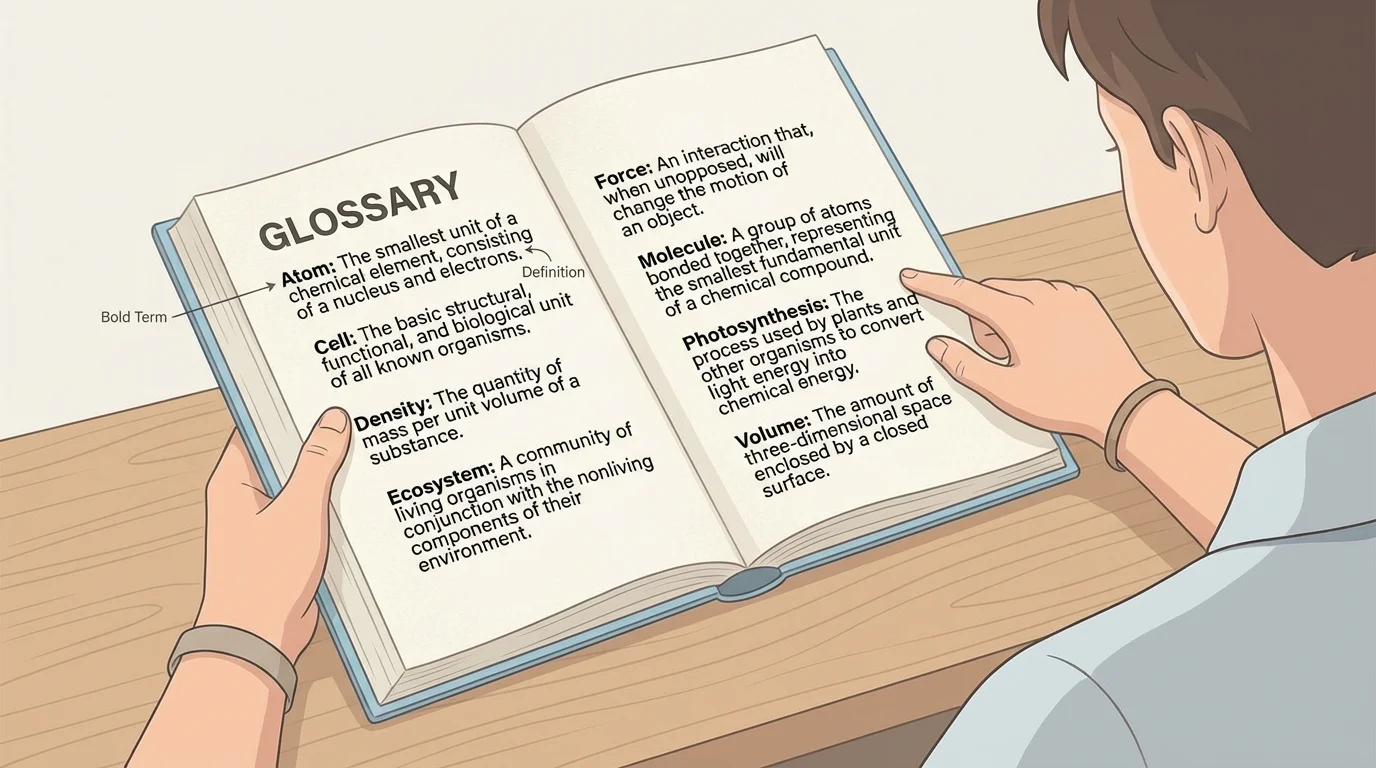
Many textbooks put the glossary near the back, along with the index. The glossary tells what important words mean. The index tells where topics can be found in the book. These are different tools with different jobs.
Some digital textbooks let you tap a bold word and open the glossary right away. That makes checking a word faster while you read.
When you use a glossary, remember that its meanings match the subject of the book. In a book about plants, the word roots will probably mean the parts of a plant under the ground, not roots in a math problem or family roots.
A dictionary is a larger tool than a glossary. It includes many words from the language, not just words from one book. You can use a dictionary when a word is not in the glossary or when you want more details about the word.
Dictionaries can be printed books or digital tools on a computer, tablet, or phone. Both kinds can help you learn the exact meaning of a word. A dictionary is especially useful when a word has several meanings, when you want to know how to pronounce it, or when you need to check spelling.
Because dictionaries have so many words, they are organized carefully. Words are in alphabetical order, and print dictionaries often use guide words at the top of the pages. Guide words tell the first and last entry on that page, helping you know whether your word is there.
When you open a glossary or dictionary, you are looking at an entry, or a record for one word. A good entry has several useful parts. Learning these parts helps you find the meaning faster and use it correctly.
[Figure 2] First, you see the entry word. This is the word you looked up. You may also see how to pronounce it. Then you may see the word's part of speech, such as noun, verb, or adjective. After that, you read one or more definitions. Some entries also include example sentences.
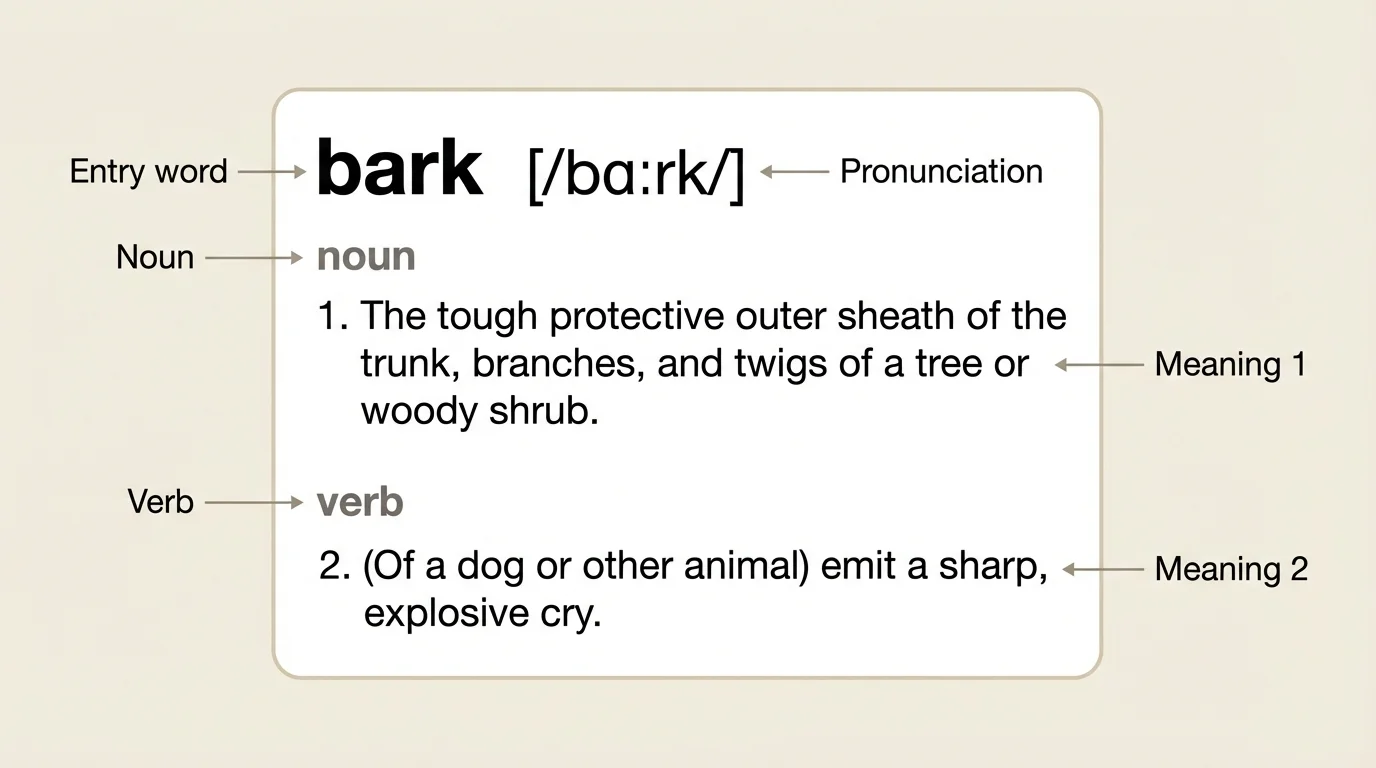
The part of speech matters because the same word can act in different ways. For example, play can be a noun, as in "We watched a play," or a verb, as in "We play soccer." Looking at the part of speech helps you choose the right meaning.
| Part of an entry | What it tells you |
|---|---|
| Entry word | The word you are looking up |
| Pronunciation | How to say the word |
| Part of speech | Whether the word is a noun, verb, adjective, and so on |
| Definition | What the word means |
| Example sentence | How the word is used in context |
Table 1. Main parts of a glossary or dictionary entry and what each part explains.
Some dictionaries number the meanings. Meaning 1 may be the most common meaning, but it is not always the meaning you need. You must compare the definitions with the sentence you are reading.
Using a print reference takes careful steps. First, notice the word that is confusing. Next, make sure you know how the word is spelled. If you are unsure, look closely at the sentence or sound it out as best you can.
Then find the first letter of the word. Use alphabetical order to move toward the right place. In a glossary, scan the list until you see the word. In a print dictionary, use the guide words at the tops of pages to narrow your search.
Using a print glossary
You are reading a science book and find the sentence: "A camel is well suited to its habitat." You are not sure what habitat means.
Step 1: Look for the glossary near the back of the book.
Step 2: Find the H section because the word begins with H.
Step 3: Scan the words until you find habitat.
Step 4: Read the definition, such as "the natural home of a plant or animal."
Step 5: Reread the sentence using that meaning.
Now the sentence makes sense: a camel is well suited to the place where it naturally lives.
After you find a meaning, go back and reread the sentence or paragraph. This final step is very important. A looked-up meaning helps most when you return to the text and see how the word works in that spot.
Digital tools can help you find meanings quickly. A digital glossary or dictionary often has a search box. You type the word, and the result appears right away. Many digital tools also include audio, so you can hear the word spoken correctly.
[Figure 3] Digital tools are useful, but you still need to read carefully. Make sure you typed the word correctly. Then read all the meanings, not just the first one. If the website or app gives examples, use them to decide which meaning fits your reading.
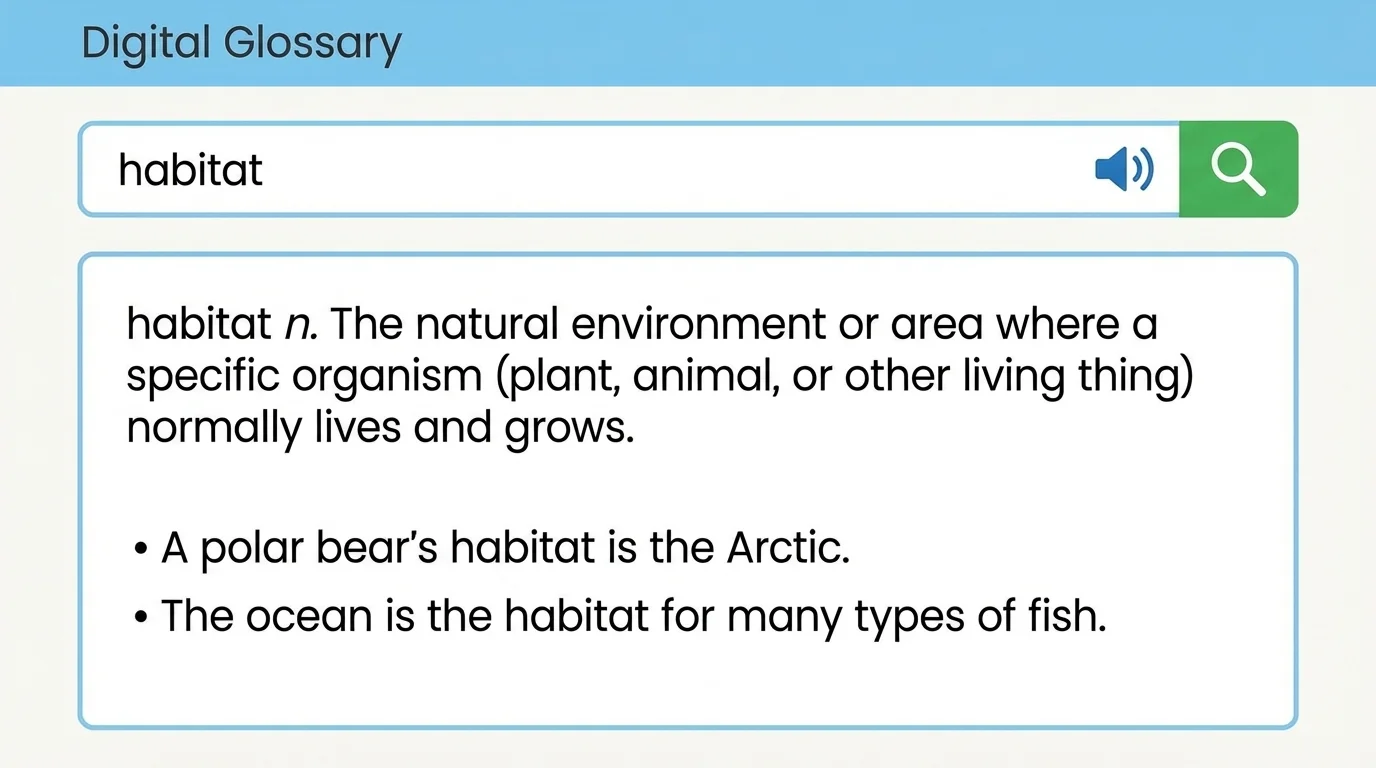
When using digital resources, choose trusted sources such as school-approved dictionaries, library databases, or well-known dictionary websites. Some websites are less reliable or give meanings in confusing ways. Good readers check that the source is clear and accurate.
Alphabetical order still matters in digital tools. Even though a search bar is faster, knowing the first letters of a word and how it is spelled helps you find the correct result.
If a digital dictionary suggests a different spelling, pay attention. Sometimes a word is hard to find because one letter is missing or out of place. Correct spelling helps you reach the right definition.
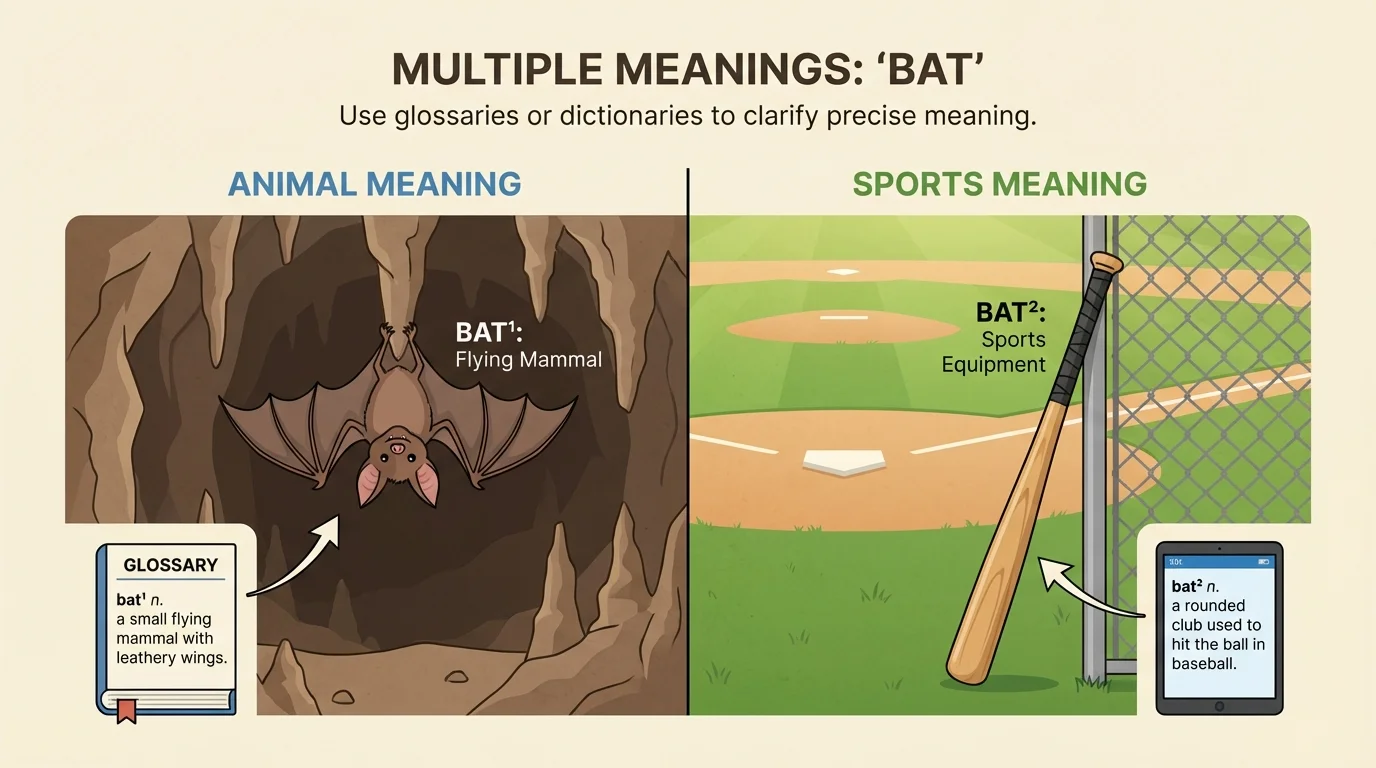
Some words are multiple-meaning words. That means one word can have more than one definition. Context helps you choose the best one.
[Figure 4] Look at the word bat. In the sentence "The bat flew out of the cave at night," bat means the animal. In the sentence "She swung the bat and hit the ball," bat means sports equipment. A dictionary may list both meanings, so you must use the sentence to decide.
Another example is bark. It can mean the sound a dog makes, or it can mean the outer covering of a tree. If a sentence says, "The rough bark protected the tree," the tree meaning fits. If it says, "We heard the bark from the yard," the dog-sound meaning fits.
How context and reference tools work together
Context clues help you make a smart guess first. A glossary or dictionary helps you check that guess and sharpen it. Strong readers often use both: they read around the word, think about what would make sense, and then confirm the exact meaning in a reference tool.
Picking the right meaning is about matching the definition to the sentence. This is why reading the whole sentence, and sometimes the sentences before and after it, is so important. The same careful thinking you used with bat can help with many other words.
Glossaries and dictionaries are important in every subject. In reading class, you may use them to understand story words or figurative language. In science, you may need to know exact topic words such as habitat or adaptation. In social studies, words such as community, citizen, or region may have special meanings.
Sometimes you will need to clarify a phrase, not just a single word. A phrase is a group of words that works together. For example, if a text says "on the other hand," a dictionary may help with the words, but context helps you understand that the phrase signals a different idea or side of a topic.
Content-area books often put bold topic words in the glossary because those words are central to understanding the subject. When you learn these words well, your knowledge grows more quickly. You are not just memorizing words; you are unlocking ideas.
Choosing the right definition from a dictionary
Read the sentence: "The seal rested on a rock near the shore." A dictionary gives two meanings for seal: a sea animal and something used to close a container.
Step 1: Notice the nearby words rock and shore.
Step 2: Compare those clues to the dictionary meanings.
Step 3: Choose the meaning that fits the setting.
Here, seal means the sea animal because animals can rest on rocks near the shore.
When you study different subjects, word meaning becomes more exact. For example, the word volume in music may relate to sound level, while in science or math it can mean the amount of space inside an object. Reference tools help you notice these differences.
First, slow down when a word seems important. Ask yourself, "Is this word a key part of the sentence or topic?" If it is, stop and check it. Guessing and moving on can lead to confusion later.
Second, examine the word itself. Look for word parts you may know. A base word, prefix, or suffix can give clues. For example, if you know care, you may understand more about careful or careless. Then use the glossary or dictionary to confirm the exact meaning.
Third, reread after looking up the word. This is where understanding becomes strong. The meaning should fit smoothly into the sentence and the whole paragraph. If it does not fit, try another listed meaning.
Good readers often look up the same word more than once in different books because words can shift meaning depending on the subject and context.
Fourth, keep learning new words. Each time you use a glossary or dictionary, you grow your vocabulary. Over time, you will need these tools less often for simple words and more often for new, interesting, and challenging ones.
Finally, remember that print and digital tools are both valuable. A print glossary is quick inside a textbook. A print dictionary helps you practice alphabetical order and guide words. A digital dictionary can be fast and can say the word aloud. Skilled readers know how to use all of them.
