Have you ever heard someone say something that made you think, "I never thought about it that way before"? That is one of the best things about a discussion. When people talk and listen carefully, ideas can grow. A discussion is not just about waiting for your turn to speak. It is about hearing what others say, thinking about it, and then explaining your own ideas in a clear way.
When you explain your thinking well, other people can understand you better. They can see what you mean, ask good questions, and respond to your ideas. In school, this matters when you talk about stories, science topics, class projects, and everyday problems. Strong discussion skills help you in one-on-one talks, small groups, and whole-class conversations.
A discussion is a focused talk where people share ideas, listen to each other, and think together. In a good discussion, everyone has a chance to speak and everyone has a responsibility to listen. The goal is not always to "win." The goal is often to understand more.
Discussions help you do several important things. You can learn new facts, hear different opinions, solve problems, and explain your own thinking. Sometimes you begin with one idea, but after hearing others, you add more details or even change your mind. That is not a mistake. That is learning.
Idea means a thought or opinion in your mind. Explain means to make your thinking clear so others understand it. Respond means to answer or react to what someone else says. Reason means why you think something is true or important.
In class, discussions often connect to a text you read, a topic you studied, or a question the teacher asks. If the class reads a story about a brave character, students may discuss whether the character made a good choice. If the class studies weather, students may discuss why storms happen. In each case, students need to explain what they think and why.
Explaining your thinking means more than saying, "I like it," or "I disagree." Those are starts, but they are too short by themselves. Clear speaking usually has at least two parts: your idea and your reason. For example, instead of saying, "The boy in the story was kind," you can say, "The boy in the story was kind because he shared his lunch with someone who had none."
This kind of answer helps others understand exactly what you mean. It also gives them something to think about. They might agree and add another example, or they might point to a different part of the story and explain a different view.
Clear explanation has three helpful parts: first, say your idea; second, tell why you think that; third, give a detail or example. A strong response often sounds like this: "I think __ because __. For example, __." This pattern helps your words stay organized.
Sometimes your idea is about a fact. Sometimes it is about an opinion. A fact can be checked, like "Frogs begin life as eggs." An opinion tells what someone thinks, like "The frog is the most interesting animal in the pond." In a discussion, both can matter, but you should know which kind of statement you are making.
Good discussions work best when students listen carefully before speaking. A connected response links your words to someone else's idea, as [Figure 1] shows in a simple listen-think-respond pattern. If you do not listen, your answer may not fit the conversation.
Active listening means paying close attention to the speaker. You look at the person, keep your body calm, and think about the message. You do not interrupt. You notice important words and details. Then, when it is your turn, you respond to what was actually said.
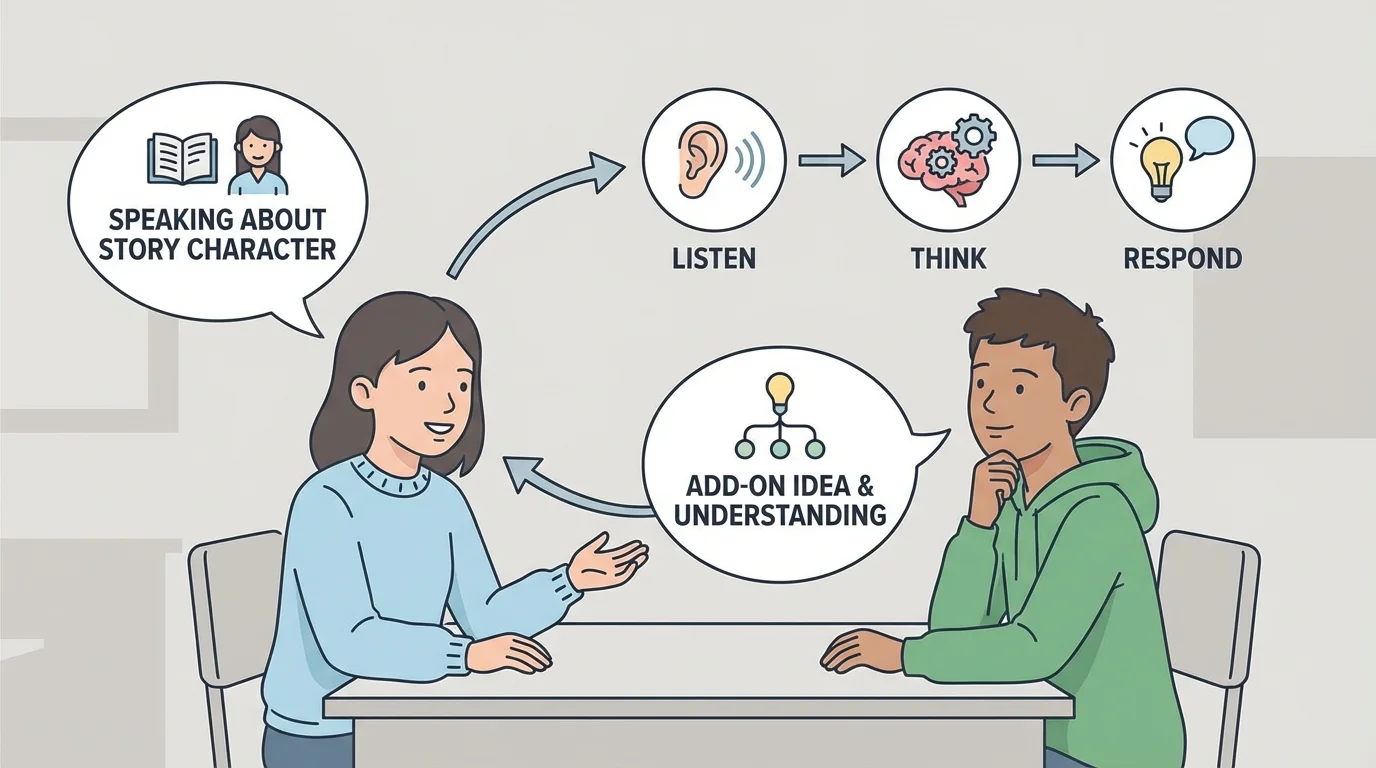
Suppose one student says, "I think the main character felt nervous because she was new at school." A strong response might be, "I agree that she felt nervous, and I also think she felt lonely because she ate by herself at lunch." This answer connects to the first speaker and adds a new thought.
A weaker response would be something unrelated, such as, "I like pizza." That may be true, but it does not match the topic. Staying on topic shows respect for the group and helps the discussion move forward.
Remember that conversations have turns. One person speaks, another listens, and then another responds. In class discussions, taking turns helps everyone feel heard and keeps ideas organized.
Listening also helps you ask better questions. If someone says, "I think the storm came quickly," you could ask, "What detail in the text makes you think it was quick?" That question invites the speaker to explain more clearly.
Later in a discussion, the same kind of connection still matters. Just as the speaking pattern in [Figure 1] links one idea to the next, your response should grow from what the group is already discussing, not start a completely different topic.
Sometimes students know what they want to say, but they are not sure how to begin. [Figure 2] organizes helpful sentence starters into clear groups so you can choose words that match your purpose. Sentence starters are tools that help organize your thinking and make your speaking clearer.
Here are some useful ways to begin:
| Purpose | Sentence starters |
|---|---|
| Share an idea | I think..., I believe..., In my opinion... |
| Give a reason | because..., One reason is..., This makes sense because... |
| Add on | I want to add..., Another example is..., I also noticed... |
| Agree | I agree with... because..., That makes sense because... |
| Disagree politely | I understand your idea, but I think..., I see it differently because... |
| Ask a question | Can you explain..., What makes you think..., Where did you find that detail? |
Table 1. Sentence starters that help students join discussions clearly and politely.
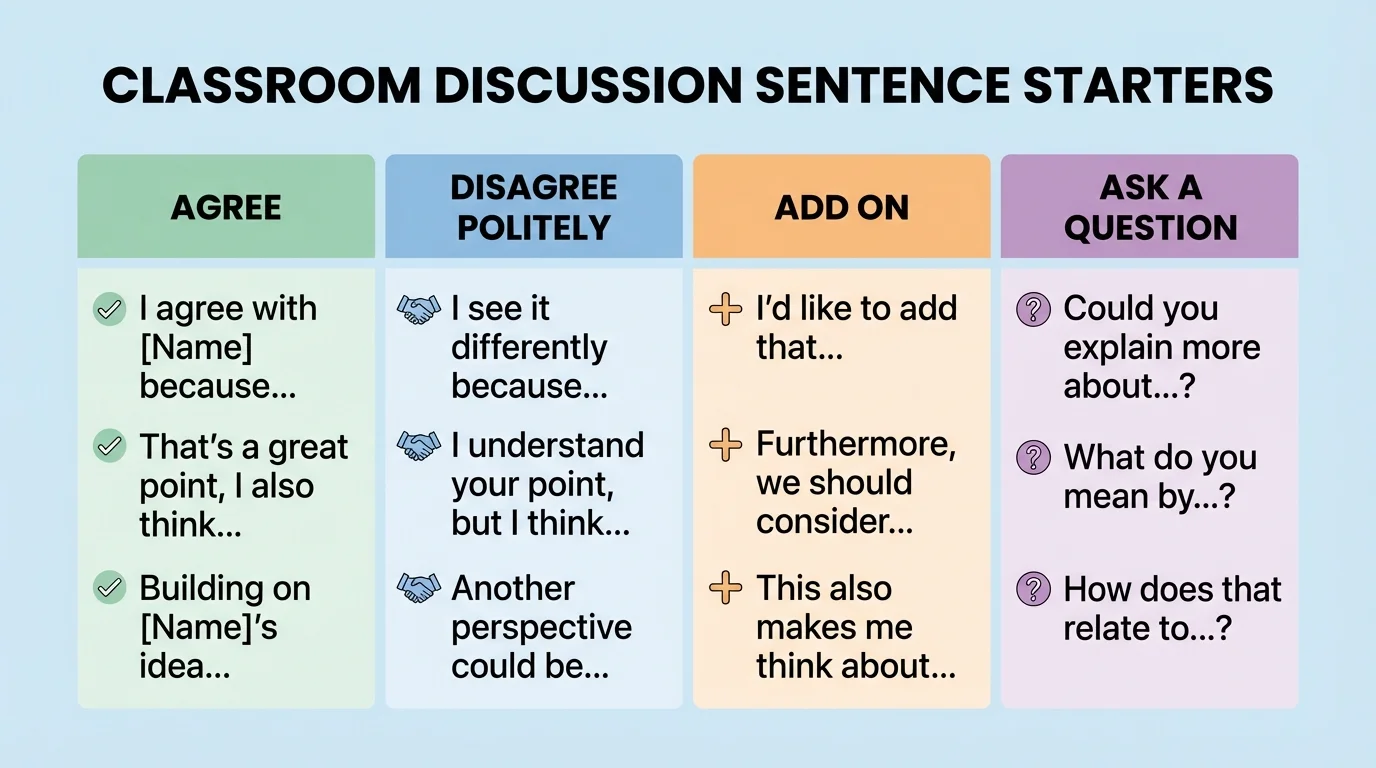
These sentence starters are helpful because they make your purpose clear. If you begin with "I agree with Maya because...," everyone knows you are connecting to Maya's idea. If you begin with "I see it differently because...," everyone knows you are sharing a different view respectfully.
Respectful disagreement is very important. It is okay not to agree with someone. In fact, different ideas can make a discussion stronger. But it is important to disagree with the idea, not be rude to the person. Saying, "That is dumb," hurts the discussion. Saying, "I see it differently because the text says something else," keeps the discussion thoughtful and kind.
Many adults use the same discussion skills in meetings, teamwork, and problem-solving. Listening closely and explaining ideas clearly are not just school skills. They are life skills.
Later, when you need to respond in a new group, the categories in [Figure 2] still help. You can decide, "Am I agreeing, adding on, disagreeing politely, or asking for clarification?" and choose a sentence starter that fits.
A strong discussion response usually includes support. Support means the reason, detail, or example that helps prove your point. Without support, your words may sound unfinished. For example, "Recess should be longer" is an opinion. "Recess should be longer because students need time to exercise and reset their brains for learning" is much clearer.
You can support your thinking in different ways. You might use a detail from a story, a fact from a science lesson, something you observed, or an example from real life. If your class is discussing why plants need sunlight, you could say, "Plants need sunlight because they use it to make food. We saw that the plant kept in the dark did not grow as well."
Example of adding support
Question: Why do you think the character was brave?
Step 1: State the idea.
"I think the character was brave."
Step 2: Add a reason.
"I think the character was brave because she helped her little brother during the storm."
Step 3: Add a detail or example.
"She helped her little brother during the storm by guiding him to safety even though she was scared too."
The final response is clear, complete, and easy for others to understand.
Notice how each step makes the answer stronger. The idea tells what the speaker thinks. The reason tells why. The detail proves it with evidence.
One of the smartest things a student can say is, "I want to change my thinking a little." That sentence shows growth. Discussions are not only for sharing what you already think. They are also for learning from others.
Maybe at first you believe a character is selfish. Then another student points out that the character gave away something important to help a friend. You might respond, "At first I thought the character was selfish, but now I think she was confused and then learned to be generous." This is a stronger idea because it includes more than one detail and shows that your thinking developed.
Strong thinkers revise ideas. Revising does not mean your first thought was useless. It means you listened, noticed new evidence, and improved your understanding. That is exactly what good discussions are meant to do.
You can also strengthen an idea without fully changing it. For example, "I still think the storm was the biggest problem, but now I also think the lack of food made things worse." This keeps your main idea while making it deeper and more complete.
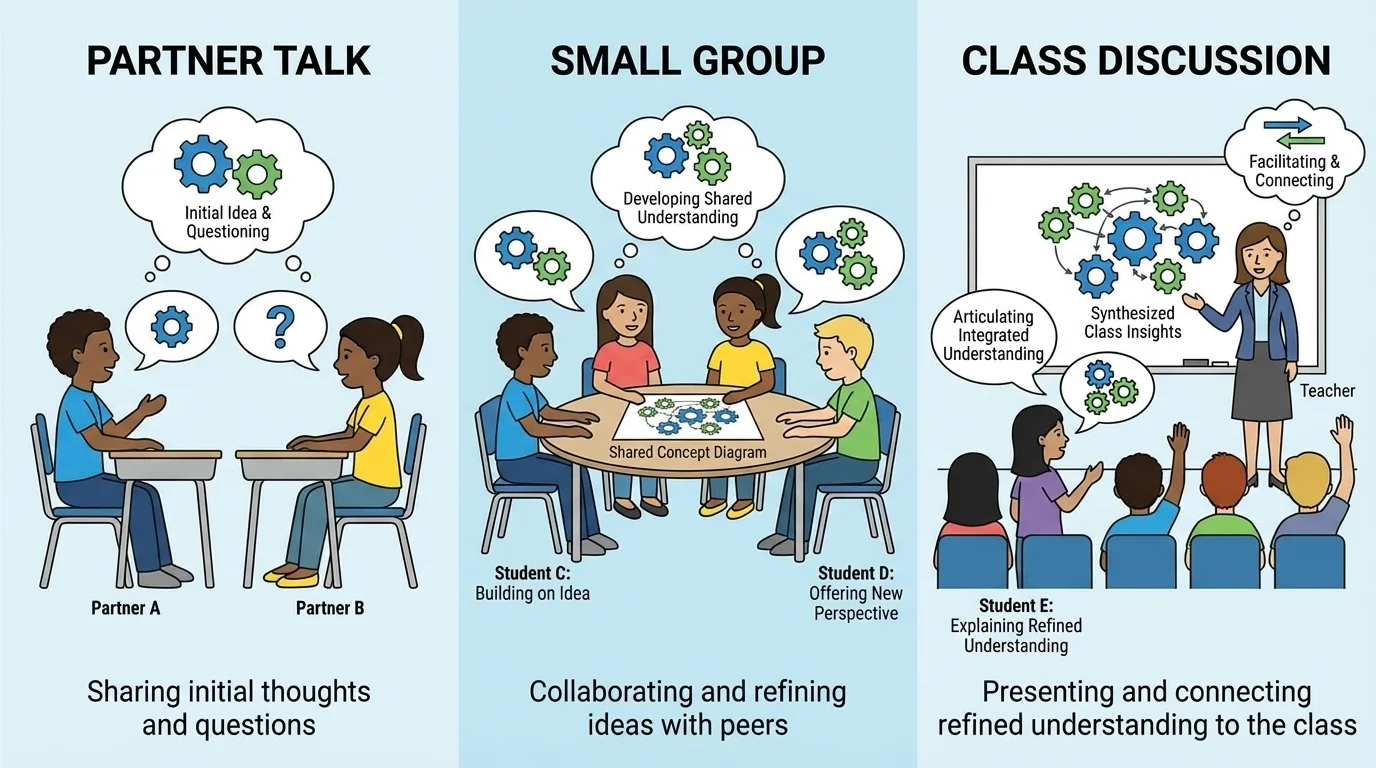
You may speak a little differently depending on the discussion setting, and [Figure 3] compares three common situations: partner talk, small-group talk, and teacher-led discussion. The basic skills stay the same, but the way you use them can change.
In a one-on-one talk, you usually have more time to speak and respond. You can ask direct questions and answer right away. In a small group, you need to share the time fairly, because more people want to speak. In a teacher-led discussion, you may need to wait longer for your turn and listen to many ideas before adding your own.
| Setting | What helps most |
|---|---|
| One-on-one | Listening closely and responding directly to one person |
| Small group | Taking turns, adding on, and staying on topic |
| Teacher-led discussion | Waiting respectfully, listening to many voices, and speaking clearly to the whole class |
Table 2. Discussion skills that are especially important in different group settings.
In all these settings, your voice should be clear enough to hear, but not so loud that it feels like shouting. Your words should be complete enough to understand. Instead of saying only, "Yeah," try saying, "Yes, I agree because the text gives that detail on the last page."
When students understand the differences shown in [Figure 3], they can choose the best discussion habits for each situation and still express their ideas clearly.
Good discussions are not only about ideas. They are also about behavior. Respectful habits make everyone feel safe enough to share. These habits include taking turns, looking at the speaker, keeping hands to yourself, staying on topic, and using polite words.
Clarify means to make something easier to understand. If someone does not understand your idea, you can clarify by saying it in a new way. For example, "What I mean is..." or "Let me explain that more clearly..." If you do not understand someone else, you can ask, "Can you clarify what you mean?"
"Good discussion is not just saying more. It is saying something clearly and listening carefully."
Body language matters too. Facing the speaker, nodding when appropriate, and waiting without interrupting all show respect. These actions tell others, "Your ideas matter." When people feel respected, they are more willing to share thoughtful answers.
Respectful speaking also means using calm words when opinions differ. You can say, "I understand your point," before you explain a different idea. That small habit helps the group stay friendly and focused.
Let's look at a full discussion example. Suppose the class is discussing this question: "Should schools have more time for art?" One student says, "Yes, because art helps students be creative." Another says, "I agree, and art also helps students express feelings." A third student says, "I understand those ideas, but I think schools also need enough time for reading and math."
Each student is doing something important. The first shares an opinion and a reason. The second builds on the first idea. The third disagrees politely and explains why. This is what cooperative discussion looks like.
Modeled response in a discussion
Question: Should schools have more time for art?
Step 1: Connect to the discussion.
"I agree that art is important..."
Step 2: State your own idea.
"...but I think schools should balance art with other subjects."
Step 3: Give support.
"Students need time for creativity, but they also need time to practice reading, writing, and math."
This response is respectful, clear, and supported with reasons.
You can use the same process with books, science topics, social studies questions, and classroom problems. First listen. Then think. Then explain your own idea clearly with a reason, detail, or example. If the discussion changes your thinking, say so. That shows you are paying attention and learning from the group.
As you grow stronger at discussion, your ideas become easier for others to understand. You also become better at understanding others. That is the real power of explaining your ideas in light of a discussion: your thinking gets clearer, deeper, and stronger.
