Have you ever heard a story or a speech that just... stopped? It can feel strange, like a song ending in the middle. Writing works the same way. When you share an opinion, your reader needs a strong ending so your ideas feel complete. A good conclusion helps your reader remember what you believe and why it matters.
An opinion piece is a kind of writing where you tell what you think about a topic and give reasons to support your thinking. At the end of that piece, you need a concluding statement or a short concluding section. This ending is the last part your reader sees, so it should be clear, thoughtful, and connected to the rest of your writing.
Think about building with blocks. First you make the base, then you add the middle, and finally you place the top piece that makes it feel finished. In writing, the conclusion is that top piece. Without it, your reader may wonder, "Is that the end?" or "What should I remember?"
A strong ending does more than stop the writing. It gives a sense of closure. Closure means the writing feels complete. In opinion writing, closure matters because you want your reader to leave with your point of view in mind.
Conclusion means the ending part of a piece of writing. In an opinion piece, the conclusion reminds the reader of the writer's opinion and helps the piece feel finished.
Point of view means what a writer thinks or believes about a topic.
When readers reach the end of your writing, they should not feel surprised by brand-new ideas. Instead, they should feel guided back to the main opinion. That is why a conclusion is important: it helps your message stay strong all the way to the last sentence.
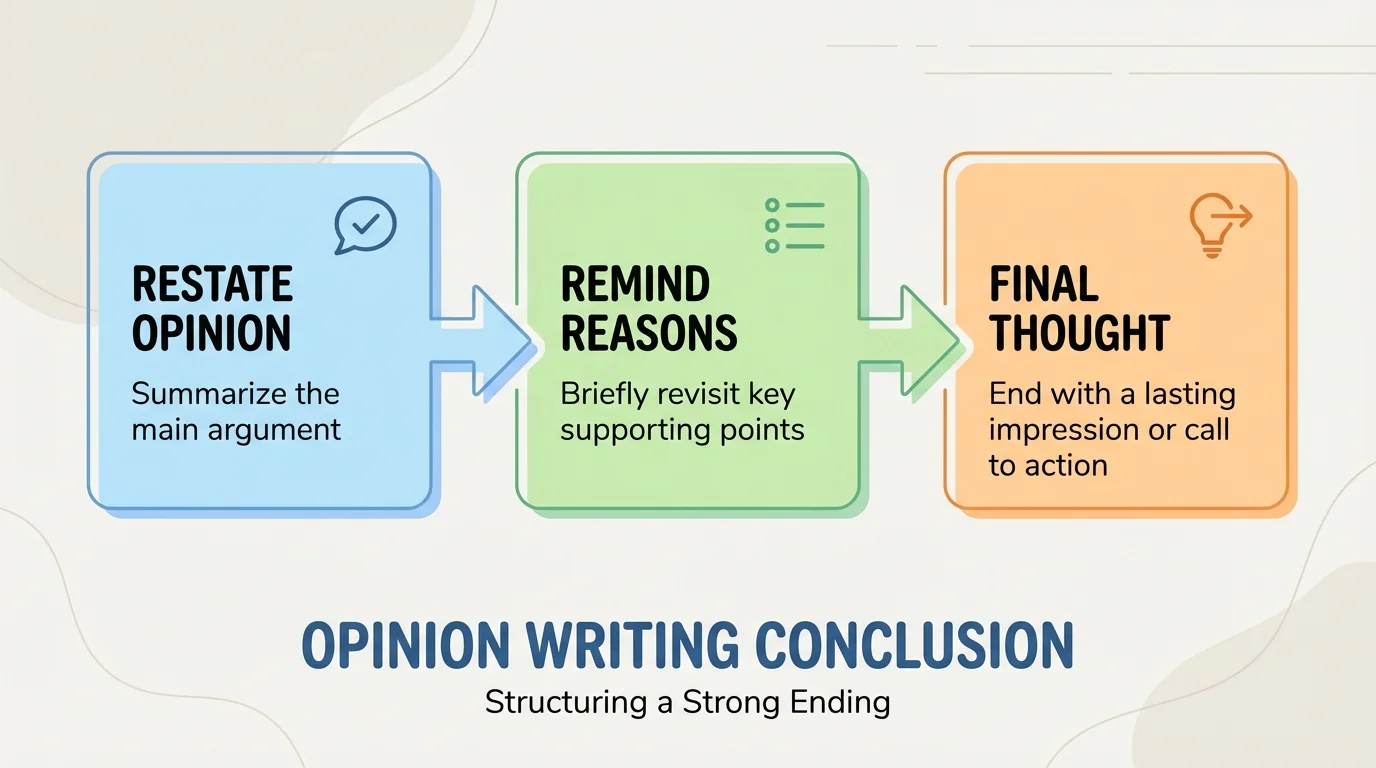
A conclusion in opinion writing has three main jobs, as [Figure 1] shows: it restates the opinion, reminds the reader of the reasons, and leaves the reader with a final thought. These jobs work together to make the ending feel complete and convincing.
First, a conclusion restates the opinion. To restate means to say the same idea again in a new way. If your opinion is "School should have longer recess," you do not need to copy those exact words at the end. You might say, "For these reasons, students need more time for recess each day." The idea is the same, but the words are fresh.
Second, a conclusion reminds the reader of the reasons. You usually do this briefly. You do not need to repeat every detail from the body of your writing. Instead, you mention the big ideas again. For example, "Longer recess helps kids exercise, refocus, and get along better with others."
Third, a conclusion leaves a final thought. This final thought can help the reader care about your opinion. It might sound like a hope, a strong statement, or a reminder of why the topic matters. For example, "A little more recess time could make the whole school day better for everyone."
Notice that a conclusion is usually shorter than the middle of the piece. It is not a place to start over. It is a place to finish with purpose. When you do these three jobs well, your ending sounds strong instead of rushed.
The shape of a strong ending
A helpful way to think about a conclusion is this: look back, then look forward. First you look back at your opinion and reasons. Then you look forward by giving a final thought that sticks with the reader. That balance makes the ending feel satisfying.
You can see this shape in many kinds of school writing. A student writing about why pets are good companions might end by restating the opinion, mentioning comfort and friendship, and then adding a final thought such as, "A pet can make a home feel happier every day." The exact topic changes, but the job of the conclusion stays the same.
There is not just one right way to end. Writers can choose different kinds of conclusions, as long as the ending matches the opinion and the reasons. Here are some common ways to end an opinion piece.
One way is a call to action. A call to action asks the reader to do something. If you are writing that the class should plant a garden, you might end with, "Let's start planning our garden so our school can become greener and more beautiful."
Another way is a strong opinion statement. This kind of ending clearly says what you believe. For example, "For all of these reasons, reading every day is one of the best habits a student can have."
You can also end with a hopeful thought. This type of conclusion looks ahead in a positive way. "If students read more often, they can learn new things, grow their imaginations, and enjoy books for years to come."
A thoughtful reminder is another good choice. This reminds the reader why the topic matters. "Healthy school lunches matter because every student deserves food that helps them learn and feel strong."
All of these endings work because they connect to the opinion and help the writing feel complete. The best choice depends on your topic and what you want your reader to think at the end.
Sometimes students know they need an ending, but they are not sure how to write one. That can lead to weak conclusions. A weak ending and a strong ending are easier to compare when you look closely at the choices, as [Figure 2] explains through side-by-side examples.
One mistake is adding a brand-new reason. Suppose your whole opinion piece is about why bicycles are a great way to travel because they are healthy and inexpensive. If your conclusion suddenly says, "Also, bicycles come in many colors," that new idea feels out of place. The ending should connect to reasons already discussed.
Another mistake is ending too suddenly. A sentence like "That is my opinion" does stop the piece, but it does not really conclude it. It does not remind the reader of the opinion or reasons in a meaningful way.
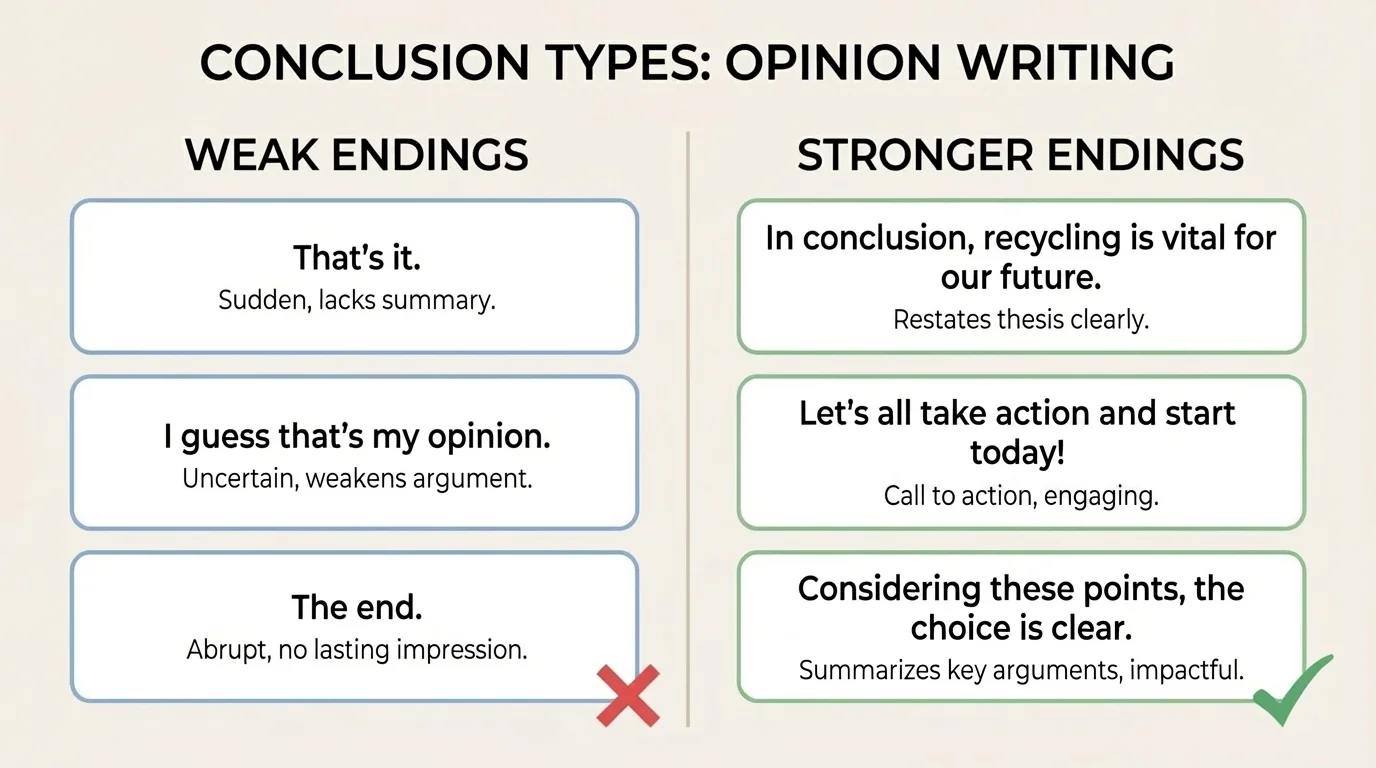
A third mistake is copying the introduction exactly. It is fine to return to the same opinion, but using the very same sentence can sound dull. Writers should restate, not simply repeat.
A fourth mistake is making the conclusion too long. If the ending becomes a whole new body paragraph, the piece may feel uneven. Most grade-level opinion pieces need a short but clear conclusion, often just a few sentences.
Writers also need to avoid unclear words. If the conclusion says, "Stuff is good so yeah," the reader does not learn much. Precise words make writing stronger. Instead of "stuff," name the real idea. Instead of "good," explain why it matters.
Earlier parts of an opinion piece include an introduction, reasons, and supporting details. The conclusion comes last, but it depends on those earlier parts. A good ending grows out of the opinion and reasons that came before it.
When you read your own ending, ask yourself: "Does this sound finished? Does it match the rest of my writing? Does it remind the reader of what I want them to believe?" Those questions help you spot weak conclusions and make them stronger.
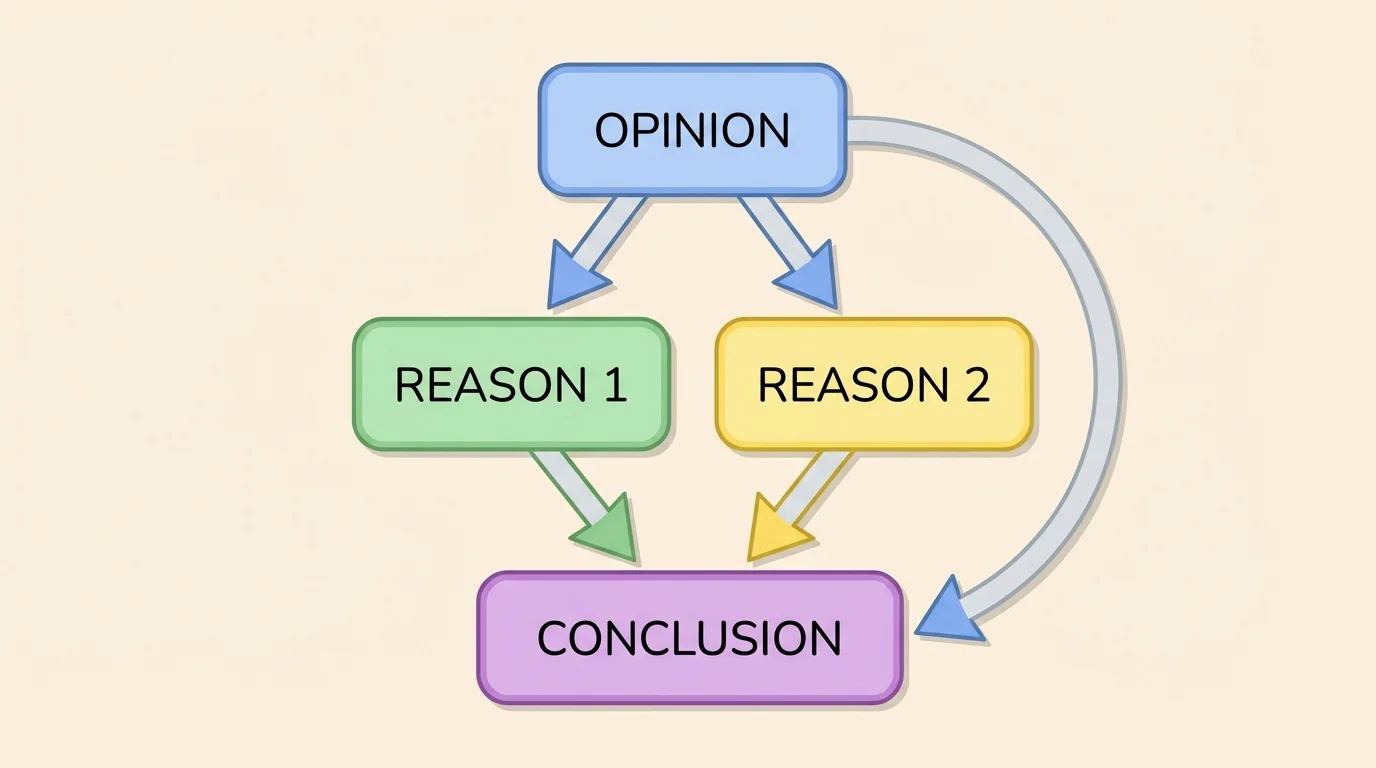
One smart way to write a conclusion is to look back at your opinion and your reasons, as [Figure 3] illustrates in a simple organizer. If you know what you said in the beginning and middle, you can build an ending that fits.
Here is an example topic: Students should wear helmets when riding bikes. The opinion is clear. The reasons might be that helmets protect heads, help prevent serious injuries, and keep riders safer. A strong conclusion could be: "For these reasons, every bike rider should wear a helmet. This simple choice can help keep kids safe every time they ride."
Notice what this conclusion does. It restates the opinion: riders should wear helmets. It reminds the reader of the reasons in a short way: helmets keep riders safe. Then it leaves a final thought: wearing a helmet is a simple choice that matters.
Example 1: Ending an opinion about bedtime
Opinion: Children should have a regular bedtime.
Reasons: It helps them get enough sleep, be ready for school, and stay healthy.
Step 1: Restate the opinion.
"For all these reasons, children need a regular bedtime."
Step 2: Briefly remind the reader of the reasons.
"A steady bedtime helps kids rest well, learn better, and feel healthier."
Step 3: Add a final thought.
"A good night's sleep can make the next day much better."
Put together, this makes a strong conclusion.
Here is another example. Suppose the opinion is: The library is one of the best places in school. Reasons might include quiet space, interesting books, and help with learning. A conclusion could be: "The library is an important part of our school because it gives students a calm place to read, learn, and explore. That is why it deserves care and respect from everyone."
As we saw earlier in [Figure 1], the conclusion works best when it does all three jobs together. It does not need fancy words. It needs clear thinking.
Example 2: Weak ending changed to a stronger ending
Topic: School should have a recycling program.
Weak ending: "That is all. Recycling is nice."
This ending is too short and does not explain why the opinion matters.
Stronger ending: "For these reasons, our school should start a recycling program. Recycling can reduce waste, protect nature, and help students make responsible choices."
This ending restates the opinion, reminds the reader of the reasons, and sounds complete.
Try listening to the rhythm of a conclusion. A weak ending often sounds abrupt or empty. A strong ending sounds finished, connected, and meaningful. Even young writers can create strong endings by thinking about the opinion, the reasons, and the final message.
Writers often use transition words to signal that the conclusion is beginning. These are words or phrases that help the writing move smoothly from one part to another. In conclusions, transition words tell the reader, "We are wrapping up this piece."
Some useful ending transitions are listed in the table below.
| Transition word or phrase | How it helps | Example |
|---|---|---|
| In conclusion | Shows clearly that the ending has started | In conclusion, recess should be longer. |
| For these reasons | Connects the opinion to the reasons | For these reasons, pets belong in loving homes. |
| That is why | Explains the result of the reasons | That is why reading each day matters. |
| As you can see | Helps the writer point back to the evidence | As you can see, exercise helps kids stay strong. |
| All in all | Creates a natural closing feeling | All in all, the park is a valuable place in our town. |
Table 1. Transition words and phrases that help start a conclusion in an opinion piece.
These phrases are helpful, but writers do not have to use them every time. If every piece begins with "In conclusion," the writing may start to sound repetitive. Sometimes a writer can begin the ending naturally with a sentence that clearly wraps up the opinion.
For example, instead of writing, "In conclusion, school uniforms are good," a student could write, "School uniforms help students focus, feel included, and get ready for learning." Both can work. The important part is that the reader can tell the writing is ending.
Professional writers think carefully about their last sentence because readers often remember endings well. A strong final sentence can make an opinion feel more powerful and easier to remember.
When choosing transition words, match them to your voice and topic. A serious topic may need a calm, thoughtful ending. A topic about improving school life may sound stronger with a call to action. The ending words should fit the writing, not feel pasted on.
A good conclusion does not float by itself. It matches the whole piece. If your opinion writing is serious, the ending should probably be serious too. If your reasons are about safety, fairness, or health, your conclusion should stay focused on those same ideas.
Suppose you wrote an opinion piece saying that neighborhoods need more trees. If your reasons were shade, cleaner air, and beauty, then your conclusion might say, "For these reasons, planting more trees would make neighborhoods healthier and more pleasant places to live." That fits the whole piece.
But if the ending suddenly says, "Trees are fun to climb," it may not match the reasons you gave. This kind of mismatch can weaken the writing. The conclusion should feel like it belongs.
You can use a quick check to test your ending. Read your introduction and your conclusion one after the other. Do they sound connected? Then read your body reasons and ask whether the conclusion reflects them. If it does, your ending is probably working well.
Another useful check is to ask whether the last sentence leaves the reader with something to think about. As we saw in [Figure 3], the conclusion grows from the opinion and reasons, but it also points to why the topic matters in the real world. That final thought is what gives your writing power.
For grade-level opinion writing, a conclusion may be one sentence, two sentences, or a short paragraph. The exact length can change, but the purpose stays the same. End by making your opinion clear, reminding the reader of your reasons, and finishing with a thoughtful final statement.
"A strong ending helps your reader carry your idea after the writing is over."
When you learn to write conclusions well, your whole opinion piece becomes stronger. Your ideas do not just appear on the page and stop. They build, support a point of view, and end with confidence. That is what makes writing feel complete.
