Have you ever heard someone tell a story and then just stop? You might think, "Wait! What happened next?" That unfinished feeling is exactly why writers need to provide a sense of closure. A good ending helps the reader feel that the story has reached a stopping place that makes sense.
[Figure 1] In narrative writing, closure means giving the reader a feeling that the story is complete. The beginning introduces characters and a situation. The middle shows what happens. Then the ending brings the story to a meaningful finish. Closure does not always mean every tiny detail is explained, but it does mean the most important part of the story feels finished.
A story without closure can feel cut off, confusing, or empty. A story with closure helps the reader understand what changed, what was solved, or what the character learned. Even a short story needs an ending that feels like the right last step.
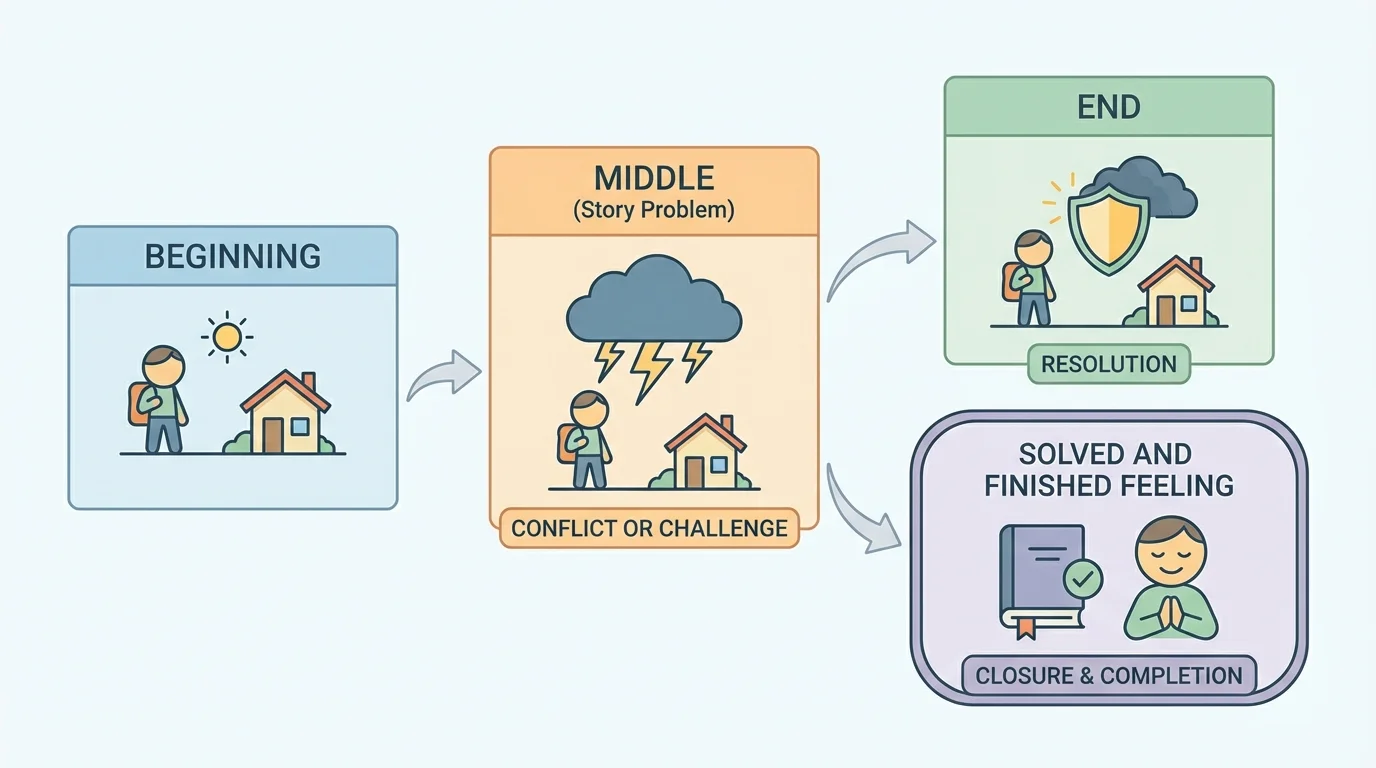
Think of a story like a trip. You start somewhere, travel through events, and then arrive. Closure is that arrival. It tells the reader, "This is where the story lands."
Closure is the feeling that a story has ended in a clear and meaningful way.
Narrative is a story about real or imagined events.
Ending is the final part of a story where the writer helps the reader feel the story is complete.
A writer does not add closure by writing only one word such as "The end." Closure comes from the events, details, and final sentences working together. The reader should be able to see how the ending connects to what came before.
Readers want to know what happened because they have followed the characters through the story. If a child loses a library book in the beginning, the reader wants to know whether the book is found. If two friends have an argument, the reader wants to know whether they make peace. If a character is nervous about a performance, the reader wants to know how it turns out.
Closure answers the important questions raised by the story. It also shows the result of the character's actions. Maybe the character succeeds. Maybe the character fails at first but learns something important. Maybe the main problem is solved in a quiet way instead of a big, exciting way. Any of these can work if the ending fits the rest of the story.
Readers also need the ending to match the tone of the story. A funny story may end with a playful surprise. A thoughtful story may end with a calm feeling or a lesson learned. When the ending matches the story, the whole narrative feels stronger.
Many favorite books and movies are remembered because of their endings. People often talk about the final scene because it helps them understand the whole story.
Closure is not only for long books. A personal paragraph about losing a tooth, a page about a soccer game, or a made-up story about a talking squirrel all need some kind of ending. No matter how short the story is, the reader should not be left wondering whether a page is missing.
[Figure 2] Writers can create closure in different ways, and this figure compares some of the most common choices. The best ending depends on the kind of story you are telling and what matters most in it.
One common way is to show that the problem has been solved. If the story is about finding a lost puppy, closure might come when the puppy is safely home. If the story is about building a treehouse, closure might come when the final board is nailed in place and the characters climb up to enjoy it.
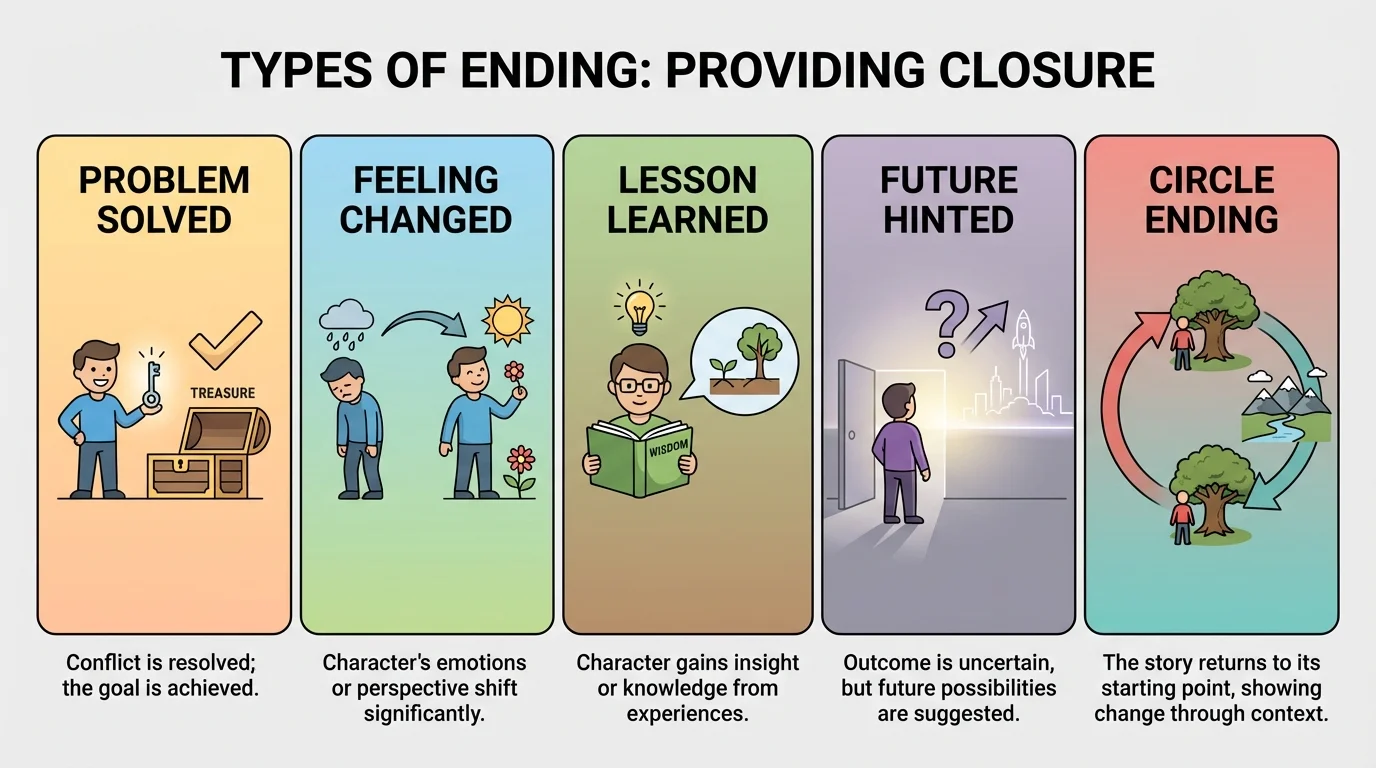
Another way is to show that a character's feelings have changed. In the beginning, a child may feel scared to join the school play. By the end, the same child might feel proud after speaking the first line on stage. The story ends not only with an event, but with a change inside the character.
A writer can also end by showing a lesson learned. For example, after rushing through a science project and making mistakes, a character might realize that careful work matters. This kind of closure helps the reader see why the events were important.
Some stories end by giving a small hint about the future. This still feels complete when the main event is finished first. For example, after winning the spelling bee, a character may smile and say, "Next year, I'm going for first place in math too." The spelling bee story is over, but the final line points ahead.
A special kind of ending is called a circle ending. This happens when the story ends by connecting back to the beginning. If a story starts with a girl staring at a bicycle she is afraid to ride, it might end with her ringing that same bicycle bell as she pedals down the sidewalk. The story comes full circle.
Different endings can all create closure. A strong ending does not have to be dramatic. It can be exciting, funny, peaceful, or thoughtful. What matters most is that it connects to the story's events and leaves the reader with a clear feeling that the narrative is complete.
As we saw in [Figure 2], these ending types are different, but they all answer the same need: they help the reader understand how the story comes to rest.
[Figure 3] A strong ending feels earned. It grows naturally from the events before it, and this figure shows how different that is from an ending that suddenly stops. The character's final action, thought, or words make sense because the story has been leading there.
A weak ending may feel rushed. It might introduce a brand-new problem in the last sentence. It might stop before the main event is settled. It might say something too general, such as "It was a nice day," even though the story was about something much more important.
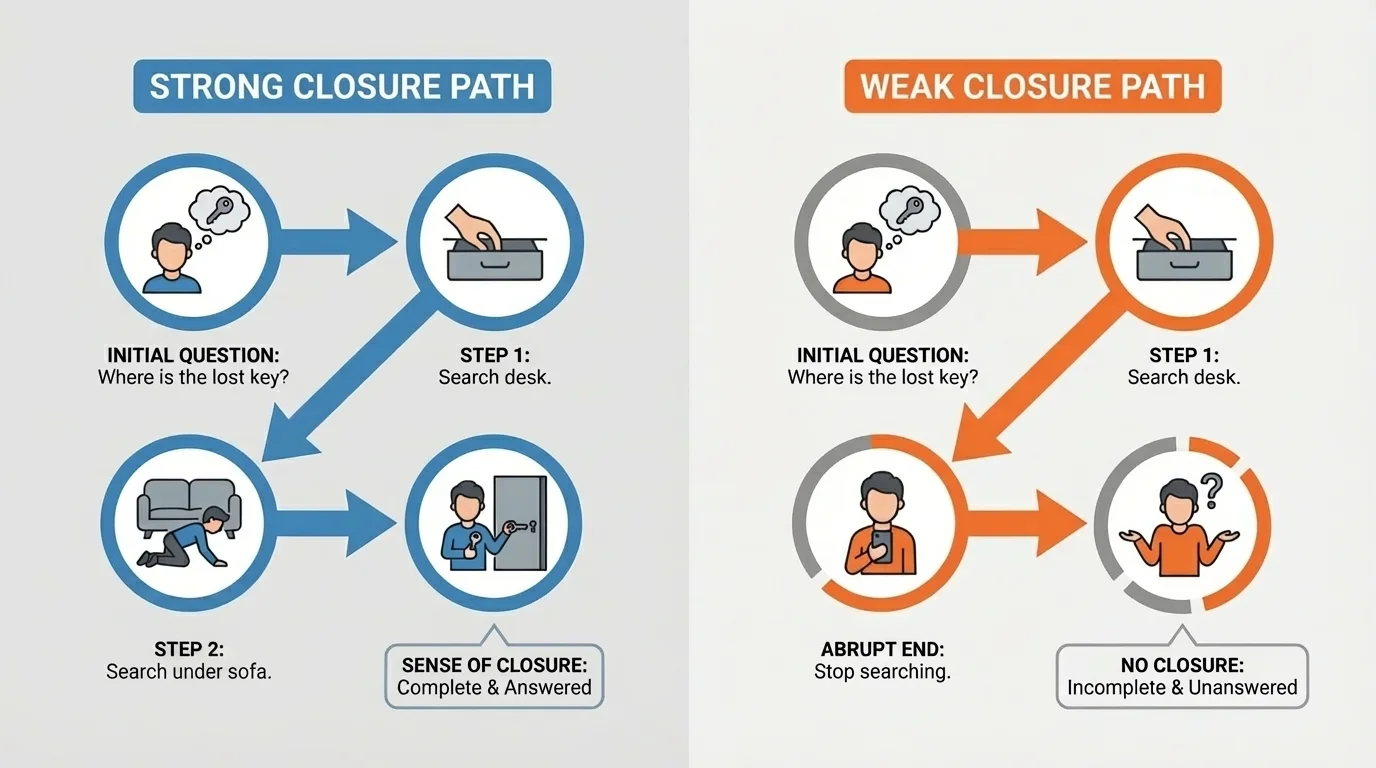
Look at this pair of endings for a story about a boy who trains for a race.
Weak ending: "Leo tied his shoe and looked at the track. Then he went home."
This ending leaves the reader wondering: Did he run the race? What happened after all that practice? The main part of the story is missing.
Strong ending: "Leo's legs shook at the starting line, but when the whistle blew, he ran harder than ever. He did not finish first, yet he grinned all the way to the water table because he had finally finished the race he once thought was impossible."
This stronger ending gives an answer. The race happens. Leo changes. The reader understands why the story matters. Later, when you check your own writing, think about the difference shown in [Figure 3]: does your ending answer the story's big question, or does it just stop?
Example: fixing an abrupt ending
Story idea: Maya is nervous about singing at the school concert.
Step 1: Read the weak ending.
"Maya stood behind the curtain. The music started."
Step 2: Notice what is missing.
The reader does not know whether Maya sings, how she feels, or what happens after the concert begins.
Step 3: Add closure.
"Maya took a deep breath and stepped onto the stage. Her voice trembled on the first line, but by the chorus she was singing loudly with the rest of the class. When the song ended, she saw her father clapping in the front row, and her nervousness melted into pride."
The revised ending shows action, feeling, and a clear finish.
Strong closure does not have to solve everything perfectly. Leo does not win the race, and Maya is nervous at first. What matters is that the ending completes the important event and shows the result.
The ending of a narrative should not be plain or empty. Descriptive details help readers see and feel what happens in the last moments. A writer can use action, dialogue, thoughts, and setting details.
Action shows what the character does. Instead of saying, "Sam was happy," a writer might say, "Sam jumped off the porch and waved the blue ribbon over his head." The action helps the feeling come alive.
Dialogue can make closure feel real. A line like "We did it!" or "I knew you could" can show success, relief, or friendship. Dialogue should sound natural and fit the story.
Thoughts can reveal what the character learned or understood. For example: "For the first time, Nia understood that being brave did not mean never feeling scared." A sentence like this can give the ending depth.
Setting details can help create a final mood. If a storm has been part of the story, the ending might mention sunlight breaking through the clouds. If a long school day is over, the ending might include the warm afternoon air outside the door. These details support the feeling of closure.
Good narratives have a clear sequence of events. The ending works best when it grows from that sequence instead of feeling dropped in at the last second.
The final part of a story often works best when it includes a mix of these details. A character acts, notices something, says something, or thinks something meaningful. The reader then feels that the story has truly arrived at its end.
A real narrative tells about something that actually happened. You might write about losing your first tooth, visiting a grandparent, moving to a new house, or learning to ride a scooter. In a real narrative, closure still matters because real events need clear endings too.
If your true story is about getting lost in a grocery store, your ending should not jump to a different event. It should show what happened when you were found and how you felt afterward. For example: "When I spotted my mom near the checkout line, I ran to her and grabbed her hand. The bright store suddenly felt safe again, and I promised myself I would stay close to the cart next time."
This ending works because it finishes the main event and shows the lesson or feeling that comes from it. The reader knows the important question has been answered.
Example: closure in a true story
Topic: The first time Elena rode a bike without training wheels.
Step 1: Main event
Elena wobbles, pedals alone, and reaches the end of the sidewalk.
Step 2: Ending with closure
"At the end of the sidewalk, Elena squeezed the brakes and put one sneaker on the ground. For a second she was too surprised to speak. Then she turned around and saw her brother cheering from the driveway. She laughed so hard she nearly tipped over, but this time she knew she could do it again."
The ending shows what happened, how Elena felt, and what changed.
Real narratives often end well with a feeling, reflection, or lesson because true experiences usually teach us something, even if the lesson is small.
An imagined narrative is made up, but it still needs a believable ending. The reader should feel that the story world follows its own rules. If your story is about a fox who enters a kite contest, the closure should connect to that contest, the fox's goal, and what happened during the story.
For example, a weak ending might be: "Then a dragon appeared and everyone flew away." Unless dragons were already part of the story, that ending feels random. It does not grow from the events before it.
A stronger ending might be: "When the wind finally lifted his patchwork kite above the hill, Tavi the fox forgot all about the torn paper and bent sticks he had worried over. The other animals clapped their paws and wings, and Tavi smiled at the kite dancing high above them. It was not the fanciest kite in the contest, but it was his, and it flew."
This ending gives closure because it returns to the fox's goal and shows the result. The character does not need to become king of the forest or discover treasure. The ending only needs to complete the story that was actually being told.
"A good ending feels surprising enough to be interesting and natural enough to feel right."
That idea is useful for imagined stories. The ending can delight the reader, but it should still make sense.
Writers often get ideas for beginnings first, but endings need planning too. Before writing the last sentences, ask yourself a few simple questions. What was the main problem or main event? What changed by the end? How does the character feel now? What should the reader remember most?
Your final sentence should leave the reader with a strong last impression. Here are some kinds of final sentences that can work well:
Not every ending needs a loud, dramatic sentence. Sometimes a quiet final line is the strongest choice. The key is that it fits the story.
One common mistake is an abrupt ending. This happens when the story stops too quickly. The reader feels as if the writer simply ran out of time.
Another mistake is adding a completely new event at the end. If a story is about a spelling bee, the ending should not suddenly become about finding buried treasure. New ideas can be exciting, but they can also break the sense of closure.
Some endings repeat the whole story instead of finishing it. A writer does not need to retell every event. Instead, the ending should focus on the most important result, feeling, or lesson.
Another mistake is using an ending that does not match the rest of the narrative. A serious story may feel odd with a silly ending. A funny adventure may feel strange if it suddenly ends in a gloomy way for no reason.
When you reread your narrative, ask: Does my ending connect to the beginning and middle? Does it answer the big question? Does it show what changed? If the answer is yes, your story is likely providing a strong sense of closure.
