Some words are used so often that readers notice right away when they are spelled incorrectly. If a sign said, "Pleese waite hear," you would probably still guess the meaning, but it would look strange and confusing. Good writers use conventional spelling so their ideas are easy to read. When you learn common spelling patterns, you do not have to guess as much. You can write with more confidence.
Spelling is part of clear communication. When you spell words correctly, your reader can focus on your ideas instead of stopping to figure out what a word means. Correct spelling also helps your writing look polished and careful.
Writers do not memorize every word in the English language at once. Instead, they learn patterns. They study common words, notice how words are built, and remember rules for adding endings. This helps them spell both familiar words and new words.
Conventional spelling means spelling words the standard, accepted way that readers expect to see them. A base word is a word that can stand on its own, such as help or smile. A suffix is a word part added to the end of a base word, such as -ed, -ing, -s, or -ness.
When writers use conventional spelling, they show command of standard English. This includes words that appear often in reading and writing, along with words that have been studied in class.
Some words appear again and again in books, directions, stories, and school writing. These are often called high-frequency words. Words like because, friend, said, could, where, and their do not always follow simple sound rules, so writers need to learn their correct spellings.
Other words are studied words. These may come from science, social studies, reading, or a class word list. For example, a student might study words such as planet, motion, community, or important. A strong speller learns these words by reading them carefully, writing them correctly, and noticing their patterns.
Sometimes students think spelling is only about sounding words out. Sounding out helps, but it is not enough for every word. English spelling includes patterns, history, and word parts. That is why studying common words matters.
Many of the most common words in English are not the easiest to spell. Because we use them so often, learning them well makes a big difference in every piece of writing.
When you know the correct spelling of common words, your sentences become smoother and easier to understand. That is especially important in stories, reports, directions, and responses to reading.
A suffix is added to the end of a word to change its meaning or job in a sentence. One word can grow into many related words, as [Figure 1] illustrates with a single base word and several endings. For example, the base word help can become helped, helping, or helpful.
The word that comes before the ending is called the base word. Writers need to look at the base word carefully before adding the suffix. Sometimes nothing changes. Sometimes a letter is dropped, changed, or doubled.
Suffixes can show time, number, or a new meaning. The suffix -ed often tells about the past, as in jumped. The suffix -ing can show an action happening now, as in jumping. The suffix -s can make a noun plural or show a present-tense verb, and -ness can turn an adjective into a noun, as in happy to happiness.
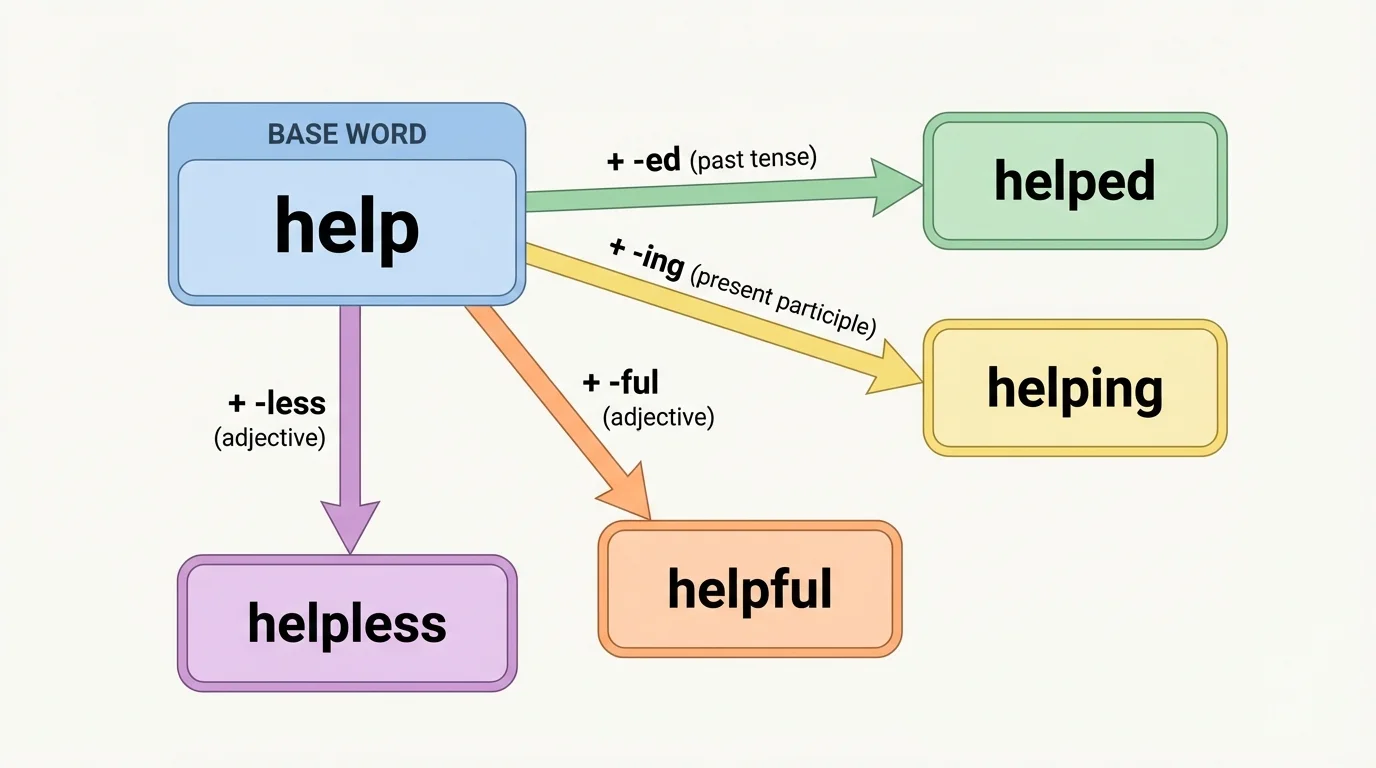
Knowing the base word helps you spell the new word correctly. If you can spot the word you started with, you can decide which spelling rule to use.
Many words are simple. You can just add the suffix without changing the base word. This happens when the word already ends in a way that works smoothly with the new ending.
Examples include jump to jumped, jumping, and jumps. The word dark becomes darkness. The word quick becomes quickly.
Here are more examples:
| Base Word | Suffix | New Word |
|---|---|---|
| play | -er | player |
| kind | -ness | kindness |
| thank | -ful | thankful |
| wish | -es | wishes |
Table 1. Examples of base words that keep their spelling when a suffix is added.
Even when a word follows the "just add" rule, it is still important to look carefully. A writer should ask, "Does this word stay the same, or is there a special change?"
Some base words end with a silent e. When you add a suffix that begins with a vowel, you often drop the final e. This keeps the word from having an extra letter.
For example, smile becomes smiled and smiling. The base word is smile. Before adding -ing, the silent e is removed, so smile + ing becomes smiling, not smileing.
More examples include hope to hoping, bake to baking, and love to loved. The final e is usually dropped before -ed and -ing.
But there are times when the e stays. If the suffix begins with a consonant, the e often remains. For example, safe becomes safely, and hope becomes hopeful. Looking at the first letter of the suffix helps you decide what to do.
Example: adding endings to words with silent e
Step 1: Look at the base word.
The base word is smile. It ends with a silent e.
Step 2: Look at the suffix.
The suffix -ing begins with a vowel.
Step 3: Apply the rule.
Drop the silent e and add the suffix: smile becomes smiling.
The correctly spelled word is smiling.
This rule explains words like smiled, which is one of the most common examples students see in their own writing.
Words that end in consonant + y often follow a special rule. If a consonant comes right before the y, you usually change the y to i before adding certain suffixes.
[Figure 2] For example, cry becomes cried and cries. The word happy becomes happier and happiness. In each case, the y changes to i first.
But if a word ends in vowel + y, the y usually stays. For example, play becomes played and plays. The word enjoy becomes enjoyed. Because the letter before the y is a vowel, the y does not change.
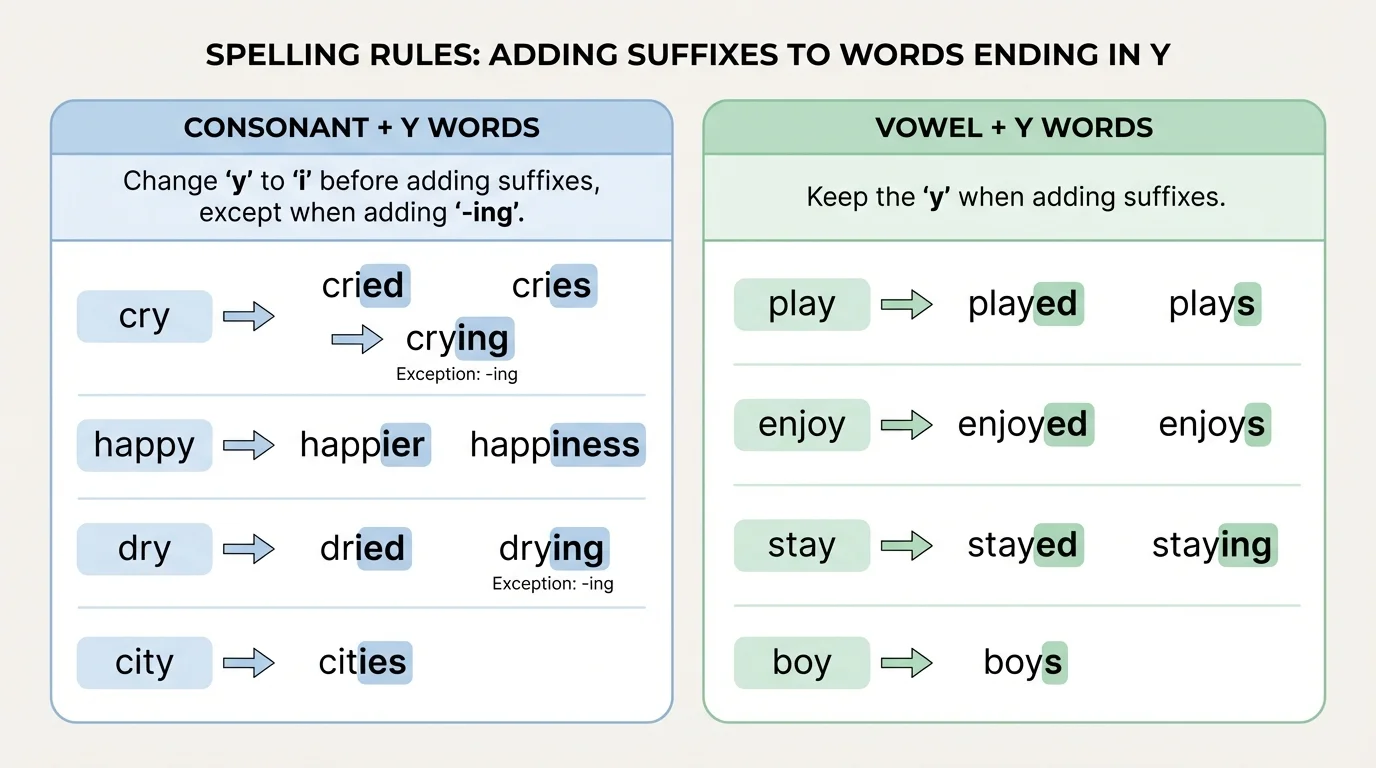
This is an important pattern because many common words use it. The word cries follows this rule exactly. So does happiness, which begins with happy and changes the y to i before adding -ness.
Later, when you edit your writing, you can use [Figure 2] in your mind as a simple check: if the word ends with consonant + y, the y usually changes; if it ends with vowel + y, it usually stays.
Sometimes a short one-syllable word ends with one vowel followed by one consonant. In many of these words, the final consonant doubles before adding -ed or -ing. This helps keep the vowel sound short.
[Figure 3] For example, sit becomes sitting. The final t doubles. The word hop becomes hopped, and run becomes running. These words have a short vowel sound followed by one consonant, so the final consonant is doubled.
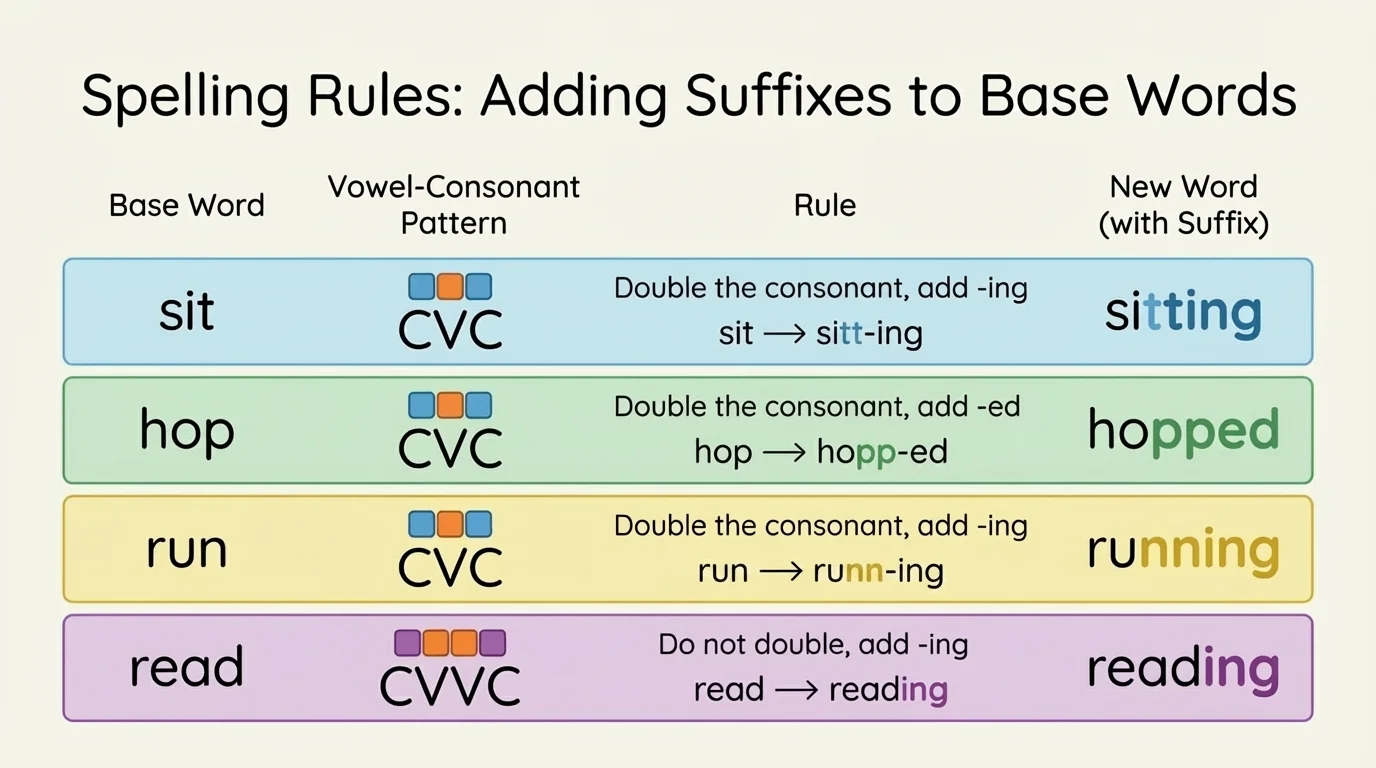
Not every word doubles. A word like read becomes reading, not readding. A word like need becomes needed, not needded. Writers listen for the short vowel pattern and also learn these forms through reading and writing.
The word sitting is a classic example of this spelling rule. If you wrote siting, it would look like a different word. Doubling the consonant keeps the spelling and sound correct.
How suffix rules work together
Good spellers do not memorize one giant list. They ask questions: What is the base word? What suffix am I adding? Does the word end with a silent e, a consonant + y, or a short vowel and one consonant? These questions help writers choose the correct spelling pattern.
When you know the common patterns, spelling becomes more logical. The word may still need careful attention, but it no longer feels completely random.
Some words do not fit the easiest patterns, or they are easy to mix up with other words. For example, their, there, and they're sound alike but have different meanings and spellings. Words such as said, does, and because may also need extra study.
Other words can be tricky because the spoken sound does not clearly match the spelling. A student might hear happyness, but the correct spelling is happiness. A student might try crys, but the correct form is cries. This is why knowing the base word and the rule is so useful.
Writers should also watch for accidental mistakes such as leaving out a doubled letter, keeping a silent e when it should be dropped, or changing y when it should stay. As we saw with [Figure 3], the final consonant doubles in words like sitting, but not in every word with an ending.
You already know that words are made of letters and sounds. Now you are adding another layer: many words are also built from parts, and those parts follow patterns when they join together.
Reading often helps with these careful words. The more times you see a correct spelling in books and your own writing, the easier it is to remember.
Spelling is not just something you think about after writing. It is part of the whole writing process. During planning, you may think of words you want to use. During drafting, you write your ideas and try your best spelling. During revising and editing, you check your words and fix mistakes.
When you edit, slow down and look closely at words with endings. Ask yourself: What is the base word? What suffix did I add? Did I just add the suffix, drop a silent e, change y to i, or double the final consonant?
For example, if you write, "The baby crys," you can stop and check the base word cry. Since the word ends with consonant + y, the correct form is cries. If you write, "I am smileing," you can notice the silent e in smile and change the word to smiling.
Editing examples in sentences
Step 1: Check the word siting.
The base word is sit. It has a short vowel and ends with one consonant, so the final consonant doubles before -ing.
Step 2: Correct the spelling.
siting becomes sitting.
Step 3: Check the word smileed.
The base word is smile. Drop the silent e before adding -ed.
Step 4: Correct the spelling.
smileed becomes smiled.
Careful editing turns almost-right spellings into correct spellings.
Strong writers know that editing is not a sign of failure. It is a normal part of writing well.
One helpful habit is to notice patterns instead of memorizing every word by itself. If you know how happy changes to happiness, you can use the same pattern with other words that end in consonant + y.
Another good habit is to look closely at words you use often. If a word appears in your writing again and again, it is worth learning well. That includes everyday words, words from reading, and words from subjects you study in school.
You can also pay attention while reading. Books, articles, and classroom texts show you conventional spelling again and again. Those correct patterns stay in your memory and support your own writing later.
"Good spelling helps good ideas shine."
When you know common spelling rules and use them carefully, your writing becomes clearer, stronger, and easier for others to enjoy.
