Have you ever noticed that if you can spell one word, you can often spell a whole group of words? If you know cake, you already have a clue for bake, lake, and snake. Spelling is not just about memorizing one word at a time. Good writers look for patterns. Those patterns make writing faster, easier, and more accurate.
When you write, you are doing more than putting ideas on paper. You are also choosing letters that match sounds, checking whether a word looks right, and using what you know about word parts and spelling rules. Strong spellers use what they already know to figure out unfamiliar words. That is why learning spelling patterns and generalizations is so useful.
Spelling patterns and generalizations are common ways words are built and spelled. They include word families, syllable patterns, ending rules, and meaningful word parts. These patterns do not explain every word in English, but they help with many of them.
English spelling has some tricky words, but it also has many regular parts. The more patterns you notice, the more confident you become as a writer. Instead of guessing, you can make smart choices based on what you know.
Writers in third grade are learning to plan, draft, revise, and edit. Spelling matters in every part of that process. During drafting, you want to keep your ideas moving. During revising and editing, you want your words to be clear and correct. Knowing patterns helps in both parts of writing.
For example, if you want to write about a hike, and you know the word bike, you can use that pattern to help spell hike. If you want to write about jumping, and you know the base word jump, you can add -ing and make jumping. Patterns are like tools in a toolbox. Different tools help with different spelling problems.
Some of the most common words in English are not spelled the way you might expect, but many longer words are actually easier to spell once you know their patterns and parts.
As you learn more patterns, you begin to notice that words are connected. A word may belong to a family, follow a syllable pattern, or include a prefix or suffix. Sometimes it does all three at once.
A word family is a group of words that share the same ending pattern. [Figure 1] This shared part helps writers spell many words. If you know one word in the family, you can often spell others by changing the first sound or sounds.
Here are some common word families: -at in cat, hat, flat; -ake in make, take, shake; and -ight in light, night, bright. The ending stays the same, and the beginning changes.
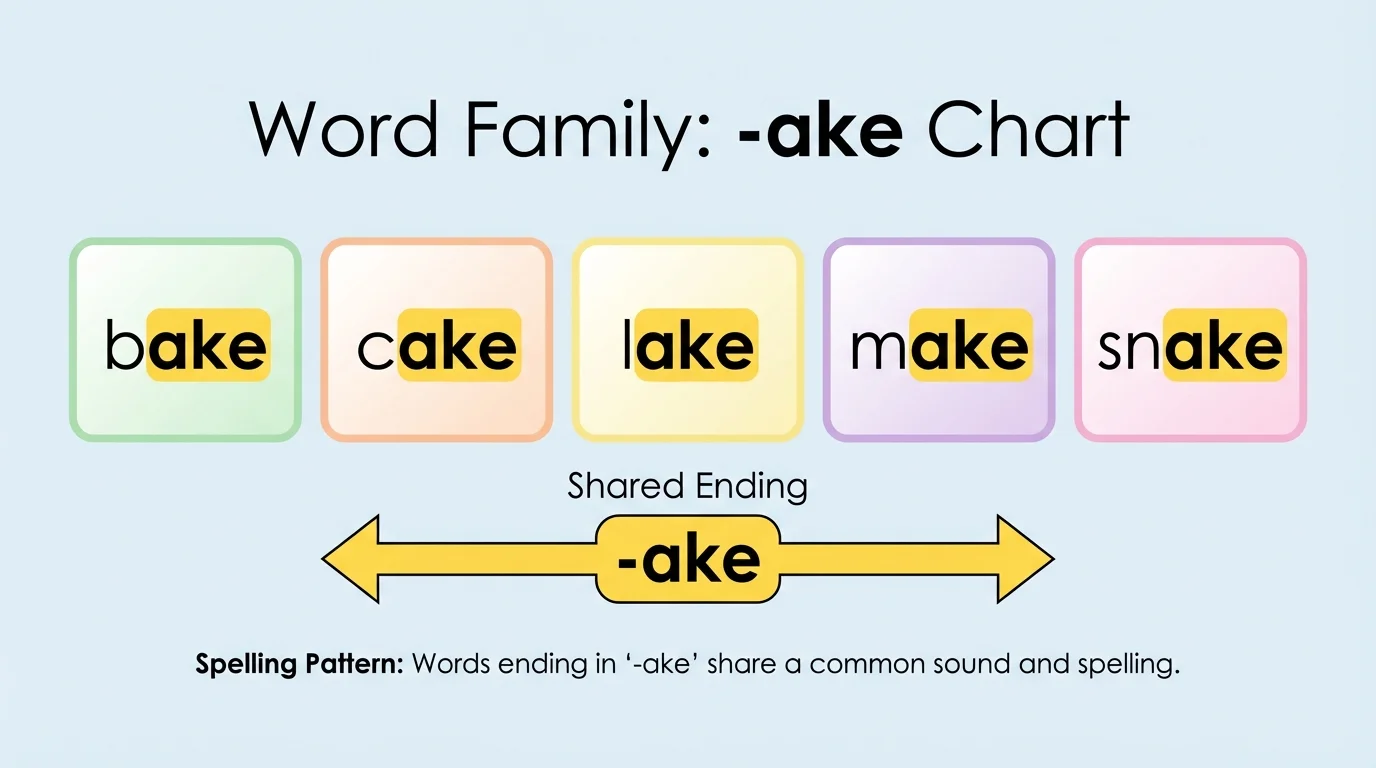
Word families are especially helpful when you hear a word and want to write it. If you hear train and already know rain, that known pattern can help you. If you know play, you can use that pattern for day and stay.
Sometimes word families have blends or digraphs at the beginning. For example, chip, ship, and slip do not all start with just one letter, but they still use useful ending patterns. Looking at the whole chunk of the word can make spelling easier.
Later, when you edit your writing, you can look for familiar chunks. If a word in your paragraph does not look right, ask yourself whether it belongs to a family you know. A strong ending pattern can guide your spelling.
Some spellings depend on where a sound comes in a word. These are called position-based spellings. The same sound may be spelled one way at the beginning of a word and a different way at the end.
One example is the sound /k/. At the beginning of a word, we often use c before the vowels a, o, and u, as in cat, corn, and cup. We often use k before e, i, and y, as in keep, kit, and key. These examples show a common pattern in English spelling.
Another example is the /j/ sound. At the beginning of a word, you may see j in jump or jar. At the end of a short word, the /j/ sound is often spelled dge, as in badge, bridge, and edge. In longer words or after a long vowel sound, it may be spelled ge, as in stage or cage.
The letter v is another useful clue. English words usually do not end with plain v. They often end with ve, as in give, have, and live. That final e helps the word fit a common English spelling pattern.
These position clues do not explain every word, but they help many times. If you are writing and pause on a word, think about where the sound is located. The position can give you a spelling clue.
Sound and position work together. Good spellers do not listen only for sounds. They also notice whether the sound is at the beginning, middle, or end of the word. That extra clue helps them choose between spellings that sound alike.
For example, if you are deciding how to spell the final /j/ sound in bridge, the short vowel in the middle helps you remember dge. If you are spelling cage, the long vowel points you toward ge.
A syllable is a word part with one vowel sound. [Figure 2] Syllables help writers break long words into smaller, easier parts. They also give clues about vowel sounds in different kinds of syllables.
One common pattern is the closed syllable. A closed syllable usually ends in a consonant, and the vowel often has a short sound. In pic-nic, both syllables are closed. The i sounds are short. In rab-bit, each syllable is also closed.
Another common pattern is the open syllable. An open syllable ends with a vowel, and the vowel often has a long sound. In ro-bot, the first syllable ro is open, so the o says its name. In ti-ger, the first syllable ti is open, and the i is long.
A third important pattern is the vowel-consonant-e pattern, sometimes called silent e. In words like hop and hope, the final e changes the vowel sound. Hop has a short o, but hope has a long o.
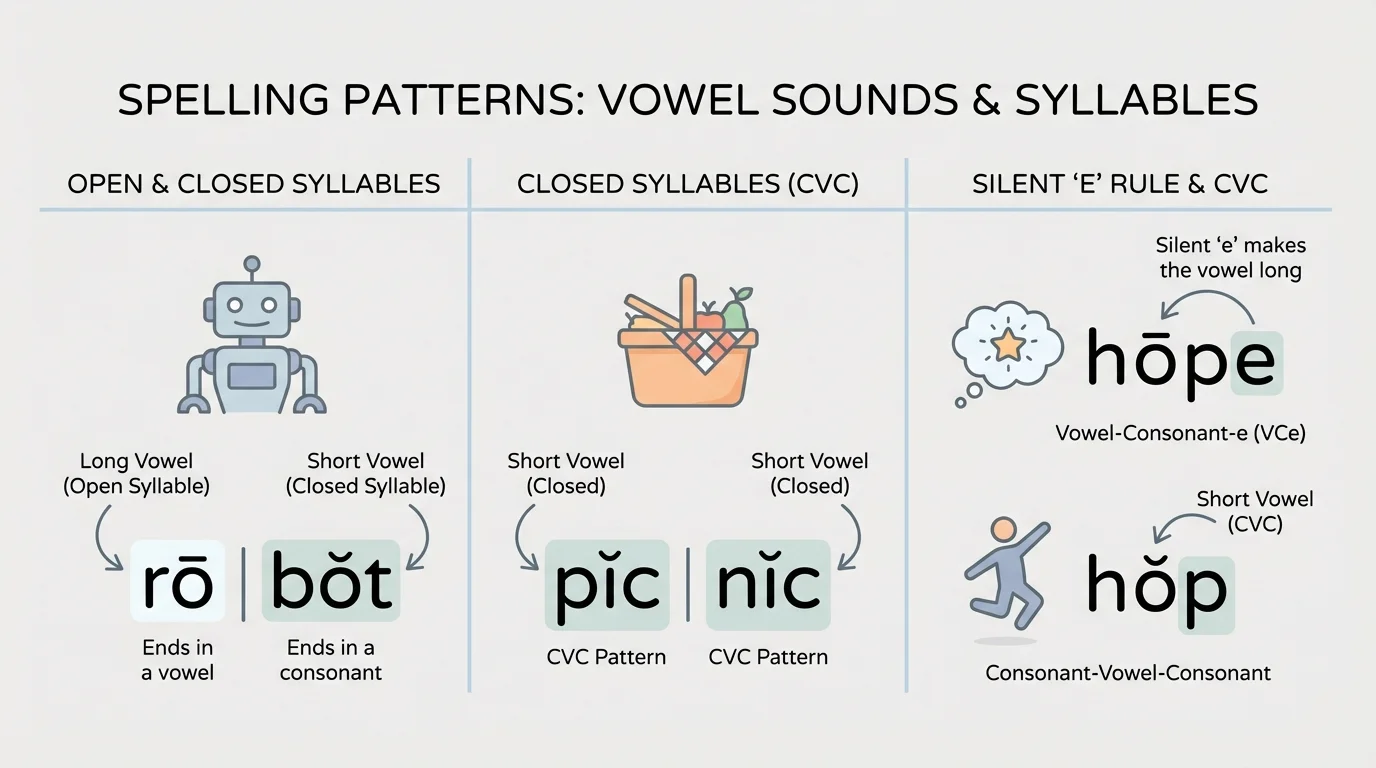
When you write longer words, syllables can help you hear and spell each part. For example, sunset can be thought of as sun and set. paper can be thought of as pa and per. Breaking words apart makes them less confusing.
This also helps during editing. If a long word looks wrong, divide it into syllables and check each part. Ask whether the vowel should be short, long, or changed by a final e.
You already know that vowels are a, e, i, o, and u. In spelling, vowels often give the biggest clues about how a word is built.
Not every word follows these patterns perfectly, but many do. The more words you read and write, the more familiar these syllable patterns become.
Many spelling changes happen when we add endings to words. Endings include -s, -es, -ed, and -ing. Learning these rules helps you write plural nouns and different verb forms correctly.
To make many nouns plural, add -s: cat becomes cats, and book becomes books. But if a word ends in s, x, z, ch, or sh, we often add -es: bus becomes buses, box becomes boxes, and dish becomes dishes.
Words ending in a consonant plus y often change the y to i before adding -es or -ed. For example, baby becomes babies, and cry becomes cried. But if the word ends in a vowel plus y, you usually keep the y: play becomes played, and toy becomes toys.
When adding -ing to a word with a silent e, we often drop the e. Make becomes making, and ride becomes riding. But words like see keep both vowels in seeing.
Some short words double the final consonant before adding -ed or -ing. For example, hop becomes hopped and hopping. Run becomes running. This often happens in short words with one vowel followed by one consonant.
| Base Word | Ending Added | New Word | What Happened |
|---|---|---|---|
| cat | -s | cats | Just add -s |
| dish | -es | dishes | Add -es |
| baby | -es | babies | Change y to i, then add -es |
| make | -ing | making | Drop silent e |
| hop | -ing | hopping | Double final consonant |
Table 1. Examples of common spelling changes when endings are added.
These rules help your writing look polished. When you reread your sentences, check words with endings carefully. A small change in spelling can make a big difference in correctness.
Using ending rules in writing
A student wants to write this sentence: "The puppy was hoping and then cryed." Some words need editing.
Step 1: Look at hoping.
The base word is hop. It is a short word with one vowel and one consonant at the end, so the final consonant doubles before adding -ing.
Step 2: Look at cryed.
The base word is cry. It ends with a consonant plus y, so change y to i before adding -ed.
Step 3: Rewrite the sentence.
The correct sentence is: The puppy was hopping and then cried.
Notice how the writer does not just guess. The writer uses a rule to fix each word.
Words often contain parts that carry meaning. These include a base word, a prefix, and a suffix. [Figure 3] Knowing these parts helps with both meaning and spelling when words are built from smaller pieces.
A base word is the main part of the word. In helpful, the base word is help. The suffix -ful is added to the end. In replay, the base word is play. The prefix re- is added to the beginning.
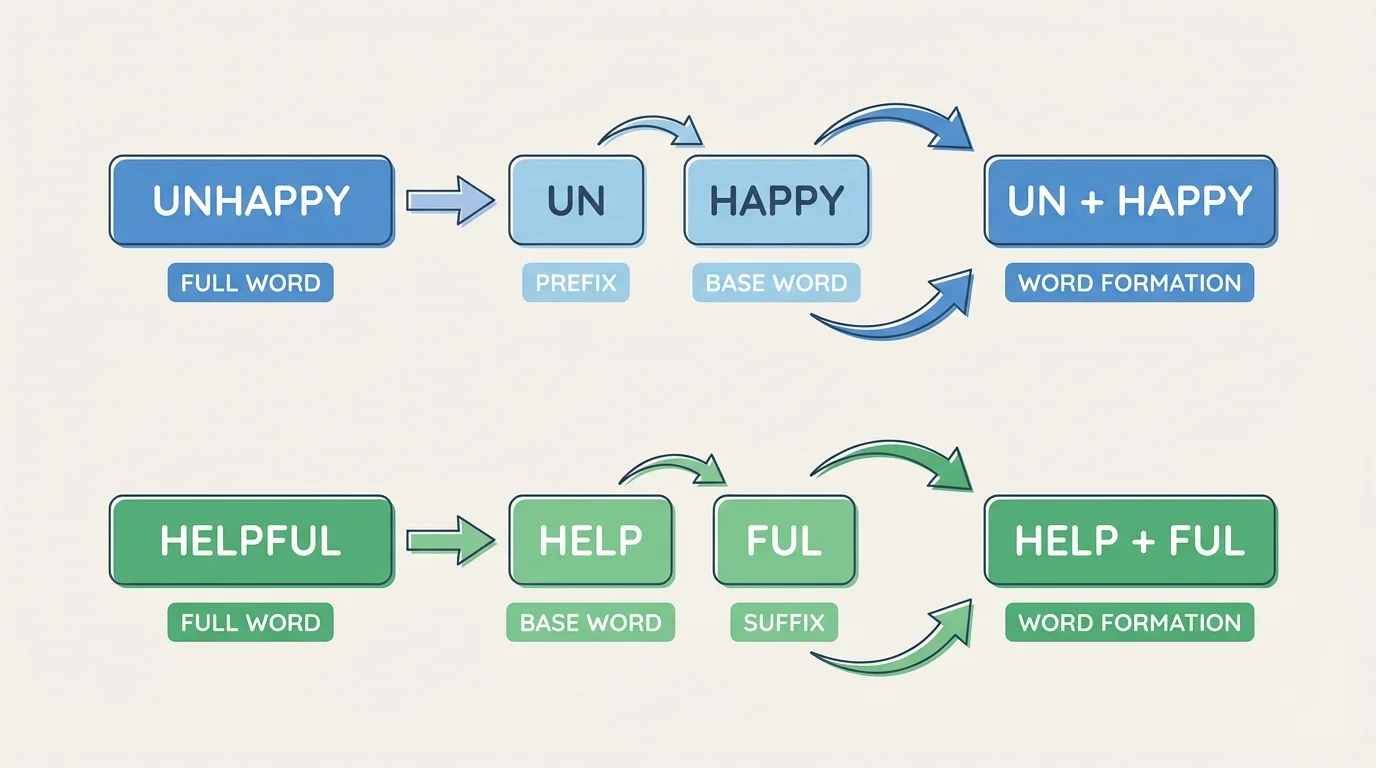
A prefix changes the meaning of a word. The prefix un- can mean "not," so happy becomes unhappy. The prefix re- can mean "again," so read becomes reread.
A suffix is added to the end of a word. The suffix -ful means "full of," so joyful means full of joy. The suffix -less means "without," so hopeless means without hope. The suffix -er can mean "a person who does something," so a teacher is a person who teaches.
Meaning helps spelling because word parts stay the same in many words. If you know how to spell help, you can use that spelling inside helpful and helper. It is easier to see how the parts join together.
Meaning supports memory. When you understand what a prefix, suffix, or base word means, the spelling is easier to remember because the word is not just a string of letters. It is a set of meaningful parts working together.
This matters in writing because many school words are built from parts. If you are writing about someone who is careful, cheerful, or fearless, you can use your knowledge of suffixes to help spell each word.
Good spelling is not only for spelling tests. It is part of real writing. When you plan and draft, you may not stop for every word, but you should use patterns to make strong guesses. When you revise and edit, you return to those words and check them carefully.
Suppose you write, "I was makeing a thank-you card for my teacher." During editing, you may notice that makeing does not look right. You can think of the base word make and the ending rule for -ing. Since make ends with silent e, you drop the e and write making.
Suppose you write, "The foxs ran into the boxes." You can check your plural endings. Boxes is correct because box takes -es. But foxs should also be foxes because fox ends in x.
Suppose you write, "My little bruder likes to help." If you are unsure about brother, you can use what you know from reading and from noticing common letter patterns. Some words must be remembered from practice and reading, but pattern knowledge still helps you decide whether a spelling looks reasonable.
Writers often ask themselves questions like these while editing: Does this word belong to a family I know? Does the ending follow a rule? Can I break the word into syllables? Does the word have a prefix, suffix, or base word? These questions turn spelling into thinking, not guessing.
Editing with spelling patterns
A student writes: The children were rideing their bikes and playing in the sunny park.
Step 1: Check rideing.
The base word is ride. When adding -ing, drop the silent e. The correct word is riding.
Step 2: Check sunny.
This word does not take an ending here. It is spelled sunny with double n in its usual form.
Step 3: Rewrite the sentence.
The children were riding their bikes and playing in the sunny park.
Reading and writing often work together. The more you read, the more correct spellings you see. The more you write, the more chances you have to use patterns on your own. Over time, familiar patterns become automatic.
Spelling generalizations are helpful, but they are not perfect rules for every word in English. Some words are unusual and must simply be learned. Still, patterns give you a strong starting place. They help you write more clearly and edit more wisely.
"Good writers do not know every word by memory alone. They use patterns, parts, and careful checking."
When you use word families, position clues, syllables, ending rules, and meaningful word parts, you are building a smart spelling system. That system helps your ideas shine because readers can focus on your message.
