Have you ever written a great sentence and then got stuck on just one word? That happens to real writers every day. A strong writer does not need to know every spelling right away. A strong writer knows how to check. Reference materials help writers solve spelling problems, fix mistakes, and make their writing easier for others to read.
When you write, you are not finished after your first try. Writers often plan, draft, revise, and edit. During editing, you look closely at your words, sentences, punctuation, capitalization, and spelling. If a word does not look right, you can use tools to help you correct it. Learning how to use those tools makes you a more independent writer.
Correct spelling matters because writing is for readers. If many words are misspelled, the reader may stop, guess, or misunderstand the message. For example, if someone writes "I lik to pla at rechs," a reader can probably figure it out, but it takes extra work. If the sentence is written as "I like to play at recess," the meaning is clear right away.
Checking spelling also shows care. When writers take time to edit, their work looks polished and thoughtful. This is true in stories, science notes, letters, directions, and reports. Even adults use dictionaries and other tools when they are unsure. Looking up a word is not a weakness. It is a smart writing habit.
Reference materials are tools that help a writer find information. For spelling, reference materials can include a beginning dictionary, a glossary, a classroom word wall, a personal word notebook, and trusted digital tools.
Edit means to check writing carefully and fix mistakes in spelling, capitalization, punctuation, and grammar.
Different tools help in different ways. A word wall may help you remember a word you use often. A glossary may help with special words from a science or social studies book. A dictionary is especially useful when you need to check the exact spelling of a word.
One important spelling tool is a beginning dictionary. A beginning dictionary is made for young readers and writers. It usually has simple definitions, large print, and sometimes pictures. It helps students find words, check spellings, and learn what words mean.
Another useful tool is a glossary. A glossary is a short list of important words and meanings found in the back of a book. If you are writing about frogs, magnets, or communities, a glossary can help you spell topic words correctly.
Writers can also use a classroom word wall, anchor charts, labels around the room, and personal spelling lists. These tools are helpful because they contain words students use often. If you are not sure how to spell because, friend, or favorite, you might find the word on a wall or chart before you even open a dictionary.
Today, many writers also use digital reference tools. These tools can be helpful, but young writers still need to know how words work. If a computer changes a word, you should still read it and make sure it matches what you mean. The tool helps, but the writer is still in charge.
[Figure 1] A dictionary is easier to use when you understand its parts. The page layout helps readers find words quickly because words are arranged in alphabetical order. That means the words go from a to z. If you want to find basket, you look in the section for words that begin with b.
At the top of many dictionary pages, you will see guide words. These are words that tell you the first and last entry on that page. Guide words help you know whether the word you want is on that page or whether you need to turn forward or backward.
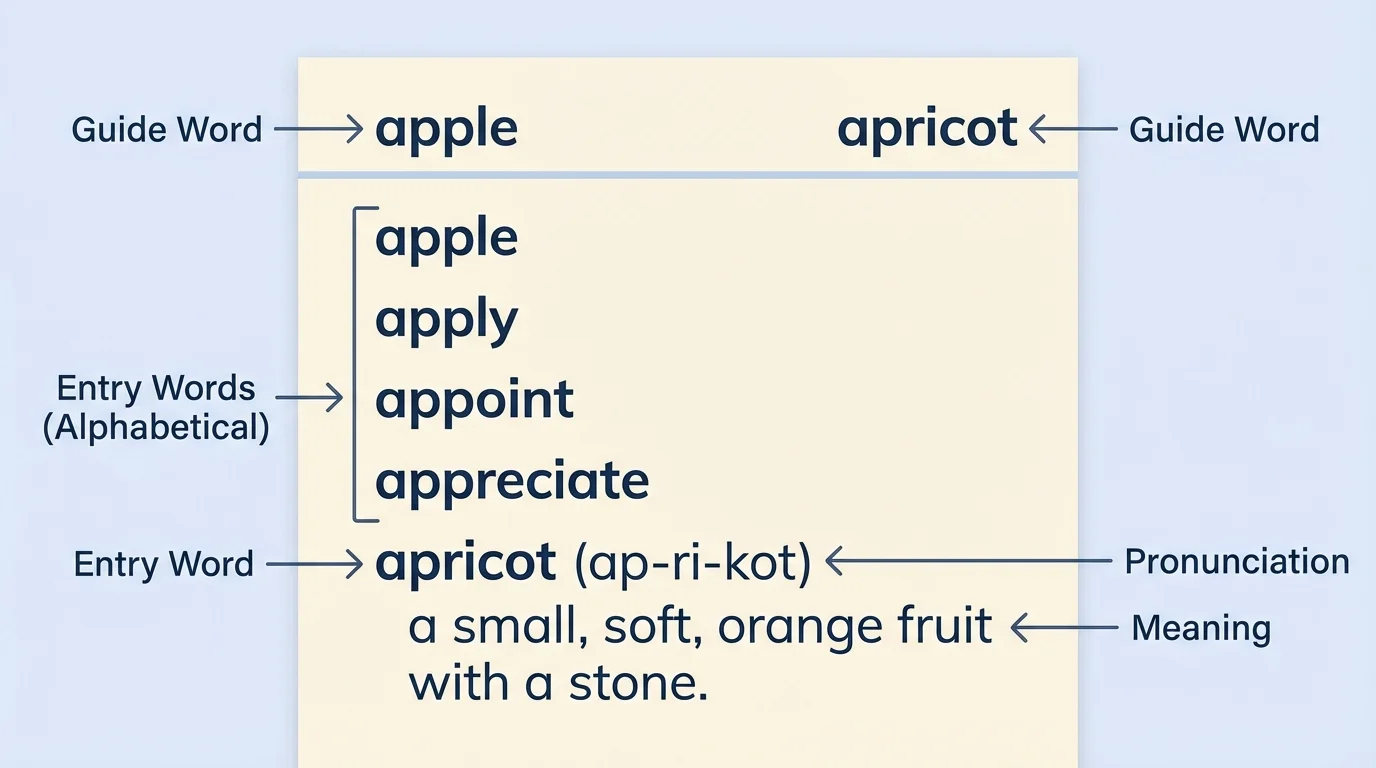
Each dictionary word is called an entry word. An entry often shows the word's spelling, how to say it, and what it means. Some beginning dictionaries also show a picture. If you look up branch, the entry tells you that the word is spelled b-r-a-n-c-h. That exact spelling is what you use to correct your writing.
Sometimes the dictionary shows words broken into syllables. Syllables are the parts you hear when you clap a word. For example, kitten has two syllables: kit and ten. This can help you say the word slowly and notice the letters in each part.
When you use guide words and alphabetical order together, you can search much faster. Instead of flipping through many pages, you can move straight to the place where the word belongs.
| Dictionary Part | What It Helps You Do |
|---|---|
| Alphabetical order | Find the correct section of the dictionary |
| Guide words | Check whether your word is on a page |
| Entry word | See the exact spelling of the word |
| Meaning | Make sure it is the word you want |
| Syllables or pronunciation help | Say the word and hear its parts |
Table 1. Main parts of a beginning dictionary and how each part helps with spelling.
[Figure 2] Writers can follow a simple process when a word looks wrong, and this figure shows the sequence from noticing a problem to fixing it. You do not need to panic when you are unsure. You just need a plan.
Step 1: Notice the tricky word. Maybe it "looks funny," or maybe you are not sure which letters belong in it. For example, you might write jumpt and wonder if it is correct.
Step 2: Say the word slowly. Stretch it out and listen for sounds. For jumped, you can hear jump and the ending ed. That helps you think about possible letters.
Step 3: Think about the first few letters and look in the dictionary. If you are checking jumped, start with j-u-m-p. Use alphabetical order to find words around it, as shown in [Figure 2].
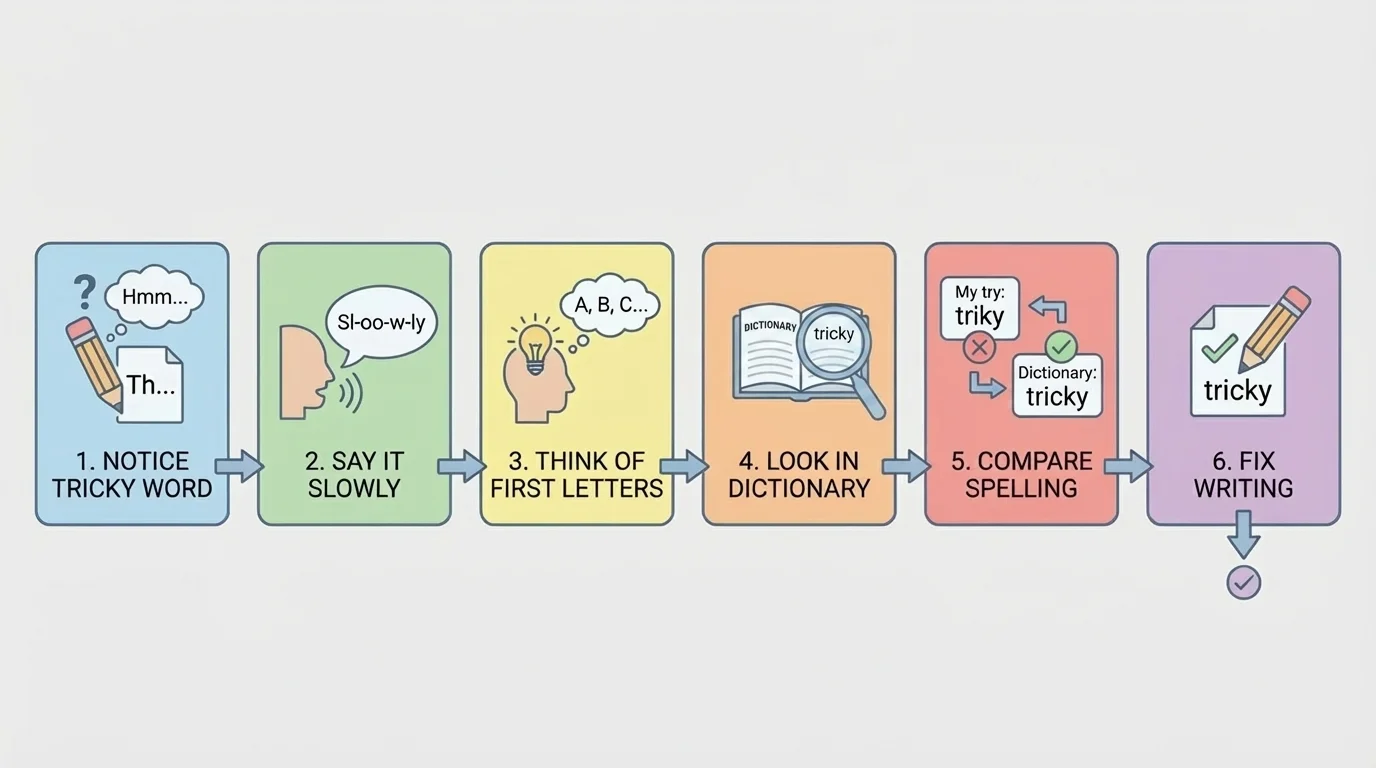
Step 4: Find the correct word and compare it to your writing. If the dictionary says jumped and your paper says jumpt, you can see the difference right away.
Step 5: Correct the word in your writing. Then reread the whole sentence to make sure it still sounds right.
Example: Checking a word in a sentence
A student writes: "We viseted the animal shelter."
Step 1: Notice the word that does not look correct.
The word viseted may not be correct.
Step 2: Say the word slowly.
The writer hears visit plus the ending ed.
Step 3: Look up the base word.
The dictionary shows visit. The past-tense form is spelled visited.
Step 4: Correct the sentence.
The corrected sentence is "We visited the animal shelter."
This process works even when the word is harder. If you cannot find the exact word, try the base word. For example, if you cannot find running, look for run. If you cannot find happiest, look for happy. You are using what you know about words to help you search.
Later, when you are editing a longer piece, the same steps still help, just as we see in [Figure 2]. Good writers repeat the process whenever they come to another uncertain word.
[Figure 3] Writing does not move in a straight line. It often loops through steps again and again in the writing cycle. A writer may start with a plan, write a draft, revise ideas, edit mistakes, and then return to an earlier step. This is called a recursive process because writers sometimes go back and try again.
During drafting, it is okay not to stop for every hard word. Some writers keep going so their ideas do not disappear. They may circle a word, underline it, or write their best guess and come back later, as shown in [Figure 3].
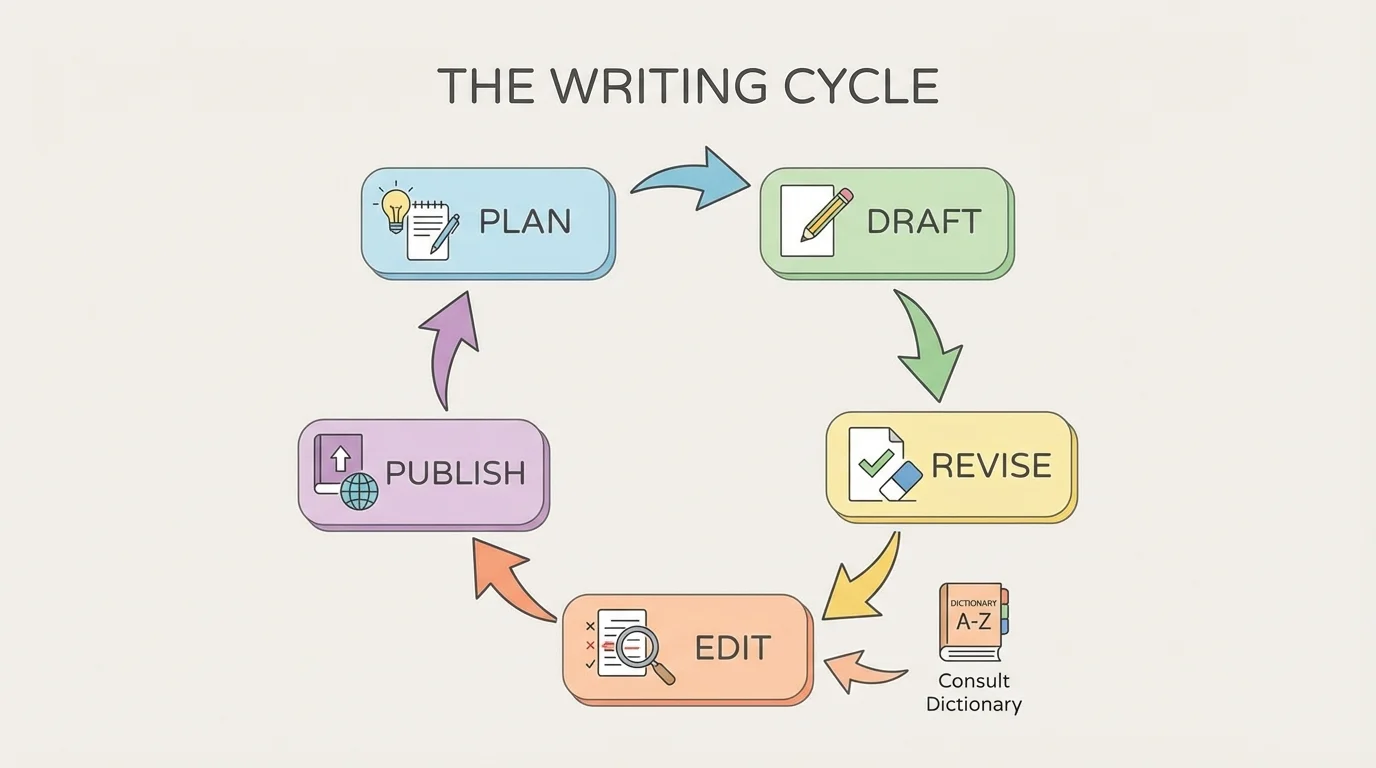
During revising, writers improve ideas, add details, move sentences, or remove parts that do not fit. Revising is mostly about making the writing better in meaning and organization.
During editing, writers focus closely on conventions such as spelling, punctuation, capitalization, and grammar. This is one of the best times to use a dictionary. You can reread your work line by line and stop at each word that seems uncertain.
The writing cycle in [Figure 3] reminds us that writers may edit, then notice they need to revise a sentence, then edit again. Reference materials are helpful all through the process, but they are especially important near the end when you are preparing your best version.
Some words are difficult because English spelling does not always match sound in a simple way. That is why writers need strategies as well as tools.
One strategy is to listen for every sound you can hear. Another is to think about word parts. In the word played, you can see the base word play and the ending ed. In helping, you can see help and ing. Looking at parts makes long words easier to check.
Silent letters can also cause trouble. In knock, the k is silent. In write, the w is silent. If your first guess leaves out a silent letter, the dictionary helps you find the correct spelling. You may need to try a nearby word or ask for help finding the base word.
Why some spellings are hard
English words come from many places and have many patterns. Some words follow common sound rules, and some do not. That is why writers use both what they hear and what they can check in a reference tool.
Double letters can be tricky too. Think about little, summer, and rabbit. A writer may forget one of the doubled consonants. If the word looks wrong, check it. The dictionary gives the exact letter pattern.
Endings matter. A writer might confuse hoped and hopping, or stopped and stoping. Reference materials help you see the correct form. Over time, seeing the right spelling again and again helps your memory grow stronger.
Some words are often confused because they sound alike or almost alike. For example, there, their, and they're are different words with different meanings. A dictionary helps not only with spelling but also with meaning, so you can choose the right word.
A dictionary is important, but it is not the only useful tool. If you are writing about a class topic, a glossary may be faster because it contains the special words from that subject. If you are writing a story that uses words already on the classroom wall, the word wall may be the quickest place to look.
A personal dictionary or writing notebook can help too. Some students keep a list of words they use often and words they have learned to spell. This makes a growing record of strong words. If you misspell because three times, adding it to your notebook gives you a tool you can use again and again.
Adults can also be reference helpers. A teacher, parent, or librarian may help you figure out where to search if you cannot find a word. But it is best to try your own strategies first: say the word slowly, think of the base word, and use alphabetical order.
Many dictionaries include more than spelling. They can also tell you what a word means, how to pronounce it, and sometimes where it came from. That means one tool can answer several questions at once.
When you use the right tool for the job, spelling becomes less mysterious. You are not just guessing. You are checking carefully and making choices based on information.
One good habit is to reread slowly. When you read your writing too fast, your brain may skip over mistakes. Reading one sentence at a time helps you notice misspelled words.
Another good habit is to check important words first. Make sure you spell names, places, and topic words correctly. If you are writing about Colorado, Jupiter, multiplication, or butterflies, those words matter because they carry key information.
It also helps to keep your writing neat when you make corrections. If you cross out and rewrite carefully, you can still read the sentence clearly. Writers want their final piece to be easy for others to understand.
You do not need to stop every few seconds while drafting, but you should return to spelling during editing. The goal is not perfect first tries. The goal is clear final writing.
Remember: Writers use a process. They plan ideas, draft their thoughts, revise to improve meaning, and edit to fix conventions. Spelling checks belong especially in the editing stage, but writers may use reference tools at any point when needed.
As you grow as a writer, you will begin to notice patterns and remember more spellings on your own. Still, even skilled writers use dictionaries and other reference materials. Careful checking is part of real writing.
