Have you ever heard someone tell a story that sounded like a pile of blocks falling over? It might go like this: "Soccer is fun. I like running. My friends play. We learn teamwork." The ideas are good, but they do not feel connected. Writers use special words to join ideas together so their writing sounds smooth, clear, and strong.
When you write an opinion piece, you are telling what you think and why you think it. Good opinion writing does more than list reasons. It helps the reader follow your thinking. If your ideas are connected well, your reader can understand your opinion more easily.
A strong opinion piece usually has an opinion, some reasons, and details or examples that support those reasons. Linking words and phrases act like bridges. They help the reader move from one idea to the next.
Linking words and phrases are words that connect ideas in writing. They can add information, show a different idea, give reasons, or connect examples. In opinion writing, linking words help the writer explain a point of view clearly.
Without linking words, writing can sound jumpy. With linking words, writing sounds more like a complete explanation. This is especially important when you are trying to convince someone that your opinion makes sense.
A linking word or phrase connects one idea to another. Some linking words add ideas. Some show contrast, or a difference. Some explain a reason. In this lesson, we will focus especially on words such as and, also, another, more, and but.
Look at these two versions of the same idea:
Version 1: "Our class should have more read-aloud time. Books are interesting. We learn new words."
Version 2: "Our class should have more read-aloud time because books are interesting, and we learn new words."
The second version sounds smoother because the ideas are connected. The linking word and joins two reasons. The word because connects the opinion to the reasons.
Very small words can do very big jobs in writing. A single word like but can change the direction of a whole sentence.
Writers do not choose linking words at random. They choose them carefully. The best linking word depends on how the ideas are related.
Sometimes a writer has many reasons for an opinion. Instead of putting them in a messy pile, the writer can place them into a category, or group, based on how the ideas go together. In opinion writing, this helps the reader stay organized, as [Figure 1] shows with one opinion connected to groups of reasons and details.
For example, suppose your opinion is: "School gardens are a great idea." Your reasons might fit into categories like learning and health. Under learning, you could include "students study plants" and "students observe insects." Under health, you could include "students try vegetables" and "students spend time outdoors."
When ideas are grouped this way, you can use linking words inside each category. That makes your writing easier to read. Instead of jumping from one random reason to another, you build one group of ideas and then move to the next group.
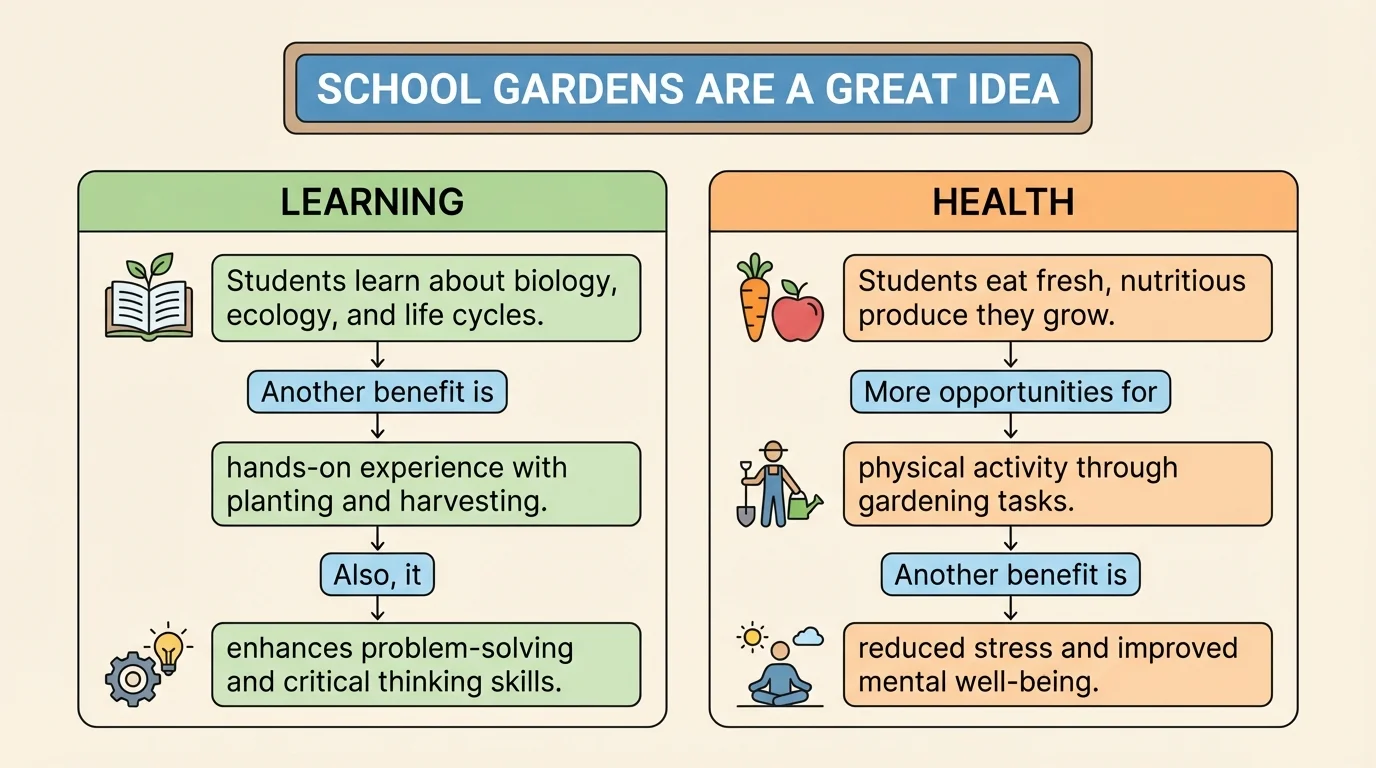
You can think of categories as boxes. Each box holds related ideas. Linking words help you connect the ideas inside each box, and they also help you move from one box to another.
Later, when you write a full paragraph, these categories help your reasons stay together. If your first category is about learning, you can use linking words to connect all the learning reasons before moving on.
Many linking words have the job of adding information. These words help a writer build a stronger explanation one piece at a time. Some common additive linking words are and, also, another, and more.
And is one of the most common linking words. It joins two related ideas, as [Figure 2] shows. For example: "Recess is important, and it helps students move their bodies." The second idea adds to the first one.
Also adds another thought. For example: "Recess is fun. It also helps students focus in class." Here, the writer adds a second reason.
Another is often used to introduce one more reason. For example: "Another reason to have recess is that children learn to cooperate." This tells the reader that a new reason is coming.
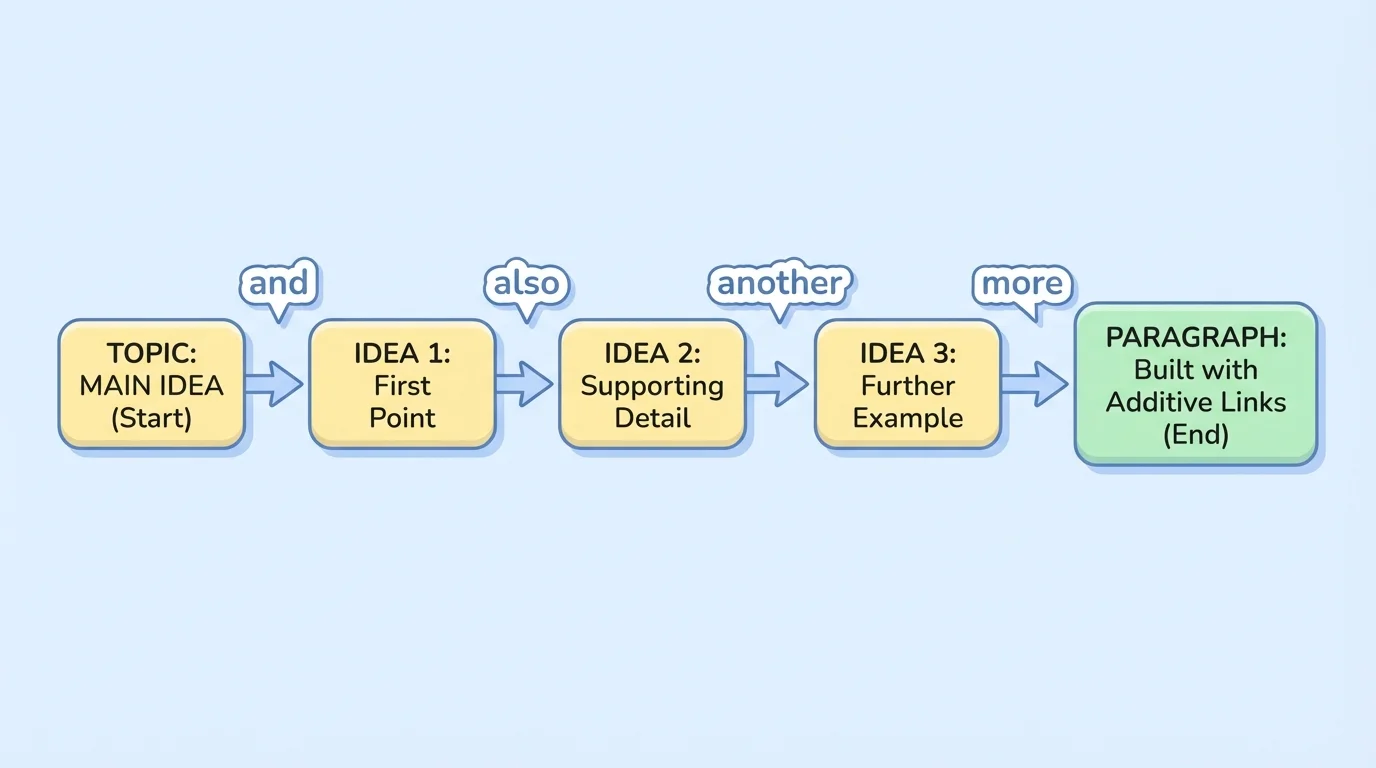
Phrases with more can help a writer extend or strengthen a point. For example: "Reading at home helps children practice. More importantly, it can make reading feel enjoyable."
Notice how these linking words do not all sound exactly the same. They all add ideas, but they are used in slightly different ways. And joins ideas inside one sentence. Also often adds a sentence-level idea. Another often begins a new reason. More can strengthen or extend an idea.
Example: Adding reasons to support an opinion
Opinion: "The library should stay open longer after school."
Step 1: State one reason.
"The library should stay open longer after school because students need a quiet place to work."
Step 2: Add a second reason with a linking word.
"The library should stay open longer after school because students need a quiet place to work, and they can get help finding books."
Step 3: Add another reason in a new sentence.
"It also gives students time to read while they wait for rides. Another benefit is having access to computers."
The linking words make the opinion sound fuller and more connected.
As you keep writing, the pattern in [Figure 2] stays useful: one idea leads to the next, and each connector tells the reader that the writer is still building the same point.
Sometimes writers want to show that two ideas are different or do not match. A contrast word helps with that. The most common one for young writers is but. It shows a change in direction.
For example: "Video games can be exciting, but too much screen time can be unhealthy." The first part gives one idea. The word but tells the reader that a different idea is coming next, as [Figure 3] shows.
In opinion writing, but can help a writer be honest and thoughtful. A writer can admit that something has one good side and still explain why another side matters more. For example: "Homework can take time, but it helps students practice what they learned."
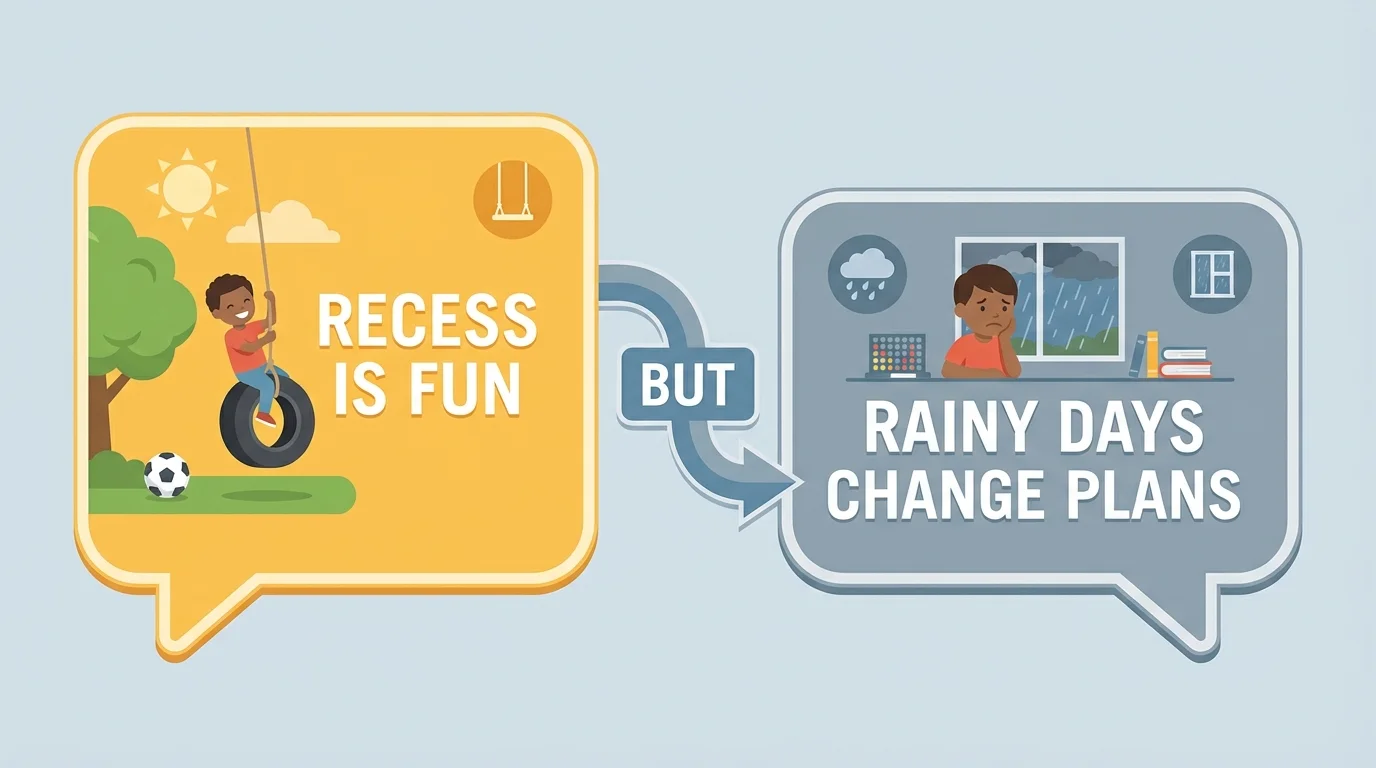
This kind of sentence sounds balanced. It shows that the writer has thought carefully. That often makes the opinion stronger.
Writers should use contrast words carefully. If the ideas do not really disagree, then but is not the best choice. For example, "Art is creative, but students use many colors" sounds strange because those ideas do not contrast. A better sentence would use and.
You already know that a sentence needs to make sense from beginning to end. Linking words do not fix weak ideas by themselves. They help connect ideas that already belong together.
Later, when you compare two thoughts in your own writing, remember the contrast in [Figure 3]. The connector should clearly signal a change, not just fill space.
An opinion piece often begins with a clear statement of what the writer believes. Then the writer adds reasons. After that, the writer may give examples or details. Linking words help at every part.
Here is a short pattern:
Opinion: "Pets can be great for families."
Reason 1: "They teach responsibility."
Reason 2: "They can be good companions."
Now connect the ideas: "Pets can be great for families because they teach responsibility, and they can be good companions. Also, caring for a pet helps children build daily habits."
Notice that the writer does not just drop in random facts. The writer starts with an opinion, then connects each reason in a way that makes sense. This is what strong organization looks like.
How linking words help a reader think
When a reader sees a linking word, the reader gets a clue. The clue says, "I am adding another idea," or "I am showing a difference," or "I am giving a reason." These clues make writing easier to follow and easier to believe.
If you are writing about a book, linking words can help you connect your thoughts about the story. If you are writing about a school rule, linking words can help you connect your reasons for agreeing or disagreeing. The same skill works across many topics.
Good writers ask themselves, "What job does this word need to do?" If the next idea adds to the first one, use an adding word like and or also. If the next idea is different, use but. If you are bringing in a new reason, another may fit well.
Look at this chart:
| Linking word or phrase | Main job | Example |
|---|---|---|
| and | Adds a related idea | "Music is relaxing, and it can improve mood." |
| also | Adds another idea | "It is fun. It also brings people together." |
| another | Introduces one more reason | "Another reason is that it saves time." |
| more | Extends or strengthens an idea | "More importantly, it keeps students safe." |
| but | Shows contrast | "It is difficult, but it is worth learning." |
Table 1. Common linking words and phrases, their jobs, and sample uses in opinion writing.
This chart shows that the words are not interchangeable. You cannot replace every connector with every other connector. The choice depends on the meaning you want.
One common mistake is repeating the same linking word too many times. A paragraph that says "and" over and over can sound dull. Writers can vary their language by using also, another, or more when those words fit better.
Another mistake is using a linking word that does not match the ideas. If the ideas add together, use an adding word. If the ideas contrast, use but. A wrong connector can confuse the reader.
A third mistake is writing a list instead of a connected paragraph. Compare these:
List-like writing: "Longer lunch is good. Students eat better. Students relax. Students return calmer."
Connected writing: "Longer lunch is good because students eat better and have time to relax. Also, they may return to class calmer."
Example: Fixing choppy writing
Choppy version: "Our class should recycle. It helps the Earth. It teaches responsibility. It reduces waste."
Step 1: Find ideas that belong together.
The ideas all support the same opinion.
Step 2: Add linking words.
"Our class should recycle because it helps the Earth and teaches responsibility."
Step 3: Add one more reason smoothly.
"Also, it reduces waste in our school."
The new version sounds more complete and easier to follow.
Strong writers reread their work and listen for places where the writing sounds bumpy. Often, a good linking word can smooth the path.
Now look at a full opinion paragraph: "Students should have more time for art. Art lets children use imagination, and it helps them express feelings. Also, art projects can build patience and focus. Another reason is that art connects to other subjects, such as history and science. Art can sometimes be messy, but the learning is worth it."
This paragraph works well because the writer has a clear opinion and connected reasons. The adding words build the case step by step. The contrast word but shows that the writer understands another side and still keeps the opinion strong.
Notice, too, that the reasons could be grouped into categories. One category is personal growth, with ideas like imagination and expressing feelings. Another category is learning skills, with ideas like focus and connections to other subjects. That kind of organization helps the paragraph stay clear, just like the grouped reasons in [Figure 1].
"Good writing helps the reader follow your thinking."
When you write your own opinion pieces, think about the path your ideas take. Each linking word is a signpost. It tells the reader whether you are adding, extending, or changing direction.
The best opinion writing is not only full of ideas. It is full of connections between ideas. Those connections help your reader understand your reasons and trust your point of view.
