Have you ever heard someone read a story in a flat, choppy voice that made the story sound boring, even when the story was exciting? The words may be correct, but the meaning can get lost. Strong readers do more than just say the words. They read smoothly, with care and feeling, so the text makes sense. That quality of reading is called fluency, and it helps readers understand and enjoy what they read.
When you read smoothly, your brain can spend more energy thinking about the meaning of the text. If you have to stop at many words, guess too often, or read in a robot voice, it becomes harder to understand what is happening. Reading fluently helps you follow the ideas, picture the action, and notice important details.
Fluent reading is important in stories, poems, plays, and informational passages. A good reader changes how the reading sounds depending on the text. A funny character in a story should not sound the same as a serious fact in a science book. A poem may need a slower, more careful voice. A play may need the reader to sound like different characters.
Fluency means reading with enough accuracy, rate, and expression to support understanding. A fluent reader reads words correctly, keeps a steady pace, and makes the reading sound meaningful.
Fluent reading does not mean racing. It also does not mean reading perfectly every time. It means reading in a way that helps you understand the text.
[Figure 1] Accuracy, rate, and expression work together to build fluent reading. If one part is missing, reading becomes harder to understand. A reader might read quickly but make too many mistakes. Another reader might read every word correctly but so slowly that the meaning gets lost. Another might read correctly and quickly, but with no feeling, so the text sounds confusing or dull.
Accuracy means reading the words correctly. Rate means reading at a pace that sounds natural, not too fast and not too slow. Expression means reading with feeling, phrasing, and attention to punctuation so the words match the meaning.
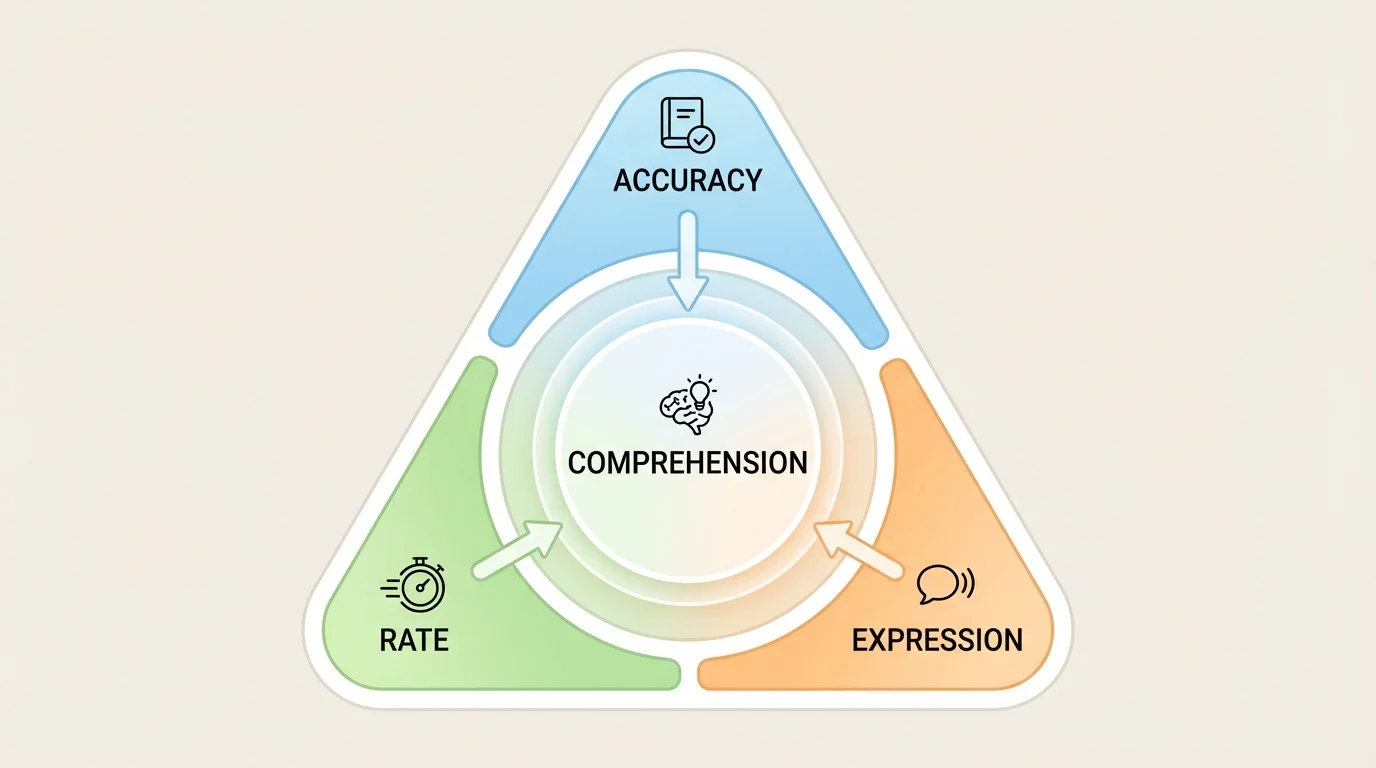
These three parts support comprehension, which means understanding what you read. If you can read the words correctly, at a steady pace, and in a meaningful voice, the ideas in the text become clearer.
Think of fluency like riding a bicycle. You need balance, steering, and pedaling. If one part is missing, the ride is hard. In the same way, fluent reading needs accuracy, rate, and expression working together.
Accurate reading begins with looking closely at the letters and parts of words. Readers notice beginnings, middles, and endings. They use what they know about letter patterns, chunks, and syllables to read unknown words. For example, the word sunshine can be read by noticing the two parts sun and shine.
A careful reader also checks whether a word makes sense in the sentence. If someone reads, "The cat drank the book," the sentence does not make sense. A reader should stop and fix that mistake. Maybe the word was bowl or milk. Good readers do not just keep going when the words sound wrong or the meaning breaks apart.
Sometimes a word looks almost right, but one small part changes the meaning. For example, jumped and jumper start the same way, but they mean different things. Accurate readers notice these details. They do not rush past endings like -ed, -ing, or -s.
Example: fixing for accuracy
A student reads the sentence: "The puppy chased the stick across the yard." But the student says, "The puppy changed the stick across the yard."
Step 1: Notice the problem.
The sentence sounds strange because puppies do not usually "change" sticks in a yard.
Step 2: Look back at the word.
The word begins with ch, but the rest of the letters matter too. The middle and ending show that the correct word is chased.
Step 3: Read the sentence again.
"The puppy chased the stick across the yard." Now the sentence sounds right and makes sense.
Accurate reading grows stronger when readers pay attention, use word parts, and reread when needed. Mistakes happen, but strong readers notice them and repair them.
The right reading speed helps your brain hold onto meaning. If you read too slowly, you may forget how the sentence started before you reach the end. If you read too fast, you may skip words, miss punctuation, or forget important details.
A natural rate sounds like talking, but it is a little more careful. Different texts may need different pacing. An exciting action scene in a story may move quickly. A poem with rich language may need a slower pace. A page full of facts may require pauses to think.
Rate is not a race. Fast reading is not always better reading. A fluent reader adjusts pace to match the text and to understand it well. When a part is tricky, the reader may slow down. When the words are easy and the meaning is clear, the reader may move a little faster.
Some excellent readers choose to slow down on purpose when they reach an important idea, a surprising event, or a beautiful line in a poem. Reading well is about meaning, not just speed.
If a reader hurries through every sentence the same way, the reading can sound rushed and confusing. A thoughtful pace helps the listener and the reader keep track of the ideas.
[Figure 2] Reading with expression means making your voice match the meaning of the words. Punctuation gives clues. A period tells you to stop. A question mark tells you the voice should sound like a question. An exclamation mark often shows strong feeling. Commas can signal a shorter pause.
Expression also includes phrasing, which means grouping words together in ways that make sense. Instead of reading one word at a time, fluent readers read in meaningful chunks. Listen to the difference between these two ways of reading: "The tiny bird / built a nest / in the tree" sounds smoother and clearer than reading each word separately with the same pause each time.
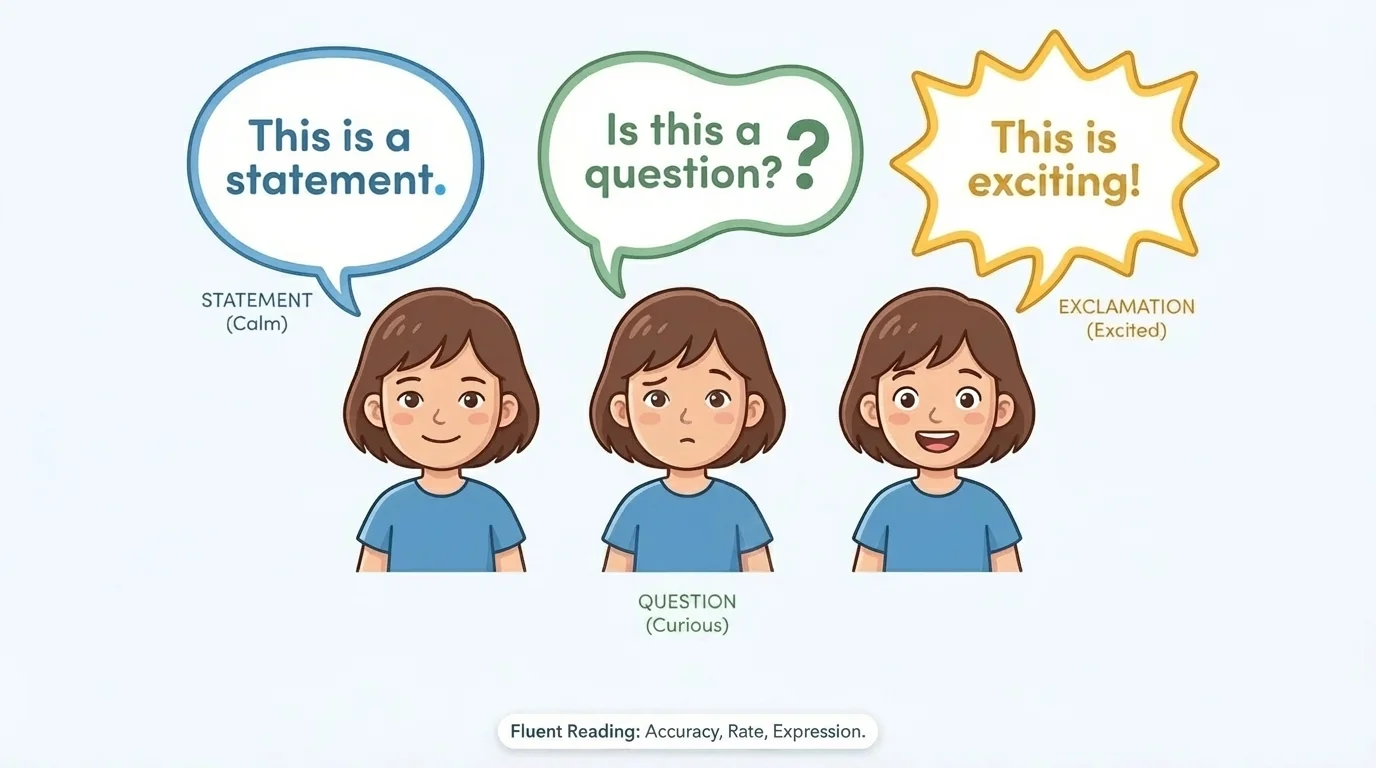
Expression helps the listener understand mood and meaning. If a character whispers, the reader should not sound like a shouting coach. If the sentence asks a question, the voice should rise naturally. If a scene is calm, the voice may sound gentle. If a character is excited, the voice may sound brighter and quicker.
Dialogue needs special attention. In a story, one character may sound worried while another sounds cheerful. Dialogue tags can help. If the text says, "Lena murmured," that tells the reader to use a softer voice. If it says, "Dad shouted," the voice should be stronger.
Poetry often uses expression in a different way. A poem may repeat sounds, use rhythm, or paint a picture with words. A fluent reader notices those patterns and reads carefully enough for the beauty of the poem to be heard.
When readers are fluent, they can think about the story or information while reading. They can notice who the characters are, what the setting is, what the problem might be, or which facts matter most. This is one reason fluency and understanding belong together.
Suppose you read, "Dark clouds rolled in, and Mia ran to gather the laundry from the line." A fluent reader quickly understands that rain may be coming. The reader can make a prediction because the sentence was read smoothly enough to hold the meaning together.
How fluency supports meaning
Fluent readers are not stuck on every word. Because they read smoothly, they can make pictures in their minds, connect ideas, ask questions, and remember important details. Fluency gives the brain room to think.
Fluent reading also helps with memory. If a paragraph is read in a clear, connected way, it is easier to remember the main idea. Choppy reading can break apart the meaning and make the text harder to hold in your mind.
The three parts of fluency still work together here, just as we saw earlier. Correct words, a natural pace, and meaningful voice all help readers understand what the author is saying.
Readers should adjust fluency for different kinds of texts. A story, a poem, a play, and an informational article are all read fluently, but they do not all sound the same.
[Figure 3] In a literary text such as a story, readers follow characters, settings, and events. Expression helps bring the story to life. Rate may change depending on the action. A scary part might be read slowly to build suspense. An exciting chase might be read a little faster.
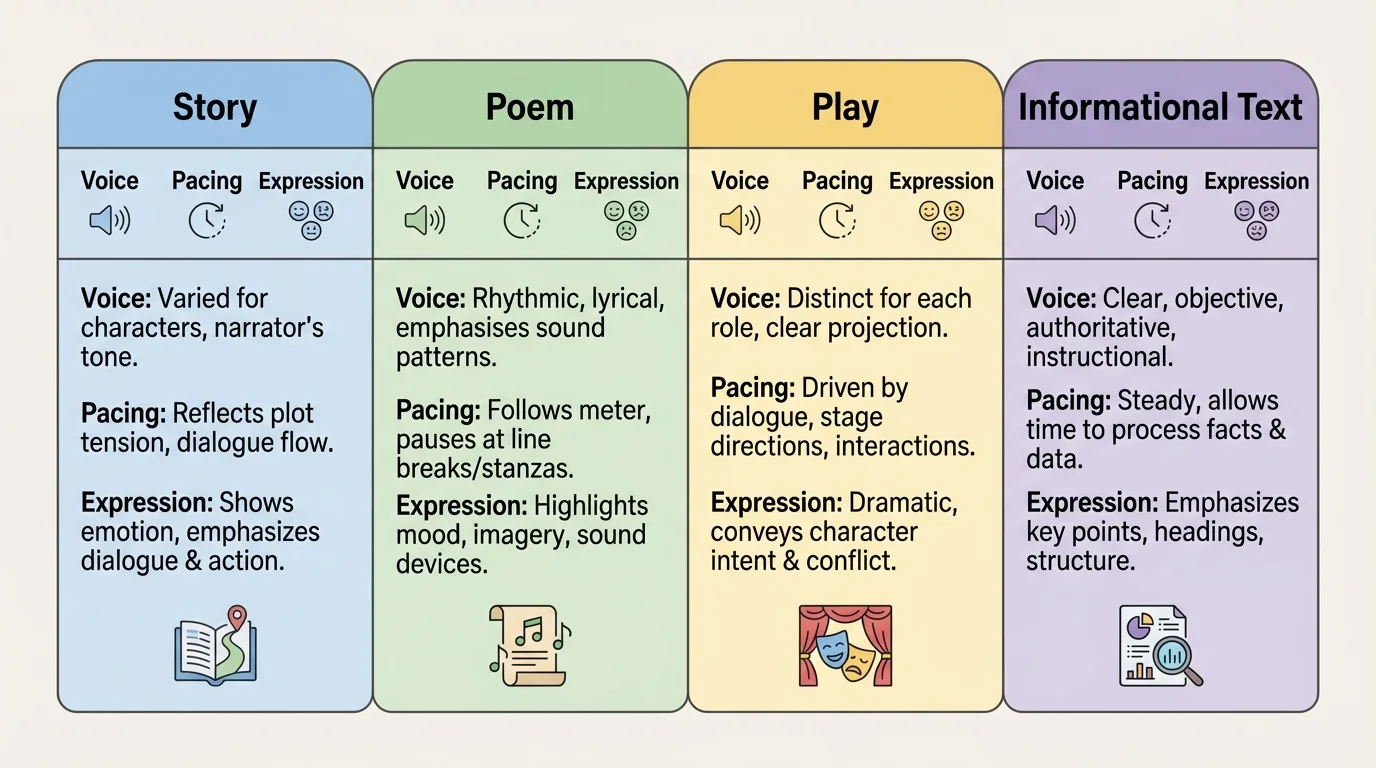
In a poem, readers pay attention to rhythm, repeated words, and line breaks. They may slow down to let images or feelings stand out. In a play, readers use voice to show different characters and must pay close attention to who is speaking. In an informational text, readers often use a clear, steady voice so facts and ideas are easy to follow.
Even within one kind of text, the voice can change. A funny story and a serious story do not sound the same. A poem about a storm and a poem about a butterfly may need different moods. A fluent reader listens to the text and adjusts.
| Type of text | What fluent readers do |
|---|---|
| Story | Use expression for characters and events, and change pace when the action changes. |
| Poem | Notice rhythm, line breaks, and strong images; read with careful feeling. |
| Play | Use different voices for characters and follow punctuation in dialogue. |
| Informational text | Read clearly and steadily so facts and main ideas are easy to understand. |
Table 1. Ways fluent reading changes depending on the type of text.
The comparison in [Figure 3] shows that fluency is flexible. Good readers do not use one exact voice for everything they read.
Even strong readers sometimes reach a sentence that does not make sense at first. Maybe a word was read incorrectly. Maybe the punctuation was ignored. Maybe the reader was going too fast. What matters is noticing the problem and using a strategy to fix it.
One strategy is to stop and reread. Another is to look at the words around the tricky part. Readers can ask themselves, "Did that sound right? Did that make sense? Did I read all the parts of the word?" These questions help readers check both fluency and comprehension.
You already know that punctuation marks help show where to pause and how a sentence should sound. You also know that word parts such as prefixes, suffixes, and endings can help you read unfamiliar words more accurately.
Sometimes changing your voice can help meaning appear. If a sentence is dialogue, reading it like someone is actually speaking may make it easier to understand. If a sentence is long, grouping it into phrases can help too. This connects back to the punctuation clues shown earlier in [Figure 2].
Example: when a reader fixes meaning
The sentence says: "After the long hike, the campers dropped their packs and drank cool water by the creek." A student reads it very fast and misses the meaning.
Step 1: Slow down.
The sentence has several important details: the hike was long, the campers were tired, and they stopped by a creek.
Step 2: Read in phrases.
"After the long hike, / the campers dropped their packs / and drank cool water / by the creek."
Step 3: Think about what happened.
Now it is easier to understand that the campers finished hiking and took a break for water.
Fluent readers are always paying attention to meaning. They do not just say the words and move on. They listen to themselves as they read.
Fluency grows over time. As you read more, many words become familiar. Your reading becomes smoother because you do not have to stop as often. You also begin to notice how authors use punctuation, sentence length, and word choice to create mood and meaning.
Confidence matters too. When readers believe they can solve tricky words and understand the text, they are more willing to keep trying. Each time you read with care, fix mistakes, and pay attention to meaning, you are building stronger fluency.
Reading fluently is one of the ways readers bring text to life. A page full of words becomes a story, a poem, a play, or a set of ideas that can be understood and enjoyed.
