Have you ever noticed that you probably do not speak to your best friend the same way you speak to your teacher? That is not because one way is always better. It is because different situations call for different kinds of language. Good speakers know how to match their words to the place, the people, and the purpose. This skill helps at school, at home, in the community, and later in jobs and important events.
When we talk, we make choices. We choose our words, our tone of voice, and even our facial expressions. Some choices sound relaxed and casual. Others sound careful and respectful. Learning how to notice these differences helps you become a strong speaker and a thoughtful listener.
People communicate for many reasons. We ask for help, tell stories, share feelings, answer questions, and speak in front of groups. The words we choose depend on who is listening. If you are talking to a cousin while playing a game, your speech may sound very different from the way you speak when thanking a guest speaker at school.
The setting matters too. A playground, a classroom, a principal's office, a birthday party, and a library all have different expectations. In some places, relaxed language feels natural. In other places, careful language shows respect. Strong communicators pay attention to these differences.
Formality is the level of carefulness and politeness in speech. Informal language is relaxed language often used with friends and family. Formal language is more careful and respectful language often used in important situations or with adults we do not know well.
Formality does not mean being fake or pretending to be someone else. It means choosing language that fits the moment. A person can still be warm, friendly, and kind while speaking formally. A person can also be cheerful and respectful while speaking informally.
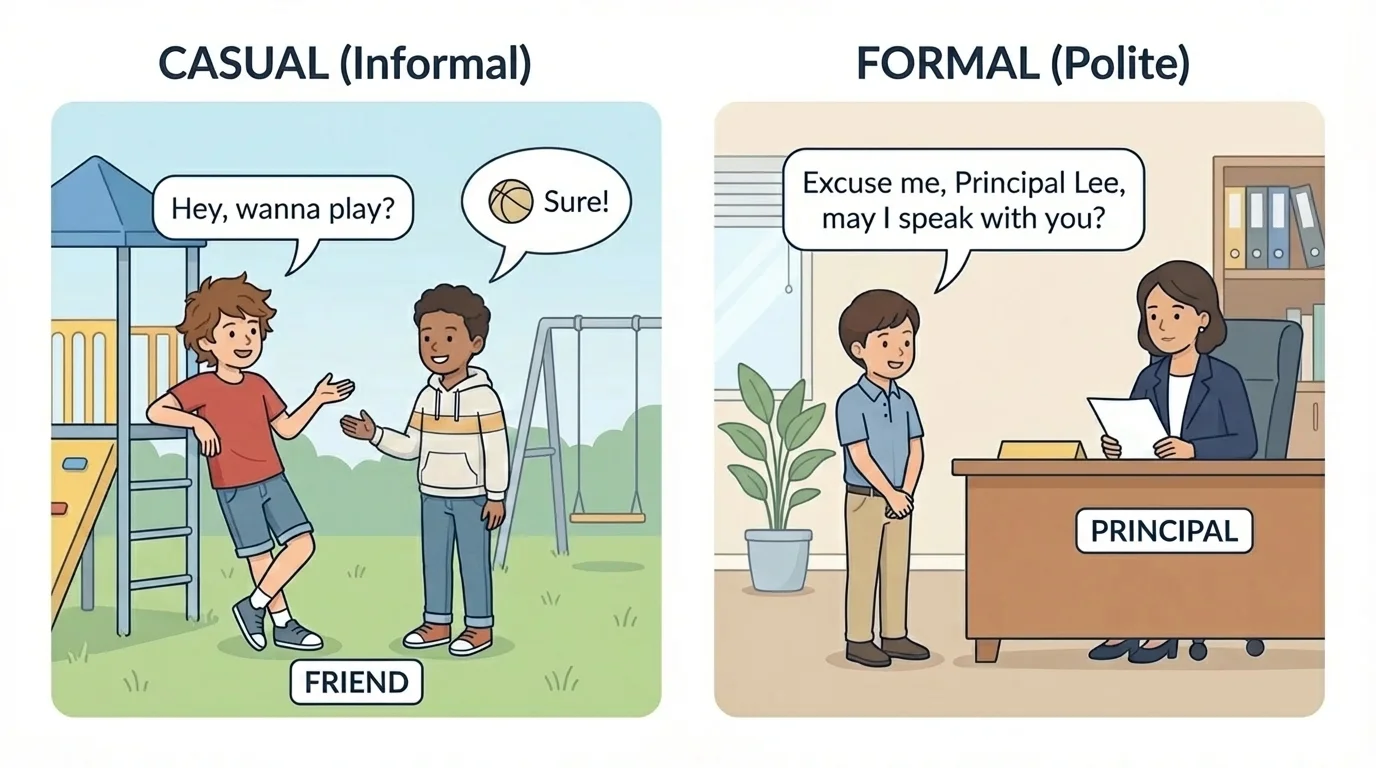
The level of formality can change from one moment to the next, as [Figure 1] shows. The same child may say, "Hey, want to race?" to a friend on the playground and later say, "Good afternoon, Principal Lee," in the school office. Both are correct because each one fits the situation.
When language is informal language, it often sounds natural, friendly, and quick. When language is formal language, it often sounds more complete, more careful, and more respectful. Neither style is right all the time. The important thing is choosing the one that matches the audience and purpose.
Think about these pairs of sentences:
Informal: "Hi, can you help me?"
Formal: "Hello, could you please help me?"
Informal: "I can't come right now."
Formal: "I am unable to come right now."
Both sentences in each pair mean almost the same thing, but they sound different. The formal version is more polished and often better for school or important conversations.
Some words are not rude on their own, but they may sound too casual in a formal setting. Even a small change, like saying "yes" instead of "yeah," can make speech sound more formal.
Age can matter, but it is not the only thing. You may speak informally with an older family member you know well, yet use more formal language with a new adult visitor. What matters most is the relationship, the place, and the reason for speaking.
Contractions are common in informal speech. Words like "I'm," "we're," "can't," and "don't" make speech sound natural and comfortable. Informal language may also include shorter greetings such as "Hi" or "Hey," and simpler sentence patterns.
Informal speech is often used with close friends, brothers and sisters, cousins, and people you know very well. If you are building with blocks, playing soccer, or telling a funny story at lunch, informal speech usually fits. It can help conversations feel easy and friendly.
Here are some examples of informal language:
Some informal words are fine in casual situations, but not all casual words belong in school speaking. Very strong slang can confuse listeners or sound careless. Good speakers know that informal does not mean messy or rude.
Formal language is used when the situation is more serious, important, or public. You may use it when speaking to a teacher, a principal, a librarian, a visitor, a judge in a contest, a coach during a meeting, or an audience during a presentation.
Formal speech usually includes complete sentences, polite greetings, and respectful words such as "please," "thank you," "excuse me," and "may I." A speaker may also avoid slang and choose clearer words so everyone understands.
Here are some examples of formal language:
Formal language can sound calm and strong. It does not have to sound stiff or scary. It simply shows care. When students speak formally during a presentation, listeners often understand them better because the words are clear and organized.
Audience, purpose, and setting work together to help you choose a level of formality. The audience is who is listening. The purpose is why you are speaking. The setting is where the conversation happens. If any of these change, the best language choice may change too.
If your audience is a friend, your purpose is to invite them to play, and your setting is recess, informal language probably fits. If your audience is the whole class, your purpose is to report information, and your setting is the classroom, more formal language fits better.
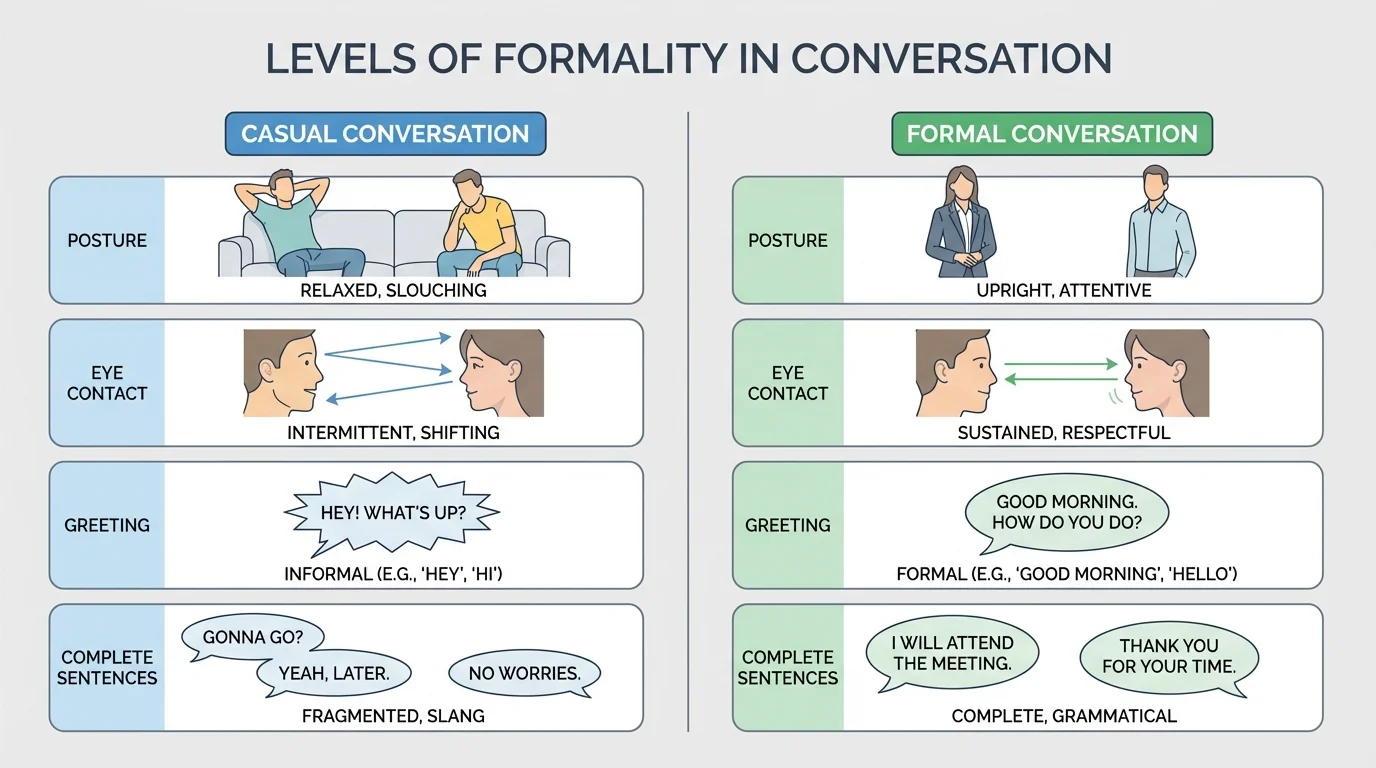
You can often tell how formal a conversation is by listening for several clues, as [Figure 2] explains. These clues include word choice, greeting style, tone of voice, complete sentences, and the way people take turns speaking.
Word choice is a strong clue. Casual words like "yeah," "cool," or "what's up?" usually sound informal. Words like "yes," "certainly," or "good afternoon" sound more formal. Tone matters too. A speaker may sound playful and relaxed in an informal conversation, but calm and careful in a formal one.
Body language also gives clues. In a formal situation, a speaker may stand up straight, make polite eye contact, and wait for the right moment to speak. In a casual situation, body language may be more relaxed. Complete sentences can also make speech sound more formal than one-word answers.
Listening matters just as much as speaking. A respectful listener does not interrupt, pays attention, and responds in a way that matches the situation. During a class discussion, for example, a student may say, "I agree with Maya because…" instead of blurting out, "Nope!"
Greeting and closing words are another clue. "Bye!" is common in informal talk. "Thank you for your time" sounds much more formal. These little phrases help listeners understand how serious or respectful the conversation is meant to be.
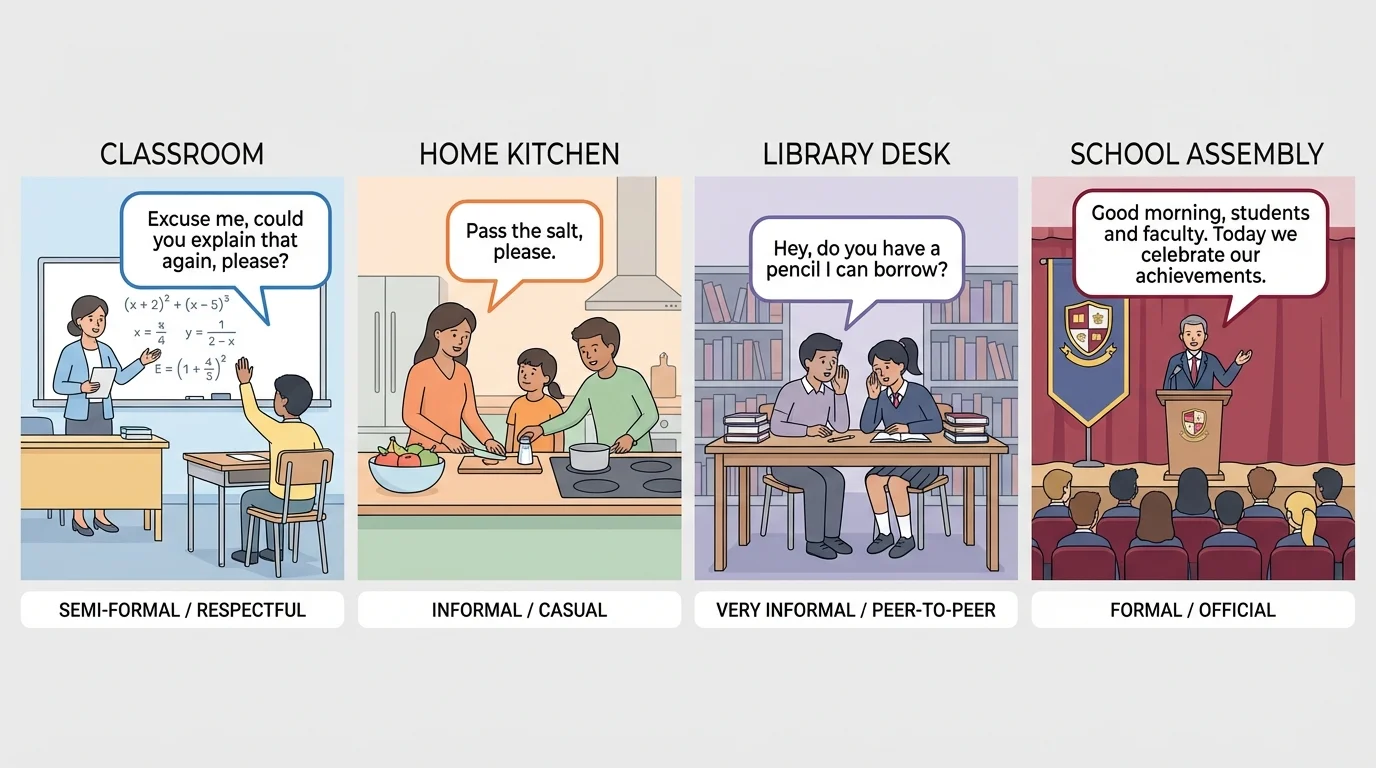
The setting helps us decide how formal to be, as [Figure 3] illustrates with everyday places. A classroom, a home kitchen, a library desk, and a school assembly may all involve speaking, but they do not all call for the same style.
At home, you might say, "Can I have some juice?" or "Come see this!" In class, you might say, "May I sharpen my pencil?" In the library, you may speak softly and politely: "Excuse me, where can I find this book?" At a school assembly, a student speaker may say, "Thank you for coming today."
When speaking on the phone, it also helps to think about formality. Calling a friend may begin with "Hi, it's me!" Calling the school office may begin with "Hello, this is Jordan Smith." The same person changes the language because the listener and purpose are different.
| Situation | More Informal | More Formal |
|---|---|---|
| Talking to a friend | "Wanna play?" | "Would you like to play?" |
| Asking a teacher | "Can I do this later?" | "May I finish this later, please?" |
| Greeting someone | "Hi!" | "Good morning." |
| Thanking someone | "Thanks!" | "Thank you very much." |
Table 1. Examples of how the same idea can sound more informal or more formal.
Notice that the meaning often stays similar, but the style changes. This is why formality is not about changing your message completely. It is about shaping your message to fit the moment.
A useful skill is learning how to change one sentence into a more formal one. You can do this by adding polite words, using a greeting, choosing complete sentences, and replacing slang with clearer language.
Changing casual speech to formal speech
A student wants to ask for help with schoolwork.
Step 1: Start with the informal version.
"Hey, I don't get this."
Step 2: Remove very casual words.
Change "Hey" to "Excuse me."
Step 3: Make the request clearer and more polite.
Change "I don't get this" to "Could you please help me understand this?"
The formal version is: "Excuse me, could you please help me understand this?"
Here are more examples:
Informal: "Gimme a minute."
Formal: "Please give me a moment."
Informal: "Yeah, I did it."
Formal: "Yes, I completed it."
Informal: "What do you want?"
Formal: "How may I help you?"
When we studied clues of formality earlier, [Figure 2] showed that complete sentences and calm tone matter too. So changing words is only part of the job. The way you say the words matters as well.
Being a strong listener means paying attention to more than just the topic. You can also listen for how the speaker is speaking. Are the words casual or careful? Is the tone playful, serious, respectful, or rushed? Does the speaker use greetings, polite phrases, and complete ideas?
If someone says, "Good evening, everyone. Thank you for being here," that sounds formal. If someone says, "Hey, everybody!" that sounds more informal. A listener can learn a lot from these signals.
Listening for formality helps you respond in a smart way. If a principal is speaking at an assembly, your response should match the seriousness of the setting. If a friend is joking with you at recess, a more relaxed reply is fine. Matching the speaker helps conversations go smoothly.
You already know how to take turns, listen with care, and speak kindly. Distinguishing formality builds on those skills. It adds another layer: choosing the style of language that best fits the situation.
Sometimes speakers mix styles. For example, a teacher might use mostly formal language during directions but switch to a friendly, informal tone during a class celebration. Good listeners notice these changes and adjust with them.
One very important idea is that respectful language belongs in both formal and informal speech. You can be casual and still be polite. You can be formal and still be warm. Respect is not the same thing as formality, but they often work together.
For example, "Pass me that!" may sound rude, even if you are talking to a friend. "Can you pass me that, please?" sounds kinder. In a more formal setting, "Could you please pass me that?" may fit even better. The speaker changes the style without losing politeness.
This is also true when listening. Rolling your eyes, interrupting, or using a sharp voice can sound disrespectful in any setting. Good communication depends on word choice, tone, and actions.
"Right words, right time, right tone."
— A strong rule for speaking well
As we saw in [Figure 1], the same person may sound different in different moments. That does not mean the person is changing who they are. It means the person understands how to show respect and communicate clearly.
One mistake is using very casual speech in an important setting. Saying "Yo!" to begin a presentation may not fit the audience. Another mistake is using language that is too stiff in a relaxed setting. If your close friend asks if you want to play, answering with "I would be delighted to participate" may sound strange.
Another mistake is thinking formal language always has to be long. That is not true. Short sentences can still be formal. "Yes, thank you." is short, but it sounds polite and respectful.
A third mistake is forgetting that listening behavior matters. Even if your words are formal, interrupting or ignoring someone can still make communication weak. Strong communication includes both speaking and listening.
Many adults switch language styles all day long. A person may speak one way in a work meeting, another way with family at dinner, and another way while cheering at a game.
Students can do this too. You already change your voice, your words, and your behavior in different places. Learning about formality helps you do it on purpose and with confidence.
A strong communicator thinks before speaking: Who am I talking to? Why am I speaking? Where am I? These questions help you choose the right level of formality. The best choice helps listeners feel respected and helps your message sound clear.
Whether you are asking a friend to join a game, answering a teacher in class, thanking a guest, or speaking to a group, your language can fit the moment. That is an important part of oral expression and listening. It helps people understand you, trust you, and enjoy communicating with you.
